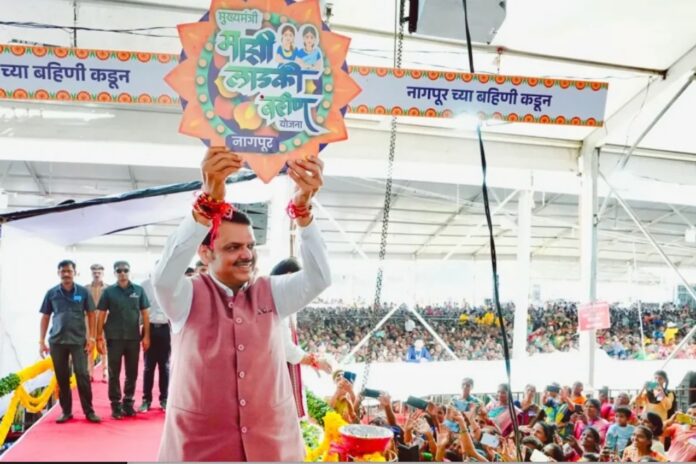
In one of the biggest beneficiary verification drives undertaken by any state government, Maharashtra has removed more than 92 lakh beneficiaries from its flagship Mukhyamantri Majhi Ladki Bahin Yojana, reducing the scheme’s coverage by nearly 38 per cent.
The large-scale deletion follows a statewide verification exercise that found lakhs of beneficiaries either failed to complete mandatory verification or did not meet the eligibility criteria laid down under the scheme. The exercise also carries significant financial implications.
While the Comptroller and Auditor General (CAG) recently flagged Rs 3,541 crore in excess expenditure and deficiencies in the scheme’s financial management during 2024-25, the removal of more than 92 lakh beneficiaries is expected to reduce the government’s annual liability by over Rs 16,500 crore, assuming each deleted beneficiary would otherwise have continued receiving the monthly assistance of Rs 1,500.
Here is a closer look at what happened, why it happened, and what it means for Maharashtra’s finances.
What is the Ladki Bahin Yojana?
Approved in June 2024 ahead of the Maharashtra Assembly elections, the Mukhyamantri Majhi Ladki Bahin Yojana was introduced as one of the Mahayuti government’s flagship welfare programmes aimed at improving the financial independence of women.
Under the scheme, eligible women between 21 and 65 years of age belonging to families with an annual income below Rs 2.5 lakh receive Rs 1,500 every month through Direct Benefit Transfer (DBT). However, government employees, income tax payers and beneficiaries of certain other welfare schemes are excluded from receiving benefits.
The programme expanded rapidly after its launch, with budgetary allocations and supplementary provisions exceeding Rs 60,000 crore. At its peak, the scheme covered around 2.43 crore women. Following the verification exercise, however, the beneficiary count has fallen to nearly 1.5 crore.
Why did Maharashtra remove more than 92 lakh beneficiaries?
The verification exercise, which began in September 2025, was intended to weed out ineligible beneficiaries and ensure that only genuine recipients continued receiving financial assistance. The findings revealed that the overwhelming majority of deletions were not because beneficiaries were found guilty of fraud, but because they failed to complete the government’s mandatory electronic Know Your Customer (eKYC) verification process.
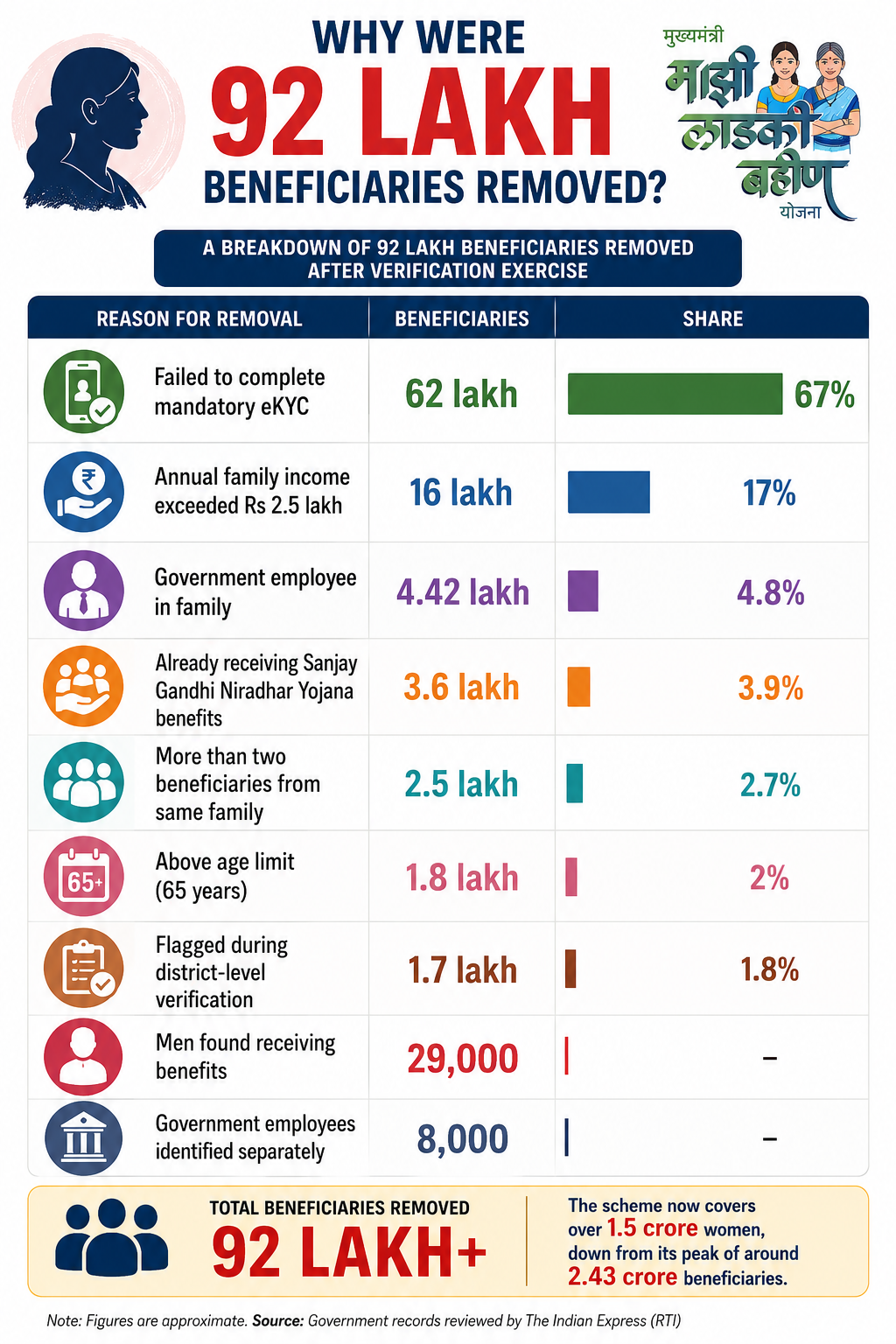
In fact, nearly 62 lakh beneficiaries, accounting for almost 67 per cent of all deletions, were removed solely because they did not complete eKYC.
The remaining beneficiaries were found to be ineligible for a variety of reasons. Around 16 lakh women belonged to families whose annual income exceeded the scheme’s prescribed ceiling of Rs 2.5 lakh. Another 4.42 lakh beneficiaries disclosed during verification that they or a family member were government employees, making them ineligible under the scheme.
The exercise also found that approximately 3.6 lakh women were already receiving benefits under the Sanjay Gandhi Niradhar Yojana, while nearly 2.5 lakh cases involved more than two members of the same family receiving benefits simultaneously, contrary to the scheme’s rules.
Additionally, nearly 1.8 lakh beneficiaries were found to be above the upper age limit of 65 years, while another 1.7 lakh cases were flagged during district-level verification. The exercise also uncovered around 29,000 men and nearly 8,000 government employees who had received benefits despite being ineligible.
Why did the eKYC exercise happen so late?
Responding to the findings, Maharashtra Women and Child Development Minister Aditi Tatkare said the government could not begin the eKYC exercise immediately after launching the scheme because Maharashtra went into Assembly elections soon afterwards and the Model Code of Conduct came into force.
According to Tatkare, the scheme was launched in June 2024, while the first two instalments were released together in August 2024. Before the verification exercise could begin, the state entered the election period, delaying the implementation of mandatory authentication. The government eventually initiated the eKYC drive in August 2025 after the new government assumed office.
She maintained that beneficiaries were repeatedly informed that payments would stop if eKYC was not completed and said multiple opportunities, including extensions until December 31, 2025, were provided to complete the process.
Tatkare also rejected suggestions that the government arbitrarily removed beneficiaries, saying that everyone who had registered and was otherwise eligible continued receiving payments until the mandatory verification process was completed.
How much money had already been paid to those who were removed?
Officials associated with the verification exercise estimate that beneficiaries who were eventually removed had collectively received around Rs 14,000 crore before their payments were discontinued.
On average, each beneficiary whose payments were stopped had received assistance for nearly 10 months. However, there was no uniform cut-off date because beneficiaries were identified at different stages during the verification exercise. Some continued receiving benefits longer than others before their eligibility was reassessed.
What exactly did the CAG report say?
Around the same time that the verification exercise was underway, the Comptroller and Auditor General (CAG) raised serious concerns regarding the financial management of the Ladki Bahin scheme.
In its State Finances Audit Report 2024-25, the CAG found that the Women and Child Development Department spent Rs 33,237.24 crore despite having an authorised budget of only Rs 29,693.09 crore, resulting in an excess expenditure of Rs 3,541.16 crore. The audit noted that no specific justification had been provided for the overspending.
The CAG also observed that Rs 15,586 crore had been transferred into Virtual Personal Deposit Accounts (VPDAs)between January and March 2025 even though there was no immediate requirement for the funds. It described this practice as a serious financial irregularity because money had effectively been withdrawn from the treasury without corresponding expenditure requirements.
Overall, the audit concluded that the implementation of the scheme suffered from significant deficiencies in budget estimation, expenditure control and financial management, and recommended that the government undertake more realistic assessments of beneficiary numbers while budgeting for large Direct Benefit Transfer schemes.
How do the beneficiary deletions relate to the CAG’s findings?
Although the verification exercise and the CAG audit are often discussed together, they deal with different issues.
The CAG’s figure of Rs 3,541 crore refers to past expenditure during the 2024-25 financial year that exceeded the authorised budget. That finding concerns how the scheme was financed and managed, not whether individual beneficiaries were eligible.
The deletion of more than 92 lakh beneficiaries, on the other hand, primarily affects the government’s future expenditure. Since every beneficiary receives Rs 1,500 every month, removing 92 lakh beneficiaries reduces the government’s annual payout obligation by approximately:
92 lakh × Rs 1,500 × 12 months = Rs 16,560 crore annually.
In other words, the verification exercise potentially saves the government more than Rs 16,500 crore every year, provided the beneficiary count remains unchanged.
This means the two figures should not be treated as directly comparable. The Rs 3,541 crore represents excess expenditure that had already taken place and cannot be reversed by deleting beneficiaries later. The Rs 16,560 crore, by contrast, represents the government’s estimated annual savings going forward because it no longer has to make monthly transfers to those who have been removed.
However, the beneficiary verification does address one of the broader concerns raised by the CAG that future budgets should be based on a more realistic estimate of eligible beneficiaries rather than inflated enrolment figures.