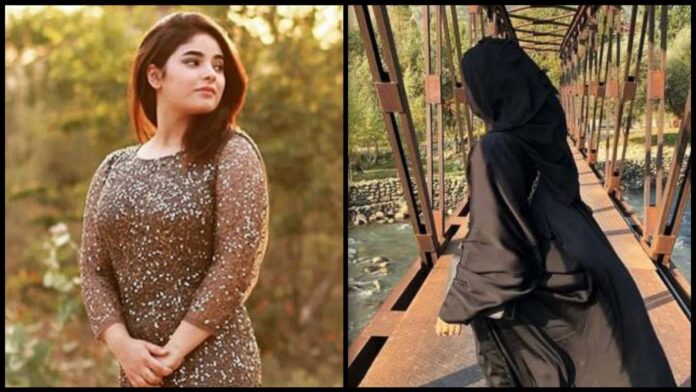
There is nothing wrong with Zaira Wasim choosing Islam over Bollywood. There is nothing wrong with her deciding that the film industry was incompatible with the manner in which she wanted to practise her faith. If she gave in to fundamentalism and altered the career choice she had initially made in her life, it was her personal decision, and she was entitled to make it.
The problem begins when a personal religious choice is transformed into a prescription for how other Muslims, particularly Muslim girls, ought to live.
That is precisely what makes Zaira Wasim’s latest intervention on Kashmir disturbing.
On August 16, the former actor took to X to question the Jammu and Kashmir Waqf Board over an Independence Day celebration at a school in Kashmir. Wasim questioned whether a religious institution should associate itself with an event where children, particularly girls, performed on stage. She asked why children were being made to “dance to irrelevant songs” instead of being given something to “think about, create, learn, discuss, build or contribute”.
Just came across a clip from a school somewhere in Kashmir. Independence Day celebrations held for or by the Waqf Board.
— Zaira Wasim (@ZairaWasimmm) August 16, 2026
I have a question. Isn’t waqf board a religious body entrusted with serving the Muslim Community. and ideally doing so while uplholding Islamic Values?
Then…
At first glance, this may sound like a criticism of the manner in which an educational institution conducts an event.
It is not.
The larger implication of Wasim’s argument is that there is something inherently problematic about Kashmiri children (read Muslim children), and especially Muslim girls, participating in ordinary public cultural activities in an Indian school environment.
And that is where her argument crosses the line from personal religious conviction into the normalisation of orthodox restrictions.
Wasim became a household name because of the opportunities offered by India’s enormously diverse entertainment industry. Her breakthrough came with Aamir Khan-starrer Dangal, followed by Secret Superstar, another Aamir Khan production. She subsequently announced in 2019 that she was leaving acting because the profession had “interfered” with her faith and had, in her words, affected her relationship with her religion.
Again, she was free to walk away.
But there is an obvious irony when someone who benefited enormously from India’s plural public sphere now uses the reach acquired through that very public sphere to question whether Muslim girls should participate in a school performance celebrating India’s Independence.
What exactly is wrong with children dancing at an Independence Day function?
Children across India sing patriotic songs, perform skits, participate in cultural programmes, play musical instruments and dance during national celebrations. This is not some peculiar practice invented for Kashmir. It is part of the ordinary socialisation of children in a country where cultural expression is woven into national celebrations.
The Republic Day celebrations themselves provide an obvious example. The Government of India has repeatedly included schoolchildren, both boys and girls, in cultural performances. In 2021, 321 schoolchildren and 80 folk artists participated in the Republic Day cultural programme, with 271 girls among the student participants.
In 2016, around 600 boys and girls participated in cultural performances, including folk dances. In 2025, schoolgirls from Jharkhand were selected to perform at the Republic Day parade, while school bands from different states participated in national celebrations.
So what is Wasim actually objecting to?
Is it dancing itself?
Is it girls dancing?
Is it girls appearing on a public stage?
Or is it the fact that the institution in question is associated with Muslims?
Because if the argument is that children should be encouraged to learn, think and create rather than merely perform, that is a perfectly legitimate discussion about education. But then why single out girls? Why invoke Islamic values? Why question the very presence of a religious institution at an Indian national celebration?
There is a deeper problem here. It is the Islamism that Zaira has perhaps internalized since 2019 or even before that, which has caused her to raise her voice against Kashmiri girls happily performing on stage for Independence Day celebrations.
It is therefore profoundly ironic when Wasim invokes Kashmir’s “remarkable legacy” of people who understood education as a means to enlighten minds, cultivate character and impart knowledge and spirituality. If that legacy is truly the standard she wants Kashmir to uphold, then using an Independence Day celebration where Kashmiri girls were happily participating as an occasion to deliver sermons steeped in religious orthodoxy hardly advances it.
More importantly, the fact that Kashmiri Pandits and other Hindus still harbour apprehensions about returning to and resettling in the Valley is a far more tangible indicator of Kashmir’s troubled legacy than the idealised historical figures selectively invoked to lend respectability to such puritanical arguments.
Kashmir has spent decades suffering from separatist and Islamist forces that sought to impose a particular conception of Muslim identity on society. The consequences were devastating. The Valley’s social fabric was torn apart, minorities were driven out, and an entire generation grew up amid violence, fear and ideological isolation. Even today, the Kashmiri Pandits and Hindus in general are routinely targeted by terrorists brainwashed with Islamic fundamentalism.
The answer to that history cannot be to tell Kashmiri children that participation in India’s public cultural life is somehow spiritually suspect and against Islam.
Quite the opposite.
A Kashmiri Muslim girl singing a patriotic song, dancing with her classmates, participating in a school parade or performing a skit on Independence Day is not being “taken away” from Islam. She is participating in the civic and cultural life of the country she belongs to.
And there is nothing inherently un-Islamic about acquiring confidence, teamwork, communication skills or the ability to stand before an audience.
In fact, these are precisely the skills an educational system should cultivate.
A child who performs on stage learns to overcome stage fright. A child who participates in a group performance learns coordination. A child who rehearses with classmates develops discipline and camaraderie. A child who stands before an audience learns confidence.
Why should Muslim girls be denied these experiences?
The answer becomes even more uncomfortable when Wasim’s own history is considered.
She has explicitly explained her decision to leave Bollywood through the prism of her faith. Her 2019 statement said that her work had taken her towards what she described as a “path of ignorance” and that her relationship with religion had been threatened.
That was her choice.
But when the same worldview is applied to other girls, particularly impressionable children, it acquires a different character.
Today it is dancing on a school stage.
Tomorrow, the same logic can be used to question girls participating in sports. Then their presence at public functions. Then mixed educational environments. Then higher education. Then employment. Then their right to move freely without a male guardian.
This is not a theoretical concern. Afghanistan under the Taliban demonstrates what happens when an extremist interpretation of religion is allowed to dictate every aspect of women’s public existence.
Five years after the Taliban returned to power, Afghanistan remains the only country in the world where girls are formally barred from secondary and higher education. The United Nations has documented the systematic erosion of women’s participation in public life, while UN officials have also raised concerns over women being detained for allegedly violating Taliban-imposed dress requirements.
UN bodies have further documented public flogging and other punishments under the Taliban’s system of religiously enforced restrictions, including cases involving alleged dress-code violations.
That does not mean Wasim is literally demanding the Taliban’s system.
But the ideological direction of restricting women’s participation in public life because of supposedly religious requirements deserves to be challenged before it becomes normalised.
The progression from “girls should not dance” to “girls should not participate” to “girls should not appear” to “girls should not study” is precisely the kind of incremental restriction societies must guard against.
And Kashmir, of all places, should be the last place where such thinking receives encouragement.
Wasim may personally choose a life away from the public eye. She may choose to dress conservatively. She may choose to avoid films, music, dancing or any other activity she believes conflicts with her understanding of Islam.
Nobody has the right to take that choice away from her.
But she has no special mandate to become the custodian of Islam for every Muslim girl in Kashmir.
Nor does a former actor, however famous, acquire theological authority merely because millions once watched her on screen.
There is an important distinction between saying, “This is how I choose to practise my faith,” and saying, “This is what a religious institution should permit Muslim children to do.”
The first is personal liberty.
The second is an attempt to regulate somebody else’s liberty.
India’s constitutional and cultural framework allows the former precisely because it rejects the latter.
The irony is impossible to miss. Wasim’s own fame came from a society that allowed a young Kashmiri Muslim girl to enter Bollywood, act alongside some of India’s biggest stars, become a national celebrity and eventually walk away from it all because she wanted to follow her faith.
That is freedom.
But freedom also means that another Kashmiri Muslim girl can choose differently.
She can study.
She can play cricket.
She can sing.
She can dance.
She can perform on stage.
She can participate in Independence Day celebrations.
She can wear what she chooses within the law.
She can pursue a career.
She can embrace her faith without being told that participation in the wider world threatens it.
Islam does not need to be protected from a school dance by removing Muslim girls from public life.
And India’s Muslims certainly do not need celebrity-appointed guardians deciding how much of India’s modern, plural and democratic culture they are permitted to experience.
The 21st century is not asking anyone to abandon their religion. It is asking societies to abandon the idea that religion gives anyone the right to curtail another person’s freedom.
Zaira Wasim was free to leave Bollywood for Islam.
The Muslim girls of Kashmir must remain equally free to choose education, public life, confidence, friendship, art and everything else that a free India offers them, and to remain Muslim while doing so.