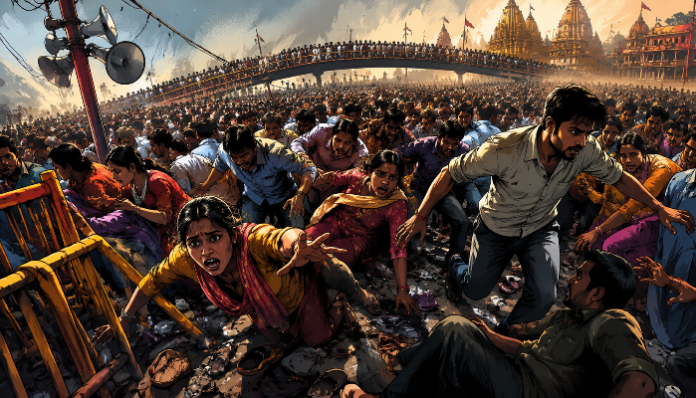
On 17th August, thousands of Hindus arrived at Ashokdham Temple, also known as Shri Indradamneshwar Mahadev Mandir, to offer prayers and perform Jal Abhishek to Lord Shiva on the third Monday of the auspicious Shravan or Sawan month in the Lakhisarai district of Bihar. What began as a morning of faith and devotion soon descended into chaos as heartbreaking scenes of wails and cries resonated throughout the place.
According to preliminary accounts, at least 50,000 devotees had gathered at the site when a rumour triggered panic among the crowd, turning the peaceful religious assembly into a matter of life and death. At least 7 persons were killed while more than a dozen others were injured and taken to hospital. Several of them are in critical condition. All the victims are reportedly women, and the toll is feared to rise as rescue and medical operations were started by the administration and authorities.
Prime Minister Narendra Modi announced an ex-gratia of Rs 2 lakh from PMNRF (Prime Minister’s National Relief Fund) for the next of kin of each deceased and Rs 50,000 for every wounded individual. The tragedy was the result of a rumour that a live electric wire had fallen on people after a pole collapsed, but it was actually a cable wire.
The more troubling aspect is that it is far from an isolated incident and adds to the long and painful list of lives lost at large gatherings, religious or otherwise, where a moment of panic sparked by a rumour or misinformation unleashes a deadly chain of reaction. Such unverified developments provoke trepidation and push already anxious crowds into sudden and uncontrollable movements.
Over the years, many major stampedes in India have been linked to mass hysteria instigated by rumours or misinformation. These instances highlight times when the collective human mind fell prey to the menace, turning special occasions into scenes of extraordinary grief. The recent incident is yet another agonising reminder of how swiftly dread can permeate a bustling area, leading to severe outcomes, just as several similar episodes serve as grim examples of the same.
Mahakaleshwar Temple
A few hours after the upheaval in Lakhisarai, a situation close to a stampede surfaced on the occasion of Nag Panchami near the Mahakaleshwar Temple as people poured into the holy city of Ujjain, Madhya Pradesh. A rumour had erupted regarding leakage of electric current adjacent to a transformer inside the barricaded section. Afterwards, barricades were broken as panic spread among the devotees near the Harsiddhi square.
Some people needed medical attention because they fell and sustained injuries, while those who fainted were also taken to the hospital. The situation was brought under control once the Collector and Superintendent of Police reached at the spot. Additionally, there were reports of chaos outside Neelkanth Square, the Bada Ganesh Temple and the path from Kark Raj Parking to the Harsiddhi entrance.
The temple, which is a part of the Mahakaleshwar Jyotirlinga complex, opens for only 24 hours on Nag Panchami, which prompted the massive influx of devotees. According to Mahakal temple administrator Pratham Kaushik, there hasn’t been any chaos or such instances there.
He outlined, “Till 12 noon today, more than 6 lakh devotees had darshan of Bhagwan Nag Chandreshwar, and more than 2 lakh devotees had darshan of Lord Shri Mahakaleshwar. All devotees have been provided with every possible facility by the temple administration. Darshan continues at the temple.”
Mansa Devi Temple
A rumour about an electric current claimed at least 6 lives and 35 others were wounded at Mansa Devi Temple of Haridwar in July of last year. The sacred Shravan month had prompted a surge in crowds as thousands of visitors flocked to the renowned destination, which attracts a high number of devotees, particularly on weekends and festivals.
A rumour tied to the snapping of a power line incited a desperate rush to flee, which resulted in the stampede. “We found through photos and videos that someone spread the rumour of an electric wire breaking; while looking at the injured or the dead, we did not get any such indication. We will investigate who spread the rumour that caused the stampede, and a magisterial inquiry will be set up to investigate cameras and other means. The death of 6 people has been confirmed,” District Magistrate Mayur Dixit had stated at the time.
Uttarakhand Power Corporation Limited (UPCL), the state power distribution utility, examined all of the electrical panels and power lines at Mansa Devi before releasing a statement affirming that “no leakage of electric current in any of their assets” could have produced the mishap.
“During the inspection conducted by our personnel at the temple premises, the leakage of electric current was found to be zero. Also, the Low-Tension lines carrying power there are completely insulated with no bare conductors in use. We also found no incident of anyone suffering an electric shock or getting electrocuted,” its then managing director Anil Kumar expressed while talking to The Times of India.
Gandhi Maidan of Patna
In October 2014, a stampede in Bihar killed at least 32 individuals, including 27 women, when rumours spread that an electrical wire had fallen on people during a religious program. According to the authorities, thousands of people were headed to their homes from the popular Dussehra celebrations when the horrific incident happened in Gandhi Maidan of Patna. Furthermore, 15 people had to be hospitalised after being hurt in the flurry.
Ratangarh Mata Temple
A similar incident happened on the last day of the Navratri festival near the famous Ratangarh Mata Temple in the Datia district of Madhya Pradesh during October 2013. The temple is situated on the banks of the Sindh River. 115 lives were lost, and 100 more were injured after a rumour circulated alleging that the bridge over the river was about to collapse. Police also began to use force to control the massive 5,00,000 frenzied mob. The fake information set off alarm as the terrified devotees succumbed to the deadly crush while many jumped into the water to save themselves.
Chamunda Devi Temple
A stampede left at least 168 people dead and over 100 injured at a temple in Jodhpur, Rajasthan in September 2008. The disaster took place on the first day of Navratri at the Chamunda Devi Temple, located within the hilltop Mehrangarh fort complex. Almost 25,000 devotees had assembled there on the religious occasion. The incident was widely asserted to have been brought on by unfounded bomb-related rumours. However, the authorities had refuted these reports.
It is important to remember that bomb blasts and terror assaults were often witnessed during that period under the United Progressive Alliance government, which was helmed by the Indian National Congress, exacerbating the stress and worries of the masses.
Naina Devi Temple
A month earlier, 162 people, mostly women and children, were killed and 47 others were wounded due to a stampede at Naina Devi Temple in the Bilaspur district of Himachal Pradesh that year. There were over 25,000 devotees for the Sawan Navratri. The chaos was ignited by rumours of a significant landslide, and some accounts indicated that stones had fallen from a retaining wall, which subsequently fuelled the panic. The long history of landslides at the temple also added to the fear.
The pilgrims were following a 2.5-mile track en route to the site perched on a hill when a portion of the iron railings on one side of the road broke, sparking a stampede. The people believed that it was a landslide, and the panic drove them to rush down to escape the potential catastrophe, crushing those who were underneath. Several people also perished as sections of the railings collapsed due to the intense human pressure.
Madras relief centre
A stampede for food coupons at an aid shelter took at least 40 deaths, predominantly women and over 50 others were hurt. The incident happened in Madras (Chennai) in December 2005. Approximately 3,000 flood victims had gathered in a small alleyway that led to a government school. People waited in a queue for hours out of concern about shortages even before the relief shelter was opened.
“Suddenly it started raining heavily, and there was a mad scramble to get in. The lock on the main door had snapped. The women at the front were crushed first. At least 11 policemen who tried to control the crowd were among those injured,” a witness mentioned. According to some reports, it was the result of a rumour about the last day for food coupons, while others pointed to a sudden downpour owing to which people scrambled for cover.
Stampede for free saris
In April 2004, 21 women were killed in a stampede during an event on the birthday of the late former governor Lalji Tandon. 10,000 women and children from low-income families had reached a public park to receive free commodities. However, a rumour erupted that there were no more saris available for distribution, which resulted in the havoc. A witness recounted, “Suddenly, a large number of women jostled with one another to reach the distribution point and collect the birthday gift.”
Conclusion
Of course, mismanagement, overcrowding, inadequate facilities and poor preparedness often play a major role in these stampedes. However, rumour-mongering has also emerged as a significant and often overlooked trigger that can be anticipated, countered and, to a large extent, prevented. Hence, the government needs to address it firmly alongside the other contributing factors. Otherwise, the country will continue to mourn such tragedies time and again.