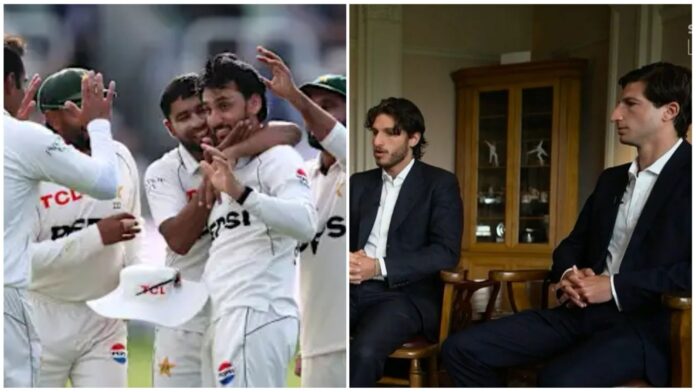
The Pakistan Cricket Board (PCB) has once again managed to turn cricket into a political battleground. This time, the target was not a rival team or a controversial match decision, but a Sky Sports interview with the two sons of jailed former Pakistan Prime Minister and World Cup-winning captain Imran Khan.
During the ongoing second Test between England and Pakistan at Lord’s, the PCB threatened to prevent the Pakistan cricket team from returning to the field after lunch if Sky Sports broadcast an interview with the two sons of former Pakistan Prime Minister and World Cup-winning captain Imran Khan.
Pakistan threatened Lord’s Test boycott after broadcaster Sky Sports telecast interview with Imran Khan’s two sons which was actually recorded at the Lord’s Long Room a day before the Test. PCB wanted SKY not to air the interview during Lunch break else they wouldn’t take the… pic.twitter.com/Z6CGuC6I75
— Vikrant Gupta (@vikrantgupta73) August 27, 2026
The threat was extraordinary. A cricket board was effectively attempting to hold an international Test match hostage to pressure a broadcaster over an interview concerning a jailed former prime minister.
And then the grand threat evaporated.
According to former England captain and Sky Sports commentator Mike Atherton, the PCB approached Sky Sports before the lunch interval and objected to the interview featuring Imran Khan’s sons, Sulaiman and Kasim Khan. The board warned that Pakistan’s players would not come back out for the afternoon session if the interview was broadcast.
Sky Sports initially delayed the segment. But the broadcaster eventually aired the approximately 18-minute interview during the lunch break.
And then came the embarrassing part for the PCB.
The Pakistani players returned to the field. No boycott. No walkout. No dramatic withdrawal. The Test simply carried on.
So why did the PCB make such an extraordinary threat in the first place? What exactly did Imran Khan’s sons say that made the Pakistan cricket establishment so uncomfortable?
This was not a cricket interview.
The interview, conducted by Atherton inside the Lord’s Pavilion, was obviously not a routine cricket conversation.
Sulaiman and Kasim spoke about the condition of their father, his treatment in prison, his alleged isolation, concerns surrounding his eyesight and the family’s difficulties in accessing him.
Imran Khan has been imprisoned since August 2023 after being convicted in corruption-related cases. His family and political supporters have repeatedly alleged that he is being subjected to political persecution and denied adequate medical care. Pakistani authorities have rejected allegations of mistreatment and have maintained that Khan is receiving appropriate medical attention.
But the most explosive part of the Sky Sports interview was Sulaiman’s allegation about what he believes is happening to his father inside prison.
Asked about Imran’s worsening situation, Sulaiman said:
“They’re just blatantly trying to kill him in there.”
He further alleged that authorities wanted to keep his father imprisoned for as long as possible and silence him.
That is a serious allegation.
And, crucially, it was not being made on an obscure political YouTube channel or a partisan Pakistani platform. It was being broadcast by Sky Sports during coverage of an England-Pakistan Test match at Lord’s.
For the Pakistani establishment, that created a very different kind of problem.
So what exactly frightened the PCB?
The PCB’s objection centred on the political nature of the interview appearing during coverage of an international cricket match. But that explanation raises a much bigger question: if the interview was so politically objectionable, why did the board think threatening to disrupt an England-Pakistan Test was an appropriate response?
The irony is almost impossible to miss.
By threatening to keep its players off the field over an interview about Imran Khan, the PCB itself made the cricket match political.
The interview was about a former Pakistan captain and prime minister who remains enormously significant to the country’s political landscape. His sons were speaking about his health and prison conditions.
The PCB had no locus standi on dictating what a private English broadcaster could broadcast. And yet, it went ahead with the threat, hoping that it could somehow force Sky to abort streaming the interview of Khan’s sons.
In other words, the board’s apparent strategy was to keep politics out of cricket by threatening to weaponise cricket in a political-media dispute.
That contradiction needs no embellishment.
The timing made the interview impossible to ignore
The interview was recorded on Wednesday, just one day before the second Test began at Lord’s.
That meant the PCB had very little room to prevent the conversation from becoming part of the wider international narrative surrounding the Test.
The interview was eventually broadcast during the lunch interval on the opening day.
By then, viewers were hearing directly from Imran Khan’s sons about claims that their father was being kept in isolation for more than 23 hours a day, concerns about his eyesight and the alleged denial of access to independent medical professionals.
Sulaiman also claimed that the brothers had not seen their father since November 2022 and that they had faced difficulties obtaining visas to travel to Pakistan.
The brothers said their priority was not to create a political spectacle but simply to see their father.
That made the interview particularly difficult to dismiss as merely another political attack.
The eyesight allegation added another layer
One of the concerns raised by Imran Khan’s sons involved his eyesight.
Sulaiman claimed that his father had lost around 80 per cent of the vision in one eye and alleged that the problem had remained inadequately addressed.
He also questioned why Imran had not been examined by an independent doctor.
According to the Pakistani government’s position, however, Khan has received medical attention and was declared fit by doctors before being returned to prison. Authorities have also cited security considerations in explaining aspects of his medical treatment.
But Pakistan’s claims can hardly be taken at face value. The country has been notorious for lying through its teeth. Even during the search for Osama Bin Laden, Pakistan kept reiterating that it was standing with the US in its fight against terrorism. But where was Laden found? In the military town of Abbottabad in Pakistan.
Here in this case, PCB and Pakistan’s government have been claiming Imran Khan has been provided with medical treatment that he needs. But that’s an eyewash to manage global outrage over the treatment of one of their former Prime Ministers and World Cup-winning captain.
A broadcaster is entitled to interview the family of a major international political figure. If Pakistani authorities dispute allegations made during the interview, they can respond to them.
Threatening the participation of a cricket team, however, is an entirely different matter.
The boycott threat lasted until it was time to actually boycott
The most revealing part of the episode is what happened after Sky Sports finally broadcast the interview.
Pakistan did not boycott the Test.
The players returned to the field after lunch.
The match continued as though the PCB’s threat had never happened.
That raises an obvious question: if Pakistan’s participation was really conditional on the interview not being aired, why did the team ultimately walk back onto the field?
That’s probably because Pakistan’s cricket team and its board are struggling. bly then decide to The boycott of the test would have not only meant Pakistan losing the series, but it would also risk upsetting the English Cricket Board, which would probably never call Pakistan again for a series. It would only result in Pakistan touring associate nations it frequently plays: Zimbabwe, UAE, and others.
Whatever the answer, the episode exposed a striking mismatch between the PCB’s reported threat and what it was ultimately willing to do.
Instead of forcing Sky Sports into silence, the PCB’s intervention arguably generated even more attention for the interview.
Had the board simply ignored it, many viewers might have watched the segment and moved on.
Instead, the PCB’s threat to boycott the Test created a second story around the first story.
The interview was no longer merely about Imran Khan’s prison conditions.
It had become a story about the Pakistan cricket establishment trying to stop an international broadcaster from airing the claims.
The PCB did exactly what it claimed to oppose: it dragged politics into cricket
This is the biggest irony of the entire episode.
Pakistan has frequently complained about politics being mixed with cricket, especially when international sporting events become vehicles for political messaging.
Yet here, the PCB itself reportedly turned a Test match into a bargaining chip over a political interview.
The board could have argued that the segment was outside the sporting remit of the broadcast.
It could have issued a rebuttal.
It could have asked the Pakistani government to respond.
Instead, it threatened to disrupt the participation of the Pakistan team at Lord’s.
That is not keeping politics away from cricket.
That is using cricket to fight a political and media battle, precisely the kind of politicisation that cricket administrators routinely claim to oppose.
Even former cricketers have raised concerns over Imran’s treatment
The controversy comes amid renewed international concern over Imran Khan’s treatment in prison.
A group of 21 former international captains, including Indian cricket legends Sunil Gavaskar and Kapil Dev as well as Atherton, have reportedly renewed an appeal to Pakistan Prime Minister Shehbaz Sharif, calling for humane treatment and adequate medical care for the former Pakistan captain.
That is significant because Imran’s situation is not merely a domestic political dispute anymore.
His status as one of Pakistan’s greatest cricketers has given the issue an international sporting dimension.
He remains the country’s only World Cup-winning captain, and his transition from cricketing icon to prime minister makes his imprisonment particularly consequential for the cricketing world.
The brothers also questioned Pakistani cricketers’ silence
Sulaiman and Kasim were asked about the limited public support for their father among former Pakistan cricketers.
Sulaiman said he believed many former players continued to respect and revere Imran, but argued that publicly speaking about his situation could carry consequences in Pakistan’s current political environment.
The brothers also pointed to the support their father had received from former international captains.
Atherton himself has been among those who have spoken publicly about concerns surrounding Imran’s treatment.
That made the Sky Sports interview even more significant.
The interviewer was not simply a political commentator looking for controversy. Atherton was a former England captain speaking to the sons of a former Pakistan captain whose cricketing legacy is inseparable from the country’s sporting identity.
They still support Pakistan at Lord’s
The interview also included a strikingly apolitical moment.
Despite being born and raised in Britain, Sulaiman and Kasim made clear that their cricketing loyalties remained with Pakistan.
When asked who they would support at Lord’s, they left little in doubt.
They backed Pakistan.
It was a reminder that whatever their father’s political fate, his sons still identify strongly with the country whose cricket team he once led to its greatest triumph.
Pakistan’s cricket troubles continue on the field
Ironically, all of this unfolded while Pakistan were already struggling to make an impact in the Test series.
Pakistan lost the opening Test at Headingley by an innings and 103 runs.
At Lord’s, Pakistan won the toss and elected to field. Mohammad Abbas led the bowling attack with four wickets, while Mohammad Ali claimed three as England finished the opening day on 248/9.
The third and final Test is scheduled to be played in Birmingham from September 9.
Pakistan also remain at the bottom of the World Test Championship standings, while England occupy seventh place.
So, at a time when the PCB should have been concentrating on cricket, it found itself fighting a broadcaster over an interview about a jailed former prime minister.
And the attempt to bully Sky Sports into dropping the segment ultimately failed.
The PCB’s panic made Imran Khan the story
There is a final irony here.
If the PCB’s objective was to prevent politics from overshadowing cricket at Lord’s, its reported intervention achieved almost the exact opposite.
The interview was aired.
The players returned after lunch.
The Test continued.
But the controversy surrounding the PCB’s boycott threat ensured that Imran Khan’s prison conditions became an international talking point during an England-Pakistan Test.
The PCB may have wanted to bury the interview before it reached a global cricket audience.
Instead, its reported threat gave the episode an even bigger spotlight.
And by threatening to keep Pakistan’s cricket team off the field because a broadcaster wanted to interview Imran Khan’s sons, the PCB revealed something far more damaging than anything contained in the interview: Pakistan’s cricket establishment often accuses others of politicising the game, but it is the PCB that is unable to keep politics out of cricket.