

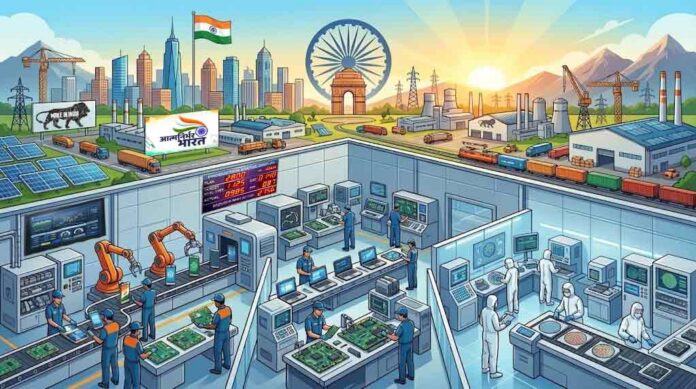
In 2014, Prime Minister Narendra Modi launched Make in India with a simple but ambitious claim: India would no longer remain content as a vast market. It would become a producer, designer and innovator. That promise travelled from a speech at Vigyan Bhawan to factory floors, assembly lines and chip plants. It is the story of a sequenced policy push that tried to convert Atmanirbhar Bharat from a political idea into manufacturing capacity.
Make in India was never only a slogan. It was accompanied by concrete measures. Under the Atmanirbhar Bharat initiative, the govt launched localisation measures such as the Phased Manufacturing Programme for mobile handsets, capital-support schemes like M-SIPS and SPECS, and later the Modified Electronics Manufacturing Clusters programme. These were meant to do the unglamorous work: change duties, create industrial parks, and nudge companies to make more in India instead of merely selling here. These steps expanded the manufacturing map, but still left a shallow value chain.
Then came the decisive turn. The Production Linked Incentive architecture, spread across fourteen sectors, was the instrument that rewarded actual production rather than announcements. This framework covered electronics, pharmaceuticals, automobiles, telecom, solar modules, batteries, textiles, white goods, food processing, steel and drones. Other schemes announced went further down the value chain. The Electronics Component Manufacturing Scheme was designed to bring displays, camera modules, circuit boards and other missing parts onshore. The India Semiconductor Mission, the Design Linked Incentive, and then Semicon 2.0 sought to move India from assembling gadgets to packaging chips and, eventually, fabricating them. A newer Mobile Phone Manufacturing Scheme is the next stage: not just more handsets, but more Indian design, brands and component sourcing.
Foxconn, Tata Electronics, Samsung, Dixon and others are not isolated corporate headlines but as part of a larger industrial map stretching across Tamil Nadu, Karnataka, Gujarat, Uttar Pradesh and beyond. Telecom, IT hardware and drone manufacturing are feeding into defence and dual-use technologies. The cumulative employment impact of the Make in India and PLI-driven electronics push is now substantial and visible across the country.
You can read the full article in Chapter 1 Magazine.


