

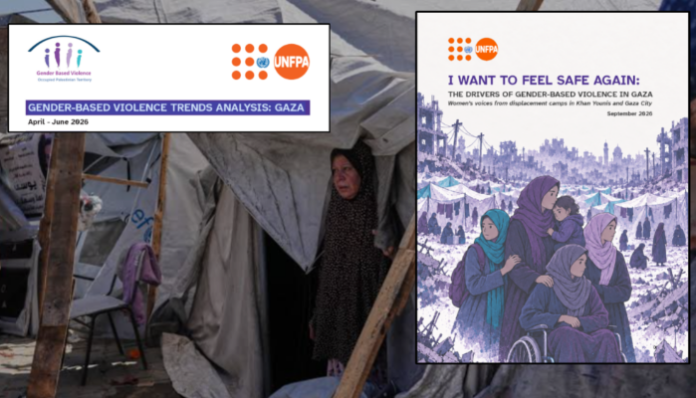
United Nations has disclosed that women in Gaza are being subjected to severe gender-based violence (GBV), forced into marriages with their rapists and even sold for food within their own communities. The startling findings were documented in its latest reports.
“Women and girls continue to face high rates of GBV, many of which result in life-threatening consequences, particularly extreme emotional trauma, including post-traumatic stress disorder and depression. From April to June 2026, the overall number of reported GBV incidents increased by 27% compared to the January-to-March period,” revealed the United Nations Population Fund (UNFPA) in its quarterly report “Gender-based violence trends analysis: Gaza.” The research was carried out between April and June of this year.
Psychological and emotional violence was the second most common type of GBV identified, followed by forced and early marriage, physical violence and sexual violence.
These occurrences were continuously being brought to the attention of the Gaza GBV Case Management Task Force, which provided case management to women and girls, many of whom had life-threatening conditions. These included physical injuries caused or made worse by GBV, alongside serious psychological deterioration like depression, suicidal thoughts and post-traumatic stress disorder.
The report evaluated data collected by 10 Gaza GBV Case Management Task Force partner organisations, who are members of the GBV Working Group, to emphasise the types and nature of reported incidents. Women between the ages of 18 and 59 were identified as being most impacted. It asserted that women and girls continue to be highly vulnerable to GBV violence because of ongoing displacement and poor living conditions.
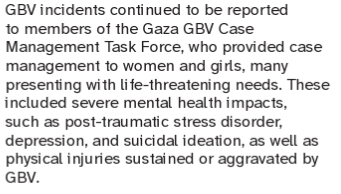
UNFPA conveyed, “Multiple forms of GBV were reported to the case management organisations, the highest GBV incidents during the period were denial of resources and opportunities (32.7%), psychological and emotional violence (30.9%); Physical assault (30.5%). Sexual violence incidents increased in number this quarter and accounted for 2.4%, unlike 2.2% in the previous quarter.”
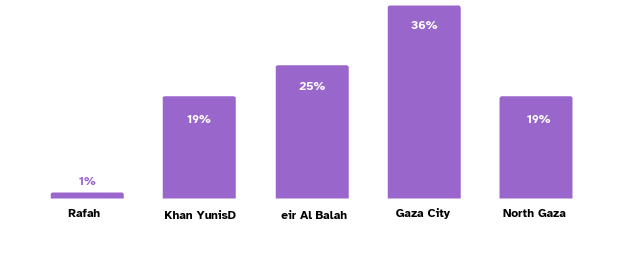
Occurrences of gender-based violence were observed in each of the five governorates. Gaza City contributed to the largest percentage of reports (36%), followed by Deir El Balah (25%), while North Gaza and Khan Younis each had an equal share (19%).
The report further read, “Women and girls remain highly vulnerable to economic deprivation through the denial of resources and opportunities, as well as other forms of gender-based violence. This highlights the multiple, intersecting forms of gendered discrimination they face, which significantly increases their vulnerability. Notably, adult women aged 18–59 constituted the highest proportion of reported survivors at 68%, representing an 11% increase from the previous quarter. This trend indicates growing vulnerability within this demographic, particularly regarding economic violence.”
According to one woman, her mother-in-law continues to deny her financial benefits after her husband died in the conflict.
An unsettling reality of forced unions and sexual violence
The figures for early and forced marriage cases in Gaza have significantly increased. Forced and early marriage made up 2.6% of all registered GBV cases during the reporting period, up from 2% in the preceding quarter (January to March). It added, “In absolute numbers, this represents a stark 123% increase, indicating a severe escalation. While the majority of reported incidents (67%) involved women aged 1859, pointing to forced and early marriage as a risk affecting young women broadly, not only adolescents, girls aged 12-17 accounted for a further 16% of cases. The highest (33%) of the incidents were reported from Gaza City, 31% from Deir Elbalah and 27% from North Gaza.”
Acts of sexual violence, including rape and sexual assault, have reached a critical stage in Gaza. There is a 61% increase in absolute case numbers, representing 2.7% of all compiled events from April to June 2026, up from 2.1% in the previous quarter (January to March 2026). “Demographic data indicates that females aged 18–59 represented the vast majority of survivors at 76%, followed by adolescent females (aged 12–17) at 8%, and males aged 18–59 at 5%. Women aged 60 and older, as well as young children (both girls and boys aged 0–11), were also affected,” UNFPA unveiled.
Another report documents persistent acts of molestation, sexual abuse
A UNFPA report titled “I want to feel safe again: Drivers of gender-based violence in Gaza” was earlier published on 17th September, presenting insights from 230 women residing in Gaza City and Khan Younis regarding their everyday experiences and exposure to gender-based violence risks. “It draws on findings from 16 focus group discussions conducted by the Women’s Affairs Centre (WAC) between December 2025 and January 2026 with women aged 19-63,” the study mentioned.
The report highlighted that ingrained gender norms already normalised male dominance over women’s bodies, resources, and decision-making, restricted their autonomy and freedom of movement and placed them as inferior to men. Hence, Palestinian women and girls faced significant GBV risks even before the armed confrontation. These standards are ingrained in legal, social and cultural frameworks and are created and passed down through generations. However, after the Hamas-led 2023 October attack on Israel and its retaliation, these pre-existing threats have intensified.
“During displacement, young men who were transporting and helping girls would take advantage of the situation to hold their hands and touch their bodies,” a woman shared. The women talked about the frequent sexual remarks, men rubbing their bodies against them in lines, purposefully touching their hands when filling water jugs and groping. Women mentioned that they had to dress modestly all the time due to these conditions.
The report emphasised that all of the Focus Group Discussions (FGDs) addressed persistent sexual harassment and assault in and near restrooms. A woman explained, “The restrooms are also the most common place for harassment of girls. Once, I was going to the restroom and saw a young man harassing young girls, staring at them and touching their private parts. I called out to him, asking what he was doing, and he quickly ran away.”
“My neighbour went to bathe at night because the bathrooms were empty. While she was bathing, she heard whispering. The bathroom had no roof, so she looked up and saw a young man watching her. She quickly put on her clothes and left the bathroom. She couldn’t tell anyone because she was afraid of being shamed. She has grown daughters and feared their reputation would be ruined. She was exhausted from crying and grief. I thought someone had died in her family,” revealed another woman.
A woman expressed how she was blamed for her ordeal and pressured into silence, conveying, “I was harassed while standing in line for water. An older man started harassing me and pressing against me. I reported him to the (camp) authorities. But my neighbours and the women in the camp told me I exposed myself. I’m really confused about this society. I’m forced to keep quiet.”

Girls married to their rapists, rape considered as adultery, no justice for survivors
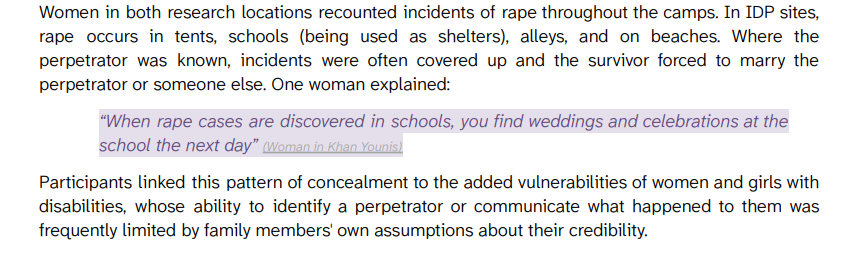
The report quoted women to outline that rapes take place throughout the camps, including beaches, alleys, schools that serve as shelters, and tents at IDP (Internally Displaced Person) sites. However, the heinous act was frequently hushed up, and the survivor was made to marry the rapist or another person if the perpetrator was known.
“When rape cases are discovered in schools, you find weddings and celebrations at the school the next day,” a woman stated. This pattern of concealment was connected to the greater vulnerability of women and girls with disabilities, whose capacity to communicate such an incident or identify a culprit was often hampered by presumptions about their credibility by their own family members.
The report specified, “Women and girls with disabilities were identified as especially at-risk, with perpetrators exploiting their limited ability to understand, resist, or report what was happening to them.” A woman highlighted, “There was a 20-year-old woman who was very naive and her level of understanding was so low that more than one young man harassed her, and one of them raped her. She almost didn’t understand what was happening to her.”
Moreover, rape was regarded as adultery, which only exacerbated the problems endured by women. UNFPA stressed, “The legal system’s classification of rape as ‘adultery’ constitutes a secondary form of violence, stripping the survivor of justice and positioning her as the perpetrator of a moral transgression. This underscores that legal institutions, even when functioning, do not always deliver justice for women.”

Marital rape was similarly identified as a significant concern in the report.
Women subjected to domestic violence by husbands, fathers, brothers
UNFPA informed, “Prior to 2023, domestic violence in Gaza was already a significant problem, with nearly one in three Palestinian women reporting violence by their husbands in the preceding 12 months. Approximately 15% of married women in Gaza experienced sexual abuse by their husbands in the previous year, with more than half experiencing it repeatedly.”
“The most common type of violence women experience is beatings. This was the most prevalent type of violence before the war, and now, after the war, it has increased significantly. Men take out their anger on their wives, and women have no choice but to endure it,” a woman asserted. Women also mentioned brothers, fathers, and parents-in-law as offenders.

The report mentioned, “Prevailing gender norms and conditions resulting from the conflict have resulted in a culture of impunity, with FGD participants emphasising that some fathers were allowing their sons to beat their daughters without consequences.”
During FGDs, domestic violence and family violence, which includes physical violence, emotional/psychological violence, suppression of access to resources, opportunities, or services, sexual exploitation, restrictions on freedom of movement, coercive control and isolation, marital rape and threats to take away kids of survivors, were the most frequently discussed forms of GBV.
According to the report, widows, women whose husbands are incarcerated, and divorcees are more likely to encounter emotional and physical violence from their in-laws. Women shared that their in-laws control them, treat them like servants, and prevent them from leaving with their children.
A woman disclosed, “My husband already forbids me from going out, even to talk to my family. Imagine what would happen if I went to a women’s safe space. If he found out, he’d beat me. I just stay quiet, sit in my tent, and keep my sadness to myself.”
Women also expressed that their husbands intercepted assistance “Fathers, brothers, and in-laws in particular were among the most frequently discussed perpetrators of denial of access to humanitarian assistance by family members,” UNFPA stated.

Exploitative arrangements in the form of child and forced marriages
“Child, early, and forced marriage are not new phenomena in Gaza – in 2019-2020, 24% of women aged 20-49 in Gaza had been married before the age of 18, reflecting longstanding social pressure to marry young,” the report read. Participants in the FGD discussed several types of these unions. These included forced marriages of rape survivors, levirate marriage (the custom of marrying widows to their deceased husband’s brother), child marriage, economic transactions in which girls are married off in exchange for resources and marriages arranged by families without women’s consent.
The report stated that “marriage was used explicitly as a transactional mechanism for securing shelter and resources, such as a widow being forced into marriage with a camp representative in exchange for a tent to shelter her children.”

It further revealed that “six participants across six different FGDs in Gaza City and Khan Younis shared stories of girls whose fathers married them off for a bag of flour.”

Women also talked about how parents have forced their daughters into marriage as a kind of “protection” for the girls or to preserve family “honour” and “avoid scandal” due to fear of sexual harassment and rape, along with strict gender norms that prohibit mixed-gender socialising.
Community members sexually exploit and abuse women, denial of basic needs
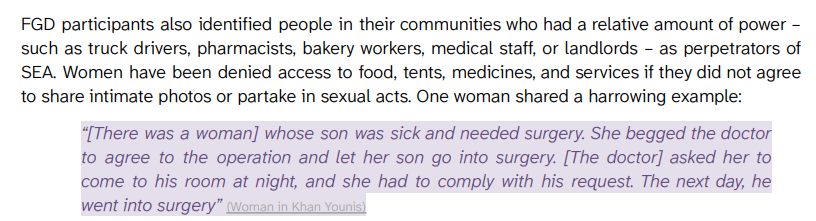
Truck drivers, chemists, bakers, doctors, landlords and other such persons in their communities with a relative amount of power were identified as Sexual Exploitation and Abuse (SEA) perpetrators by the FGD attendees. Women who refused to provide private images or engage in sexual activity were denied access to food, tents, medications, and other services.
“There was a woman whose son was sick and needed surgery. She begged the doctor to agree to the operation and let her son go into surgery. The doctor asked her to come to his room at night, and she had to comply with his request. The next day, he went into surgery,” a woman recounted.
Women also discussed incidents in which they were beaten, shoved, or struck by distributors or other members of the community while attempting to get assistance.
UNFPA highlighted that both men and women have lost access to traditional conflict resolution procedures, but the impact remained gendered. Women’s access to dispute settlement mechanisms was already more restricted than men’s, and when it did exist, it was rarely survivor-centred before the ongoing war.
According to the report, women and girls who are divorced, separated or widowed are often identified as those who are most vulnerable to SEA, denied access to humanitarian aid, economic exploitation, forced levirate marriage and abuse by in-laws. The list also included adolescent girls, females with disabilities, women whose husbands are missing or jailed, pregnant women, new mothers and older women.
Meanwhile, accounts of violence are regularly met with victim-blaming. “Participants also noted a culture of victim-blaming, with survivors choosing silence over the humiliation of being blamed for the violence,” the report pointed out.


