

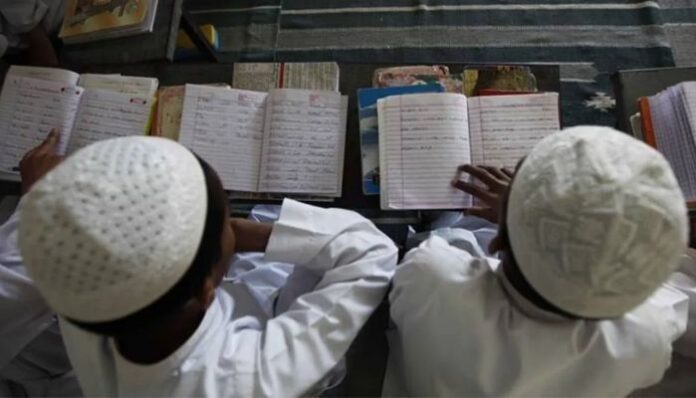
The West Bengal government has launched a major crackdown on madrassas across the state, ordering the closure of 252 institutions and issuing show-cause notices to another 100. The action came after a statewide survey conducted by the Minority Affairs and Madrassa Education Department to check whether madrassas were operating with the required approvals, infrastructure and academic standards.
Officials said the survey began in June and was carried out across districts to assess the functioning of both government and private madrassas, with particular attention to Khariji madrassas. These are independently run Islamic religious institutions that generally depend on public donations or charitable trusts rather than government funding.
𝐖𝐞𝐬𝐭 𝐁𝐞𝐧𝐠𝐚𝐥 𝐬𝐡𝐮𝐭𝐬 𝟐𝟓𝟐 𝐦𝐚𝐝𝐫𝐚𝐬𝐬𝐚𝐬 𝐨𝐯𝐞𝐫 𝐢𝐧𝐚𝐝𝐞𝐪𝐮𝐚𝐭𝐞 𝐚𝐩𝐩𝐫𝐨𝐯𝐚𝐥𝐬, 𝐛𝐚𝐬𝐢𝐜 𝐢𝐧𝐟𝐫𝐚𝐬𝐭𝐫𝐮𝐜𝐭𝐮𝐫𝐞
— IndiaToday (@IndiaToday) September 13, 2026
West Bengal has ordered 252 madrassas to close and sought explanations from around 100 others after a statewide survey. The move… pic.twitter.com/WTw4Vqzbh1
According to reports based on findings submitted by district administrations, around 2,396 madrassas were functioning without registration. The government has said that the action is primarily aimed at institutions that lack the necessary approval, do not have basic infrastructure or deviate from prescribed educational requirements. The state has also maintained that madrassas that meet the required rules and have valid approval will be allowed to continue functioning.
Minister Kshudiram Tudu, who heads the Minority Affairs and Madrassa Education Department, said the survey was ordered to establish how many madrassas were authorised and how many were functioning without the necessary permissions. “As many as 252 madarsas have been ordered to close while 100 others have been sent show-cause notices for lacking requisite approvals and basic infrastructure,” he said.
Tudu also said the government wanted students studying in madrassas to have access to mainstream education and opportunities similar to those available to students in other schools. “We want madarsa students to pursue modern, mainstream education and shine in life just like students from other schools,” he said.
The districts with the highest number of closure notices include Malda, North Dinajpur, South 24 Parganas, Murshidabad and Nadia. Reports said around 44-45 institutions in Malda, about 37 in North Dinajpur, around 32 in South 24 Parganas and around 25 each in Murshidabad and Nadia have been affected.
The West Bengal government has also raised a security-related concern. Officials have said that complaints were received about some Khariji madrassas and that intelligence inputs indicated anti-national propaganda being taught at some institutions. State Panchayati Raj Minister Dilip Ghosh said there had been cases where people associated with madrassas were arrested in connection with extremist activities.
“Complaints against madrasas had repeatedly been received. There have been instances of people carrying out anti-national activities from some seminaries,” Ghosh said. At the same time, he stressed that madrassas operating legally would not be targeted. “Madarsas being run in accordance with the law and with government permission will continue to function. But the government will not allow madarsas to be opened indiscriminately and cause trouble,” he added.
The latest move has therefore combined two arguments from the state government, regulation of educational institutions and concerns over extremist or anti-national activities. The government has said the survey will help separate recognised institutions from those functioning outside the regulatory system.
Uttarakhand follows with action against illegal madrassas
West Bengal is not the only state where authorities have recently stepped up action against madrassas that do not have the required recognition. Uttarakhand has also intensified its crackdown, although its approach has largely been presented as a regulatory exercise aimed at bringing minority educational institutions under a new recognition system.
The latest action in Uttarakhand has taken the number of madrassas whose operations have been discontinued to 20. Of these, 17 have been sealed, while the managements of three others have submitted written undertakings confirming that they have stopped operating. The latest action involved institutions in Dehradun and Haldwani.
Uttarakhand: Action has been taken against unrecognised madrasas in Dehradun and Haldwani. Three madrasas in Dehradun and two in Haldwani were sealed, taking the total number of unrecognised madrasas sealed across the state to 17, while operations at three others have also been… pic.twitter.com/pbVaEQhdAG
— ANI (@ANI) September 5, 2026
In Dehradun, Madrasa Jamia-Tus-Salam Al-Islamia in Azad Colony was sealed. The managements of Madrasa Dar-e-Arqam in Azad Colony, Majra, and Madrasa Darul Uloom Rahimia submitted written undertakings saying that they had stopped running the institutions.
Two more madrassas were sealed in Haldwani after their managements failed to produce the required recognition documents. Authorities said the institutions were being dealt with because they did not meet the prescribed recognition and academic requirements.
The action is part of a much larger overhaul of minority education in Uttarakhand. In July 2026, the state became the first in India to abolish its statutory Madrasa Board and replace it with the Uttarakhand State Authority for Minority Education (USAME). The new authority covers educational institutions run by all six notified minority communities – Muslims, Christians, Sikhs, Parsis, Jains and Buddhists.
The government repealed the earlier framework under which madrassas were regulated and introduced a common system for minority educational institutions. Under the new arrangement, institutions have to meet recognition requirements and follow prescribed educational standards.
The crackdown has gone beyond the 20 institutions whose closure or sealing was recently highlighted. According to the Uttarakhand Minority Education Authority, around 200 unrecognised madrassas have ceased operations, while more than 100 have applied for recognition. In Haridwar, which had 269 operational madrassas, 102 had shut down, while 76 had applied for recognition. Thirty-five madrassas across the state had received recognition at the time of the latest update.
The government has also said that the action is not intended to leave students without education. Officials have said children studying in closed madrassas are being shifted to nearby schools or recognised madrassas so that their education does not stop.
Chief Minister Pushkar Singh Dhami has maintained that no educational institution should be allowed to function without recognition and compliance with rules. The state government says the objective is to ensure that minority institutions also provide modern and quality education and that students do not lose out because of institutions operating outside the regulatory framework.
Assam began the madrassa crackdown years earlier
Before the recent actions in West Bengal and Uttarakhand, Assam had already taken some of the country’s most significant steps to change the madrassa education system. The process began in 2020, when the Assam government moved to abolish the system of state-run madrassas and convert them into regular schools.
In December 2020, the Assam Legislative Assembly passed legislation abolishing government-run madrassas. The law removed government funding for religious education in these institutions and provided for their conversion into general schools. The State Madrassa Education Board, Assam, was also to be disbanded. The government said the change would create a secular education system in which state-funded institutions would focus on general education.
Then Education Minister Himanta Biswa Sarma defended the decision by saying that students should be given opportunities to pursue mainstream careers. He said the government had conducted a survey and claimed that a large majority of madrassa students wanted general education. “We have conducted a survey among Madrassa students,” Sarma said.
The legislation did not mean that all privately run madrassas in Assam would automatically disappear. The initial law dealt primarily with government-run and government-funded institutions. Sarma had also said that the government would introduce a separate system to regulate private or Qawmi madrassas and make registration conditional on teaching subjects such as science and mathematics alongside religious education.
The Assam government’s policy became even more prominent in March 2023 when Chief Minister Himanta Biswa Sarma said that 600 madrassas had already been closed and that he intended to close all madrassas in the state. Speaking at a public gathering in Belagavi, Karnataka, Sarma said, “I have closed 600 madrasas and I intend to close all madrasas because we do not want madrasas. We want schools, colleges and universities.”
His remarks went beyond the original policy of converting government-run madrassas into regular schools and reflected his broader argument that children should receive mainstream education rather than separate religious schooling.
In the same month, Sarma announced that another 300 madrassas would be closed. He said the decision followed discussions between the state government, Assam Police and organisations representing the madrassa community.
“There was a meeting between the BJP and the people who run these madrasas. There is a consensus that 300 more madrasas will be closed down. This is a result of the discussion between the Assam police and the Qaumi organisations,” Sarma said in May 2023.
The numbers and statements around the closures have often been discussed alongside Assam’s larger campaign against institutions that authorities consider unrecognised or outside the regulatory system. The government has repeatedly argued that religious education should not come at the cost of general education.
By December 2023, the Assam government’s earlier decision had resulted in another major administrative change. The state government renamed 1,281 madrassas as Middle English, or ME, schools.
Education Minister Ranoj Pegu announced that the institutions, which had already been converted into general schools, would no longer carry the term “Madrasa” in their official names. “Consequent to the conversion of all Govt and Provincialised Madrasa’s into general schools under SEBA, the Department of School Education, Assam has changed the names of 1,281 ME Madrasas into ME Schools,” Pegu said.
Consequent to conversion of all Govt and Provincialised Madrasa’s into general schools under SEBA, @SchoolEdnAssam has changed the names of 1281 ME Madrasas into ME School by a notification today. Here is the link for the list of schools. @himantabiswa @Samagra_Assam…
— Ranoj Pegu (@ranojpeguassam) December 13, 2023
The institutions were spread across 21 districts. Dhubri had the highest number, with 269 such schools, followed by Nagaon with 165 and Barpeta with 158. These were government or provincialised institutions, meaning they were funded by the government, including expenditure on staff and other facilities.
The change was therefore not simply about shutting down buildings. In many cases, the institutions continued as schools but were brought into the mainstream education system. Religious subjects were removed from the curriculum while students continued with the general school curriculum. Assam‘s policy involved a wider restructuring of government-funded madrassa education.
Uttar Pradesh: Focus on madrassas and religious structures along Nepal border
Uttar Pradesh has also witnessed action against unaided madrassas, particularly as part of a broader campaign against encroachments on government land along the India-Nepal border.
The campaign has covered districts including Bahraich, Shravasti, Balrampur, Pilibhit, Lakhimpur Kheri, Maharajganj and Siddharthnagar. Joint teams of revenue and police officials have been checking encroachments and taking action against unauthorised structures, including mosques, Eidgahs and madrassas.
In an earlier phase of the campaign, authorities said at least 20 mosques and madrassas located within a 15-kilometre radius of the India-Nepal border had been removed as part of action against encroachments on government land. In Shravasti alone, action was reported against 17 illegal madrassas.
Bahraich has been one of the key districts in the campaign. Officials identified 227 encroachment cases in the Nanpara area, with dozens of encroachments removed while cases pending before courts were kept outside the immediate action.
The Uttar Pradesh government has maintained that the campaign is aimed at illegal occupation of government land and institutions operating without the required recognition, rather than at recognised madrassas as a category. The state’s minority affairs authorities have also said that recognised madrassas are permitted to function under the applicable rules.
The government has linked the border-area campaign to concerns over changes in population patterns and the emergence of unauthorised structures in sensitive areas. Officials have pointed to earlier reports and intelligence inputs concerning the establishment of religious structures along the border.
The developments in West Bengal, Uttarakhand, Assam and Uttar Pradesh point to a broader approach by BJP-led governments, which are bringing madrassas under stricter regulation while ensuring that students have access to mainstream education. The focus is increasingly on recognition, registration, infrastructure, curriculum and regulatory oversight of madrassas.


