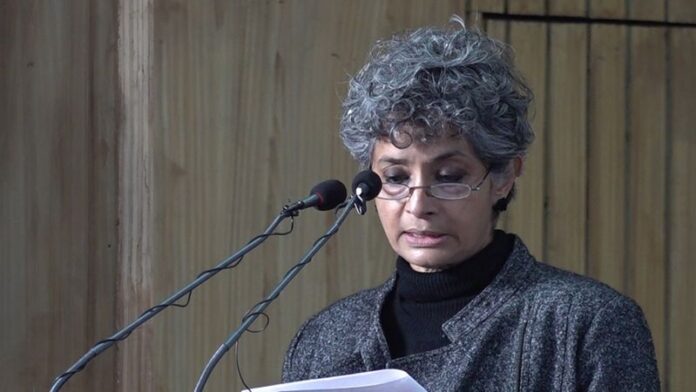
Former JNU professor Nivedita Menon has repeatedly courted controversy over her views on Kashmir, nationalism, Hindu society, the Uniform Civil Code and the political climate in India.
Now, one of those controversies has followed her to Udaipur.
A coalition of civil society groups in the Rajasthan city has demanded that the Rama Mehta Trust cancel Menon’s scheduled Rama Mehta Memorial Lecture at the Vidya Bhavan Auditorium. The groups held a press conference on Saturday, September 19, accusing Menon of making divisive and “anti-national” remarks and questioning why she had been invited to address the event.
Menon, who superannuated from Jawaharlal Nehru University (JNU) in November 2025, is a feminist ‘intellectual’ prominent in left-wing academic circles. She taught at JNU’s School of International Studies from 2009, after spending 15 years at Lady Shri Ram College and seven years in Delhi University’s political science department.
Her public interventions, however, have frequently extended well beyond conventional academic debates and sparked outrage over her remarks on India’s sovereignty, Kashmir, nationalism and the country’s political institutions.
‘India is illegally occupying Kashmir’
One of the most prominent controversies surrounding Menon erupted in 2016 during the intense political debate over nationalism at JNU.
While delivering a lecture on nation formation and Kashmir, Menon was reported as saying that “everyone knows that India is illegally occupying Kashmir”. She was also reported to have said that Kashmir and Manipur had been “illegally occupied” by the Indian state.
An ABVP student leader subsequently filed a police complaint against her.
Menon disputed some of the specific wording attributed to her and defended her lecture as an academic discussion about nationalism and Kashmir. No conviction followed from the complaint.
Another portion of the lecture nevertheless drew considerable attention. A video clip showed Menon describing Hindu society as “the most violent, to the root violent society in the world”.
The remarks triggered a backlash, with more than a dozen academics and activists subsequently issuing a statement condemning what they described as the “vilification” of Menon.
The controversy resurfaced in Jodhpur
The following year, i.e 2017, Menon’s lecture at Jai Narain Vyas University in Jodhpur became another flashpoint.
Menon had been invited to speak on “History Reinterpreted: Nation, Individual and Culture”. The university later filed a police complaint alleging that she had made objectionable comments concerning Kashmir and Indian soldiers, besides showing disrespect towards the national flag and anthem.
The university’s vice-chancellor told the media that Menon had said Kashmir was not an integral part of India and that soldiers worked for their livelihood rather than for the nation.
Menon rejected the allegations as baseless and alleged that the controversy had been manufactured by an RSS-affiliated former professor.
The episode led to ABVP-linked protests and a temporary shutdown of the university that day.
‘A stick to beat Muslims with’
Menon’s position on the Uniform Civil Code has also been a source of political disagreement.
Writing in The Hindu in 2016, she argued that the UCC debate “has nothing to do with gender justice” and was instead linked to a Hindu-nationalist agenda to “discipline” Muslims.
She described the proposed Code as “a stick to beat Muslims with” while arguing that aspects of Muslim personal law, including marriage as a civil contract and women’s property rights, were being overlooked in the debate.
It was a pointed intervention in one of India’s most contentious constitutional and political questions, and attracted criticism from those who viewed her argument as an ideological defence of personal law.
‘Is manhoos desh’
The latest controversy involves a much more recent remark.
In a recently surfaced interview uploaded on journalist Mandeep Punia’s YouTube channel, Menon discussed the political climate of the past decade, the Muslim community, student movements, bulldozer demolition drives and the political response to protests.
While discussing the political space available to Muslims, she referred to India as “is manhoos desh”, translated as “this accursed country” or “this cursed country”.
Menon was discussing the experience of Muslims in India in the context of the CJP protests when she said that the movement had provided “a little breathing room”, after which Muslims perhaps started feeling that “in this cursed country, there is a place for us too.”
The clip subsequently went viral and triggered criticism.
The wider context of the interview is relevant. Menon was making a broader argument about the political situation and the experiences of Muslims in India. Nevertheless, the description of India as a “cursed country” has become the latest flashpoint involving the former JNU professor.
But that was far from the only controversial assertion made during the interview.
Menon hails CJP protests as a ‘democratic victory’
Discussing the CJP protests, Menon described the movement as having made “accountability” part of everyday political vocabulary and called this the “biggest victory” of the movement.
She also discussed the role of its leadership, arguing that although the movement had become “organic”, such a movement did not emerge on its own and that there had to be a centre giving the call. She specifically referred to Abhijit Dipke and said his role could not be forgotten.
Menon further argued that the movement had broken what she described as a “dense silence” that had prevailed for 12 years and had brought different Left groups together, along with supporters from across India and abroad.
‘It has been a Hindu Rashtra here for 12 years’
Menon’s criticism during the interview was not confined to a particular government policy.
Speaking about India’s political direction, she said: “It has been a Hindu Rashtra here for 12 years; attempts were made to make it a Hindu Rashtra, and in a way, it has become a Hindu Rashtra. We are all living under the shadow of a Hindu Rashtra.”
She also sharply criticised the Union Government’s education policy and the Education Minister, while questioning the composition of a high-powered task force constituted for educational reforms.
The comments provide further context to why Menon’s proposed Udaipur lecture has become politically contentious. Her critics are not objecting merely to an academic discussing feminism or education; they are objecting to a speaker whose public interventions routinely extend into questions of nationalism, sovereignty, religion and the functioning of India’s democratic institutions.
‘EVM, ECI, SIR, delimitation’: Menon questions electoral system
Menon also questioned the functioning of India’s electoral system during the interview.
Discussing the government’s conduct, she argued that it showed an absence of concern about winning elections and referred specifically to EVMs, the Election Commission of India, SIR and delimitation.
Her argument was that the government had reached a point where it believed it did not even need to win elections anymore.
These are sweeping allegations about the functioning of India’s democratic institutions.
They are also precisely the kind of political claims that are bound to invite scrutiny when made by a former professor of one of India’s premier universities.
‘Seeds’ of anti-CAA and farmers’ protests
Menon further drew a line between earlier protest movements and the CJP protests.
She described the anti-CAA and farmers’ protests as having planted “seeds” that had subsequently emerged as a “continuity”, specifically mentioning young activists including Umar Khalid.
Her supporters can view this as an academic interpretation of the evolution of protest politics in India.
Her critics, however, see it as an attempt to place disparate political movements within a single continuum of resistance against the Indian state.
Either way, the comments make clear that Menon’s latest intervention is not confined to an old controversy from 2016. She continues to make strong political arguments about the nature of the Indian state, its institutions and the direction of Indian democracy.
Udaipur groups now demand cancellation
It is against this backdrop that the Udaipur controversy has erupted.
Dr Parmveer Singh Dulawat, representing the group, cited Menon’s past remarks while demanding that the Rama Mehta Trust withdraw the invitation.
The group questioned why an organisation in Udaipur would invite Menon and demanded that the trust’s office-bearers explain the decision.
Dulawat also pointed to the fact that trustees associated with the Rama Mehta Trust, including Ajay Singh Mehta and Hemraj Bhati, are also associated with Vidya Bhavan Society and Seva Mandir.
According to the group, these overlapping institutional positions make the organisers’ decision even more worthy of scrutiny.
The group has warned that a larger protest could follow if the event goes ahead.
As of the latest available information, neither the Rama Mehta Trust nor Vidya Bhavan Society had publicly announced that the lecture had been cancelled.
Menon’s lectures have faced disruption before
The Udaipur protest is not the first organised opposition Menon has faced at a public lecture.
In March 2024, her lecture at Gangadhar Meher University in Odisha was disrupted roughly 15 minutes after it began. Protesters shouted “Nivedita Menon Go Back”, following which she left the podium and the event was called off.
The JNU Teachers’ Association condemned the incident, arguing that scholars should not be intimidated because of their political views.
That position raises an important distinction.
There is nothing unusual or objectionable about protesting against a speaker’s views. Speakers who draw legitimacy from their lectures in universities across the country must bear with the possibility of facing calls for cancellation when they spew venom against the national flag, disrespect soldiers, or promote an integral part of its territory as disputed.
For JNU professors like Nivedita Menon, the Udaipur episode should serve as a reminder that contentious remarks on Kashmir, India’s sovereignty and national identity cannot simply be insulated from public scrutiny by invoking “freedom of speech”, “constitutional guarantees” and academic freedom. The right to speak is protected; so is the public’s right to question, criticise and protest against what is said.