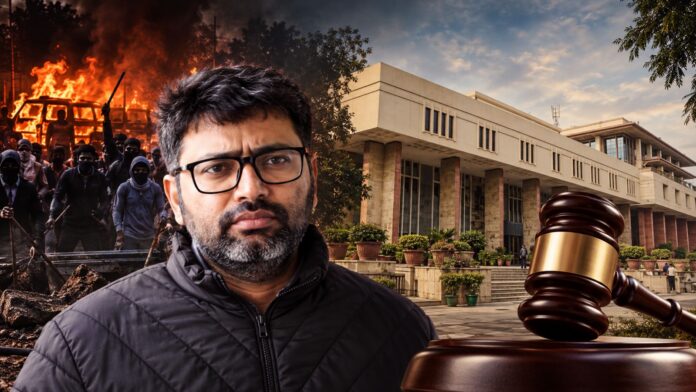
On the 12th of October 2026, after 48 hours of violence by various CJP mobs and on the day Congress was coordinating a massive protest with violent undercurrents, Nadeem Khan approached the Delhi High Court claiming that his detention on the 29th of September ahead of the violent CJP protests was ‘illegal’. He also pleaded with the court to rule against the restrictions put in place by the Delhi Police around Jantar Mantar. The media characterises Nadeem Khan as “Association for Protection of Civil Rights (APCR) National Secretary and human rights activist”. They, however, hide the most important element of his Curriculum Vitae – Nadeem Khan was one of the key conspirators of the Delhi anti-Hindu riots of 2020.
The petition by Nadeem Khan alleged that he was detained for several hours on the 29th of September 2026 and prevented from attention the CJP protest on the same day. Represented by lawyer Shahrukh Alam, he also challenged the restrictions around Jantar Mantar and the imposition of Section 163 BNSS in Delhi. Khan alleged that the police visited Nadeem Khan’s office, which is inside the Jamaat-e-Islami Hind compound, and detained him from 9:30 AM to 4:30 PM on 29th September. The Police contended that he was not detained, but the police were merely ensuring he did not attend the protest, for which no permission was granted, making it an illegal protest. He further claimed that on the 2nd of October, he was going to tend to his ailing mother when the police called him and questioned him about his travel. “They did not detain me, but there has been constant surveillance”, he said.
The court then shot back, “How can you enter the house of this man… Where is your cause to confine him?”
According to Bar and Bench, the court said, “Where is your response? Why is the petition served on you? How can you enter the house of this man? You had the right to conduct the duty; how can you do it in such a way? Where is your cause to confine him? Denying permission is within your rights. Please show us in law”.
At this point, the police asked for time to file a formal response to the petition and took on record that the police will not call Nadeem Khan to ask about his whereabouts.
Who is Nadeem Khan – associated with United Against Hate
Nadeem Khan is a 449-year-old self-proclaimed “activist”, who exclusively focuses on rallying for imagined Muslim victimhood. He is the National Secretary ofthe Association for Protection of Civil Rights (APCR) and Founder of UAH (United Against Hate).
APCR is an organisation which claims to work for an egalitarian society; however, it focuses, just like Nadeem Khan, on imagined Muslim victimhood almost exclusively. United Against Hate is an organisation which is harder to track. It has no website and only scattered news reports that mention it. From what has been gathered, it was started by those like Khalid Saifi (an accused in the Delhi anti-Hindu riots) and Nadeem Khan somewhere in 2017 to launch a campaign against “lynching of Muslims”. A 2019 HuffPo article mentions http://www.unitedagainsthate.in as their website; however, it is not accessible anymore.
Essentially, United Against Hate started as an off-and-on campaign. In a 2019 interview, Khalid Saifi said, “There was a spurt of lynchings across the Hindi belt and the Opposition political parties were not ready to do anything about it. We decided we had to help these poor people who have nobody to turn to. We started in July 2017 in Delhi. Now, there is a core group of 17 members in Delhi. We meet often and discuss what we need to do and how we should go about it. We then inform our 25 extended groups, which are spread across Uttar Pradesh, Bihar, Maharashtra and Kerala. In Delhi alone, we have eight groups working with us”.
In the same interview, he also said, “Among our members we have six PhD scholars. Umar Khalid and Anirbhan Bhattacharya from Delhi’s Jawaharlal Nehru University are our members. Umar is one of our founding members”.
United Against Hate, co-founded by Khalid Saifi, Nadeem Khan and Umar Khalid, has attracted the usual anarchists over the years – many of them were intimately involved in the Delhi anti-Hindu riots of 2020 – including Khalid Saifi (a named accused), Nadeem Khan (whose footprints were all over but was not made an accused), Umar Khalid – one of the key conspirators, Prashant Bhushan (who hosted the first conspiracy meeting), Yogendra Yadav (a constant mentor and present at conspiracy meetings) and more.
In 2018, for example, United Against Hate led by Nadeem Khan released a fact-finding report on the Kasganj violence in Uttar Pradesh, where a Hindu boy, Chandan Gupta, was brutally murdered by a Muslim mob. While addressing the press conference, Banojyotsna Lahiri (Umar Khalid’s girlfriend), who was part of the fact-finding team, raised several doubts over police investigations and narrated how the local administration is selectively targeting the Muslim community. Jamaat-e-Islami General Secretary addressing the press conference claimed, “This is an attack not only on a few persons, a community or area, but it is an attack on the very idea of India, its root, brotherhood and secularism.”
Nadeem Khan, Rakhi Sehgal, journalist Arfa Khanum and Amit Sengupta also addressed the gathering. Retired IG of UP Police SR Darapuri, Adv. Asad Hayat, journalists Amit Sengupta, Hasanul Banna, Aleemullah Khan, Rakhi Sehgal, Mohit Pandey, Nadeem Khan, Khalid Saifi and Shariq Hussain were part of the fact-finding team.
While in 2018, United Against Hate, led by Nadeem Khan, Khalid Saifi and Umar Khali,d branded the Kasganj violence as an attack by Hindus against the Muslim community, in 2025, the NIA court convicted 28 Muslims who brutally murdered Chandan Gupta during the Tiranga Yatra in Kasganj. Chandan Gupta was murdered by the Muslim mob because he refused to chant Pakistan Zindabad. This was the same mob that Nadeem Khan had defended.
In 2024, the same Nadeem Khan was booked by police for hatching a criminal conspiracy to instigate hate and violence. In 2024, Nadeem Khan, under the banner of United Against Hate,e had constituted an exhibition where he made communally charged speeches and also essentially displayed Muslim victimhood w, with fake news being his guiding light. During the exhibition, an almost hit list was displayed of individuals and organisations he claimed “targeted Muslims” – OpIndia was on the hit list as well.
The First Information Report stated, “The video also shows photographs of some politicians and media personalities… on multiple display boards, whom the person accuses of spreading hatred.” “After this, the person mentions incidents from different parts of the country, portraying a particular community as victims and trying to disrupt communal harmony in the country,” it further added.
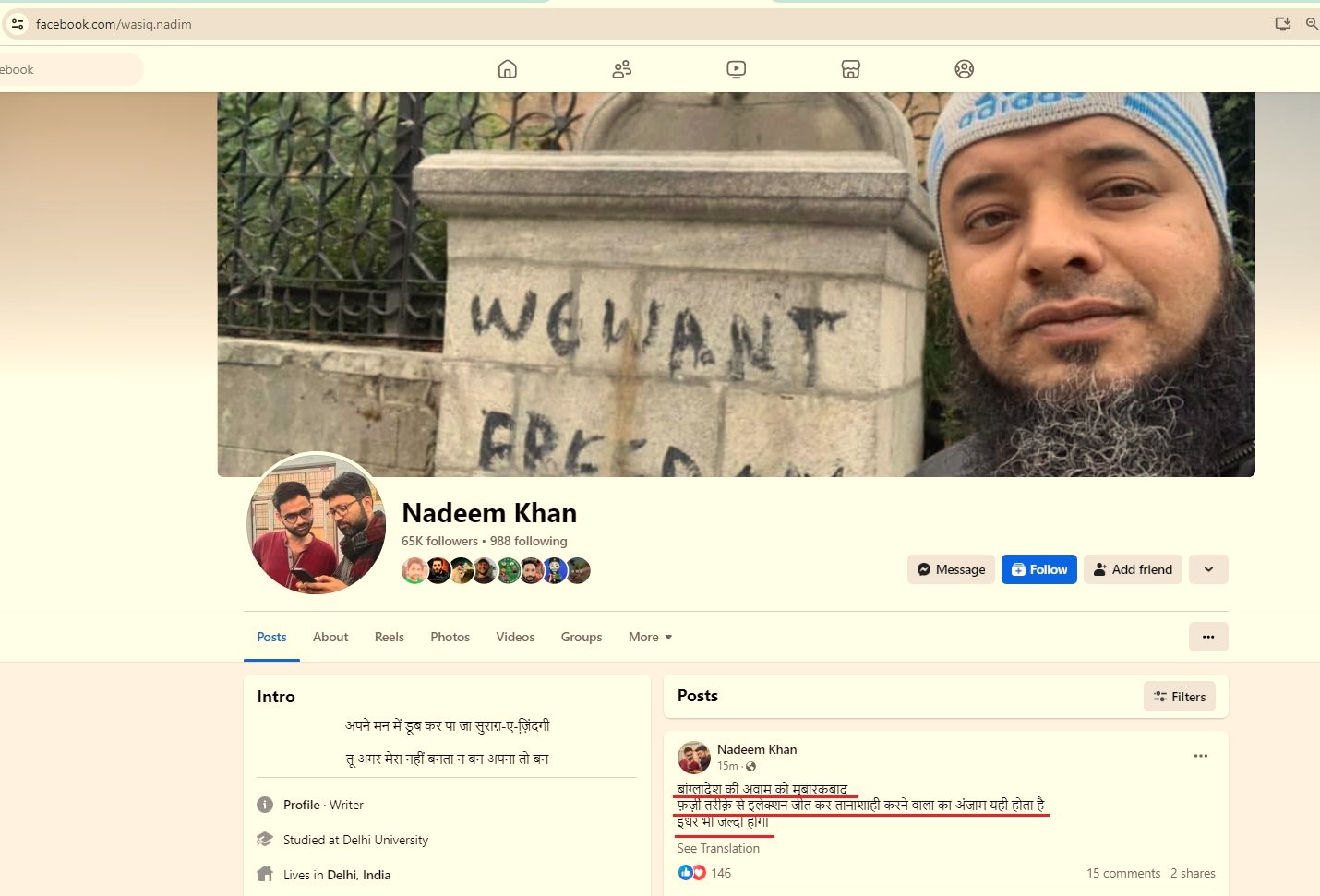
Following the undemocratic ouster of Sheikh Hasina as Prime Minister of Bangladesh, the national secretary of APCR had fantasised about the overthrow of the elected BJP government at the hands of Islamists.
“Congratulations to the people of Bangladesh. The dictators who win elections in a fraudulent manner face such an end. This will happen here (in India) soon,” he posted on Facebook on 5th August 2024.
In July 2024, OpIndia had debunked a malicious report, published by APCR, claiming that incidents of anti-Muslim crimes have increased in India following the 2024 Lok Sabha Election results. The outrageous claims made in the report were amplified by other media houses, es including Free Press Journal, Clarion, and Muslim Mirror.
We exposed discrepancies and glaring inconsistencies in the narrative peddled by Nadeem Khan’s organisation about the deaths of Aurangzeb, Salman Wohra, Maulana Sahabuddin, Irshad Alam, Javed, Firoz Qureshi and others.
Nadeem Khan – a close aide of Umar Khalid and Sharjeel Imam and his role in the anti-Hindu Delhi Riots
This, of course, is only the tip of the iceberg when it comes to capturing who Nadeem Khan is. The depth of his hate was fully manifested during the Delhi anti-Hindu riots. While he was not a named accused, his presence and involvement were recorded by the Delhi Police in their Conspiracy chargesheet – from mobilisation to execution – Nadeem Khan was almost omnipresent.
From the 5th of December 2019, Sharjeel Imam, Umar Khalid and a few others had started hatching the conspiracy. First, communally charged pamphlets were printed by Sharjeel Imam, along with Arshad Warsi (who is now arrested for being an ISIS terrorist) and distributed in the thousands in and around mosques in Delhi. They formed a group called Muslim Students of JNU to coordinate protests and pamphlet distribution as well.
In the pamphlets that were printed and distributed at mosques around Delhi, the protest call by United Against Hate at Jantar Mantar was supported by MSJ. In both these groups – UAH and MSOJ – the same people were involved: Umar Khalid, Sharjeel Imam, Nadeem Khan and Khalid Saifi.
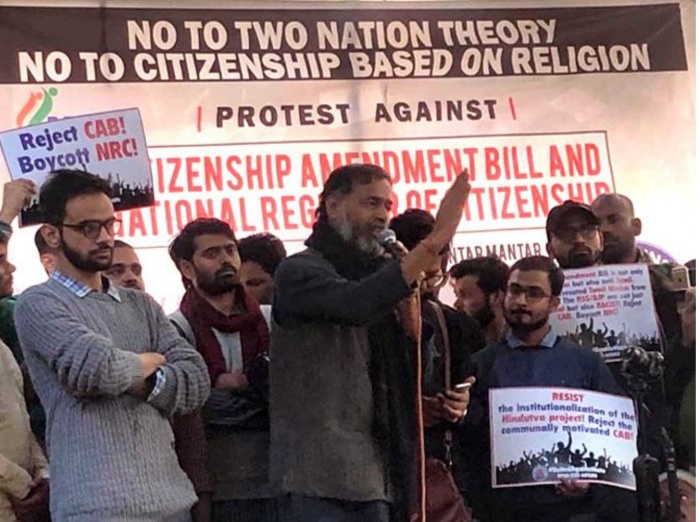
At the UAH rally, Umar Khalid introduced Sharjeel Imam to Yogender Yadav, and it was here that Yadav asked Umar Khalid and Sharjeel Imam to use social media for large-scale indoctrination and mobilisation of Muslims against CAA – including Chakka Jam.
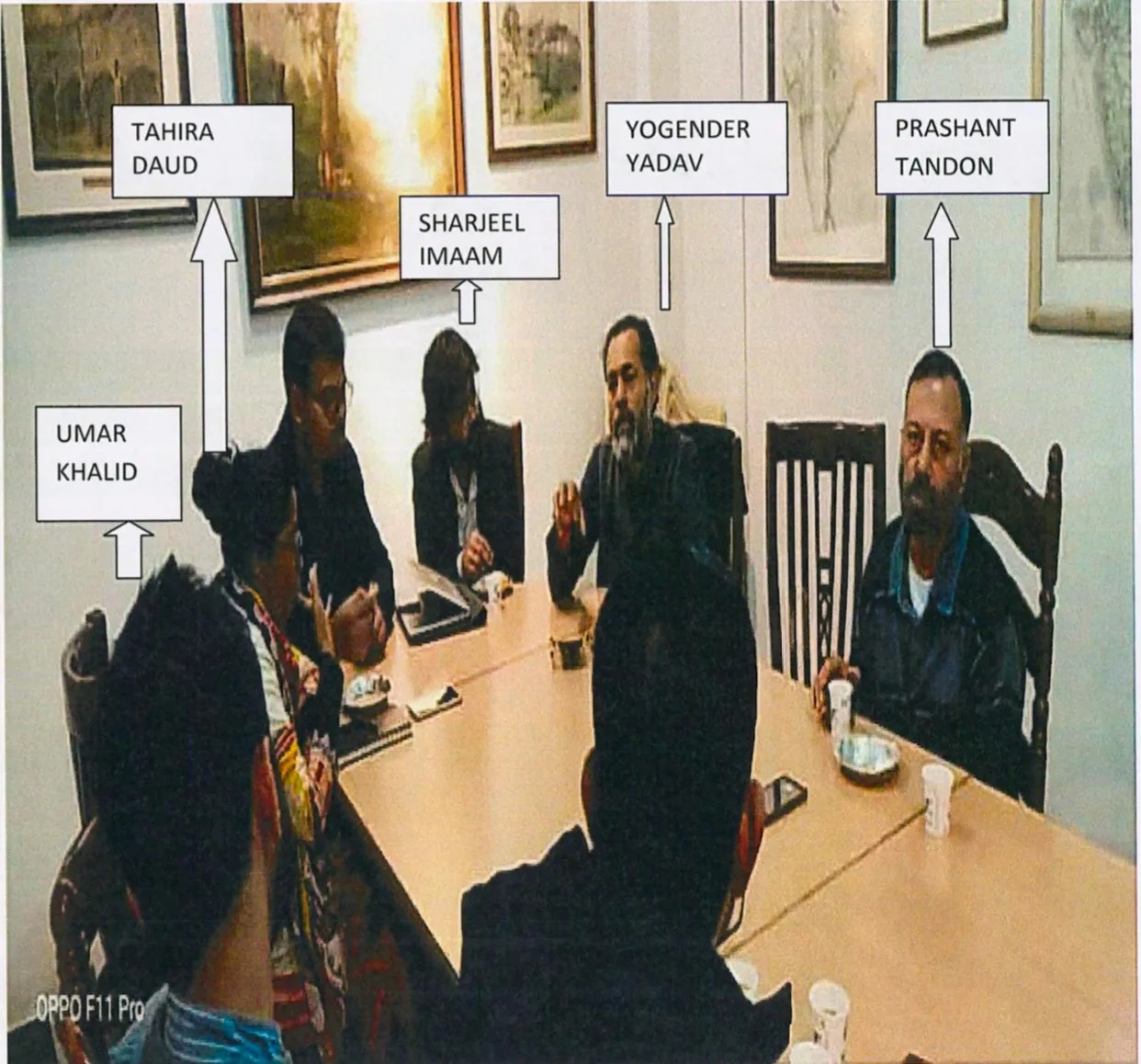
On the 8th of December 2019, a meeting was called at 6/6 Jungpura to plan for Chakka Jam against CAA. This is considered the first official conspiracy meeting to plan the violence. It was at this meeting that another group was planned, called the CAB Team. The core members of the team were Yogender Yadav, Umar Khalid, Sharjeel Imam, Nadeem Khan, and Parvez Alam. They were all present at the meeting, which was held at 6/6 Jungpura – the premises of Prashant Bhushan.
After this meeting, on the 10th of December, the Citizenship Amendment Bill (CAB) was passed in the Parliament, and the conspiracy simply started gathering steam. On the 10th, the CAB Team protested at Jantar Mantar, and it was Nadeem Khan who had asked Sharjeel Imam to visit the Aligarh Muslim University (AMU). After the meeting at Jantar Mantar, a meeting was called at Teflas Dhaba, JN, U to decide further course of action as per conspiratorial directions given at Jantar Mantar.
On the 11th, as per the instructions of Nadeem Khan, Sharjeel Imam visited AMU to mobilise Muslim students for violence.
On the 13th of December, violence broke out after the mobilisation by Sharjeel Imam, Umar Khalid and several others accused in the conspiracy. While the violence was raging, on the 15th, Nadeem Khan and Umar Khalid visited Jamia. As soon as Umar Khalid and Nadeem Khan visited Jamia, violence broke out at JamiGate 4, 7,,7 and 8, in which 35 police personnel and 95 Public persons were injured, and 02 police booths were burnt)
Shaheen Bagh bloomed thereafter. The violence raged on throughout December. On the 24th of December, a protest was held at Jantar Mantar yet again, which was attended by many organisations, Umar Khalid, Yogendra Yadav, and Nadeem Khan. The organisations also included UAH.
It was during this protest at Jantar Mantar that Nadeem Khan, Yogendra Yadav and Rahul Roy decided that a group should be created where all organisations could be united for better mobilisation. This was meant to start several other protest sites like that of Shaheen Bagh – for mobilisation of Muslims, Chakka Jam and violence. Merely 48 hours later, a meeting was held at ISI Lodhi Road attended by Harsh Mandar, Yogender Yadav, Umar Khalid, Nadeem Khan, Khalid Saifi, Sahil, Rahul Roy, Saba Dewan, Amrita Johri and others. All the conspirators present, including Nadeem Khan, decided to form the DPSG group – a group where the violence during the Delhi Riots was orchestrated. In this meeting, which included Nadeem Khan, it was also decided that multiple protest sites would be organised in Muslim-dominated areas and that women would be used as shields during the protest and the violence.
By January, several protest sites had come up, and the conspiracy was well underway. So far, Nadeem Khan was involved in every stage of the conspiracy. On the 13th of January, Nadeem Khan had sent Asif Iqbal Tanha and Saiful Islam to meet Sharjeel Imam in Jamia. During this meeting, Sharjeel Imam shared a contact list of lawyers who could ensure that the protest sites were not evacuated by the police.
Nadeem Khan was essentially a close aide of Umar Khalid and a mentor of Sharjeel Imam. It was Nadeem Khan who raised and sustained the protest site at Khureji, as evidenced by the WhatsApp chat between Sharjeel Imam and Nadeem Khan, included in the Chargesheet filed in the conspiracy case.
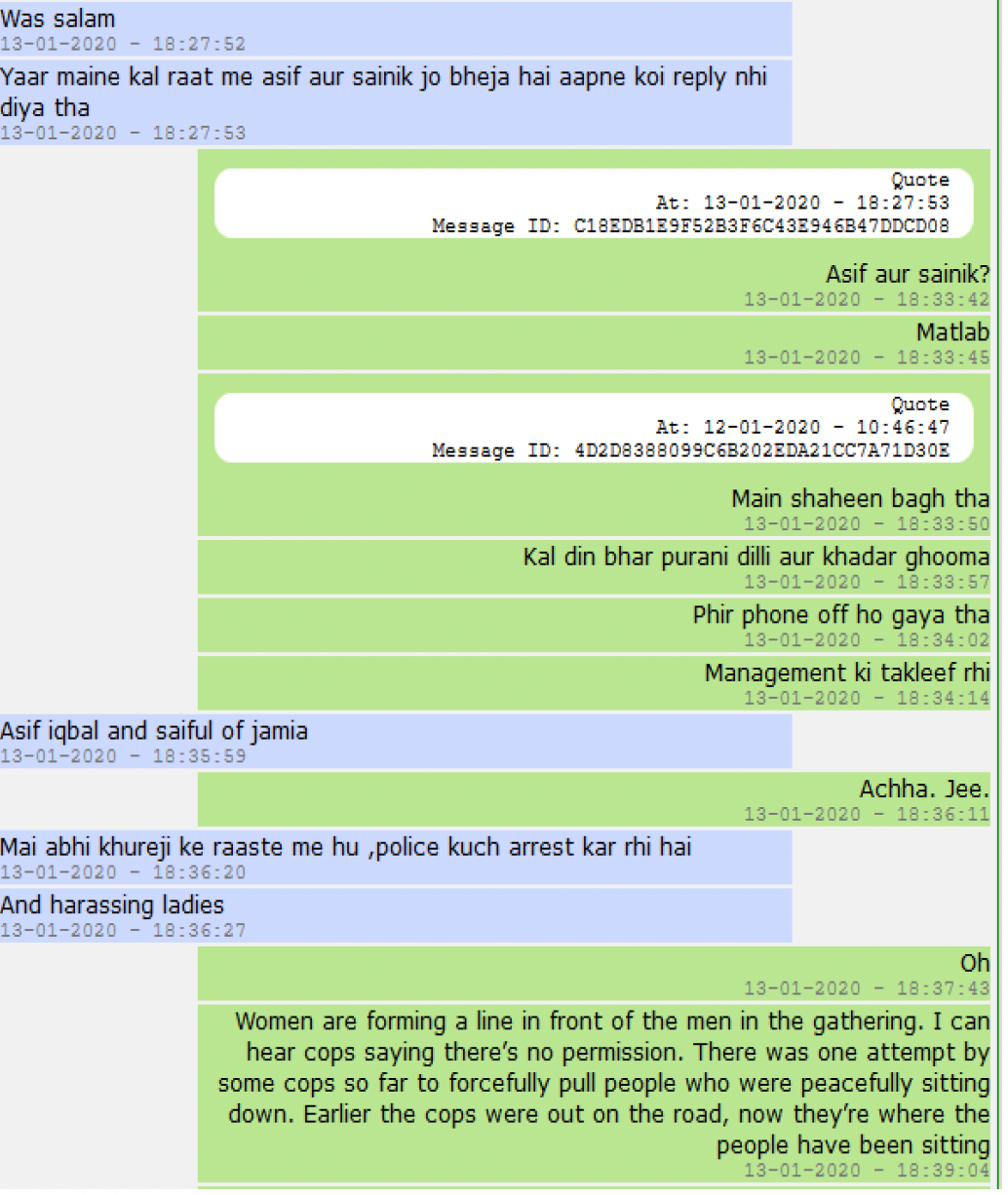
Days before the violence, on the night of 22nd February 2020, DPSG members also organised a conspiratorial meeting of JCC members at Jamia University wherein conspirators exhorted Jamia students to reach Jafrabad Chakka-Jaam site and other protest sites of North-East to escalate protest sites to move and occupy nearby highways for disruptive Chakka-Jaam for engineering violent riots. In this meeting, Asif Iqbal Tanha informed that he had received directions from the DPSG members Umar Khalid and Nadeem Khan that all must reach the North-East protest sites and create Chakka-Jaam and orchestrate riots. He also informed Jamia students’ members that they all should flee from the rioting sites before firing and bombing in North East Delhi.
One of the protected witnesses, Bond, explained the role of Nadeem Khan in the conspiracy to orchestrate Chakka Jam and the subsequent violence. Bond, in his statement,t said:
“On 22.02.2020, Chakka-Jamam was done at Jafrabad. On the same day at about 10 PM, JCC called an urgent meeting at the CC office, which was attended by Safoora, Saiful Islam, Asif Tanha, AAZMI office bearers,s among others. I was also present in the meeting. In that meeting, Safoora said that in North-East, Chakka-Jaam has to be started at other sites like Hauzrani. Asif said that he has received instructions from Umar Khalid and Nadeem Khan that they have to go to protest sites and start riots by Chakka-Jaam. Only then will the government take back the bill; Saiful also said he has received the same instructions from Umar and Nadeem Khan and also said that when shots are fired, and a bomb is set off during riots,s then leave well within time. After this, 20/25 members of the JCC left for protest sites.
Right after this, on the 23rd of February, the Delhi anti-Hindu riots were sparked, leading to several Hindus being brutally murdered. The ruthlessness of Nadeem Khan is clear from the fact that after the first day of violence, there is evidence to suggest that it was Nadeem Khan who had expressed his displeasure at the scale of the violence and wanted more carnage.
On the night of 23rd February, the first day of violence, another midnight conspiracy meeting was held by some of the other conspirators. In that meeting, Athar Khan, another accused, said that Nadeem Khan was unhappy with the scale of the violence and wanted more carnage.
Athar (DPSG member) informed that Nadeem Khan was annoyed as he was not getting the desired scale of violence in riots due to CCTVs. Nadeem Khan had instructed CCTVs cameras should be covered and destroyed. Athar then informed that he had tasked Salim Khan and Salim Munna to break the CCTV Cameras. DPSG member Shadab also informed that he would also get it done through his team.
Protected witness Radium corroborated these details in his statement.
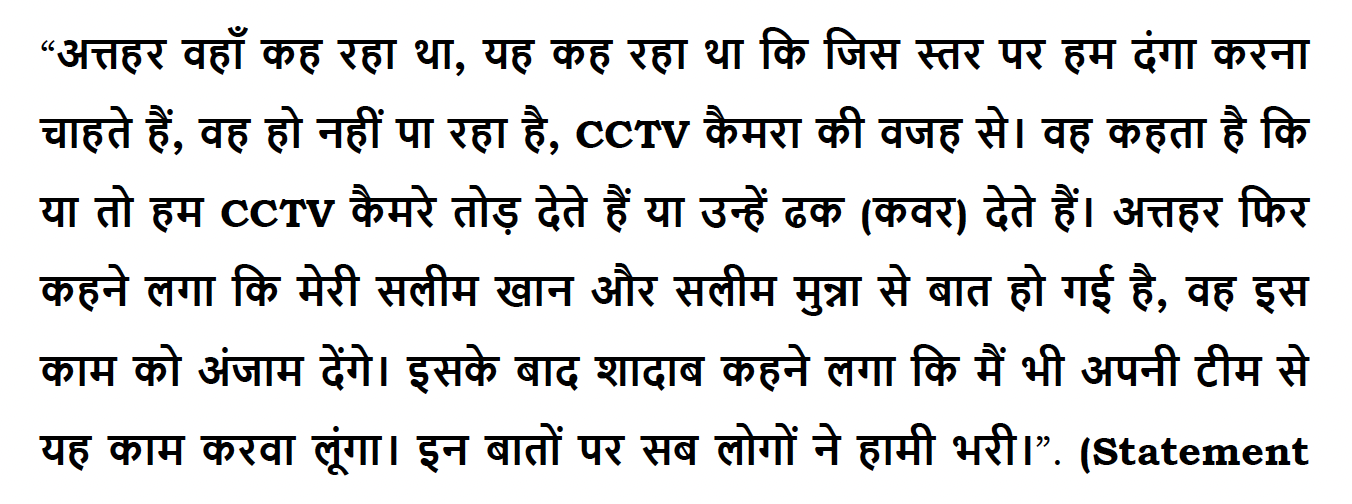
It is, therefore, evident that Nadeem Khan was at the core of the conspiracy, along with Sharjeel Imam and Umar Khalid, behind the Delhi anti-Hindu riots. As evidenced by the statement of protected witnesses, Nadeem was perhaps one of the most ruthless conspirators since he was on record stating that the violence of 23rd February was not brutal enough. His displeasure was also noted by a protected witness, who said that he had then proceeded to break/cover CCTV cameras so the desired scale of violence could be achieved.
Court upset about Nadeem Khan’s detention ahead of violent CJP protest: Naivete or ignorance.
The Delhi anti-Hindu Riots were one of the most carefully planned episodes of violence in modern India. The conspiracy started right from the 5th of December 2019, culminating in rampant violence starting from the 23rd of February 2020. In the ensuing 4-day period of violence, several lives were claimed. For example, Tahir Hussain, a former AAP councillor, was convicted for the murder of Ankit Sharma, an IB official. He was brutally murdered and stabbed tens of times because Tahir Hussain, an integral part of the conspiracy, wanted to teach “kafirs a lesson”.
Sharjeel Ima,m who was involved in the conspiracy in multiple ways, also delivered several communal speeches. In one, he instigated Muslims by saying that if they wanted, they could cut off the Chicken’s Neck permanently. Umar Khalid, besides instigating speeches at Amravati and other locations, carefully orchestrated the protest sites and violence.
The court was enraged. “Where is your cause to confine him?, the bench asked.
This question is riddled either with ignorance or shameful naivete.
Nadeem Khan, as evidenced above, was a core member of the team of people conspiring to burn Delhi. Is the court of the measured opinion that someone with a history of instigating violent protests would attend the already violent CJP protest in good faith?
The police’s job is not only to restore law and order, but also to ensure that law and order is not breached in the first place. The police’s job is as much to stop the riot before the first stone is cast, as it is to arrest those who have cast the stone.
Way back in 1829, Sir Robert Peel, who founded London’s Metropolitan Police, made a simple point. Police efficiency is measured by the absence of crime and disorder, not by how much visible action you take against it. Our own Kautilya said much the same thing centuries earlier, putting spies and vigilance at the heart of statecraft.
So what does real preventive policing look like? It’s not glamorous.
It is the beat constable who knows every lane in his area and notices when outsiders start turning up. It is the intelligence unit that tracks WhatsApp forwards and social media handles spreading fake videos to whip up a crowd. It is securing a procession route in advance, deploying forces at known flashpoints, checking rooftops before the yatra passes, not after and ensuring that when intelligence of violence exists, bad characters who can pour fuel on the raging fire are stopped from joining the circus.
Good policing is also about acting on the small stuff. When hate speech goes unpunished and minor clashes are brushed aside to “avoid escalation,” the troublemakers get the message loud and clear: the state is scared of them.
That impunity is what eventually explodes into a riot.
By questioning the police,e which is actively trying to prevent violence by detaining elements like Nadeem Khan, the court is serving impunity on a silver platter to elements who would ensure that every protest escalates into a riot.
The court must realise that police officers on the ground often know exactly who the troublemakers are. What they don’t always have is the freedom to act. When the instigator has a vote bank behind him, the officer who arrests him may find himself transferred overnight. Meanwhile, the selective outrage brigade is ready to brand any firm action as “targeting” a community.
In this case, it is not the politics that has become a foundation for police dysfunction, but, I daresay, the Judiciary.
The police in this case have the political go-ahead to deal with bad characters and rioters as they deem fit. What they are truly scared of is activists and lawyers for rent approaching the courts and the courts, in their ignorance and/or naivete, questioning the policing methods because they need to keep up the appearances of being the epitome of ‘fairness’. More than politicians today, it is the Judiciary which is fearful of being branded “biased” not only for following the law, but also plain logic.
In the case of Nadeem Khan, pure logic should have driven the Judiciary – he has done it before,efore so he may do it again. It is the police’s job to ensure that those with a violent and problematic history are monitored and kept in check when there is a potential law and order situation. That it makes the judiciary uncomfortable is not and should not be the problem of the police officer, tasked with maintaining law and order.
If one is to be extremely kind, one could assume that the Bench was either ignorant about Nadeem Khan’s history or was naive to believe that this partileopardeapord has mastered the art of changing his spots. Neither of these scenarios inspires hope. What it does inspire is fear – fear that the Judiciary, in its ignorance or naivete, is playing with fire – a fire that might engulf us all.