The Indian Right has spent years accusing the Congress and the Left of being puppets of George Soros. If that is the charge, perhaps there is one person whose ideas the Left should be willing to hear: Karl Popper, the intellectual whose ideas profoundly influenced George Soros and gave the Open Society tradition its name.
“Unlimited tolerance must lead to the disappearance of tolerance.”
Popper’s argument was not that an open society should suppress unpopular opinions. It was that an open society cannot be expected to tolerate indefinitely those ideas and movements that seek to destroy the institutions that make an open society possible. Now, whether one agrees with the foundation of open societies and what those open societies would entail is a separate discussion altogether.
But that principle, in and of itself, offers a useful way to read Sharjeel Imam’s recent letter from Tihar. Imam, in his letter, raises a question: have Indian Muslims received adequate political and socio-economic representation? A serious answer must begin with evidence rather than assume the conclusion.
Another issue inseparable from the question of an open society is what exactly Imam is alleged to have advocated, and how the judicial system has dealt with those allegations.
In the larger Delhi riots conspiracy case, the judiciary has repeatedly considered Imam’s bail at different levels. The trial court and Delhi High Court considered his bail in 2025. The Supreme Court then considered his case in January 2026 along with other accused. The Supreme Court granted bail to five co-accused but declined bail to Imam and Umar Khalid, while providing a route for a renewed bail application after the examination of protected witnesses or after one year, whichever came earlier.
Imam subsequently returned to the trial court with a fresh bail application in 2026. The trial court rejected it, and the Delhi High Court again considered and rejected his appeal in September 2026. There are also separate proceedings arising from the Jamia case in which his bail has been litigated.
The High Court, in rejecting the bail petitions of Umar Khalid and Sharjeel Imam, were scathing in their observations. In the order, the HC observed that they are “held to be the ideological drivers of the alleged conspiracy, like the speeches given, meetings held, communications, deliberations, master minding the protests, chakka jam, etc” whereas other accused, like Gulfisha Fatima, were local-level facilitators. Their alleged role in the conspiracy is far more central and serious. These observations were drawn from the Supreme Court order denying bail to the two accused. Essentially, based on the Supreme Court order, the HC too held that Umar Khalid and Sharjeel Imam are alleged to be the core conspirators and masterminds, which is why they cannot be granted bail like the other accused persons.
The Supreme Court held that the prosecution material, taken at face value at the bail stage, disclosed reasonable grounds for believing that the accusations against Sharjeel Imam were prima facie true.
SC observed, “The material suggests involvement at the level of planning, mobilisation, and strategic direction, extending beyond episodic or localised acts. The statutory threshold under Section 43D (5) of the Unlawful Activities (Prevention) Act, 1967, therefore stands attracted qua these appellants”.
None of this proves guilt, of course. Bail decisions, even when accompanied by an observation that the charges are prima facie true, are not convictions, and the allegations must ultimately be tested at trial. But the opposite claim also cannot be made honestly: that the Indian state simply imprisoned a dissident without allowing his case to be examined by independent courts.
Indeed, the allegations being examined are considerably more serious than a disagreement with government policy. In the prosecution’s account of Imam’s January 2020 speech, he advocated mobilising a large mob to block the route to Assam, referred to cutting the Northeast off through the Siliguri corridor or “Chicken Neck”, and advocated disruptive chakka jams. The Supreme Court’s January 2026 order records these allegations.
Again, the distinction matters. The allegation is not that Imam merely criticised the Citizenship Amendment Act or supported Muslim political mobilisation. Those are forms of political dissent. The prosecution’s case concerns not just coordination of disruptive action aimed at a strategically vital corridor and the role of such mobilisation in the broader conspiracy surrounding the Delhi riots, but also his active involvement in planning the violence which ensued.
The prosecution case against Sharjeel Imam is considerably more complex and does not hinge only on the speeches he delivered. The charge-sheet alleges that he was involved in organising and mobilising protests from early December 2019. For instance, chats between Imam and Arshad Warsi recorded in the investigation indicate that Imam was planning “something big” and intended to mobilise students from AMU and Delhi University. The prosecution subsequently linked these activities to the protests and violence that took place at Jamia from December 13 onwards.
These facts do not automatically establish the case of the prosecution; however, it does make it impossible to discuss his incarceration honestly as though the only issue were the expression of an unpopular political opinion.
An open society must protect dissent. But an open society also has the right to investigate conduct that the state alleges threatens public order or national security, subject to judicial scrutiny and due process. That is precisely why Popper’s argument about the limits of tolerance is relevant.
The evidence on the socio-economic question is also more complicated than Imam’s narrative suggests.
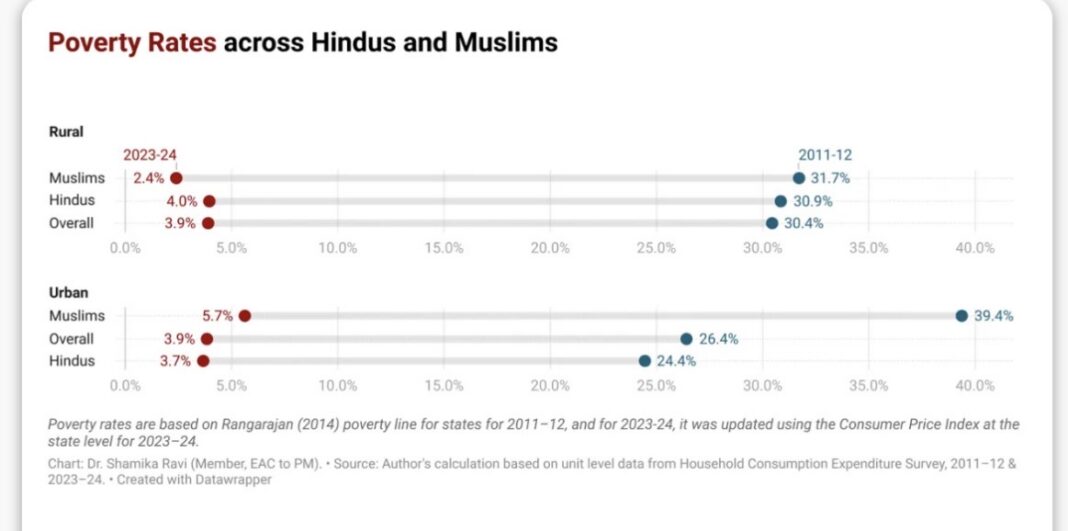
Poverty rates across Hindus and Muslims, 2011-12 and 2023-24. Source and calculations as shown in the supplied chart.
The Household Consumption Expenditure Survey data presented by Shamika Ravi show a dramatic reduction in poverty between 2011-12 and 2023-24. Rural Muslim poverty fell from 31.7% to 2.4%. Rural Hindu poverty fell from 30.9% to 4.0%. Urban Muslim poverty fell from 39.4% to 5.7%, while urban Hindu poverty fell from 24.4% to 3.7%.
The point is not that Muslims have no socio-economic disadvantage. Urban Muslim poverty remains higher than urban Hindu poverty. The point is that the data do not support a simple narrative of an Indian Muslim population experiencing uninterrupted or uniformly worsening socio-economic exclusion. In rural India, the Muslim poverty rate is actually lower than the Hindu rate.
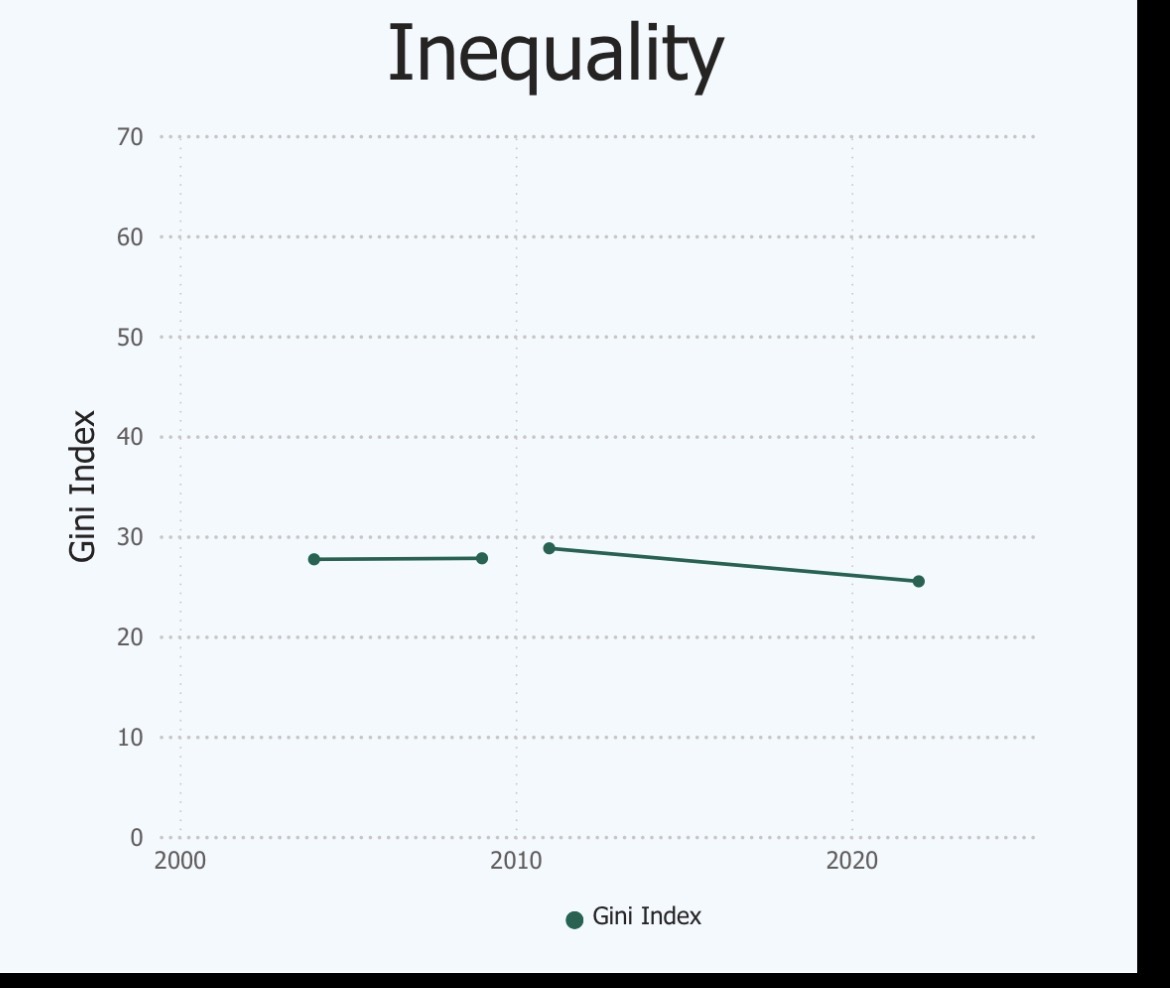
India’s consumption-based Gini index, as shown in the supplied chart.
The inequality data by the World Bank provides another reason for caution against the narrative that things are getting worse for marginal sections. The consumption inequality as measured bythe Gini measure shown here falls from approximately 28.8 to 25.5 over the period represented. This does not mean India has no inequality. It means that any sweeping claim about a continuously deteriorating socio-economic order has to engage with evidence that points in the opposite direction.
This is where Popper becomes relevant. An open society is not merely a society in which one is free to make accusations of injustice. It is a society in which those accusations themselves remain open to evidence and criticism.
The same problem becomes even more serious when Imam moves from socio-economic disadvantage to political representation. He argues for proportional representation and stronger institutional safeguards for Muslims. But there is a crucial distinction between protecting Muslims as citizens and representing Muslims as a permanent political community.
India’s constitutional settlement deliberately chose the former. British India had already experimented with separate electorates and communal political representation. Rather than eliminating communal politics, the system helped institutionalise religious identity as a basis for political mobilisation.
After Partition, the Constituent Assembly made a conscious choice to move away from that model. It rejected separate electorates and adopted a common electoral system. That was not a declaration that minorities did not matter. It was an attempt to protect minority rights without permanently converting minorities into separate political constituencies.
There is nothing inherently undemocratic about proportional representation. India itself uses proportional representation for elections such as those to the Rajya Sabha. But proportional representation of citizens is very different from proportional representation of religious communities. The first seeks to translate votes more proportionately into seats. The second risks making religion a permanent organising principle of political power.
Imam’s argument about Partition therefore deserves scrutiny. He presents the history largely as a story of Muslim demands for decentralisation, autonomy and political representation being denied. But Partition was not the consequence of one constitutional disagreement. It involved competing nationalisms, the Muslim League’s demand for Pakistan, Congress’s competing vision of the Union, British policy, the failure of the Cabinet Mission settlement and escalating communal mobilisation.
To reduce that extraordinarily complicated history to a simple story of Muslim demands being denied is not historical inevitability. It is historical selection.
Imam also describes India’s Constitution as providing inadequate safeguards for minorities. But the Constitution expressly protects freedom of religion and religious affairs and provides cultural and educational protections for religious and linguistic minorities. Those protections can be criticised, and their implementation can be criticised. But saying that the constitutional order simply failed to provide minority safeguards is much harder to sustain.
The test of an open society is not whether it protects every political demand made in the name of a community. It is whether it protects the individual’s ability to live, argue, dissent and participate as an equal citizen.
Muslims deserve equal rights. Muslims deserve protection against discrimination. Muslims deserve genuine political opportunity. But it does not follow that Muslims must therefore become a permanently constituted political bloc entitled to a predetermined share of political power.
Perhaps, then, there is a lesson here for both sides of India’s political argument. Those who invoke George Soros against the Left should perhaps read Karl Popper more carefully. And those who invoke minority rights to argue for communal political representation should do the same.
Because Popper’s warning cuts both ways: an open society must tolerate disagreement. But it must also defend the institutional conditions that allow citizens to disagree as citizens, rather than forcing them back into permanent political communities defined by religion.
That is the question Sharjeel Imam’s argument does not adequately answer.
References:
• Karl Popper, The Open Society and Its Enemies
The Open Society and Its Enemies – Karl Popper
• Supreme Court of India, Gulfisha Fatima v. State (Govt. of NCT of Delhi), 5 January 2026
Supreme Court judgment – Gulfisha Fatima v. State
• Delhi High Court, Sharjeel Imam v. State of NCT of Delhi, 30 September 2026
Delhi High Court judgment – Sharjeel Imam v. State
• Shamika Ravi, “India is winning the fight against poverty”
Shamika Ravi – India is winning the fight against poverty
• World Bank, India: Poverty and Equity Assessment
World Bank – India Poverty and Equity Assessment
• World Bank, World Development Indicators – Distribution of Income or Consumption
World Bank – World Development Indicators
• Constituent Assembly of India, Advisory Committee Report on Political Safeguards for Minorities, 11 May 1949
Constituent Assembly – Advisory Committee Report on Political Safeguards for Minorities