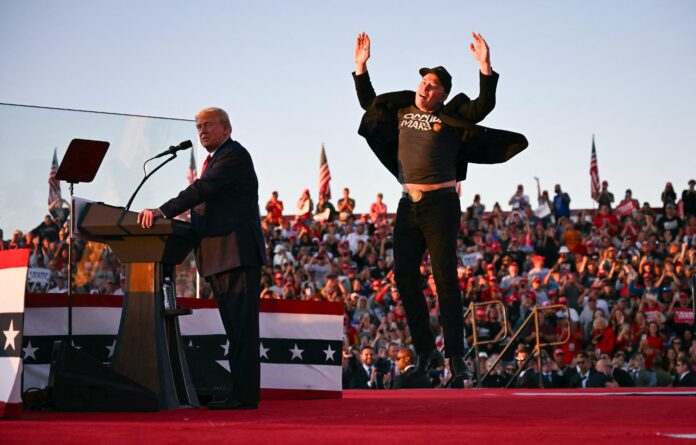
Elon Musk has once again demonstrated how quickly his enormous social media platform can become an amplifier for political messaging. The billionaire owner of X has thrown his weight behind US President Donald Trump’s latest attack on Ukrainian President Volodymyr Zelenskyy, declaring that the Ukrainian leader has “gone too far” after Trump demanded that Ukraine elect a new president.
The timing of Musk’s intervention is particularly noteworthy. Only days ago, the billionaire was attacking the Indian government and the Ambani family over regulatory hurdles facing his satellite internet company, Starlink. Now, as Washington escalates its confrontation with Kyiv, Musk has chosen to echo the American President’s position.
The contrast raises an important question about the principles underpinning Musk’s public interventions. Is the billionaire consistently standing up for what he believes is right, or does his willingness to challenge political authority depend on whose government is involved and whether its decisions affect his interests?
Musk backs Trump’s demand for a new Ukrainian president
On October 11, Musk responded to a post by the White House rapid-response account Rapid Response 47, which had shared a video of Trump criticising Zelenskyy and arguing that Ukraine needed a new president.
“Zelenskyy has gone too far,” Musk wrote.
@RapidResponse47 @POTUS Zelensky has gone too far
— Elon Musk (@elonmusk) October 10, 2026
The remark came amid a sharp deterioration in relations between Washington and Kyiv. Trump had accused Zelenskyy of repeatedly failing to reach an agreement with Moscow and argued that Ukraine should elect a leader capable of negotiating an end to the war.
The immediate backdrop was a dispute over Ukrainian attacks on Russian oil refineries and a controversial arrangement announced by Trump to facilitate Russian diesel supplies to international markets.
Zelenskyy criticised the arrangement, arguing that easing restrictions on Russian energy exports could provide Moscow with additional resources to sustain its military campaign. Trump, meanwhile, blamed Ukrainian attacks on Russian energy infrastructure for aggravating fuel shortages and putting pressure on American consumers.
Musk’s intervention effectively placed him alongside Trump in this confrontation. It was not an isolated instance of the billionaire criticising Zelenskyy. In 2025, Musk had also called for elections in Ukraine and made allegations about Zelenskyy’s popularity and corruption that were not substantiated by evidence in the statements cited in contemporary reporting.
There is, of course, nothing inherently wrong with Musk expressing an opinion on the war or criticising a foreign leader. The question is whether his interventions reflect a consistent set of principles or a selective approach to political power.
When India exercises regulatory scrutiny, Musk takes a different tone
The contrast becomes more interesting when viewed alongside Musk’s recent confrontation with India over Starlink.
The satellite internet company has faced regulatory scrutiny as it seeks to establish and expand its services in India. Such scrutiny is hardly extraordinary. Telecommunications infrastructure involves questions of licensing, spectrum allocation, security requirements and lawful access to communications. Governments have legitimate responsibilities in each of these areas, particularly when the infrastructure is operated by a foreign company.
India’s regulatory requirements cannot simply be dismissed because they inconvenience a prominent entrepreneur. Nor should the commercial ambitions of a multinational company automatically take precedence over national security considerations.
Yet Musk’s public attacks on the Indian government and the Ambani family have helped frame the dispute as a broader battle against entrenched business interests and alleged crony capitalism.
That narrative deserves scrutiny in its own right. The existence of regulatory delays does not, by itself, establish that a government is acting to protect a particular business group. Such allegations require evidence, not merely the assertion of a billionaire whose company has a commercial interest in the outcome.
There is also a wider competitive context. India is developing its domestic space capabilities, while its telecommunications and satellite connectivity markets are commercially significant. Starlink’s expansion would inevitably intersect with existing operators and India’s strategic ambitions.
These factors do not prove that Musk’s attacks are motivated by commercial self-interest. They do, however, make it reasonable to examine his public statements alongside the business interests at stake.
The contradiction in Musk’s public posture
Musk has cultivated an image as a disruptive entrepreneur who challenges established institutions, questions conventional wisdom and resists political pressure. Since acquiring Twitter and rebranding it as X, he has repeatedly presented the platform as an important arena for free expression.
But the freedom to criticise governments is not the same thing as a commitment to challenge every government equally. Nor does opposing one administration automatically make someone a consistent champion of individual liberty. Musk’s public interventions have curiously been aligned with the US government’s stance.
Afraid that China would block the supply of rare earth minerals, the US has refrained from calling out Beijing over the purchase of Russian oil or other protectionist measures. Similarly, Musk has maintained a deafening silence on China’s ban on Starlink, possibly following the US government’s cue and for his own business interests — for Teslas are mainly manufactured in China.
In India’s case, Musk has been willing to publicly confront the government when Starlink’s commercial ambitions encounter regulatory obstacles. In Ukraine’s case, he has amplified Trump’s demand for a change in political leadership.
The two situations are not identical. India is considering the regulatory conditions under which a foreign company can operate, while Ukraine is fighting a war against Russia and facing pressure over the terms of a possible settlement. Treating the disputes as interchangeable would obscure important differences.
Nevertheless, both episodes illustrate Musk’s willingness to intervene in political debates that extend well beyond the immediate operation of his businesses.
The central issue is not whether Musk is entitled to hold these opinions. He plainly is. It is whether his self-presentation as an independent-minded defender of free expression withstands scrutiny when his interventions align with the priorities of political leaders who hold power over matters important to him.
Ukraine’s future cannot be reduced to a dispute between Trump and Zelenskyy
There is another fundamental consideration in the Ukrainian controversy: the right of Ukrainians to determine their own political leadership.
Trump can argue that Zelenskyy has failed to secure a peace agreement. Musk can agree with him. But neither man’s opinion substitutes for the political will of the Ukrainian people.
Ukraine’s wartime circumstances also complicate the question of elections. The country’s martial-law framework restricts the holding of national elections during the current period, making any discussion of a new president inseparable from the legal and security conditions under which voting could take place.
Moreover, the debate over negotiations cannot be separated from the conduct of Russia’s war. Any assessment of Zelenskyy’s approach must consider not only Kyiv’s decisions but also Moscow’s actions and the terms on which a durable settlement might be achieved.
A demand for new leadership is not, by itself, evidence that a change in leadership would produce peace.
The same standard of scrutiny should apply to Musk’s intervention. His enormous reach on X can turn a short remark into a global political talking point, but the scale of that reach does not make the argument more persuasive.
A billionaire’s principles deserve the same scrutiny as his business interests
Musk is entitled to criticise Zelenskyy, just as he is entitled to challenge India’s regulatory decisions. The point is not to deny him that freedom. It is to apply the same scrutiny to his conduct that he frequently demands of governments and other powerful institutions.
When India imposes regulatory requirements on Starlink, Musk’s supporters may frame the dispute as a struggle against political interference. When Trump demands that Ukraine replace its president, Musk’s supporters may interpret his endorsement as support for peace negotiations.
But the underlying question remains: what consistent principle connects these interventions?
If the answer is the defence of free speech, that principle should accommodate disagreement with both Indian and American authorities. If the answer is national sovereignty, it should recognise India’s right to regulate foreign telecommunications companies and Ukraine’s right to determine its political future.
Musk’s freedom to speak is not in question. The consistency of the principles he invokes is. When a billionaire who presents himself as an independent force in global affairs repeatedly enters political disputes, it is entirely reasonable to ask whether his positions are driven by a coherent philosophy or by the shifting alignment of political and commercial interests.
That question is particularly relevant when his latest intervention mirrors the position of the American President at a moment of heightened tension between Washington and Kyiv.