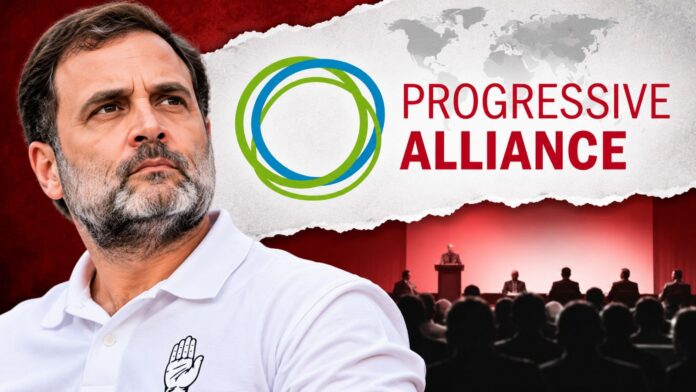
From November 12 to 14, Hyderabad will host what the Congress has grandly named the Bharat Summit. More than 1,000 delegates from 70 countries will arrive to talk about a “new global order”, “electoral integrity”, “cooperative federalism” and, of course, the fight against the “politics of hatred, division and authoritarianism”.
If that vocabulary sounds familiar, it should. It is the same script India has heard for over a decade from foreign-funded activists, Western op-ed pages and one particular Hungarian-American billionaire who has openly vowed to see the Modi government fall.
The Congress wants you to see this as a harmless gathering of thinkers. Salman Khurshid says the discussions will reflect “Rahul Gandhi’s vision for India and the world”. There will be 12 international sessions, eight sessions on Telangana, and the launch of a new international think tank called ‘Our World’.
Strip away the brochure language, though, and the picture is far less innocent. The Bharat Summit is tied to the Progressive Alliance, a global network of Left and socialist parties whose stated mission is to organise against “right-wing populism” and “nationalism”. Rahul Gandhi is not a guest at its table. He sits in its top leadership.
What exactly is the Progressive Alliance?
The Progressive Alliance (PA) was founded in Leipzig, Germany, in 2013 as a breakaway from the Socialist International. Its members include the UK’s Labour Party, Germany’s Social Democrats, Brazil’s Workers’ Party and Australia’s Labour Party. From India, the Congress and the Samajwadi Party are on its list. By its own published figures, it brings together 119 parties from 97 countries.
This is not a debating society. The PA’s stated objectives include sharing political strategies, running campaign workshops, strengthening party machinery, coordinating international campaigns and building common responses to political developments around the world.
Its guiding principles leave no room for doubt about whom it sees as the enemy. Members are expected to take political action against “dangerous authoritarianism” and “right-wing populism”. In plain terms, it is an international coalition built to fight nationalist governments, and India today has one of the most popular nationalist governments in the world.
So when an Indian Opposition party embeds itself in such a network, the question is obvious. Is the Congress using a global platform to sharpen its fight against its domestic rival, the BJP, by recasting an elected government as a global “threat” that foreign parties must unite against?
Rahul Gandhi is in the driver’s seat
The Congress’ link with the PA is not a line in a membership register. Rahul Gandhi is one of the nine members of its Praesidium, the executive body that runs the organisation between Board meetings. The Praesidium discusses global developments, proposes policy and takes decisions on urgent political issues and resolutions. Gandhi represents Asia.
Two other Congress figures, Sam Pitroda and Jothimani Sennimalai, have been associated with its Board.
How much does Rahul Gandhi value this role? Enough to skip Parliament for it. In December 2025, when he was absent from the Winter Session, Sam Pitroda told India Today that Gandhi had gone to Berlin for a Progressive Alliance meeting because the Congress was a member and Gandhi sat on the Praesidium. That meeting was held on December 19, 2025, the final day of the session.
Think about that. The Leader of the Opposition, elected to hold the government to account inside India’s Parliament, chose a meeting of foreign Left parties in Berlin over the closing day of the House.
It was not a one-off either. In October 2024, Gandhi attended a PA gathering in Santiago, Chile, where leaders discussed “democratic backsliding” and “global uncertainties”. Anyone who has followed Rahul Gandhi’s foreign tours knows exactly which country he tends to cast as Exhibit A of “democratic backsliding”.
The Soros worldview, word for word
To understand why the PA deserves hard scrutiny, look at the ideology of George Soros and his Open Society Foundations (OSF).
Soros has spent decades and billions building a global web of foundations and civil society groups that promote his idea of an “open society”, borrowed from Karl Popper’s The Open Society and Its Enemies. In practice, the “enemies” have turned out to be elected nationalist leaders who refuse to bend to the Western liberal consensus.
He has not been shy about India. At Davos in January 2020, Soros attacked PM Modi by name, accused him of building a “Hindu nationalist state”, and announced $1 billion for a global university network to counter nationalism. In February 2023, he went further, tying the Adani-Hindenburg row to Modi’s political future and predicting a “democratic revival” in India. In other words, a foreign billionaire publicly hoped for regime change in the world’s largest democracy.
Now place the Progressive Alliance’s mission statement next to Soros’ speeches. Fight “right-wing populism”. Resist “authoritarianism”. Defend “civil society”. Push liberal internationalism. Paint nationalism as a source of “hatred” and “division”. The vocabulary is nearly identical. The target list is nearly identical. Trump, Orbán, Modi.
Whether or not a single dollar moves between OSF and the PA, the alignment of purpose is impossible to ignore. And the Congress has chosen to place itself right at the centre of it.
The Congress and the Soros shadow
This is not the first time the Congress has had to answer questions about Soros.
In December 2024, the BJP alleged in Parliament and on its official handles that Sonia Gandhi was associated with the Forum of Democratic Leaders in Asia Pacific (FDL-AP) as a co-president, and that the organisation had received funding from Soros-linked foundations. The BJP also pointed to the forum’s positions on Kashmir. The Congress dismissed the charges, but never offered the kind of detailed explanation that would have put them to rest.
Then there is OSF’s footprint inside India. It began working here in 1999 and launched an India-specific grant programme in 2014, funding work on access to medicine, justice reform, human rights and civil society. Its activities drew regulatory action, and the foundation itself admits that government restrictions have limited its grants to Indian NGOs since 2016. Investigations have also examined OSF’s links with groups active on contentious policy issues, including the Human Rights Law Network and Namati.
Receiving foreign money does not automatically make an organisation anti-national. But when foreign-funded groups shape debates on national security, constitutional institutions and elections, Indians are entitled to know who is paying and why.
Soros works through grants and NGOs. The Progressive Alliance works through political parties and elected leaders. One shapes civil society, the other shapes politics. When both are chasing the same goal, the defeat of nationalist governments, and the Congress plugs itself into one of them, the overlap stops being a coincidence worth shrugging off. It becomes a question of national interest.
Hyderabad, again
The Bharat Summit is not the first time the Congress has handed Hyderabad over to the PA.
On April 25 and 26, 2025, the two jointly hosted ‘Delivering Global Justice’ at the Hyderabad International Convention Centre. The PA also held its Board meeting there. By the PA’s own account, the Board approved its strategy for 2025, including regional exchanges to counter “the rise of far-right politics”.
The conference ended with the Hyderabad Declaration, presented by Rahul Gandhi alongside leaders from Africa, the Arab world, Asia, Europe and the Americas. It accused “far-right leaders and autocratic governments” of undermining democracy, spreading lies and fuelling division.
The Board also held a “strategic dialogue” with Congress leaders on India’s international outlook and its place in the emerging world order.
Read that again. Foreign political parties sat down with India’s main Opposition party to discuss India’s foreign policy direction, on Indian soil, under a declaration that brands nationalist governments as liars and autocrats. This year’s summit is simply the next chapter.
‘Our World’: Making it permanent
The most worrying piece of this year’s event is ‘Our World’, the international think tank the Congress plans to announce. Salman Khurshid says it will bring together progressive thinkers and organisations from many countries.
Think tanks are where narratives are manufactured. They write the policy papers, supply the talking points, feed the media and give political campaigns their intellectual cover. A permanent, multinational think tank of Left parties and allied groups could easily become a factory for common positions on “electoral integrity”, “media freedom”, “minority rights” and “federalism”, the exact issues that the Opposition and its foreign cheerleaders use to attack the Indian state.
So the Congress must answer some simple questions. Who will fund ‘Our World’? Who will appoint its leadership? Which organisations will be its partners? Will any of them have received money from Open Society Foundations or similar foreign donors? Will its accounts be made public?
If the answers are clean, the Congress should have no difficulty sharing them.
Why this is dangerous for India
The summit’s headline promise is to discuss a “new global order” and India’s role in it. That should set alarm bells ringing.
India’s foreign policy rests on strategic autonomy. New Delhi deals with Washington and Moscow, the Gulf and Europe, the Global South and the West, without signing up to anyone’s ideological bloc. That independence has served India well.
The Progressive Alliance is the opposite of autonomy. It is an ideological bloc with a declared enemy. When India’s main Opposition party, led by a man in that bloc’s leadership, starts framing India’s democracy and foreign policy through its lens, it imports a foreign ideological agenda into Indian politics.
India’s nationalism is not authoritarianism. A government elected three times by hundreds of millions of voters does not lose its legitimacy because Labour in London or the SPD in Berlin dislikes its politics. Disputes about elections, media or institutions are for India’s courts, Parliament and voters to settle, not for declarations drafted in Hyderabad and applauded in Berlin.
India must ask whether the Congress is helping build an international machine designed to delegitimise the choices Indians make at the ballot box.
The Congress has every right to make friends abroad. But Indians have an equal right to know who is in the room, who is paying, what they want, and what role ‘Our World’ will play once the delegates fly home.
A civilisation of India’s size and stature cannot afford to look away.