

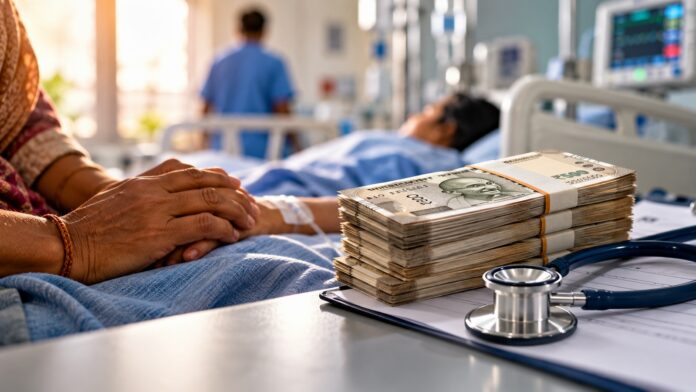
On 27 October 2026, a bench of the Supreme Court comprising Justice Vikram Nath and Justice Sandeep Mehta heard a compelling public interest petition that laid bare the stark realities of India’s healthcare ecosystem. The court was presented with the case of a drug distributor’s wife receiving cancer treatment at a major private hospital. A chemotherapy injection available on the open market for ₹11,000 was barred from being brought from outside, and the hospital billed it to the patient at a staggering ₹1.30 lakh.
Expressing deep dismay, the bench questioned the justification for such “open plunder” and asked where the money leaving patients’ pockets ultimately goes. During the proceedings, other startling disclosures emerged – such as a saline drip line costing retailers ₹15 being billed at ₹250 by hospitals. Observing that approximately 90 per cent of medicines remain outside price control frameworks, the court bluntly remarked that these are human lives, not commercial trades. While private hospital counsels argued that high margins compensate for public infrastructure gaps, the Supreme Court firmly rejected the notion that institutions can mark up essential life-saving medicines by 100 to 200 times.
Price controls on cancer drugs: progress and persistent gaps
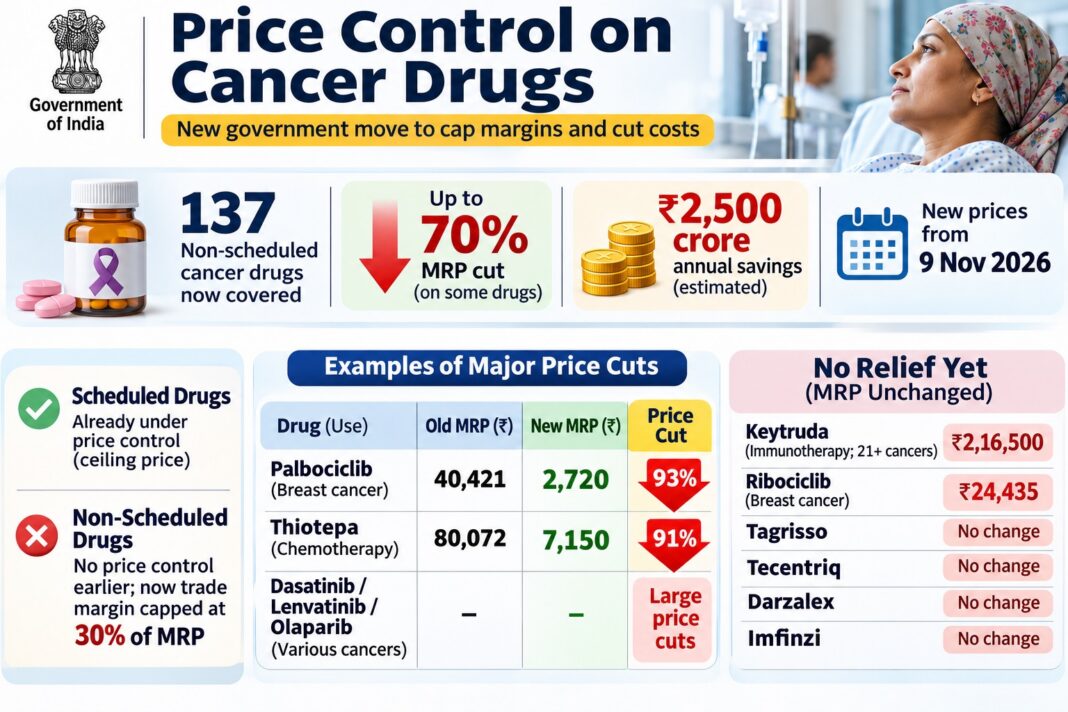
Shortly before these judicial observations, the Union Ministry of Chemicals and Fertilisers announced a significant policy intervention on 8 October 2026. Trade margins on all non-scheduled cancer drugs were capped at a maximum of 30% over the Price to Retailer (PTR) to determine the MRP, effective from 9 November 2026. According to the National Pharmaceutical Pricing Authority (NPPA), the MRPs of 543 cancer-related drug formulations and packs were revised, resulting in dramatic cost reductions for several treatments- such as Palbociclib and Thiotepa.
However, patient rights activists, including Malini Aisola of the All India Drug Action Network (AIDAN), note that several extremely high-cost immunotherapy and specialized drugs, such as Keytruda, priced at over ₹2.16 lakh, remain entirely outside this price control ambit. Analysts point out that exemptions granted to certain manufacturer assistance programmes and distributor margins still leave room for substantial markups, keeping financial toxicity a primary concern for cancer care.
Decoding healthcare expenses: Insights from the NSS 80th round
While high-profile cancer cases highlight extreme medical costs, everyday health burdens for the masses involve common ailments like fevers, infections, hypertension, and diabetes. The 80th round of the National Sample Survey (NSS) on Household Social Consumption: Health, conducted by MoSPI between January and December 2025 and released in April 2026, offers authentic insights into Out-of-Pocket Medical Expenditure (OOPME).
The survey data reveals a wide chasm between public and private healthcare facilities:
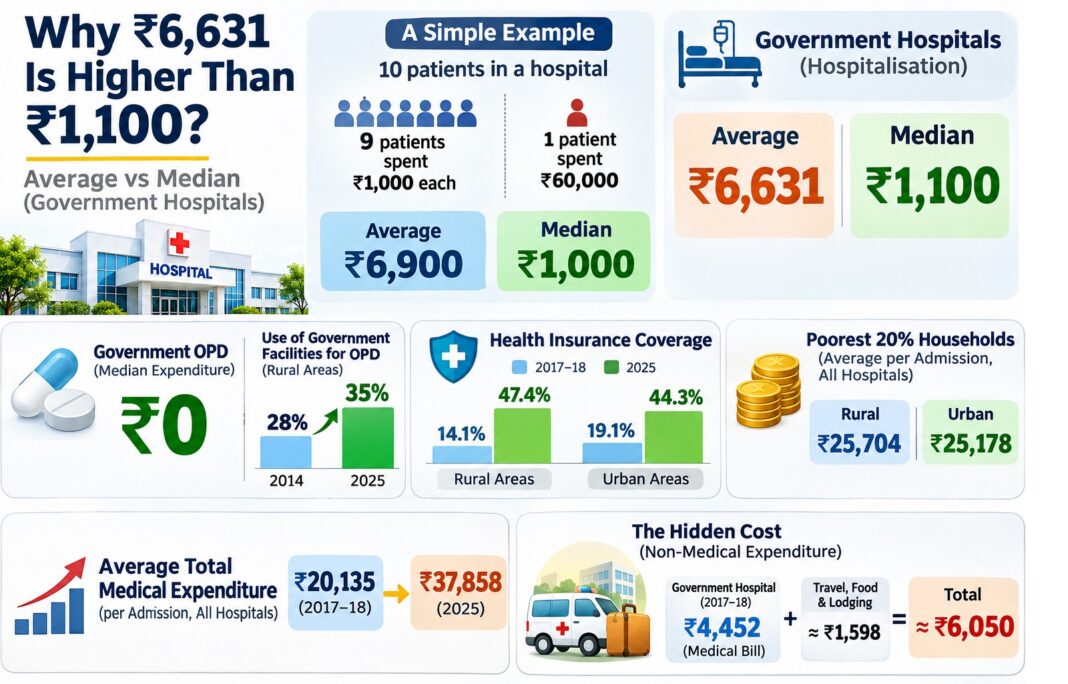
- Average Admission Costs: The average out-of-pocket expenditure per hospital admission in a private hospital is roughly seven and a half times higher than in a government facility₹50,508 vs ₹6,631. At the median level, the gap widens to 22 times ₹24,000 vs ₹1,100.
- Institutional Childbirth: Deliveries in government hospitals incur an average out-of-pocket cost of ₹2,299 (median ₹801), compared to an average of ₹37,630 (median ₹32,000) in private setups.
- OPD Services: Outpatient department (OPD) visits in government hospitals reflect a median expenditure of zero, indicating that more than half of public OPD treatments are entirely free.
Despite these low public OPD costs, the share of total hospital admissions handled by government facilities has dropped to 36.7 per cent, down from roughly 42 per cent in the 2017-18 survey. Analyses by health experts like Oommen C. Kurian of the Observer Research Foundation (ORF) show that roughly two out of every three hospitalized patients now turn to the private sector.
The three cracks in government hospitals: Medicines, machines and specialists
The preference for private facilities stems from fundamental supply chain bottlenecks within public institutions, often categorized into three major structural gaps:
- The medicine window shortage: Essential Drug Lists (EDLs) exist on paper, but Comptroller and Auditor General (CAG) audits across states like Uttar Pradesh, Karnataka, Bihar, and Rajasthan highlight frequent stockouts. Procurement delays force patients to secure essential prescriptions from external retail stores at full MRP.
- Idle diagnostic equipment: Advanced diagnostic machines (CT scanners, MRIs, and ultrasound units) frequently remain non-operational in district and rural hospitals due to a lack of trained technicians, radiologists, or delayed annual maintenance contracts (AMCs), pushing patients toward costly private laboratories.
- The human resource famine: Official data from the Ministry of Health’s Health Dynamics of India reports underscores a severe shortage of specialist doctors in rural Community Health Centres (CHCs). With nearly 80 per cent vacancy rates for surgeons, physicians, obstetricians-gynaecologists, and paediatricians, rural CHCs are unable to perform basic surgical procedures, triggering mandatory referrals to urban medical centers.
Ayushman Bharat (PM-JAY) and the burden of hidden costs
The Ayushman Bharat Pradhan Mantri Jan Arogya Yojana (PM-JAY) has expanded coverage significantly empanelling over 38,700 hospitals and extending benefits to senior citizens aged 70 and above. However, evaluation studies submitted to NITI Aayog’s DMEO indicate that roughly 65 per cent of beneficiaries treated in private hospitals still incur out-of-pocket expenses for non-covered items, diagnostics, and medicines. Furthermore, logistical expenses such as private ambulance transport, lodging, food, and wage losses remain outside scheme packages, placing continuous pressure on low-income households.
Conclusion: towards a true right to health
Recent National Health Accounts (NHA) estimates for 2022-23 indicate that government health expenditure has risen to ₹3.85 lakh crore (1.43% of GDP), helping lower the overall out-of-pocket share to 43.4 per cent. Yet, families still bear a substantial portion of day-to-day medical costs directly.
As the Supreme Court aptly noted, healthcare is fundamentally about human lives rather than commercial enterprise. Bridging the gap between policy claims and ground realities will require sustained financial investment in public infrastructure, uninterrupted medicine supply chains, functional diagnostic assets, and adequate deployment of rural specialists to ensure universal and truly free healthcare.
(This report was published on Chapter1Mag. Click here to read the detailed story.)