

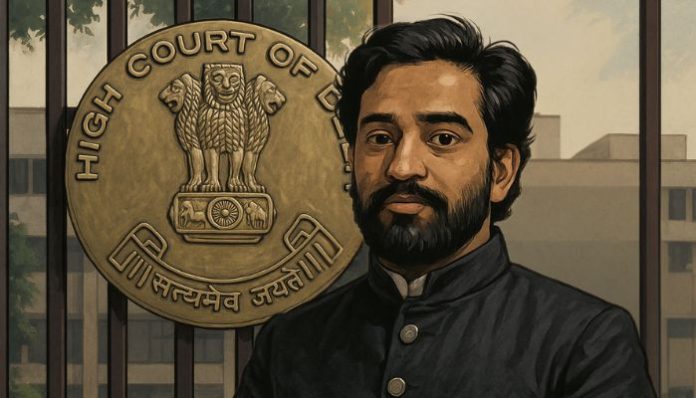
On 2nd September, the Delhi High Court dismissed the bail plea of Tasleem Ahmed, an accused in the 2020 North-East Delhi riots conspiracy case. The Court stressed that the very delays cited by him were the result of adjournments repeatedly sought by co-accused, many of whom are already on bail.
Defence cites five years in custody and right to speedy trial
During the hearing, Ahmed’s counsel argued that he has been in custody since 19th June 2020 and completed over five years as an undertrial without the trial itself commencing. His counsel contended that this amounted to a violation of Article 21 of the Constitution of India that guarantees the right to life and liberty, including the right to a speedy trial.
The defence highlighted that the prosecution had indicated plans to examine hundreds of witnesses, and with the trial still at the stage of arguments on charge, there was no foreseeable end in sight. They relied on the Supreme Court’s ruling in KA Najeeb to say that prolonged incarceration, even under the stringent UAPA, could be a ground for bail. The argument was that liberty cannot be indefinitely curtailed simply because the allegations are serious. The defence therefore pressed that the sheer length of custody should tilt the balance in favour of release on bail.
Prosecution blamed co-accused for dragging the proceedings
The Solicitor General, supported by the Special Public Prosecutor, firmly rejected this reasoning. They argued that while long custody may in rare cases justify bail, the facts of this case did not allow such relief. The prosecution placed on record the trial court’s proceedings to show how arguments on charge were repeatedly stalled at the request of the accused themselves.
According to the prosecution, adjournments were sought on multiple occasions by co-accused such as Devangana Kalita, Natasha Narwal and Asif Iqbal Tanha, all of whom are already out on bail. Furthermore, even those who are in custody, like Umar Khalid and Sharjeel Imam, sought adjournments. The trial court had noted that the requests directly delayed progress and those still in custody now sought to use the delay as a ground for bail.
It was contended that this was an attempt to game the system. The prosecution pointed out that KA Najeeb does not apply where delay is self-inflicted. The prosecution urged the court not to permit a situation where the accused deliberately prolonged trial proceedings on one hand and on the other hand, argued for bail on the ground of those very delays.
Court noted ‘systematic delay’ caused by accused
The Bench of Justices Subramonium Prasad and Harish Vaidyanathan Shankar agreed with the prosecution. After examining the trial court record, it noted that adjournments had been sought again and again by the accused, despite earlier consensus to proceed with arguments. The trial court itself had recorded its “distress” over this behaviour on 4th October 2024.
The High Court observed, “the inordinate delay in trial, as alleged by the Appellant herein, is not due to the inaction of the Respondent Agency or the Trial Court… the accused themselves have been responsible for delaying the trial.”
The judges went further, warning against misuse of constitutional guarantees, “Speedy trial is a fundamental right. But to ask for bail after there has been systematic delay in trial on the part of the accused is not acceptable, and if it is done, then the statute which restricts the grant of bail on the ground of delay in trial can easily be circumvented by delaying the trial on the one hand and by pressing bail applications on the other.”
The Bench concluded that the delay argument in Ahmed’s case could not hold, since he himself began pressing his arguments on charge only in April 2025, well after filing the present appeal.
UAPA’s tough bail bar emphasised
The court also underlined the legal standard under Section 43D(5) of the UAPA, which bars bail if accusations appear “prima facie true”. Citing the Supreme Court’s Watali precedent, the Bench reiterated that bail under UAPA is an exception, not the rule. The court stressed that while liberty is important, it cannot override the gravity of offences linked to terrorism and conspiracy against the State. Long custody by itself, absent other factors, was insufficient to justify release.
Case background
Tasleem Ahmed was named as Accused No 12 in FIR 59/2020, the principal case alleging a larger conspiracy behind the February 2020 riots in Delhi. He is charged under multiple sections of the IPC, the Arms Act, the Prevention of Damage to Public Property Act, and UAPA provisions relating to terrorism and conspiracy.
The prosecution alleges that the riots were not spontaneous but a “deep-rooted conspiracy” to coincide with the visit of the then US President, resulting in the deaths of 53 people, injuries to scores of police officers and civilians, and widespread destruction of property. Ahmed is among several accused, including student activists, local politicians, and organisers of protest sites, whom the police say played different roles in the conspiracy.
By rejecting Ahmed’s plea, the High Court drew a sharp line: while the right to a speedy trial is sacrosanct, it cannot be turned into a loophole by those accused of delaying proceedings themselves.
Documents:
Jugdment on bail plea of Tasleem Ahmed.


