

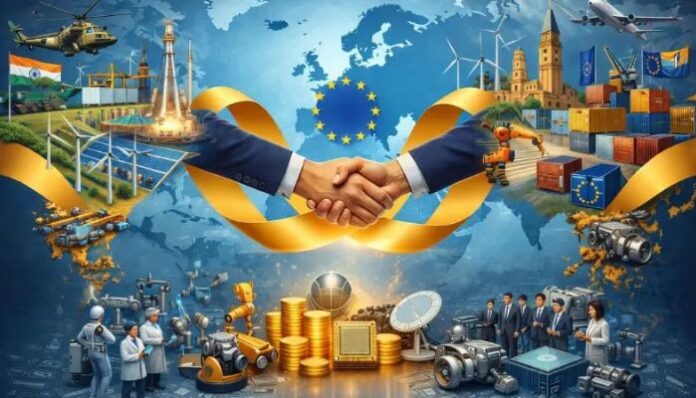
The dates of 26th and 27th January are being seen as historic not just for India, but for global politics and economics. A major agreement is about to be signed between India and European countries, which is being called the “Mother of All Deals.” It has been awaited for the past 20 years.
To finalise this long-awaited deal, top European leaders, including European Commission President Ursula von der Leyen and European Council President Antonio Costa, have arrived in New Delhi. The Indian government has rolled out a grand welcome, underlining the importance of the moment.
Who said, Indian economy is dead ??
— Kiren Rijiju (@KirenRijiju) January 21, 2026
The European Commission President Ursula von der Leyen has called- the upcoming "India–EU" agreement the “Mother of all Deals” and hails India as the world’s fastest-moving & most dynamic economy.
🇮🇳🤝🇪🇺 pic.twitter.com/j0XcTvy26N
This occasion is also special because, for the first time in India’s history, European leaders will be the chief guests on our Republic Day (26th January), and a contingent of the European military will also parade down Delhi’s Line of Duty. The primary objective of this entire agreement is to facilitate “free trade.”
This will open up a huge market for 2 billion people. Furthermore, it will make both India and Europe stronger partners for trade, rather than relying on China and the United States.
The ‘Mother of All Deals’: A market of 2 billion people and 25% of global GDP
European leader Ursula von der Leyen has called this agreement the “Mother of All Deals,” meaning it’s the largest and most important trade agreement ever. The key reason is that when India and 27 European countries come together, they will create the largest and most powerful trading market in the world. This market will be so vast that nearly a quarter of the world’s total revenue will be tied to this deal alone.
« The mother of all trade deals »
— Ursula von der Leyen (@vonderleyen) January 24, 2026
We are closing in on the 🇪🇺🇮🇳 Free Trade Agreement.
See you soon in Delhi. pic.twitter.com/gfiLv2eEam
The biggest beneficiaries of this agreement will be small and large Indian businesses. Currently, when Indian goods, shoes, jewellery, or IT services are exported to Europe, they face heavy taxes. However, with this deal, our goods will be sold in European markets without any additional taxes, resulting in significant profits for Indian companies.
The deal will also benefit European companies and Indian consumers. Luxury European cars such as Mercedes-Benz, BMW, and Volkswagen currently attract very high import duties in India, making them expensive.
Under the new agreement, these tariffs will be reduced significantly. This means European cars could become more affordable for Indian buyers in the coming years. The same applies to European wines and other premium products, which are currently heavily taxed in India.
This tariff reduction is expected to increase competition in the Indian market, giving consumers more choices and better prices.
Defence and Technology: India’s entry into the ‘SAFE’ programme
This agreement is not limited to the exchange of goods; India and Europe are now beginning a new chapter of friendship, called the “Security and Defence Partnership.” This step will significantly help India become self-reliant in its military and weapons. Following this agreement, Indian defence companies will be able to participate for the first time in Europe’s special fund (SAFE program), which holds approximately 150 billion euros.
To date, no non-European country has had the opportunity to benefit from such a large fund, which is a matter of pride for India. Additionally, India and Europe will now share intelligence. Whether it’s maritime security, cyberattacks on the internet, or combating terrorism, both sides will work together.
Europe has openly supported India after the recent terrorist attacks, stating that India has every right to retaliate in its own defence. This is a major diplomatic victory for India internationally. Another important development is that major European companies are now looking to make India their new destination, leaving China.
They want to set up their factories in India, which will not only increase work in modern sectors like chips (semiconductors) and clean energy here, but India will also emerge as a major manufacturing centre for the entire world.
Job boom: Golden Opportunity for Youth and Skilled professionals
This major agreement will have a significant impact on employment in our country. Experts say that it will employ millions of people. Best of all, it will become much easier for Indian engineers, doctors, and scientists to travel to Europe and work. To this end, both sides are developing a special mobility framework that will eliminate visa difficulties and provide better opportunities for our talent abroad.
Additionally, major European car companies will now locate their factories and parts manufacturing units in India. This will open up recruitment opportunities for thousands of engineers and technicians. Furthermore, Europe is now relying on India for its pharmaceutical supplies. This will significantly increase research and drug manufacturing in our pharmaceutical companies (pharma sector) and create thousands of new jobs.
India and Europe will also collaborate on the energy of the future, generating electricity from Solar, wind, and hydrogen. This will create a plethora of jobs in India for experts working in the field of clean energy. Overall, this deal will prove to be a major boost to the careers of Indian Youth.
New World Order and India’s dominance
This “Mother of All Deals” isn’t just a piece of paper, but a profound sign of a changing world. At a time when the United States is making drastic changes to its trade policies and trust in China is waning, Europe has chosen India as its most reliable democratic partner. This agreement will transform India into a global economic powerhouse, establishing a new identity for itself, independent of the pressures of the United States and China.
Experts say that today, Europe’s population is ageing, so it desperately needs India’s youth and its large market to work. On the other hand, India needs Europe’s advanced technology and significant investment to progress. This means that this friendship offers significant benefits to both. However, India must be careful not to exploit this agreement to allow a third country like China to sell its cheap goods into our market. When it is ratified on 27th January, it will be considered India’s biggest and most historic victory to date.
(This article is a translation of the original article published on OpIndia Hindi.)


