

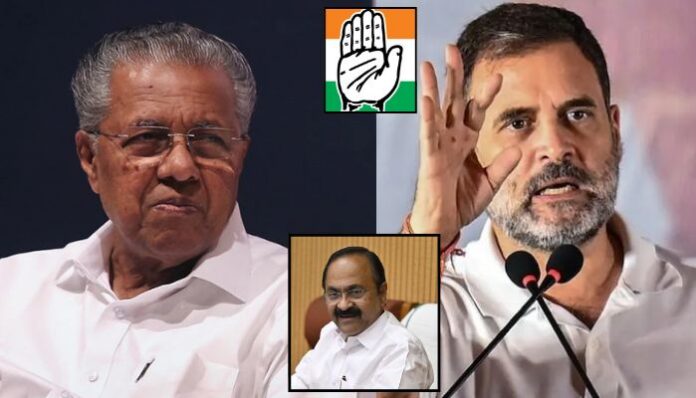
The newly elected Congress-led United Democratic Front (UDF) government in Kerala has released a detailed White Paper on the state’s finances on Thursday, 4th June, presenting what it describes as a grim picture of an economy pushed into severe financial distress during the ten years of Left Democratic Front (LDF) rule. Titled “Kerala’s Fiscal Health: A Status Report”, the 195-page document was prepared by an expert committee headed by former Cabinet Secretary K M Chandrasekhar and was tabled in the Assembly by Chief Minister V D Satheesan, who also holds the Finance Ministry.
The White Paper was among the first major decisions taken by the new UDF government after assuming office. It seeks to explain the scale of the fiscal challenge inherited by the administration and argues that Kerala’s economy is suffering from deep structural problems that have accumulated over the past decade.
Among other things, the White Paper on Kerala’s fiscal health, tabled in the State Legislative Assembly on June 4, has reopened the debate on whether the State should have nuclear power plants to boost internal power generation.https://t.co/lmjRZHQp2q
— The Hindu (@the_hindu) June 6, 2026
According to the report, Kerala has violated the basic principle of public finance that governments should “borrow to invest, and growth will repay.” Instead, borrowing increasingly financed consumption and recurring expenditure rather than productive investments. As a result, the state’s growth-generating capacity weakened while debt continued to pile up.
The White Paper comes at a politically significant moment. It has been projected by the UDF as an honest assessment of the state’s finances and as a roadmap for future corrective action. However, it also opens up a larger political debate: whether Congress governments across India have developed a pattern of blaming previous administrations for financial troubles and then finding themselves trapped by similar fiscal challenges after coming to power.
How LDF ruined Kerala’s economy in the last ten years
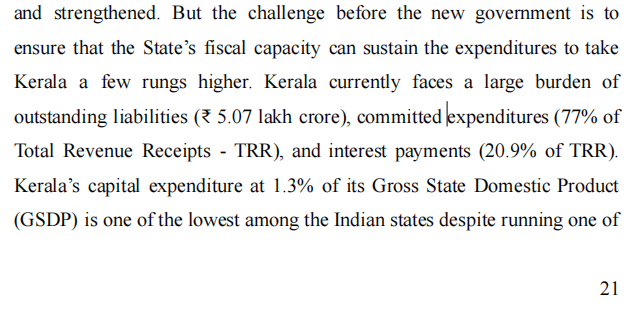
The most striking finding of the White Paper is the scale of Kerala’s public debt. According to the report, total public debt has ballooned to ₹5.07 lakh crore. Such a large debt burden means a significant portion of the state’s resources now goes toward servicing old liabilities rather than creating new assets or funding development projects.
The report argues that the financial situation has reached a stage where future governments will continue to carry the burden of decisions taken during the previous decade. Rising debt has translated into rising interest obligations, creating a vicious cycle in which more borrowing is required merely to meet existing commitments.
Another major concern highlighted in the report is the state’s committed expenditure. Nearly 77% of total revenue receipts are already pre-committed to salaries, pensions and interest payments. This leaves very little fiscal space for fresh development initiatives, infrastructure creation or social sector investments.
Interest payments alone account for more than one-fifth of the state’s revenue receipts. In practical terms, this means a substantial amount of taxpayer money is being spent simply to service old debt.
The report also points to Kerala’s poor capital expenditure performance. Capital expenditure is often considered one of the most important indicators of long-term economic health because it creates infrastructure and productive assets that generate future growth. However, Kerala’s capital expenditure has fallen to just 1.3% of GSDP, among the lowest levels in the country.
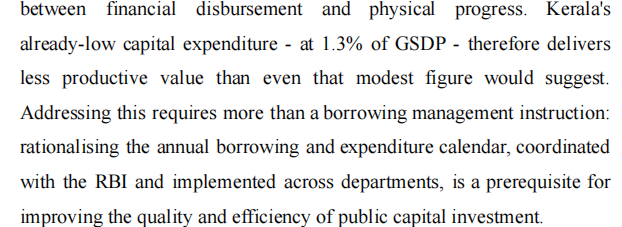
The White Paper argues that this trend directly contradicts the justification often offered for high borrowing. Governments generally defend borrowing by claiming that the funds are being invested in projects that will generate future growth. However, when capital expenditure remains low despite high borrowing, the benefits of such borrowing become difficult to justify.
KIIFB under the scanner
A major portion of the report focuses on the role of the Kerala Infrastructure Investment Fund Board (KIIFB), a flagship institution promoted during the LDF era.
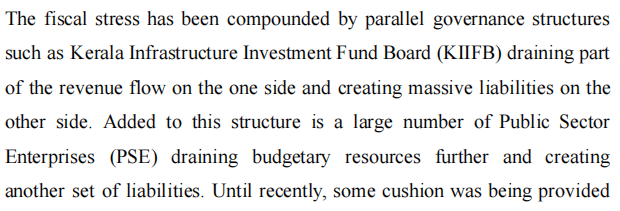
The White Paper describes KIIFB as a “parallel fiscal authority” and argues that it contributed significantly to Kerala’s present liabilities. According to the report, KIIFB has left the state with financial obligations worth around ₹56,000 crore. Of this amount, nearly ₹21,000 crore relates to loan liabilities while another ₹35,000 crore is linked to projects currently in the pipeline.
The report also raises questions about the geographical distribution of KIIFB spending. It alleges that more than 20% of KIIFB funds were concentrated in Kannur, a district widely considered a political stronghold of the CPI(M). The implication is that political considerations may have influenced investment decisions.
The White Paper further argues that many KIIFB-funded projects increased liabilities without creating sufficient economic returns to justify the costs.
Massive pending liabilities
The UDF government has also highlighted what it calls inherited payment arrears worth ₹48,733 crore. These include substantial Dearness Allowance (DA) and Dearness Relief (DR) arrears owed to government employees and pensioners. The report suggests that the state delayed payments to manage immediate fiscal pressures, effectively pushing liabilities into the future.
As a result, the new government faces the challenge of honouring commitments made years ago while simultaneously trying to stabilise public finances.
A familiar political pattern of Congress-led government
While the Kerala White Paper directly targets the previous LDF government, Congress governments elsewhere have adopted a similar political approach. The pattern, they often begins with blaming the previous administration for financial distress and then, after coming to power, launching expansive welfare schemes and election promises that place additional pressure on state finances.
The results are clearly visible in prominent states such as Karnataka and Himachal Pradesh, where Congress governments have repeatedly cited inherited debt and financial stress while simultaneously struggling to fund their own commitments.
From South India to North India, the story has remained remarkably similar: blame the previous government, announce ambitious welfare guarantees, and then face mounting fiscal challenges when revenue growth fails to keep pace with expenditure.
Karnataka: From revenue surplus to fiscal stress
Karnataka can be seen as a warning about the long-term consequences of aggressive welfare spending without adequate fiscal planning.
When the BJP government under Basavaraj Bommai presented its budget in 2023, Karnataka was in a relatively comfortable fiscal position. The state recorded a revenue surplus and maintained a balance between welfare spending and infrastructure investment.
The budget allocated significant resources to agriculture, education, irrigation and infrastructure projects while avoiding major fiscal disruptions. Education alone received allocations exceeding ₹37,000 crore. Major irrigation projects such as Upper Bhadra and Kalasa-Banduri also received substantial funding.
However, after the Congress government led by Siddaramaiah came to power, it implemented its five flagship guarantee schemes, Gruha Lakshmi, Gruha Jyoti, Anna Bhagya, Shakti and Yuva Nidhi.
These schemes formed the core of Congress’s election campaign and were credited with helping the party secure a decisive victory.
But the financial implications soon became apparent.
According to a report by the Comptroller and Auditor General (CAG) released last year, the guarantee schemes alone carried a budgetary provision of ₹36,538 crore in 2023-24, equivalent to around 15% of the state’s total revenue expenditure.
Karnataka state government has borrowed Rs 63,000 Crore to finance the guarantee schemes and the resulting deficits. This is Rs 37,000 crore higher than last year's net debt of Rs 26,000 crore, a CAG report stated.
— ANI (@ANI) August 20, 2025
Of the capital expenditure earmarked for infrastructure in…
The impact on Karnataka’s finances was shocking. Revenue grew by only 1.86% while expenditure surged by 12.54%. The state slipped into a revenue deficit of ₹9,271 crore.
The fiscal deficit rose sharply from ₹46,623 crore in 2022-23 to ₹65,522 crore in 2023-24. To bridge the gap, Karnataka borrowed nearly ₹63,000 crore from the market, almost two and a half times the borrowing of the previous year.
Meanwhile, capital expenditure fell substantially, leading to delays and unfinished infrastructure projects.
Congress leaders themselves sound alarm bells
Perhaps the strongest criticism of Karnataka’s financial position has come from within the Congress ecosystem itself.
On 11th July, 2024, Siddaramaiah’s financial advisor, Basavaraj Rayareddy, openly acknowledged the strain on state finances.
“Many MLAs are demanding funds for development works in their constituencies; however, there is no money with the government. We are spending approximately Rs 65,000 crore on guarantee schemes,” he said.
#BREAKING | Karnataka CM Siddaramaiah's economic advisor Basavaraj Rayareddy states that guarantees have become a huge burden.
— Republic (@republic) January 9, 2024
"As we have directed Rs 58,000 Cr for guarantees it has become a huge financial burden to us. We are holding discussions on what to do. In the primary… pic.twitter.com/AkiiffHNps
He added: “People want development. But believe me, there is absolutely no money.”
The remarks triggered a major political debate because they appeared to confirm what opposition parties had been alleging for months.
Congress’s freebies have even resulted in internal strife. There are some Congress leaders who claim that the schemes failed to provide the electoral returns anticipated, and there are doubts about whether such lavish expenditure was worth the price.
The financial strain has been acknowledged on several occasions by senior Congress leaders themselves. CM DK Shivakumar admitted in July 2023 that the government was finding it difficult to have funds for development because ₹40,000 crore had to be kept aside for party’s guarantees.
These admissions have been used by critics to argue that Karnataka’s fiscal stress is no longer merely an opposition talking point.
The impact on infrastructure
As expenditure on welfare schemes increased, concerns emerged regarding infrastructure spending.
The CAG noted a decline in capital expenditure and a sharp rise in incomplete projects. Critics argue that resources which could have gone toward roads, irrigation, transport and industrial infrastructure are increasingly being diverted toward recurring welfare obligations.
The situation has also affected state-owned transport corporations. Under the Shakti scheme, women are provided free bus travel. However, transport corporations later reported significant financial pressures and delayed obligations.
KSRTC salary crisis: how ‘Shakti’ broke public transport
Earlier, in August last year, workers of the Karnataka State Road Transport Corporation (KSRTC) and Bengaluru Metropolitan Transport Corporation (BMTC) went on a strike against unpaid salary revisions and arrears.
They were demanding a 25% hike in salary and payment of arrears for 38 months, which totals ₹1,800 crore. The state government, however, proposed to settle arrears of just 14 months due to financial constraints.
What infuriated workers was that their salaries were being withheld even while the government was spending thousands of crores on the Shakti scheme, under which women get free bus travel. The Congress government owes ₹1,600 crore to the four state-owned transport corporations (KSRTC, BMTC, NWKRTC, KKRTC) for carrying out Shakti.
The debate in Karnataka has therefore evolved into a broader question: how should governments balance welfare commitments with long-term development spending?
Himachal Pradesh: A similar story in the hills
The financial debate surrounding Congress governments is not limited to South states only.
In Himachal Pradesh, where Congress came to power under Chief Minister Sukhvinder Singh Sukhu in December 2022, concerns over fiscal stress have repeatedly surfaced.
Before the election, Congress promised a range of welfare measures, including free electricity, monthly financial assistance for women, restoration of the Old Pension Scheme, government jobs and several subsidy-based initiatives. After coming to power, however, the state increasingly faced fiscal pressures.
Reports emerged of difficulties in meeting salary and pension obligations. The government reportedly struggled with monthly commitments of nearly ₹2,000 crore toward salaries and pensions alone.
At one stage, delays in salary and pension payments affected hundreds of thousands of employees and retirees, sparking a major political controversy. The state also resorted to additional borrowing to meet expenditure requirements.
New taxes, higher charges and cost-cutting measures
As fiscal pressures mounted, the Himachal government introduced several measures aimed at increasing revenue.
The Assembly approved amendments introducing environmental cess and milk cess. The government also reduced some subsidy benefits and increased certain user charges.
Opposition leaders accused the government of burdening ordinary citizens after winning elections on promises of generous welfare schemes. Among the controversial decisions were the withdrawal of some free power benefits, higher diesel prices and increased water charges in rural areas. The government also explored new revenue sources, including discussions around regulated cannabis cultivation for industrial and medicinal purposes.
These measures are evidence that the state’s finances were under severe stress.
Even temple trusts drawn into the debate
One of the most politically sensitive controversies emerged when a notification encouraged temple trusts to contribute funds toward welfare schemes such as the Mukhyamantri Sukh-Aashray Yojana and Mukhyamantri Sukh Shiksha Yojana.
The move generated intense political reactions and became another symbol cited by opponents who argue that the state government is struggling to finance its welfare commitments.
Ally with those who hold Sanatan in contempt, oppose legal moves that will allow sanatanis to regain control of their places of worship but then without batting an eyelid, also milk Sanatanis for funds.
— Rahul Shivshankar (@RShivshankar) February 28, 2025
Indeed, Congress government in Himachal has called on temples to release… pic.twitter.com/o3GWXoNhiY
Meanwhile, Chief Minister Sukhu has continued to argue that much of the state’s debt burden was inherited and that a large portion of recent borrowing has gone toward repaying old loans and interest obligations.
The same blame game in Kerala, Karnataka, and Himachal
The Kerala White Paper has reignited a broader pattern of blame game and about fiscal responsibility and freebies politics.
The Congress-led UDF government in Kerala has presented the report as evidence of financial mismanagement under the previous LDF administration. The document highlights rising debt, mounting liabilities, low capital expenditure and structural weaknesses in the state’s finances.
However, similar explanations have been offered by Congress governments in Karnataka and Himachal Pradesh after assuming power. In both states, the previous governments were blamed for fiscal difficulties, but concerns later emerged regarding the sustainability of new welfare commitments and the resulting pressure on public finances.
As Kerala begins examining the financial legacy of the past decade under the LDF through its White Paper, the experiences of Karnataka and Himachal Pradesh are likely to remain central to the debate.


