

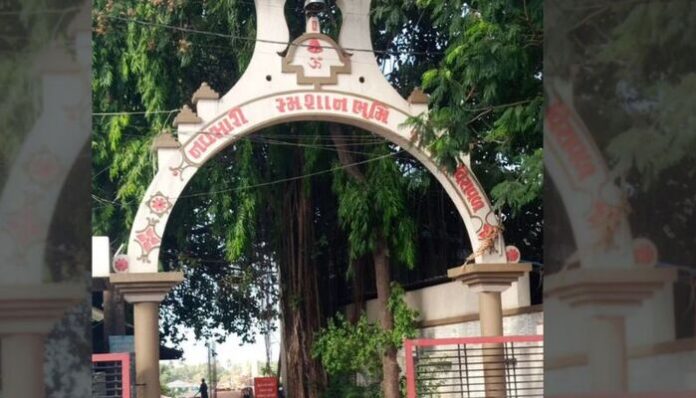
The mortal remains of a Parsi woman, who had married a Muslim man, were kept waiting for the last rites for two days at a mortuary after both the Muslim and the Parsi communities refused to accept her. The husband of the woman consulted some Muslim clerics seeking permission for her burial, but the permission was not granted. The Parsi community also refused to perform her last rites. Rejected by both the communities, the woman was finally cremated as per Hindu rituals in the Veraval area of Navsari in Gujarat on Friday (5th June).
The incident has thrown light on the inherently accepting and inclusive nature of Hinduism. Generations of Hindus have been able to protect and nurture these features of Hinduism despite facing persecution at the hands of Islamic invaders for centuries. Hinduism embraced the woman, who was abandoned by her and her husband’s communities even in death.
What is the entire case?
The 55-year-old woman from Gujarat had married a Muslim man against the wishes of her family and community. While she went against her family and community to be with her Muslim husband, the Muslim community did not accept the woman, not even in her death. The Muslim community denied her dignity in death by not allowing her to be buried as per Islamic rituals, and her Parsi community also did not accept her.
According to The Indian Express, about 35-years ago, the Parsi woman had married Professor Nisar Ahmed while she was a student. Professor Nisar Ahmed met the student while she was pursuing a bachelor’s degree in the Gujarati language at a college affiliated with the Veer Narmad South Gujarat University. She grew close to Professor Ahmed and told her family that she wanted to marry him, even though he was 15 years older than her. The woman came from an educated family. Her father worked for a private firm, while her mother was a teacher at a government school in Navsari. Despite her family’s disapproval, the woman married Professor Ahmed.
Her decision to marry Professor came with a huge cost. She was ostracised by her Parsi community, and her family severed all ties with her. She was not allowed to participate in any Parsi community social gatherings. Her parents maintained distance from her for nearly 10 years, but later relented. Some close family members of the woman revealed that a few years ago, she was not allowed to attend the weddings of her elder brother and younger sister.
The woman had not converted to Islam and remained a Zoroastrian. The couple had no children. Recently, she fell severely ill and passed away on 4th June, following days of medical treatment. After her death, her husband contacted the Parsi community for her last rites, but the community did not give permission. Then he consulted Muslim clerics, requesting her last rites to be performed as per Islamic rituals, but they also refused to accept her. The professor contacted the caretakers of a Muslim cemetery, who also refused to allow them to bury the body according to Islamic customs.
While several incidents of Muslim women luring non-Muslim women into relationships and marrying them to bring them within the Islamic fold emerge every day, the Muslim community refused to accept this Parsi woman, even though she married a Muslim man, only because she did not convert to Islam.
The family of the woman was distraught, as her body remained in the hospital morgue for two days. Her parents are no longer alive. Her brother and younger sister were informed of her death and came to the scene. After facing rejection by both communities, the family turned to the Hindu community for help. A member of the Vishwa Hindu Parishad (VHP), Sajan Bharwad, arranged for her last rites to be performed as per Hindu rituals with the permission of her family. “Seeing no other way, we sought help from Sajan Bharwad, a social worker and Vishwa Hindu Parishad leader from Navsari. He offered to cremate the body if we all agreed… to which we all agreed,” said the sister of the deceased woman.
The Parsi community, or Zoroastrians, is one of the smallest and oldest religious communities in India. Many of their social and religious rules are centuries old, aimed at preserving their distinct religious identity and traditions. These have remained unchanged over time. Even today, a Parsi woman’s rights are revoked if she marries outside her community. She cannot visit places of worship like the Agni Mandir or participate in social events.
How did the Parsis come to India?
According to popular Zoroastrian legend, Parsis came to the western coast of India, especially Gujarat, between the 8th and 10th centuries as refugees to escape religious persecution following the Islamic conquest of Persia (Iran). As per a 17th-century historical chronicle, ‘Kissah-i-Sanjan’, the local king, Jadi Rana, permitted them to settle in his kingdom. The legend says that the Parsis pledged to live peacefully in local society, adopt the local language, and integrate into society while maintaining their identity.
Why is the Parsi population dwindling?
The number of Parsis is continuously decreasing. In response to a question in the Rajya Sabha, Union Minority Affairs Minister Kiren Rijiju had said that in 1941, there were more than 1 lakh 14 thousand Parsis in the country, which reduced to 57 thousand in the 2011 census. Under the National Commission for Minorities Act 1992, the Central Government has taken several initiatives to stop the decline in the population of the minority community. He said that the Jiyo Parsi scheme has been started, which aims to encourage marriage, family and birth of children in the Parsi community.
The Parsi community has a fertility rate significantly lower than almost all other major communities in India. A large number of young Parsis do not marry or marry very late. The elderly population has increased. The death rate exceeds the birth rate. Rules regarding interfaith marriage are very strict. If a woman marries someone from another religion, her religious identity is revoked. Even the religious identity of her children is disputed. A large number of Parsis from India have settled abroad. This is also a major reason for their declining numbers.
(The article is a translation of the original article published on OpIndia Hindi.)


