

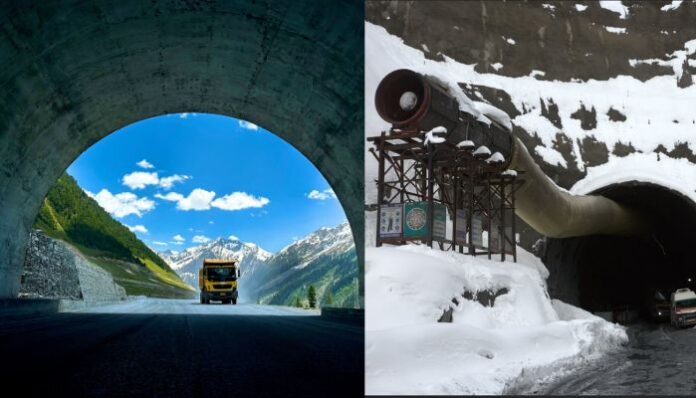
India is set to achieve a major infrastructure milestone on Tuesday, 9th June, with the final breakthrough of the Zojila Tunnel, one of the country’s most ambitious and technically challenging engineering projects. The breakthrough marks the completion of the excavation phase of the 13.153-kilometre-long tunnel that is being built beneath the snow-covered mountains of the western Himalayas.
Once completed and opened to traffic, the Zojila Tunnel will become the world’s longest single-tube bi-directional road tunnel at the highest altitude. Located at nearly 11,578 feet above sea level, the tunnel is expected to transform connectivity between Kashmir and Ladakh, a region that remains cut off for several months every year because of extreme winter weather.
The Zojila Tunnel is shaping up as one of India’s most remarkable infrastructure feats — a 13.153 km single-tube bi-directional road tunnel built at about 11,578 feet in the Himalayas. Once complete, it will provide all-weather connectivity between Srinagar and Ladakh,… pic.twitter.com/qC2uzZNU1L
— Megha Engineering and Infrastructures Ltd (@MEIL_Group) June 7, 2026
Connecting Kashmir and Ladakh through the mountains
The Zojila Tunnel is being constructed between Baltal near Sonmarg in Jammu and Kashmir and Meenamarg in the Drass region of Ladakh. The project aims to provide seamless all-weather connectivity along the strategic Srinagar-Kargil-Leh highway, which serves as the main road link between Kashmir and Ladakh.
हिमालय की दुर्गम उँचाईयों में आकार ले रही भारत की सबसे चुनौतीपूर्ण अवसंरचना : जोज़िला टनल!
— Nitin Gadkari (@nitin_gadkari) June 8, 2026
मुख्य 'सुरंग ब्रेकथ्रू' समारोह : 9 जून 2026#ZojilaTunnel #AllWeatherRoad #TunnelBreakthrough #PragatiKaHighway #GatiShakti #BuildingTheNation pic.twitter.com/QurXHRD7mu
For decades, the Zojila Pass has been both a lifeline and a challenge. Heavy snowfall, blizzards and avalanches regularly force the closure of the mountain pass during winter. Entire stretches of the highway become inaccessible for months, disrupting civilian movement, trade, tourism and the transportation of essential supplies.
Tomorrow, the 13.15-km Zojila Tunnel will achieve breakthrough, marking a milestone in India's infrastructure journey. Once completed, Asia's longest bi-directional road tunnel will provide all-weather connectivity between Kashmir and Ladakh, strengthening mobility and logistics. pic.twitter.com/GFyd3DYjrn
— infoindata (@infoindata) June 8, 2026
The tunnel is designed to eliminate this seasonal isolation by allowing vehicles to travel safely throughout the year regardless of weather conditions outside.
The scale of the project is enormous. While the main tunnel itself stretches for 13.153 kilometres, the total project length, including approach roads, bridges and associated infrastructure, extends to nearly 30.9 kilometres.
Apart from the main tunnel, the project also includes the Nilgrar twin tunnels measuring 457 metres and 1,953 metres respectively, seven cut-and-cover structures covering 2.35 kilometres, a 450-metre snow gallery and three major bridges with a combined length of 460 metres.
The 13.153-km Zojila Tunnel, the world’s longest single-tube bi-directional road tunnel at the highest altitude, and its final breakthrough will be a historic milestone in India’s infrastructure history.
— ANI (@ANI) June 7, 2026
Located in the Zojila region between Baltal (Sonamarg) and Meenamarg (Drass… pic.twitter.com/CUstVp7zj0
An engineering marvel in the mountains
The Zojila Tunnel is not just another road project. It is one of the most complex engineering undertakings ever attempted in the Indian Himalayas.
The project is being executed by Megha Engineering & Infrastructure Limited (MEIL) for the National Highways & Infrastructure Development Corporation Limited (NHIDCL), the Union government’s specialised agency for highway development in difficult terrains.
One of its most remarkable features is the ventilation and safety system. Since there is no separate escape tunnel, engineers have constructed three massive vertical shafts to provide ventilation and emergency access. The largest shaft extends 474.3 metres deep into the mountain and is currently the longest vertical shaft in India. The other two shafts measure 367.38 metres and 213.5 metres respectively.
#InPics | A landmark moment for #India's infrastructure sector as the 13.153-km #Zojila Tunnel achieves its final breakthrough. Set to become the world's longest single-tube bi-directional road #tunnel at the highest altitude, the project will provide all-weather connectivity… pic.twitter.com/55quFdhqS6
— The Times Of India (@timesofindia) June 7, 2026
The tunnel is being built using the New Austrian Tunnelling Method (NATM), a construction technique specially suited for fragile mountain geology. Unlike conventional tunnelling methods, NATM allows engineers to continuously adapt to changing rock conditions through phased excavation, immediate reinforcement and constant geological monitoring.
This flexibility proved essential because the geology along the Zojila alignment turned out to be highly unpredictable. Engineers recorded as many as 67 changes in rock classification along the 13-kilometre stretch, forcing frequent modifications in excavation and support strategies.
Adding to the challenge were the extreme weather conditions. Temperatures in the region often fall below -20°C and can drop to -30° during peak winter. Construction teams have worked through severe snowfall, blizzards and multiple avalanche incidents over the years.
Despite these difficulties, more than 1,200 workers continued construction activities, helping the project achieve over 10 million safe man-hours.
Why the tunnel is a major infrastructure milestone
The Zojila Tunnel represents a significant leap in India’s ability to execute large-scale infrastructure projects in some of the world’s most difficult terrain.
The project showcases advanced tunnelling technology, high-altitude engineering expertise and the country’s growing capability to build strategic infrastructure in remote mountain regions. The successful excavation of a tunnel of this scale beneath avalanche-prone Himalayan mountains is itself considered a major achievement.
The tunnel is also expected to bring substantial economic benefits. Once operational, it will reduce travel time between Baltal and Meenamarg. The journey through the Zojila Pass, which currently takes around three and a half hours under normal conditions, is expected to be reduced to just about 15 minutes.
Reliable year-round connectivity will improve the movement of people, goods and services between Kashmir and Ladakh. Businesses will no longer need to stockpile supplies for months due to road closures. Farmers, traders and transporters will benefit from uninterrupted access to markets.
The tourism sector is also expected to receive a major boost. Destinations such as Sonmarg, Drass, Kargil, Zanskar and Leh could attract visitors throughout the year instead of only during the summer season. Improved accessibility is likely to create new economic opportunities and generate employment across the region.
For residents of Ladakh, the tunnel promises relief from the annual isolation that has shaped life in the region for generations. Access to healthcare, education and essential services is expected to become far more reliable once the road remains open throughout the year.
A critical asset for National Security
The Srinagar-Leh highway serves as a crucial logistics corridor for the Indian Armed Forces. It is the primary route used to transport troops, equipment, fuel and supplies to Ladakh, a region that has become increasingly important following tensions along the Line of Actual Control (LAC) with China.
In recent years, India has strengthened infrastructure across Ladakh to improve military mobility in the high-altitude frontier region. The Zojila Tunnel forms a key part of that broader effort.
Currently, heavy snowfall and weather-related closures can restrict movement through the Zojila Pass for several months. The tunnel will remove this vulnerability by ensuring uninterrupted access to Ladakh throughout the year.
Military experts believe the project will greatly improve operational flexibility by allowing faster deployment of troops and equipment whenever required. It will also reduce dependence on weather windows and alternative routes that are often longer and more vulnerable.
The strategic value of the tunnel becomes even more significant in the context of increasing military activity along India’s borders with China and Pakistan. Reliable all-weather connectivity strengthens India’s logistics preparedness and enhances its ability to maintain a strong presence in sensitive border areas.
The need for such infrastructure was first highlighted during the 1999 Kargil War. More recently, tensions along the India-China border have reinforced the importance of maintaining uninterrupted road access to Ladakh.


