

Two powerful earthquakes rocked Venezuela on Wednesday (24th June), causing massive destruction in Caracas and the coastal state of La Guaira. The earthquakes measuring 7.2 and 7.5 were followed by at least 20 aftershocks ranging between 4.9 and 6.4 magnitude. The jolts triggered tsunami warnings across parts of the Caribbean.
Horrifying visuals of the earthquakes captured by people stuck in the calamity emerged on social media, showing swarms of people running around in panic to save their lives.
Inside a shopping mall at the exact moment the powerful 7.1 and 7.5 magnitude earthquakes struck Venezuela pic.twitter.com/hWhO4Dh3hh
— Surajit (@surajit_ghosh2) June 25, 2026
The moments of earthquakes showing people running for safety from the building collapsing around them seemed straight out of a movie.
Video captured the first moments of two powerful earthquakes striking Venezuela, triggering panic as people fled for safety as buildings collapsed around them. pic.twitter.com/ZadZ6VNrNo
— Al Jazeera Breaking News (@AJENews) June 25, 2026
The scale of damage and devastation caused by the earthquakes could be guessed from the images of high-rise buildings that had collapsed and turned into debris.
WATCH: Magnitude 7.1 earthquake destroys apartment building in Caracas, Venezuela. Number of casualties unknown. pic.twitter.com/eTVroUH5St
— BNO News Live (@BNODesk) June 24, 2026
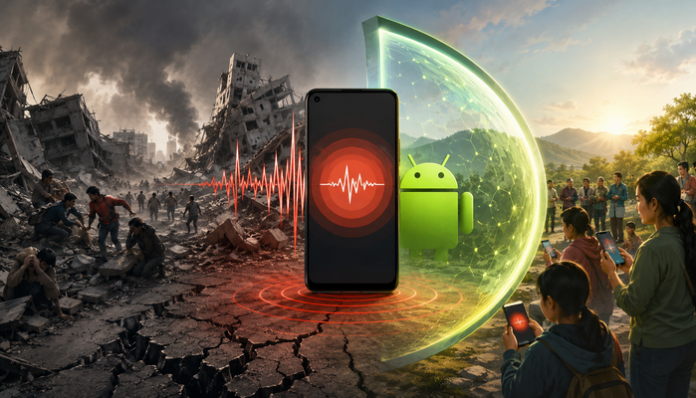
While around 100,000 people are feared dead after the earthquakes, which are said to be the deadliest earthquakes of the century, many were saved by Google’s Android Earthquake Alerts System, which sent a warning to people’s Android phones after sensing seismic activity.
Some users on X said that they received Google’s warning moments before the earthquakes struck the South American country. The system detected early signs of the earthquakes and alerted people before the major tremors arrived.
Recibí mi primera alerta de sismo en el móvil. Magnitud 6.2.
— Jesús Morán | AI Infra (@jamoran1356) June 24, 2026
Lo interesante: la alerta llegó porque mi teléfono forma parte de un sismógrafo distribuido global.
Android Earthquake Alerts usa el acelerómetro como sensor sísmico de bajo costo. pic.twitter.com/p8Xq4VNtup
What is Google’s Android Earthquake Alerts System?
Google’s Android Earthquake Alerts System is an example of how modern technology has evolved to not only assist humans but also save lives by strengthening disaster preparedness. The system relies on motion sensors built into Android phones for detecting the slightest ground vibrations.
Modern Android phones are fitted with accelerometers, which support the phone’s screen rotation system. But an accelerometer has another important use, which is to detect and measure vibrations. Android phones with accelerometers act as a distributed sensing network for the Android Earthquake Alerts System to detect seismic waves, which constitute an earthquake.
To estimate an upcoming earthquake, the system initially detects P-waves (Primary waves), which are weaker seismic waves and travel faster than the S-waves, which travel slower but are capable of causing damage. If the system detects P-wave signals from enough Android phones in an area, it combines the signals to assess the earthquake’s location and magnitude, and sends alerts to nearby users before the damage-causing S-waves arrive. The signals from Android phones travel at the speed of light, which allows the system to gather signals from phones in the area and estimate an earthquake.
This early detection of P-waves gives a tiny but crucial window before the disaster hits that can save lives. This is how several Android users in Venezuela received warning messages from the Android Earthquake Alerts System before the earthquakes hit the region.
A similar alert was sent by the Android Earthquake Alerts System to users during an earthquake that hit India’s northeastern region in September last year. The earthquake measured around 5.8 on the Richter Scale and had its epicentre near Udalguri town in Assam.
Around 2 billion Android phones are part of this network, making it the largest distributed seismograph (earthquake detector) in the world. This system marks a key shift taking place in disaster management from post-disaster measures to pre-disaster measures.


