

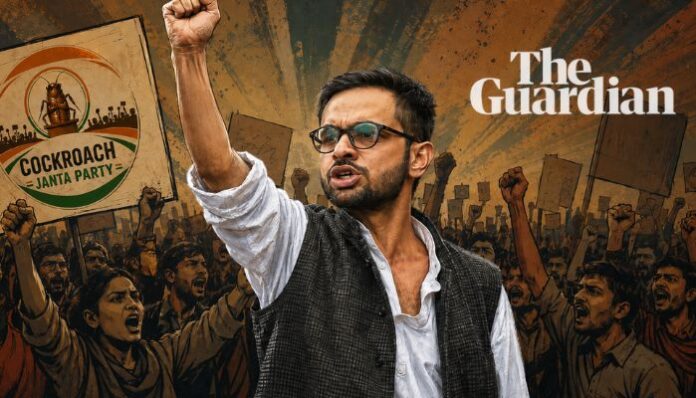
On 30th June, The Guardian published a sympathetic profile of Umar Khalid, presenting the accused in the larger conspiracy case related to the 2020 anti-Hindu Delhi Riots as one of India’s most prominent “political prisoners” and a victim of a government crackdown on dissent. Built around reflections on prison, fading hope, Dostoevsky and Bhagat Singh, the article largely avoided examining the prosecution’s case against him.
The article needs to be scrutinised not just for what it said, but also for what it deliberately left outside the frame. The publication came amid open support for Khalid from the leadership and supporters of the so-called Cockroach Janta Party (CJP), whose protests were launched around the NEET paper leak and youth issues. However, protesters and CJP supporters, both online and offline, have called for Umar Khalid to be freed.
What The Guardian said about Umar Khalid
Titled “‘Humanity is a privilege’: Umar Khalid on his six years in an Indian jail without trial”, The Guardian article was written by Hannah Ellis-Petersen, the publication’s Delhi correspondent who is known for her anti-India propaganda. In the article, she described Khalid as an activist, a left-wing rights campaigner and a fierce critic of Prime Minister Narendra Modi. She claimed that he had become a symbol of the alleged weaponisation of the judicial system against government opponents.
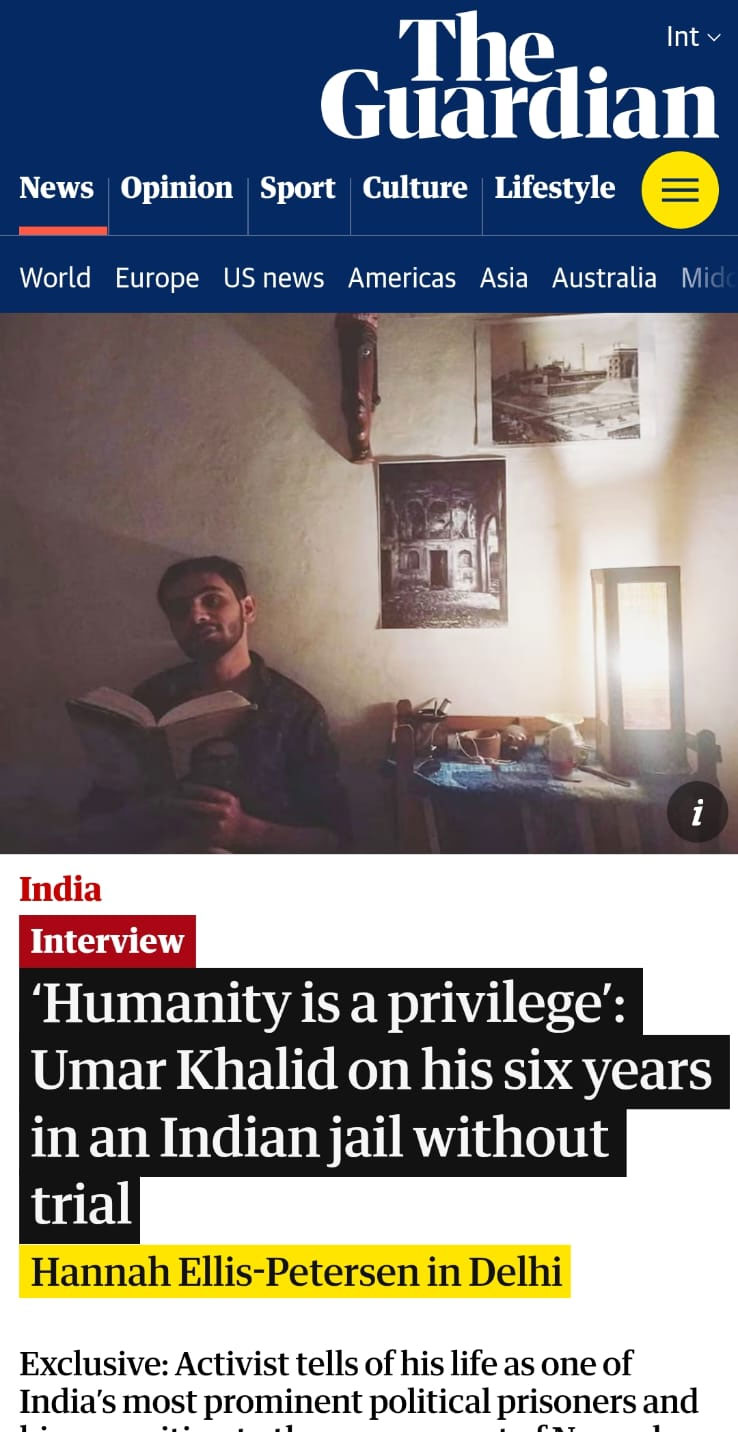
The author invoked Umar Khalid’s mental and physical suffering, compared his experience with Fyodor Dostoevsky’s prison memoir and ended with a quote from Bhagat Singh written on the wall of his cell. Khalid spoke at length about propaganda, dehumanisation, Hindu nationalism, the condition of Muslims and what he called India’s transformation into a “post-truth society”.
However, the publication itself admitted that it had agreed not to discuss his legal case. It also did not interview Khalid directly, with the questions and answers conveyed through his relatives and friends.
This arrangement allowed The Guardian to publish an emotional first-person account without seriously confronting Khalid with the material cited by the prosecution. The accusation of a larger conspiracy was reduced to a few phrases, while his physical absence from north-east Delhi at the time of the violence was prominently presented as though conspiracy charges required the accused to be standing at the scene when the riots began.
The report was subsequently amplified by the usual political and ideological ecosystem. Congress leader Shashi Tharoor called it a “moving article” and asked why the accusations had not been proved in court.
This moving article on @UmarKhalidJNU in prison prompts a simple question: if he really has incited terrorism, why not prove it in a court of law? Why deny him the basic right of any Indian citizen accused of a crime, the right to a fair trial? Languishing six years behind bars,…
— Shashi Tharoor (@ShashiTharoor) June 30, 2026
Ruchika Sharma, a propagandist who poses as a historian, declared that India’s “collective conscience” was dead, while Kaushik Raj, who has written for The Guardian, claimed that the world was taking note of the “injustice” against Khalid.
India's collective conscience is so déad that a bright mind has been in jail without trial, without bail for 6 years now, yet there has been very little outrage over this thoroughly illegal incarceration. What a morally vacuous society! https://t.co/t4QgKXSnkz
— Dr. Ruchika Sharma (@tishasaroyan) June 30, 2026
CJP founder and spokespersons openly backed Khalid
Support for Khalid was not confined to random CJP followers. It extended to the organisation’s founder and public faces.
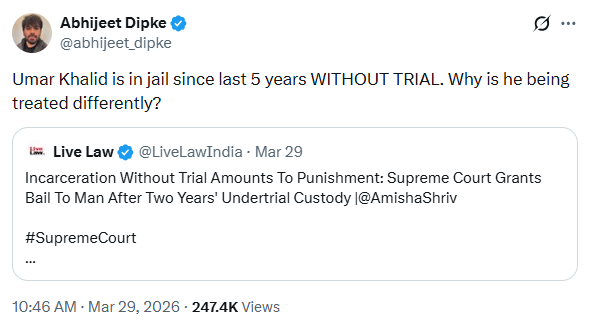
Earlier this year, CJP founder Abhijeet Dipke questioned why Khalid had remained imprisoned without trial and claimed that he was being treated differently.
In a recent interview with Samdish Bhatia on Unfiltered by Samdish, Dipke claimed that he had kept his movement peaceful, Constitution-centric and difficult to discredit. Out of no where, Samdish remarked that his surname was not Khalid, to which Dipke said that had he been a Khalid, Saifi or Muslim, he would have been in jail. Through the remark, Dipke appeared to suggest that so-called Muslim “activists” such as Umar Khalid were imprisoned because of their religious identity, conveniently ignoring the serious criminal and conspiracy charges against them. The forceful insertion of Khalid’s reference was uncanny but gave the idea what exactly they were trying to do.
If my name were Khalid or Saif, I would be in Jail.
— Mr. Democratic (@MrDemocratic_) July 1, 2026
– CJP Founder pic.twitter.com/aRX3gVivoU
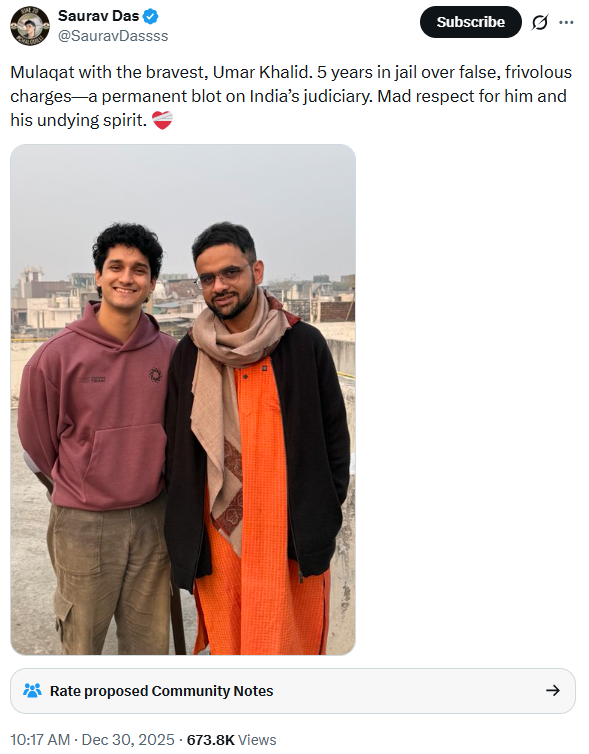
Spokesperson Saurav Das went further, describing the charges against Khalid as “false” and “frivolous” and calling his imprisonment a blot on India’s judiciary.
Another CJP spokesperson, Vijeta Dahiya, attempted to reduce the case against Khalid to a speech quoting Mahatma Gandhi and his presence in a WhatsApp group. When questioned about the larger conspiracy case and the more than 50 people killed during the Delhi Riots, Dahiya fell back on the argument that no trial had taken place and accused the journalist questioning him of being “godi media”.
CJP Spokesperson Vijeta Dahiya Supporting Umar Khalid.
— Dear Men (@Dear_Men_Life) June 6, 2026
Reporter:"Viral Video of Saurav Das backing Umar Khalid".
Vijeta Dahiya:"Umar Khalid just gave a speech where he quoted Gandhiji thats it"
Reporter:"Because of him 40 people died"
Vijeta:"Godi Media"
Shamelss Cockroach pic.twitter.com/G5HhfRJdVv
The argument was framed as a defence of due process. Let the trial happen, punish him if he is guilty and release him if he is innocent. However, the same people repeatedly cited the absence of a conviction as proof that the charges were false. They simultaneously demanded that the court process be allowed to conclude and treated the fact that it had not concluded as a declaration of innocence.
The procedural history was also more complicated than the slogan “six years without trial” suggested. Khalid’s latest plea, which was submitted to the court on 6th June, the same day CJP launched its first protest in Delhi, identified itself as his third bail application. His first and second bail applications were dismissed, as were subsequent appeals before the Delhi High Court. His Special Leave Petition was dismissed by the Supreme Court in January 2026, followed by the dismissal of his review petition in April.
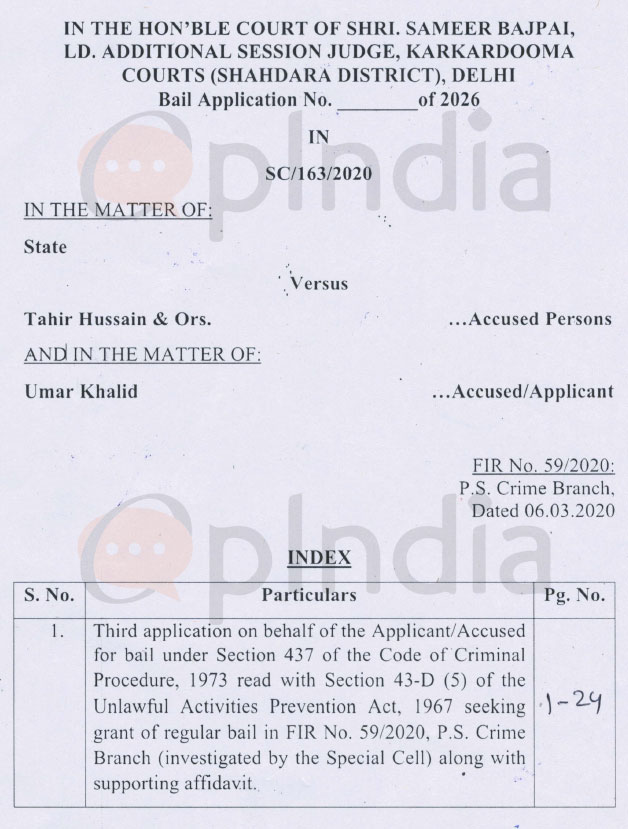
The application itself reproduced the Supreme Court’s observation that the case involved several accused persons, voluminous documentary and electronic evidence and accusations concerning a structured and continuing conspiracy. The court also said the record did not show that Umar Khalid and the other accused were in jail only because of prosecution delays or that they had played no role in causing those delays.
While a debate over prolonged pre-trial detention is legitimate in a broader context, in Umar Khalid’s case, the delay in the trial was not caused by the justice system but by the accused themselves. Umar Khalid and the other accused in the larger conspiracy case used every possible tactic to delay the trial and then used the delay as an excuse to seek bail. From repeated bail pleas to pleas seeking to prevent the trial from starting, there was enough evidence to show that India’s justice system was not the culprit behind the six-year-long delay in the trial.
CJP protesters called Umar Khalid their leader
Support for Khalid was also visible at CJP’s first major protest at Jantar Mantar on 6th June. One protester was filmed declaring, “Umar Khalid is our leader.” Another said that he supported Khalid and saw nothing wrong with doing so. A CJP supporter also described Khalid and Sharjeel Imam as potential future occupants of the country’s highest political offices.
"Umar Khalid is Our Leader" — Cockroach Supporter at 'Jantar Mantar'
— Dhirendra Singh (@dhiru13) June 6, 2026
Nothing Strange they are aligned with Cockroach Party Leadership.. #IndiaRejectsCJP #cjp_पार्टी pic.twitter.com/lTbXaOmizo
When a woman questioned an older supporter about Khalid, he responded with a crude and abusive remark instead of addressing the charges. At another protest, a participant named Faizan Ansari criticised CJP members who supported Khalid, showing that the issue had become a point of conflict even among those present at the demonstrations.
Faizan Ansari, being a Muslim, is saying that the members of the Cockroach Party who support Umar Khalid, a terrorist who raised the slogan 'Bharat tere tukde honge', beta tukde tumhari party ke honge… pic.twitter.com/cqSwXIug85
— Dilpreet Grewal ☬ (@DpreetG) June 11, 2026
Nevertheless, the repeated declarations of support were not isolated remarks disconnected from the organisation. They reflected the language already being used by the founder, spokespersons and members of CJP’s Discord community.
Cockroach 🪳 saying I support Umar Khalid, there is nothing wrong in it.
— Oxomiya Jiyori 🇮🇳 (@SouleFacts) June 7, 2026
I don’t know Chicken neck, I have no idea.
These cockroach 🪳 are the real danger, immediately HIT should be used against them. pic.twitter.com/F4QkKs4DLM
Calls to free Umar Khalid flooded CJP’s Discord channel
CJP’s Discord channel, which had reportedly gathered more than 20,000 members within days of its launch, provided a clearer picture of the ideological direction in which parts of the movement were heading. OpIndia’s investigation into the channel revealed highly problematic trend to support Khalid.
When a user criticised Dipke for supporting Khalid, another member said that Dipke’s support for Khalid was precisely why he would now fully back both Dipke and CJP. The user called Khalid’s imprisonment a human rights violation.
In another discussion, a member declared, “Umar Khalid is exactly what we need in this country, which is why CJP exists.” Several “Free Umar Khalid” messages appeared across the channel. Khalid was described as a “revolutionary”, while he and Dipke were called “fighters for freedom”. One user imagined Dipke as India’s Prime Minister and Khalid as Defence Minister.
Others insisted that the accusations against Khalid were baseless, claimed that the judiciary was compromised and argued that he had been branded a terrorist because of his religion. One user reasoned that Khalid could not be a terrorist because the charge had not been proved after several years.
When questions were raised about the larger conspiracy case, the discussions routinely shifted from evidence to emotion. Khalid was described as a student, scholar, political activist, victim, revolutionary and symbol of resistance. The police, media and judiciary were portrayed as compromised institutions acting together against him.
This was not an examination of the case. It was a method of making the examination itself appear immoral.
Who is Umar Khalid and what is his role in the Delhi Riots conspiracy?
The prosecution did not present Umar Khalid as a street rioter who personally threw stones or set property on fire. Its case portrayed him as a planner, coordinator and ideological driver of the larger conspiracy behind the February 2020 Delhi Riots.
Therefore, the repeated argument that Khalid was not physically present in north-east Delhi during the violence did not, by itself, answer the accusations against him. In a conspiracy case, the prosecution is required to establish participation in the alleged plan, not physical presence at every location where that plan was allegedly executed.
The prosecution cited Khalid’s speech at Amravati on 20th February 2020, in which he referred to 24th February, the day then-US President Donald Trump was scheduled to visit India. The riots began four days after the speech.
His name appeared in FIR 59, FIR 114 and chargesheets connected to the larger conspiracy. The prosecution referred to the meeting at Shaheen Bagh on 8th January, Khalid Saifi’s alleged role as a link between Umar Khalid and Tahir Hussain, discussions about taking “big action” over the Citizenship Amendment Act and the National Register of Citizens, alleged funding and logistical assistance, WhatsApp groups, pamphlets, speeches, meetings, digital trails and witness statements.
The prosecution also cited post-riot conversations with activists, celebrities, journalists and media figures to argue that an effort had been made to build a favourable narrative after the violence.
A structured campaign to present Khalid as a leader while hiding his past
The Guardian profile and the CJP campaign followed the same broad script. First, the charges were stripped of their context. References to conspiracy, secret meetings, funding, coordination and mobilisation were replaced with phrases such as “a speech” and “a WhatsApp group”.
Second, the focus was shifted entirely to Khalid’s identity and suffering. His years in prison became proof of persecution, while questions about the case were presented as dehumanising attacks.
Third, every institution that did not endorse the preferred narrative was delegitimised. The police were accused of fabrication, the judiciary was called compromised and journalists raising inconvenient questions were dismissed as “godi media”.
Finally, Khalid was elevated from an accused demanding bail to a revolutionary, freedom fighter, national leader and even a prospective minister.
The objective was not merely to argue that a prisoner deserved a timely trial. It was to erase the distinction between an accused seeking legal relief and a political icon whose innocence had to be accepted in advance.
How CJP and the campaign for Khalid could be connected
CJP held its first protest at Jantar Mantar on 6th June. Khalid’s third bail application was also moved during the same early-June period, with the supporting affidavit bearing a 5th June stamp. The application sought regular or interim bail on the grounds of prolonged incarceration and recent Supreme Court developments.
At the protest, CJP supporters publicly called Khalid their leader. On Discord, members demanded his release and described him as exactly what the country needed. The founder and spokespersons had already endorsed the same broad narrative. Weeks later, The Guardian supplied the international human-interest version of that argument, and Congress and left-wing commentators amplified it.
CJP presents itself as an outlet for young people frustrated over NEET, examinations, unemployment and the political establishment. Those issues offer it a broad and emotionally charged recruitment base. Yet within its leadership statements, protest conversations and online forums, Umar Khalid is repeatedly projected as a victim, hero and future leader.
This raises a serious question about whether NEET is the movement’s defining cause or merely the most useful mask for a wider ideological mobilisation.
Conclusion
Every accused has the right to seek bail under Indian law, demand a speedy trial and contest every accusation against him. It is the duty of the judiciary to determine whether the prosecution proves its case. However, the right to a legal defence is not the same as a right to have the allegations erased from public discussion. Nor does prolonged incarceration automatically establish innocence.
The Guardian’s carefully constructed prison memoir, CJP leaders’ public statements, protest-site declarations, Discord campaigns and political amplification all move in one direction, away from scrutiny of Khalid’s role in the Delhi Riots conspiracy and towards his rehabilitation as a persecuted national figure.
Over the past six years, Umar Khalid has been presented as a hero, a rising leader and a person who has been wronged by the Government of India. His role in the Delhi Riots and his views about terrorists such as Afzal Guru are slowly being pushed under the rug with every article like the one published by The Guardian. The orchestrated delay in the trial has provided this so-called “student leader” with an easy way to become a prominent personality in the political arena.


