

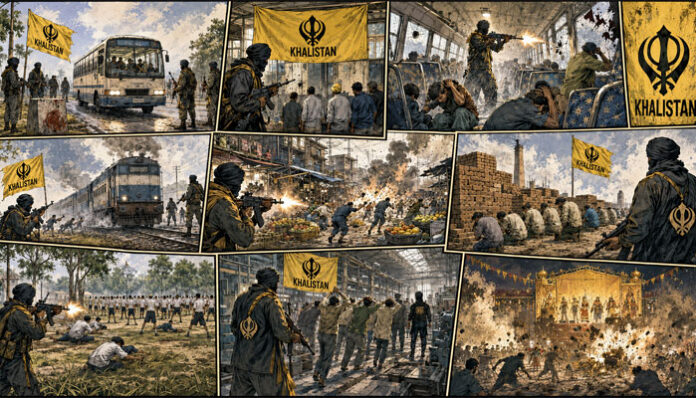
The Punjab insurgency is often remembered through political assassinations, Operation Blue Star and the counterterrorism campaign that followed. But another part of that history lies in attacks on ordinary Hindu civilians. Khalistani terrorists repeatedly targeted buses, trains, markets, workplaces and public gatherings, sometimes separating passengers by religious identity before killing them. The pattern had emerged even before Operation Blue Star and continued through the bloodiest years of the insurgency.
One of the earliest notorious incidents took place near Dhilwan in October 1983, when six Hindu passengers were taken off a bus and shot after their religion was identified. Another four Hindu passengers were killed in Kapurthala the following month. In February 1984, months before the Army entered the Golden Temple complex, multiple attacks on buses and trains left 11 Hindus dead in a single day. In May, terrorists hijacked a bus near Moga and killed four Hindu passengers. These incidents show that the communal targeting of civilians had already become part of the insurgency before June 1984.
The attacks became increasingly brutal. Near Muktsar in July 1986, terrorists reportedly ordered women, children and identifiable Sikh passengers to leave a bus before firing on those who remained. At least 14 of those killed were believed to be Hindus. Four months later, near Khuda in Hoshiarpur district, Hindu passengers were ordered off another bus and shot as they descended. Twenty-four people were killed. Contemporary reports linked such killings to an attempt to divide Hindus and Sikhs and frighten Hindus into leaving Punjab.
The Lalru massacre of 6th July 1987 became one of the most horrifying examples of this strategy. Armed men stopped a Haryana Roadways bus travelling from Chandigarh towards Rishikesh, drove it away from the highway, looted passengers and opened fire from both ends. Thirty-eight people, including five women and four children, were killed. The next day, two buses were attacked near Fatehabad in Haryana, killing 34 Hindu passengers. By 1991, trains too had become killing grounds. At least 80 people were killed in attacks on two passenger trains in Ludhiana district in June, while more than 50 passengers who reportedly appeared to be Hindu were shot on a train near Sohian in December.
Public transport was not the only target. Around 20 labourers were killed at Mallian near Jalandhar in March 1986. In June 1989, terrorists opened fire on an RSS morning gathering at Nehru Park in Moga, killing at least 24 people, with later counts putting the toll higher. In March 1990, gunmen opened fire in a crowded Abohar market and killed 22 Hindus. The violence also travelled beyond Punjab. More than 40 people were reported killed in bomb explosions during Ram Lila celebrations in Rudrapur in October 1991, while 16 Hindu factory workers were reportedly killed at Harkishanpura in March 1992.
The victims were pilgrims, labourers, commuters, shopkeepers, factory workers, women and children. In several attacks, visible religious markers such as turbans and beards became the difference between being allowed to leave and being killed. The objective, as contemporary officials and reports repeatedly suggested, was larger than the immediate death toll: create fear among Hindus in Punjab, provoke retaliatory violence against Sikhs elsewhere and break the everyday coexistence between the two communities.
The strategy belonged to Khalistani terrorist organisations, not the Sikh community. Sikh politicians, policemen, civilians and opponents of separatism were themselves murdered by terrorists. Harchand Singh Longowal, who signed the Rajiv-Longowal Accord in 1985, was assassinated within weeks. Remembering the massacres of Hindus, therefore, does not mean blaming Sikhs. It means acknowledging a documented part of the insurgency in which ordinary civilians were deliberately selected for death because of their religious identity.
Read the full article on Chapter One Magazine.


