

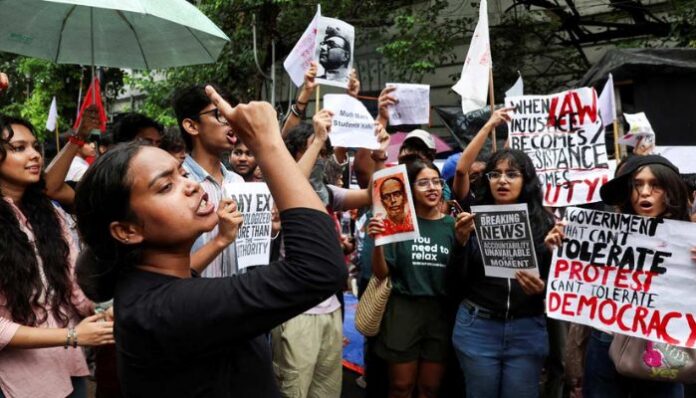
Amid the Cockroach Janta Party’s celebration videos circulating on social media, an X user, Yashaswinee Raje Singh, with X handle @ywineethpooh, on Sunday, 26th July, shared a post detailing the harassment and misogyny she faced while attending the claimed student protests. The protests were organised by another leftist group, the CJP, at Jantar Mantar.
Curiously, Singh posted her ordeal a day after CJP claimed victory as the Centre agreed to its demands. But even then, Singh appeared to shield the CJP from accountability, saying her intention was not to tear down the movement but to expose what she described as the glaring hypocrisy of those leading it. Singh, a daughter of a former BJP MLA from Uttar Pradesh and who recently dominated trends on social media platforms for her ‘friendship’ with a Pakistani, highlighted how, beneath the tall claims of fighting for justice, hope, and solidarity, these spaces are frequently infected by brazen misogyny, sexual assault, and a rampant rape culture.
In her post, Yashaswinee recounted the horrifying sequence of events from around 12:15 am on 24th July. As she and her sister tried to make their way toward the main stage, hundreds of protestors were packed tightly in front of metal detectors in complete chaos. Suddenly, a barricade collapsed just three feet away from them, triggering a dangerous surge that felt like the start of a stampede. Deciding it was unsafe to continue, they turned around to leave. It was at this moment that a man behind her attempted to grope her and force his hand between her legs. Reacting instinctively to the assault, she turned around and slapped the perpetrator thrice.
— Yashaswinee Raje Singh (@ywineethepooh) July 26, 2026
What happened immediately afterwards was even more infuriating. A young male volunteer who witnessed the incident rushed over, saw her visibly shaken, and instead of offering help or asking what happened, began aggressively shouting at her, “Aap yahaan kyun aa rahe ho?” When she countered, “Women are being sexually assaulted at the protest, and your response is to yell at them?!”, the volunteer continued yelling, “Main kya karun? Aap sun hi rahe ho!” As a crowd gathered, another young male volunteer casually dismissed the sexual assault, sighing, “Ab yeh sab galti toh hoti rehti hai. Aap udhar chale jao.”
Yashaswinee highlighted how the political humour and slogans at the protest leaned heavily on disgusting misogyny, ranging from boys holding sanitary pads reading “Modi, wear this” to posters depicting male politicians in bikinis, bras, or schoolgirl skirts with vulgar phrases.
A persistent pattern across left-led movements
Yashaswinee’s experience is not an isolated incident, nor is it the first time women have faced systemic harassment, intimidation, and assault in protests organised or backed by the Left ecosystem. Time and again, under the guise of revolution and civil rights movements, female attendees, journalists, and activists have found themselves exposed to predators who operate with near-total impunity while the organisers turn a blind eye.
A glaring example of this unfolded during the farmer protests at the Delhi borders. Allegations of sexual assault against prominent activists associated with the movement opened a Pandora’s Box. Social media documenter Mohammad Zuber, associated with the Kisan Ekta Morcha and Trolley Times, was accused of raping a woman, after which he deactivated his Instagram account. When the survivor spoke out, Varun Chouhan, a key figure in Trolley Times, mocked her publicly.
Later, multiple women came forward through “The Kaur Movement” detailing how Varun Chouhan had manipulated, groomed, and sexually assaulted them. One victim shared how he forced himself upon her during an election campaign meeting, leaving her with physical injuries and deep emotional trauma, while another recounted how he groped her in his room and dismissed her tears by saying, “I know you want it.”
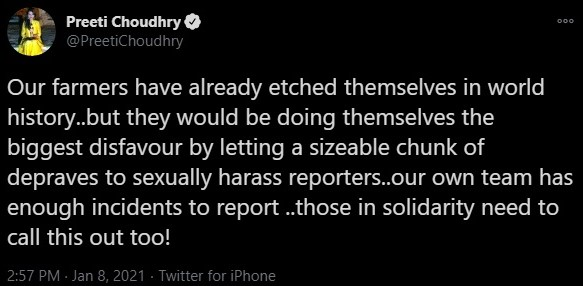
It was not just female activists who were targeted; journalists attempting to cover the demonstrations faced constant abuse. Preeti Choudhry, Editor at India Today, publicly called out the “sizeable chunk of depraves” among the protesting groups who were sexually harassing female reporters on the ground. When she spoke out against the pervasive groping and misconduct, figures linked to the movement tried to justify the behaviour, claiming news-hungry reporters were asking for it. Choudhry had to publicly remind them that if someone did not want to give an interview, they could simply decline rather than pinch a reporter’s buttocks.
Similarly, during the anti-CAA protests, women faced political violence and harassment from leaders associated with the movement. In one high-profile incident in Northeast Delhi, Aam Aadmi Party MLA Abdul Rehman, who had earlier been booked by the Delhi Police for inciting mobs during the anti-CAA demonstrations in Seelampur, was booked under an FIR at the Jaffrabad police station after a woman accused him and his associates of eve-teasing, physical assault, and thrashing her when she dared to object to their harassment during municipal bypolls.
Yogendra Yadav dismissed concerns raised by women during Farmers protests
When allegations of sexual abuse emerge within these movements, the leadership’s primary instinct is rarely to seek justice for the victim; instead, it is to protect the image of the protest. A tragic testimony to this culture of complicity was the case of a 25-year-old female activist from West Bengal who travelled to the Tikri border to join the farmer protests. She was sexually harassed on the train journey to Delhi and subsequently gang-raped at the protest site by two men affiliated with the Aam Aadmi Party, Anil and Anup Singh, before contracting COVID-19 and tragically passing away in a hospital.
Professional protester Yogendra Yadav later admitted in a press conference that he was aware of the woman’s predicament well before her death. Yadav revealed he had been in contact with her and her father since 24th April, 2021, speaking to her when she was being taken away by the accused, who lied about their location.
Yet, despite knowing about the harassment and suspecting foul play, Yadav and the protest committee did not inform the police. Even after the victim’s father explicitly detailed the horrific rape to Yadav on 1st May, 202,1 after her funeral, the leadership restricted its response to internal measures like “social boycotts” and removing tents, waiting for days while the accused publicly claimed it was a political conspiracy to defame the movement.
The victim’s father later noted that Yadav turned a blind eye to the brutalities and failed to alert law enforcement, prioritising the protection of the protest over the life and dignity of a young woman.
The expectation of the left ecosystem
This recurring apathy points to a broader, toxic ethos within the Left ecosystem: the expectation that women must keep quiet about their personal trauma for the “greater good” of the political cause.
Victims are made to feel that speaking out against abusers within their ranks will weaponise the narrative for their political opponents, damage the movement, or dilute the fight against fascism. In this twisted hierarchy of priorities, political optics are treated as far more sacred than human rights, and women are coerced into enduring abuse so that the movement’s facade remains untarnished.
Over time, this ideological conditioning becomes so deeply internalised that many women affiliated with the Left end up rationalising their own silence. Instead of demanding immediate accountability, they convince themselves that reporting a predator who belongs to a protected identity group or a shared political ideology will fan hatred or empower their political adversaries.
Brainwashed into overlooking abuse
This troubling mindset is clearly illustrated by public figures within the liberal-left space who have openly admitted to concealing sexual misconduct to protect their political narratives.
A recent case involved The Wire journalist Omar Rashid, who was accused by a Hindu woman of sexual coercion, physical abuse, and psychological manipulation, where he reminded her of her identity in a “Hindu Rashtra” to enforce her silence for the “greater good.”
Commenting on the incident, YouTuber who likes to refer to herself as a historian, Ruchika Sharma, publicly revealed that she too had chosen not to name or report her own sexual abuser in the past. She also claimed that they chose silence over justice, not out of fear of their abusers, but out of fear of “fanning Islamophobia.” She argued that if she spoke out, “dingbat Sanghis will just use it to further their own horrible communal agenda.” In Sharma’s worldview, the fear that right-wing opponents might gain political mileage from her story outweighed the necessity of holding a sexual predator accountable.
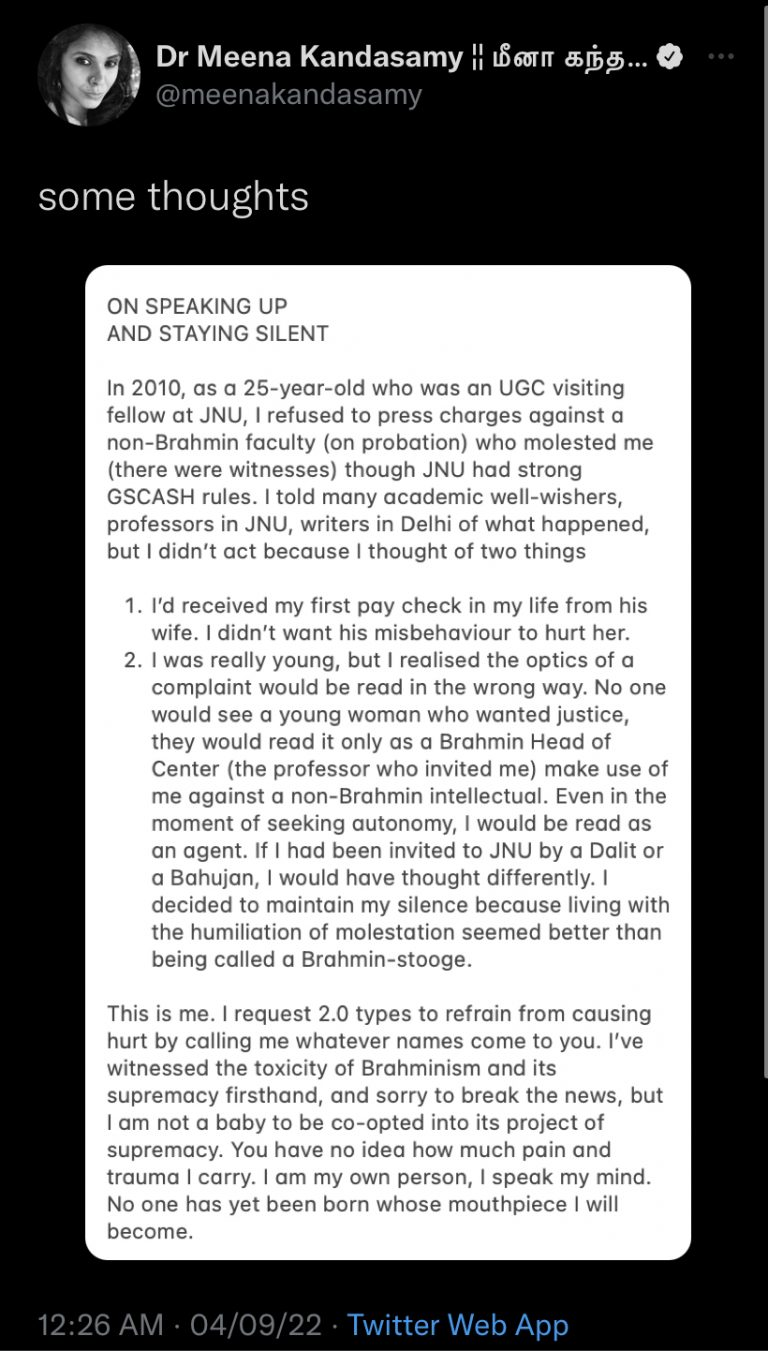
An even more explicit admission came from anti-Brahmin activist and writer Dr Meena Kandasamy. Reflecting on an incident from 2010 when she was a 25-year-old visiting fellow at JNU, Kandasamy admitted that she actively refused to press charges against a non-Brahmin faculty member who had molested her, despite having eyewitnesses and strict institutional rules like GSCASH available to her.
She explained her refusal to seek justice by admitting that her primary fear was being labelled a “Brahmin-stooge” by her peers. She wrote that “living with the humiliation of molestation seemed better than being called a Brahmin-stooge,” showing how ideological hatred completely subverted her self-respect and pursuit of justice.
When women are groomed to believe that exposing a rapist or a molester is an act of political treason, predators are given the ultimate haven. True gender justice cannot exist in spaces where progressive ideals are used as a cover to justify silence, cover up abuse, and protect perpetrators.


