

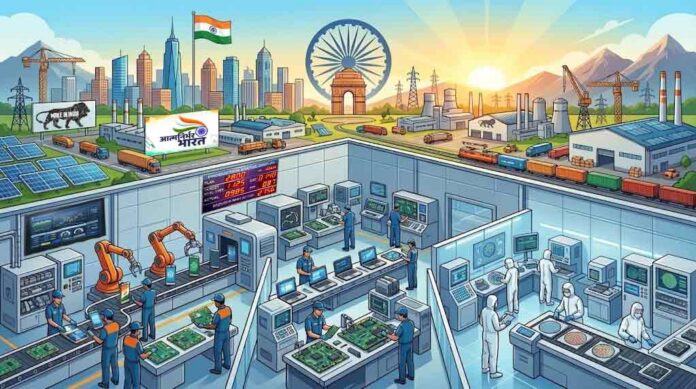
HomeSpecialsFrom policy to factories and jobs: How India became a hub of new technology...

From policy to factories and jobs: How India became a hub of new technology manufacturing

This is the story of sequenced policy — from the vision of Make in India, through localisation programmes, the catalytic PLI schemes launched from 2020, the component and semiconductor missions, and the fresh approvals of Semicon 2.0 and the Mobile Phone Manufacturing Scheme.

On 25 September 2014, months after forming the BJP-led NDA government, Prime Minister Narendra Modi stood at Vigyan Bhawan in New Delhi and launched the Make in India initiative. Addressing a gathering of top global CEOs, he redefined Foreign Direct Investment as “First Develop India,” underlined India’s unique combination of democracy, demography and demand, and declared that the country would no longer remain content as a mere market.

It would become a competitive producer, designer and innovator, he said. Twenty-five priority sectors were identified, separate sectoral brochures were released, and a dedicated portal was created so that investors could receive answers to queries within 72 hours. The ambition was clear: raise manufacturing’s share of the economy, create large-scale employment, and embed India firmly in global value chains.

While India had already become an IT powerhouse, the country has missed the manufacturing revolution taking place in other countries. The Modi government planned to change it, because as a large number of people were moving away from agriculture, the industrial sector needed to grow, as the dominant service sector can’t absorb everyone.

Starting with the announcement of Make in India and Atmanirbhar Bharat initiatives, the Modi government has launched a series of schemes and policy initiatives to encourage setting up of manufacturing units, especially in new technology areas like mobile phones, electronics and semiconductors.

While the Make in India initiative covered several broad areas, from manufacturing to logistics, industrial corridors, tax reforms and new payment initiatives, this article focuses only on initiatives focused on manufacturing in new technology sectors.

Twelve years later, the transformation is measurable and dramatic. Mobile phone production has risen roughly 33 times — from about ₹18,000–18,900 crore in 2014-15 to ₹6.27 lakh crore in 2025-26. Exports of mobile phones have surged 165 times, from roughly ₹1,500–1,566 crore to ₹2.59–2.60 lakh crore. In 2014, India was heavily dependent on imports for mobile phones, with around 80% coming from abroad. And now, 99.2 per cent of the mobile phones used in India are manufactured domestically. India is now the world’s second-largest mobile phone manufacturer by volume. In FY 2025-26 mobile phones overtook traditional leaders to become India’s single largest export item.

Overall electronics production has grown nearly seven-fold to ₹13.11 lakh crore, and electronics exports eleven-fold to ₹4.24 lakh crore. The Production Linked Incentive (PLI) architecture across 14 sectors has attracted actual investments exceeding ₹2.40 lakh crore, generated more than 14.15 lakh direct and indirect jobs, and enabled exports of over ₹15.2 lakh crore as of 31 March 2026.

One fact remarkably reflects the growth in Made-in-India phones. Before the 2019 Lok Sabha elections, in almost every speech that Rahul Gandhi made, he used to target the central govt over imported mobile phones. He repeatedly claimed that every time an Indian took a selfie, a Chinese youth got a job, and promised to set up a mobile phone plant in the place he was delivering the speech. Cut to 2026, and he has stopped mentioning it, because the India has already achieved what he was promising. Later he tried to change his tactic to claim that phones made in India are actually assembled, but eventually stopped mentioning the topic altogether, as his advisors might have realised that the strategy was backfiring.

This is the story of sequenced policy — from the vision of Make in India, through localisation programmes, the catalytic PLI schemes launched from 2020, the component and semiconductor missions, and the fresh approvals of Semicon 2.0 and the Mobile Phone Manufacturing Scheme.

The Early Building Blocks: 2014 to 2020

Make in India was never only a slogan. It was accompanied by concrete measures. The government progressively liberalised FDI, simplified procedures and introduced the Phased Manufacturing Programme (PMP) for mobile handsets. Under PMP, customs duties and incentives were calibrated year by year to encourage progressive localisation of components and sub-assemblies. Public procurement preferences for domestically manufactured electronic products were strengthened.

The Modified Special Incentive Package Scheme (M-SIPS) and later the Scheme for Promotion of Manufacturing of Electronic Components and Semiconductors (SPECS) provided capital expenditure support. SPECS, notified on 1 April 2020, offered a 25 per cent incentive on capital expenditure for electronic components, semiconductor and display fabrication units, ATMP units, specialised sub-assemblies and capital goods.

By the time SPECS matured, 58 applications had been approved with a total project cost of about ₹22,081 crore, approved capital expenditure of ₹16,562 crore and approved incentive of ₹3,316 crore. Units under the scheme had invested over ₹9,500 crore, produced goods worth nearly ₹26,000 crore and provided high-skill employment to almost 40,000 professionals

These measures raised the number of mobile manufacturing units from just two in 2014 to well over 200. Yet value addition remained relatively shallow, and India continued to run a significant trade deficit in finished handsets until the inflexion around 2019.

The Full PLI Architecture: Fourteen Sectors, One Mission

The decisive institutional intervention that converted the Make in India vision into measurable industrial outcomes was the Production Linked Incentive (PLI) scheme architecture. Beginning in 2020 and expanded thereafter, the government launched PLI programmes across 14 key sectors with a consolidated outlay of approximately ₹1.97 lakh crore. The schemes were conceived as a performance-based instrument rather than a traditional grant or subsidy. Their designs were based on a clear set of objectives and a carefully structured incentive mechanism.

The core of the PLI framework is a set of five inter-linked. First, to attract large-scale investments — both domestic and foreign — into manufacturing capacity that India lacked or in which it remained uncompetitive. Second, to significantly increase domestic production and achieve economies of scale so that Indian units could compete on cost and quality in global markets. Third, to boost exports and integrate Indian manufacturers deeper into global value chains. Fourth, to generate large-scale employment, particularly in labour-intensive and high-skill segments. Fifth, to reduce chronic import dependence in strategic and high-growth sectors and move the country towards technological self-reliance under the broader Atmanirbhar Bharat vision.

The operating mechanism was simple yet rigorous. Eligible companies receive a financial incentive calculated as a percentage of incremental sales of manufactured goods over a defined base year. The incentive rates typically range between 4 per cent and 6 per cent for most sectors, though they are higher in select cases — up to 20 per cent of value addition for drones and drone components, and elevated rates for certain automobile and auto-component categories. The incentive is usually available for five or six consecutive years after a short gestation period, provided the applicant meets both the prescribed incremental investment thresholds and the incremental sales/production targets each year. Claims are subject to verification, and disbursement occurs only after the company demonstrates actual performance.

Eligibility criteria were calibrated to encourage both global champions and domestic players. In several schemes, different thresholds applied to large global companies and to domestic or MSME applicants. Some schemes (notably telecom) later introduced additional incentives for design-led manufacturing to encourage higher domestic value addition and intellectual property creation. Applications were invited through transparent online portals, with selection based on clear quantitative criteria. An Empowered Group of Secretaries, along with the nodal ministries, monitors progress and addresses implementation issues.

By design, the PLI schemes were sector-specific yet guided by a common philosophy: reward actual production and sales rather than mere investment announcements, push manufacturers towards scale, and create competitive pressure that improves quality and cost structures. The result, visible by March 2026, has been actual investment of over ₹2.40 lakh crore, employment generation of more than 14.15 lakh persons (direct and indirect), and exports exceeding ₹15.2 lakh crore under the PLI umbrella — clear evidence that the architecture moved beyond policy intent into industrial reality.

Manufacturing of several items, including mobile phones, exploded in India as a result of the PLI scheme. As global companies were already looking to diversify their export bases out of China, the scheme have them the motivation to choose India. The result was spectacular, with almost all phone makers, including contract manufacturers, investing heavily in expanding their manufacturing capacities in India.

SchemeSectorTotal OutlayInvestment as on 31 March 2026Employment as on 31 March 2026
Large Scale Electronics Manufacturing (LSEM)Mobile phones & specified electronic components₹40,951 crore₹20,580 crore1,69,249
Critical Key Starting Materials / Drug Intermediaries & APIs (Bulk Drugs)Bulk Drugs / APIs₹6,940 crore₹5,070 crore5,226
Manufacturing of Medical DevicesMedical Devices₹3,420 crore₹1,151 crore5,268
Pharmaceuticals (Drug Formulations)Pharmaceuticals₹15,000 crore₹45,158 crore1,14,880
Automobiles and Auto ComponentsAutomobiles & Auto Components₹25,938 crore₹44,326 crore67,820
Specialty SteelSpecialty Steel₹6,322 crore₹23,896 crore14,138
Telecom & Networking ProductsTelecom & Networking Products₹12,195 crore₹5,278 crore33,610
Electronic / Technology Products (IT Hardware)IT Hardware / Electronic Products₹17,000 crore₹908 crore4,859
White Goods (ACs and LED Lights)White Goods – ACs & LEDs₹6,238 crore₹6,409 crore52,703
Food ProductsFood Processing₹10,900 crore₹9,207 crore3,29,200
Textile Products (MMF & Technical Textiles)Textiles (MMF & Technical Textiles)₹10,683 crore₹8,117 crore33,427
High Efficiency Solar PV ModulesSolar PV Modules₹24,000 crore₹64,873 crore14,794
Advanced Chemistry Cell (ACC) BatteryACC Batteries₹18,100 crore₹4,570 crore1,245
Drones and Drone ComponentsDrones & Drone Components₹120 crore₹595 crore2,650
Total ₹1,97,807 crore₹2,40,138 crore8,49,069

The solar, pharmaceutical and automobile sectors absorbed the largest capital, while electronics and food processing delivered substantial employment. The schemes have enabled domestic production of critical items that were earlier imported — including 191 bulk drugs manufactured in India for the first time under the pharmaceuticals PLI.

The Mobile and Large-Scale Electronics Transformation

The flagship PLI for Large Scale Electronics Manufacturing (LSEM) was notified on 1 April 2020 with an outlay of approximately ₹40,995 crore. It offered incentives of 4–6 per cent on incremental sales of mobile phones (invoice value ₹15,000 and above) and specified electronic components for five years. Global companies needed base-year sales above ₹10,000 crore; domestic companies needed sales above ₹100 crore.

By 31 March 2026, the scheme had far exceeded its original targets. Cumulative investment reached ₹20,587 crore against a five-year target of ₹7,000 crore (294 per cent achievement). Production stood at ₹11.61 lakh crore against the target of ₹8.13 lakh crore (142 per cent of target) and exports at ₹6.21 lakh crore against the target of ₹4.88 lakh crore. (132 per cent). The scheme catalysed broader ecosystem investments estimated at around ₹96,000 crore. Mobile phone production under the larger electronics umbrella grew about 2.4 times since the scheme’s launch, while imports of finished mobiles declined by roughly 77 per cent. Domestic value addition rose to around 23 per cent by FY 2023-24 according to external evaluation.

The physical transformation is visible in the factories. Foxconn (Hon Hai Precision Industry) operates major facilities in Sriperumbudur in Tamil Nadu and a sprawling nearly 300-acre campus at Devanahalli near Bengaluru. The Devanahalli plant, which began trial production in 2025, rapidly scaled to employ close to 30,000 workers — predominantly young women — within months and has capacity to reach 50,000. It produces the latest iPhone models, with the bulk of output exported.

Tata Electronics has emerged as a formidable Indian champion. It acquired Wistron’s operations, formed a joint venture with Pegatron, and is expanding at Narasapura (Karnataka), Chengalpattu (Tamil Nadu) and a new greenfield facility at Hosur (Tamil Nadu). By 2026, Tata Electronics had become one of the largest contract manufacturers for Apple in India and was employing tens of thousands.

Samsung continues large-scale production, including display-related capacity. Dixon Technologies, a homegrown EMS (Electronics Manufacturing Services) player, rose dramatically: it claimed the single largest share of smartphone production volume in India in calendar year 2025 (19 per cent), overtaking Samsung, and led domestic EMS companies to a combined 28 per cent share of smartphone production in FY26. Dixon assembles for Motorola, Realme, Xiaomi, Samsung, Transsion and others, and has capacity in the range of 40–50 million units annually, with further expansion under way through partnerships.

Apple’s India footprint has grown to roughly one in four iPhones produced globally. Samsung and Chinese brands have expanded both domestic and export-oriented capacity. The net result is that India has moved from net importer of finished mobiles to net exporter and the second-largest producer by volume. Smartphones now form the single largest export commodity.

Last month, the Mobile Phone Manufacturing Scheme (MPMS) was cleared by the Union Cabinet with an outlay of ₹62,500 crore for five years (FY 2026-27 to 2030-31). It succeeds the original PLI-LSEM and offers incentives of 2.25–5 per cent on eligible sales, plus additional incentives for domestic sourcing of components (up to 1.5 per cent) and for local product design and R&D (3 per cent) aimed at building Indian brands and patents. The scheme targets cumulative production of around ₹39 lakh crore and approximately 60,000 direct jobs while pushing domestic value addition higher.

Building the Component Ecosystem

While the PLI schemes successfully scaled the assembly of finished products such as mobile phones, the next critical challenge was the shallow domestic value addition in components. Display modules, camera modules, multi-layer printed circuit boards, lithium-ion cells and other high-value parts continued to be largely imported. To address this structural gap, the government launched a dedicated scheme focused exclusively on the component layer of the electronics value chain.

Alongside the incentive-based schemes, the government also addressed the critical need for quality industrial infrastructure. The Modified Electronics Manufacturing Clusters (EMC 2.0) Scheme, notified in April 2020 with an outlay of ₹3,762 crore, was designed to create world-class electronics manufacturing clusters with common facilities and amenities. These include ready industrial plots, Ready Built Factory (RBF) sheds and plug-and-play infrastructure so that companies can set up operations quickly. As of late 2025, 11 EMC projects and 2 Common Facility Centres had been approved across 10 states, covering nearly 4,400 acres. These projects carry a projected investment of over ₹1.46 lakh crore and are expected to generate approximately 1.80 lakh jobs. By providing ready infrastructure, EMC 2.0 has complemented the PLI and component schemes, reducing the time and cost of setting up manufacturing units and strengthening the overall electronics ecosystem.

The Electronics Component Manufacturing Scheme (ECMS) was approved by the Union Cabinet and notified on 8 April 2025 with an initial outlay of ₹22,919 crore. The Union Budget 2026–27 later enhanced the allocation to ₹40,000 crore, reflecting strong industry response. The scheme has a tenure of six years with an optional one-year gestation period. Its core objectives, as stated in official documents, are to build a robust and self-sustaining ecosystem for electronics component manufacturing, attract both domestic and global investments across the value chain, raise domestic value addition, and integrate Indian industry more deeply into global supply chains. It is also designed to complement the India Semiconductor Mission.

Unlike the pure production-linked structure of the main PLI schemes, ECMS uses a hybrid incentive model that combines turnover-linked support with capital expenditure incentives. This is intended to encourage both capacity creation and actual production of critical components and sub-assemblies.

The response from industry has been substantial. By early 2026, investment commitments under the scheme had reached ₹1,15,351 crore, nearly double the original target of ₹59,350 crore. Projected production over the scheme period stands at ₹10,34,751 crore, and direct employment is expected to exceed 1.41 lakh jobs. As of the latest available data, 46 projects across 11 states had already been approved in three tranches, with a combined investment of ₹54,567 crore and projected production of ₹3,67,343 crore. They are expected to generate direct employment for around 51,000 people.

These approved applicants would manufacture a wide spectrum of electronic components such as multi-layer PCBs, camera modules, connectors, oscillators, optical transceivers, and enclosures for mobile and IT hardware products as well as related devices.

Electronics have emerged as India’s third largest and fastest growing export category in 2024–25, rising from the seventh position in 2021–22. In the first half of FY 2025–26, electronics exports stood at USD 22.2 billion, maintaining strong growth momentum and placing the sector on course to become the country’s second largest exported item.

India’s electronics industry has grown on the back of strong policy support and targeted government initiatives. By targeting the missing middle of the electronics value chain, ECMS aims to convert India’s success in final assembly into deeper manufacturing capability and higher domestic value addition — a necessary step if the country is to move from being a major assembler to a more complete electronics manufacturing power.

Telecom, IT Hardware and Drones

The PLI for Telecom and Networking Products (Department of Telecommunications, outlay ₹12,195 crore) has drawn ₹5,278 crore in investment and created over 33,600 jobs. An additional 1 per cent incentive was introduced for design-led manufacturing. The IT Hardware 2.0 scheme has begun to scale laptop, server and related production.

The PLI for Drones and Drone Components (Ministry of Civil Aviation, outlay ₹120 crore) offered incentives of up to 20 per cent of value addition — the highest rate among all PLI schemes. Twenty-three beneficiaries (12 drone manufacturers and 11 component manufacturers) were shortlisted. The scheme supported rapid growth in the domestic drone sector, including agricultural and industrial applications, and laid the foundation for higher localisation of flight controllers, navigation and communication modules. Subsequent policy has raised the ambition further, with discussions around expanded outlays and mandatory domestic value-addition targets.

These electronics and drone capabilities feed directly into the Atmanirbhar Bharat push in defence. Private defence startups and established players are increasingly integrating indigenous electronics, sensors, communication systems and unmanned platforms. The same policy ecosystem that built mobile and component capacity is enabling dual-use technologies critical for national security.

The Semiconductor Frontier

Parallel to the success in mobile assembly and component manufacturing, the government launched a far more ambitious programme to build a complete semiconductor ecosystem in India. The India Semiconductor Mission (ISM), also known as the Semicon India Programme, was launched in December 2021 with an outlay of approximately ₹76,000 crore. Its core objectives were to attract global semiconductor companies, develop domestic manufacturing capability across the value chain, reduce strategic dependence on imported chips, create high-skill employment, and position India as a trusted player in the global semiconductor supply chain.

The scheme operates through fiscal support for capital expenditure (typically 50% of project cost under ISM 1.0, later differentiated under 2.0), technology partnerships, and a Design Linked Incentive (DLI) component for chip design startups and MSMEs. An Empowered Committee and the India Semiconductor Mission office evaluate and monitor projects. The policy deliberately covers the full spectrum of the semiconductor value chain rather than focusing only on the most advanced nodes.

Semiconductor manufacturing involves two distinct stages, and India is developing manufacturing units in both. The first category is Fabrication, and the second is Assembly, Testing, Marking and Packaging.

Fabrication is the most complex and capital-intensive facility, where silicon wafers are processed to create the actual chips (integrated circuits). Building a modern fab requires a multi-billion-dollar investment, ultra-clean environments, and advanced technology partnerships. Tata Electronics is building a fabrication plant in Gujarat’s Dholera with an investment of ₹91,000 crore. The plant has a planned capacity of around 50,000 wafer starts per month.

After the wafers are made, Assembly, Testing, Marking and Packaging (ATMP) or Outsourced Semiconductor Assembly and Test (OSAT) units take the finished wafers, cut them into individual chips, package them, and perform rigorous testing. These are less capital-intensive than fabs but critical for completing the manufacturing process and are essential for volume production.

Three ATMP plants have already started production this year: Micron Technology, Kaynes Semicon and CG Semi, all of them in Sanand in Gujarat. Several other packaging and testing plants are coming up in Gujarat, Odisha, Uttar Pradesh and other states, including a massive plant in Assam by Tata Electronics. Overall, 12 projects with investment commitments of about ₹1.64 lakh crore were approved under ISM 1.0.

India’s existing strength in chip design

Even before large-scale manufacturing began, India already possessed a significant global footprint in semiconductor design. Nearly one-fifth of the world’s semiconductor design engineers are based in India, primarily in Bengaluru, Hyderabad, Noida and other technology hubs. Major global companies — including Qualcomm, Nvidia, AMD, Intel, Texas Instruments and others — operate large design centres in the country. Indian teams have contributed to advanced designs, including work on cutting-edge nodes. The Design Linked Incentive scheme under ISM has further supported 24 startup and MSME design projects and provided industry-standard Electronic Design Automation (EDA) tools to over 100 companies and hundreds of academic institutions.

Semicon 2.0

On 15 July 2026, the Union Cabinet approved Semicon 2.0 with a substantially higher outlay of ₹1,27,500 crore. Building on the foundation of the first phase, it is structured around six pillars: chip design and indigenous IP, semiconductor equipment and materials, more fabrication facilities, advanced ATMP/OSAT capacity, research & development, and talent development. Differentiated incentives (ranging from 25% to 40% of project cost depending on the segment) have been introduced to attract both advanced and mature-node investments as well as the critical materials and equipment ecosystem.

India’s emerging role amid global semiconductor shortages

The global semiconductor industry has faced repeated supply shocks in recent years due to geopolitical tensions, concentrated manufacturing in a few geographies, and surging demand from artificial intelligence, electric vehicles, telecommunications and defence. In this environment, India is uniquely positioned to play a stabilising and complementary role.

With a large and growing domestic market, a proven design talent pool, rapidly expanding assembly and packaging capacity, and the policy commitment to build fabs, India offers an alternative and resilient manufacturing base. As more ATMP facilities come online and the first commercial fabs begin, India will not only reduce its own import dependence but also contribute meaningfully to global supply chain diversification — a strategic advantage for both Indian industry and international partners seeking reliable capacity outside traditional hubs.

Jobs, Value Addition and the Road Ahead

The cumulative employment impact of the Make in India and PLI-driven electronics push is now substantial and visible across the country. The electronics manufacturing ecosystem supports nearly 25 lakh jobs (direct and indirect). Within this, the mobile phone manufacturing value chain alone employs around 12 lakh people. Under the PLI schemes across all 14 sectors, more than 14.15 lakh jobs had been generated by the end of March 2026. In the Large Scale Electronics Manufacturing PLI specifically, direct employment had already crossed 1.85 lakh by early 2026, with total employment in the mobile ecosystem significantly higher when ancillary and indirect jobs are included.

A notable feature of this employment generation is the high participation of women, particularly in high-precision assembly and testing roles, where they constitute nearly 70% of the workforce in several large facilities. Clusters in Tamil Nadu, Karnataka, Uttar Pradesh and Gujarat have emerged as major employment hubs, absorbing both skilled engineers and large numbers of semi-skilled and entry-level workers.

On the value-addition front, progress has been steady but remains a work in progress. Domestic value addition in large electronics, which stood at roughly 15–20% at the start of the PLI era, has risen to the 18–23% range. The Electronics Component Manufacturing Scheme and the deepening semiconductor ecosystem are specifically designed to push this figure higher in the coming years by localising displays, camera modules, PCBs, batteries and eventually chips.

Challenges remain. Advanced-node fabrication, specialty materials, equipment manufacturing and deeper design-led intellectual property still require sustained effort. Global geopolitical and tariff uncertainties continue to test supply chains. Yet the direction of travel is unmistakable. From a country that imported the overwhelming majority of its mobile phones in 2014 to one that now manufactures 99.2% of the handsets used domestically, exports them at scale, packages memory chips, and is constructing its first commercial silicon fab, India has travelled a remarkable distance in just over a decade.

Make in India supplied the vision. The PLI architecture supplied the scale and incentives. The component and semiconductor missions are now supplying the depth. With Semicon 2.0 and the new Mobile Phone Manufacturing Scheme in place, the next phase will focus on higher domestic value addition, indigenous design capability, Indian brands, and continued large-scale job creation. The factories are already running. The road ahead is about converting this manufacturing base into lasting technological and economic strength.

Join OpIndia's official WhatsApp channel

  Support Us  

For likes of 'The Wire' who consider 'nationalism' a bad word, there is never paucity of funds. They have a well-oiled international ecosystem that keeps their business running. We need your support to fight them. Please contribute whatever you can afford

Raju Das
Raju Das
Editor and Analyst | Facts first. Bharat above all.

Related Articles

Trending now

Are PM Modi’s foreign visits extravagant? Here’s how his global outreach outpaced Manmohan Singh’s without a proportionate rise in travel expenditure

PM Modi's foreign travel has been more frequent, more geographically expansive, organised around shorter itineraries and involving high-frequency diplomatic travel compared to Singh’s.

Is FCRA Amendment Bill anti-Christian? Debunking the lies and setting the record straight

The disinformation surrounding FCRA Amendment Bill is that it empowers the Indian government to arbitrarily takeover churches and religious institutions. A direct reading of the statutory text demonstrates that this narrative is factually inaccurate.
- Advertisement -

