

HomeNews ReportsGhost in the machine: The escalating threat of 3D-printed guns and how the menace...

Ghost in the machine: The escalating threat of 3D-printed guns and how the menace is almost impossible to stop

From plastic toys to untraceable lethal weapons, digital blueprints are outrunning physical security frameworks—and lawmakers are struggling to catch up.

On 14th August 2026, former software engineer Luigi Mangione pleaded guilty in a US federal court, formally confessing to the assassination of UnitedHealthcare CEO Brian Thompson in December 2024. While the high-profile nature of the victim, a titan of the American healthcare industry, dominated international headlines, law enforcement agencies and security analysts were almost entirely fixated on the weapon used to carry out the attack. When police apprehended Mangione in Pennsylvania, they did not recover a standard, commercially manufactured firearm from his backpack. Instead, they found a black pistol and a silencer, both manufactured outside the bounds of traditional industry and regulatory oversight.

Using a fabricated identity and possessing only basic computer-aided design skills, Mangione had systematically bypassed every background check, waiting period, and federal regulation designed to keep lethal weapons out of the hands of dangerous individuals. He merely downloaded digital blueprints for a gun from the internet, fed them into a consumer-grade 3D printer, and manufactured an untraceable murder weapon and its accompanying sound suppressor in the privacy of a residential space.

3D-printed gun used by Luigi Mangione

Mangione’s confession and conviction have thrust 3D-printed firearms squarely into the public spotlight, serving as undeniable proof that what was once dismissed as a fringe hobbyist project has matured into a robust, lethal, and virtually unstoppable security crisis. The digital realm has fundamentally breached the physical barrier of arms control.

The Evolution of the 3D-Printed Firearm

To fully grasp the magnitude of this threat, one must understand that the foundational technology of 3D printing, technically known as additive manufacturing, is neither a recent invention nor originally intended for domestic consumer use. The genesis of the technology dates back to 1981, when Dr Hideo Kodama of the Nagoya Municipal Industrial Research Institute in Japan first theorised and experimented with a rapid prototyping system using ultraviolet-cured photopolymers.

However, the commercial birth of 3D printing occurred in 1986, when American engineer Chuck Hull patented Stereolithography (SLA) and subsequently founded 3D Systems, effectively bringing industrial additive manufacturing to the market. Shortly thereafter, in 1989, S. Scott Crump patented Fused Deposition Modelling (FDM), the precise process of extruding melted thermoplastic filaments layer by layer to build a solid object, and co-founded Stratasys, while researchers at the University of Texas were simultaneously perfected Selective Laser Sintering (SLS).

Photo of a Desktop 3D-Printer
A desktop 3D printer

For decades, these technologies remained highly expensive, proprietary tools locked safely behind the doors of corporate prototyping labs and aerospace engineering facilities. The paradigm shifted irrevocably in 2005 with the launch of the RepRap Project by Dr Adrian Bowyer at the University of Bath. This open-source initiative aimed to create a self-replicating, low-cost desktop 3D printer, bringing the power of additive manufacturing to the masses. When the foundational FDM patents finally expired in 2009, this open-source community ignited a consumer hardware revolution. Almost overnight, 3D printing transitioned from a million-dollar industrial asset to a ₹25,000 desktop appliance, completely democratising the means of physical production and, inadvertently, setting the stage for the unregulated, home-brewed manufacture of lethal weapons.

The terminology surrounding 3D-printed guns is often slightly misleading, conjuring images of entirely plastic weapons that pass invisibly through metal detectors. This misconception stems from the early days of the movement, most notably the release of the “Liberator” pistol in 2013 by Defense Distributed. That early iteration was indeed almost entirely plastic, but it was also a spectacular engineering failure. The material science of early 3D printing could not cope with the immense thermodynamic pressures and kinetic energy generated by discharging a cartridge. The Liberator was brittle, inherently dangerous to the user, and notoriously prone to catastrophic structural failure, often shattering into plastic shrapnel after a single shot.

Photo of a 3D-Printed Gun
3D Printed Gun

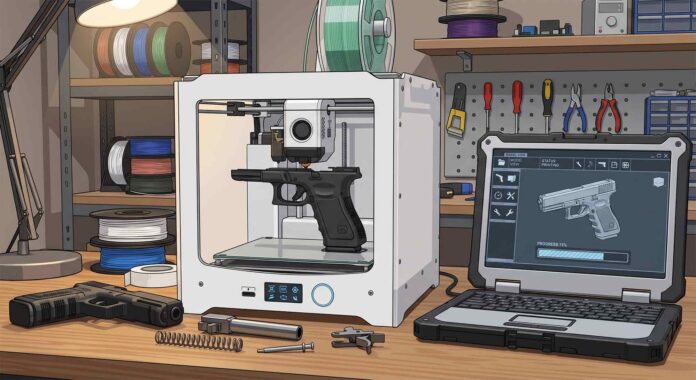
Today, the modern 3D-printed firearm has evolved far beyond those rudimentary plastic toys. The contemporary iteration is a highly engineered hybrid weapon, designed to exploit the legal definitions of a firearm while compensating for the structural weaknesses of thermoplastic polymers. Under most international and United States legal frameworks, the “frame” or “receiver” of a gun is the only part legally classified as the actual firearm. It is the central chassis that holds the trigger mechanism, the magazine, and the barrel together. Because this specific component does not face the direct explosive pressure of the ignited gunpowder, it can be printed out of durable, modern polymers such as PLA+ or glass-filled nylon.

Using standard Fused Deposition Modelling printers, which melt and extrude plastic layer by layer and are widely available at consumer electronics stores for minimal cost, an individual can print this receiver at home. Because it originates on a personal desktop printer rather than a licensed factory floor, it carries no serial number, rendering it a completely untraceable “ghost gun.”

Photo of a 3D-Printed Gun
3D Printed Gun

Engineering the Untraceable: Metallurgy and Hybrid Builds

To transform this printed plastic chassis into a durable, lethal weapon, builders combine the polymer frame with commercial metal components specifically for the high-stress areas. The barrel, the slide, the firing pin, and the recoil springs are subjected to tens of thousands of pounds of pressure per square inch during firing. To manage this, builders purchase these components online in unregulated “parts kits.”

Diagram showing hybrid assembly of 3D-printed receiver with metallic slide and barrel

Because a steel barrel or a metal slide is not legally classified as a firearm on its own, it can be shipped directly to a buyer’s doorstep without any background check or registration. Moreover, some of these components can also be repurposed from other hardware equipment and bought at a store. The resulting weapon looks and functions exactly like a factory-made Glock or AR-15, possessing the same lethality and cyclic reliability, but entirely devoid of a paper trail.

Even when regulatory bodies attempt to close this loophole by restricting the sale of metal gun parts, the digital gun-smithing community demonstrates remarkable engineering adaptability. Innovators in the 3D-printed firearms space have developed highly sophisticated methods to manufacture even the pressure-bearing metal components at home, completely bypassing the commercial supply chain. The most prominent of these techniques is Electrochemical Machining. Traditionally, manufacturing a rifled gun barrel requires heavy, expensive industrial lathes and specialised button-rifling tools to carve the spiral grooves that stabilise a bullet in flight.

The 3D-printing community bypassed this requirement entirely by turning to fluid dynamics and chemistry. By 3D-printing a plastic jig, wrapping it in a specific configuration of copper wire, and submerging it in an electrolyte solution of saltwater, individuals can run an electrical current through the setup to precisely erode the inside of a standard, normal steel pipe.

Photo of a homemade setup to create riffling groovs inside a metal barrel
Homemade setup to create riffling groovs inside a metal barrel

This process, which can be done in a bucket, produces highly accurate rifling within the barrel, capable of withstanding the metallurgical stress of live ammunition. This development fundamentally severs the final reliance on commercial firearms manufacturers, allowing anyone to build a weapon from raw steel and plastic spools.

The Machining of Mayhem: Conversion Devices

Perhaps the most alarming development in the realm of 3D-printed weaponry is the proliferation of machine gun conversion devices, commonly known on the streets as “Glock switches” or auto-sears. These are not full firearms, but rather tiny pieces of plastic, roughly the size of a Lego brick or a small thimble. A standard 3D printer can manufacture dozens of these devices in a matter of hours. Their purpose is mechanically simple but devastating in application.

When inserted into the back plate of a standard semi-automatic handgun, the printed device forcibly overrides the weapon’s internal mechanics. Specifically, it applies continuous downward pressure on the trigger bar, preventing the sear from catching the firing pin after a round is discharged. This mechanically converts the weapon into a fully automatic machine gun.

A handgun equipped with a printed switch can discharge its entire magazine at a cyclic rate of up to 1,200 rounds per minute. The physical reality of firing a handgun at such a rapid rate results in uncontrollable muzzle climb and immense recoil, rendering the weapon almost impossible to aim accurately. Consequently, these printed switches have transformed targeted street violence into indiscriminate spray-and-pray scenarios, dramatically increasing the collateral damage and civilian casualty rates in urban environments.

Diagram showing how Glock Swtich converts semi-automatic guns to full-automatic weapons

The original Glock Switch was actually a real patented item invented in 1998. However, it was not supposed to be freely available. But over time, cheap imitations of such converters became easily available, and now they can be simply printed at home.

Systemic vulnerabilities: The crisis

It might seem counterintuitive that 3D-printed weapons are causing a systemic panic in the United States, a nation that already possesses more commercially manufactured firearms than it has citizens. The legal availability of guns in America is unprecedented globally. However, law enforcement agencies and policy experts recognise that the threat lies not in the aggregate volume of weapons, but rather in the specific demographics of the individuals acquiring them. The 3D-printed gun represents a catastrophic failure of the established regulatory bottleneck.

The American gun control framework relies entirely on the National Instant Criminal Background Check System. This system is designed to serve as a physical barrier, prohibiting convicted felons, domestic abusers, individuals with severe mental health adjudications, and minors from legally purchasing firearms. 3D printing provides a completely unregulated, invisible backdoor for these prohibited individuals to arm themselves. The technology removes the licensed firearms dealer from the equation entirely, dismantling the primary mechanism the state relies upon to screen out dangerous actors.

Furthermore, the proliferation of these weapons creates an unprecedented dilemma for homicide detectives and the Bureau of Alcohol, Tobacco, Firearms and Explosives. Traditional criminal investigations rely heavily on the chain of evidence. When a commercial firearm is recovered at a crime scene, investigators can trace its serial number from the manufacturer, to the distributor, to the retail storefront, and finally to the original purchaser. This trace often provides the critical first lead in a murder investigation.

Ghost 3D-Printed guns completely obliterate this investigative tool. Because they are born on a desktop printer, they enter the world with no identifying marks, no point of sale, and no registered owner. They represent an entirely untraceable class of weaponry that allows violent crime to be committed with a significantly reduced risk of apprehension.

Threat to India from 3D-printed guns

While the United States grapples with the impact of 3D printing on domestic urban crime, the proliferation of digital firearms poses a distinct, severe, and arguably more destabilising threat to the entire world, including India’s national security framework and regional stability. India operates under some of the strictest gun control laws in the world, governed primarily by the Arms Act of 1959. This rigorous bureaucratic and legal framework has historically been highly successful in keeping military-grade firearms out of the hands of the general public. Consequently, the illicit arms market in India has traditionally been dominated by two distinct categories: crude, unreliable, locally manufactured pistols known as “desi kattas,” and sophisticated weapons smuggled by terrorist groups at great physical risk across highly militarised borders from regions like Pakistan, China or Myanmar.

Photo of a locally made pistol in India
A desi katta

The advent of the 3D-printed firearm threatens to completely bypass this massive physical security apparatus. For decades, counter-terrorism agencies, the Border Security Force, state police forces, and the National Investigation Agency have focused their resources on intercepting physical shipments of arms, monitoring shipping lanes, patrolling mountain passes, and scanning cargo for steel and gunpowder. 3D printing transitions the threat from physical logistics to digital transmission. If the technology becomes widespread in India, terrorist organisations and insurgent groups operating in sensitive zones will no longer need to risk moving heavy, easily detectable crates of rifles across heavily guarded checkpoints. They only require a few operatives with the knowledge to run a 3D Printer and make guns using necessary CAD files downloaded online.

This digital smuggling democratises access to lethal force, fundamentally empowering the “lone wolf” attacker. Historically, radicalised individuals acting independently within India have struggled to procure high-calibre weaponry without drawing the attention of intelligence agencies during the acquisition phase. Such terrorists mostly used homemade explosive devices to carry out their missions. 3D printing allows these individuals to manufacture highly sophisticated, reliable firearms inside a locked room, entirely undetected by the state’s surveillance apparatus until the moment the weapon is deployed.

Pho
Fuck Gun Control 9mm

Moreover, the probable transition of organised crime syndicates away from rudimentary local manufacturing towards precision 3D engineering marks a massive escalation in the firepower of the underworld. Weapons like the FGC-9, an acronym for “Fuck Gun Control 9mm,” were designed specifically by international digital gunsmiths to be built using zero commercial gun parts, relying entirely on 3D-printed polymers, hardware store metal, and electrochemical machining. If domestic syndicates adopt these blueprints, the qualitative leap from single-shot, unreliable pipe guns to semi-automatic, untraceable 9mm carbines will place immense pressure on local police forces, completely altering the tactical reality of law enforcement in the subcontinent.

Bureaucratic responses and legislative frameworks in the USA

As the physical regulation of ghost guns proves increasingly futile, bureaucratic committees, legislative task forces, and state governments in the USA have begun attempting to target the manufacturing technology itself. Recognising that controlling the flow of plastic filament and steel pipes is an administrative impossibility, lawmakers are trying to mandate digital guardrails. States heavily impacted by urban gun violence have already begun advancing historic legislative mandates.

In June this year, New York State included a landmark gun safety legislation in its Fy2027 budget. Similarly, the California Assembly has passed legislation targeting 3D-printing of guns. These laws require all 3D printers sold within their jurisdictions to include hardcoded algorithmic technology designed to detect and block the printing of illegal firearm components.

To meet this new legislative demand, third-party cybersecurity firms and software developers have rushed to create Digital Rights Management software tailored for the 3D printing industry. Systems like the “3D GUN’T” module operate on a relatively straightforward concept. The software is designed to sit as a digital checkpoint between the user’s computer and the 3D printer. As a digital file is sent to be printed, the software scans the geometric data and compares it against a constantly updated, cloud-based database of known firearm components. If the software recognises the distinct shape of a pistol receiver, a high-capacity magazine, or an auto-sear, it is programmed to instantly intercept the data stream and cancel the print job.

Concurrently, major online file-sharing platforms and digital repositories have implemented automated shape-analysis algorithms to constantly scrub gun blueprints from their servers, whilst immense legal pressure mounts on global hardware manufacturers to integrate these security layers directly into the motherboards of their consumer machines.

While state governments are attempting to force hardware modifications onto the physical printers, federal legislators in the United States are pursuing a different strategy by targeting the digital supply chain itself. In June 2025, Senator Ed Markey and Representative Jared Moskowitz reintroduced the 3D Printed Gun Safety Act. Rather than attempting to regulate the open-source firmware of consumer appliances, this federal legislation seeks to make it a federal crime to intentionally publish or distribute digital files, such as CAD models and G-code, that can automatically program a 3D printer to manufacture a firearm or a critical component like an auto-sear.

This approach aims to legally dismantle decentralised digital gun-smithing communities by treating the dissemination of lethal blueprints as a public safety hazard. Notably, the vast majority of people who 3D print guns don’t create the necessary files themselves; they just download the files from the internet or messaging groups.

Opposition to restrictions

However, much like the hardware DRM mandates, these measures have sparked intense legal controversy. These legislative manoeuvres and hardware-level restrictions have sparked fierce, coordinated opposition from an unlikely coalition of open-source technologists, civil liberties advocates, hardware manufacturers, and constitutional lawyers. At the forefront of the backlash is the open-source software and “maker” community, who argue that state-level mandates would effectively criminalise the foundational right to tinker. Because consumer 3D printing is built almost entirely upon open, community-driven firmware architectures like Marlin and Klipper, forcing manufacturers to deploy tamper-proof digital locks would necessitate shutting down user modifications entirely.

Digital rights organisations and constitutional lawyers argue that computer code and CAD blueprints are protected forms of speech under the First Amendment, setting the stage for a monumental legal battle over whether a government can lawfully censor digital code simply because it has lethal physical applications. Engineers and hobbyists contend that locking down hardware architecture imposes immense collateral damage on legitimate educational, scientific, and industrial rapid-prototyping innovation, all while creating endless “false positive” friction for mechanical engineers printing innocuous items like structural brackets, robotics chassis, or specialised handles.

Simultaneously, digital rights groups such as the Electronic Frontier Foundation (EFF) and constitutional scholars have challenged both hardware DRM mandates and federal file-sharing prohibitions on civil liberties grounds. Enforcing geometric scanning at scale requires invasive algorithmic telemetry and persistent cloud connectivity, establishing a troubling surveillance precedent over what citizens design and fabricate within the privacy of their own homes.

Furthermore, legal challenges against measures like the 3D Printed Gun Safety Act centre heavily on the well-established legal principle of “code as speech.” Opponents argue that digital blueprints and CAD files constitute protected technical expression under the First Amendment, meaning government attempts to outlaw the publication of code amount to unconstitutional prior restraint. Compounding these legal challenges, firearms rights organisations assert that law-abiding citizens possess a long-standing historical right to manufacture personal firearms, viewing software and hardware-level blocks as an unlawful overreach that punishes an entire technological ecosystem while doing virtually nothing to impede dedicated illicit actors.

The precedent of prevention: Anti-counterfeiting technology

The technological arms race to prevent the unauthorised reproduction of restricted items is not a new phenomenon; it is a battle that has simply evolved from two-dimensional paper currency to three-dimensional physical objects. For decades, the global financial system has relied on sophisticated digital roadblocks to prevent the casual counterfeiting of banknotes using software and consumer electronics.

EURion constellation on US Dollar

The earliest and most visible of these mechanisms is the EURion constellation (also known as Omron rings). First implemented in the late 1990s and subsequently named by security researcher Markus Kuhn in 2002, the EURion constellation is a specific, mathematically arranged pattern of five small yellow, green, or orange circles incorporated into the design of banknotes. Designed to subtly resemble the astronomical Orion constellation, this pattern is woven seamlessly into the background art of most major global currencies, including the US Dollar, the Euro, and the British Pound.

EURion constellation on Indian Rupee note

Modern colour photocopiers and digital scanners are hardcoded at the firmware level to recognise this exact geometric arrangement. When the optical sensors of a consumer photocopier detect the EURion pattern, the machine’s internal logic instantly intercepts the process. It will categorically refuse to copy the note, typically outputting a completely blank page, printing a block of solid black colour, or temporarily locking up the machine entirely.

However, as personal computers, high-resolution digital cameras, and image-editing software became exponentially more powerful, simple hardware-level optical blocks were no longer sufficient. In response, a consortium of more than 30 global central banks formed the Central Bank Counterfeit Deterrence Group (CBCDG). In collaboration with digital watermarking pioneers like Digimarc, the CBCDG developed a highly secretive, software-based solution known as the Counterfeit Deterrence System (CDS).

Photoshop preventing use of banknote image

Unlike the visually detectable EURion rings, the CDS relies on a robust, invisible digital watermark embedded directly into the structural data of the banknote’s design. To make this system effective, the CBCDG supplies a compiled binary detection module to major technology corporations, who voluntarily integrate it into their consumer software and hardware drivers.

Consequently, the CDS operates as an invisible digital dragnet across a vast ecosystem of technology. If a user attempts to open a high-resolution scan or photograph of a protected banknote in industry-standard graphic design software, most notably Adobe Photoshop, Adobe Illustrator, or Corel PaintShop Pro, the integrated CDS module analyses the image structure in the background. Upon detecting the hidden Digimarc watermark, the software completely locks the file. It refuses to open, edit, or print the image, instead presenting the user with an un-bypassable warning dialogue box that redirects them to an international legal database outlining currency reproduction laws. This same digital roadblock is secretly embedded within modern desktop scanner utilities and printer spooler drivers, ensuring that even if a user bypasses image-editing software, the final physical hardware will still refuse to deposit ink onto the page.

The technological illusion: Why software solution fails for 3D-printed guns

Politicians, regulatory committees, and advocates for legislative mandates for 3D printers compare the proposed software solution to the EURion constellation and CDS. Lawmakers argue that a similar logic can easily be applied to 3D printers to prevent the manufacture of firearms.

However, computer scientists, mechanical engineers, and digital rights groups have debunked this comparison, arguing that equating 2D image recognition with 3D volumetric geometry is a fundamental misunderstanding of the technology. The software mandates currently being passed into law are widely viewed by the tech industry as “security theatre”—measures that provide the illusion of safety while being trivially easy for bad actors to bypass. The failure of this digital dragnet lies in the inherent nature of 3D printing code.

Unlike a 2D printer, which looks for a static, visual image, a 3D printer does not “see” final printed shapes at all. It operates on a language called G-code. When a user wishes to print an object, they run a 3D model through a “slicing” program, which translates the 3D geometry into a massive, sequential text file of XYZ coordinates. This G-code simply tells a mechanical stepper motor exactly where to move the hot nozzle, layer by layer, fraction of a millimetre at a time. Analysing this complex, volumetric data in real-time to determine what the final physical object will look like requires significant computational processing power. The cheap, basic microcontrollers that serve as the brains for standard consumer 3D printers simply do not possess the bandwidth to perform advanced heuristic analysis of a 3D mesh while simultaneously managing the precise thermal dynamics and mechanical movements of the printing process.

Furthermore, even if the processing power existed, algorithmic geometry detection is incredibly easy to evade. An algorithm cannot easily distinguish the complex curves of a pistol’s trigger guard from a custom-designed door handle, or the blocky housing of a Glock switch from an innocuous mechanical bracket used in robotics. A user intent on bypassing the database can simply use free software to digitally cut a gun frame into three or four abstract, harmless-looking pieces. They can print these pieces separately, which the DRM software will ignore as unrecognisable shapes, and fuse them together later using chemical solvents or high-strength industrial epoxy. Users can also make changes to the gun design to fool the detection program.

The note detection technology works because the security features incorporated into the design of notes are fixed, and the software knows exactly what to look for. The same is not true with 3D files for printing guns, as they can be made in different shapes and sizes, and they are not necessarily exact replicas of guns made in factories.

The most fatal flaw of the legislative mandates for detection software, however, lies in the open-source reality of the 3D printing ecosystem. Conventional printers run proprietary software installed by the manufacturer, and it is almost impossible to bypass the restrictions placed in the firmware. But the same is not true for 3D printers.

The vast majority of consumer 3D printers run on open-source firmware architectures, such as Marlin or Klipper. These systems were built on a philosophy of user control and modification. Even if a manufacturer complies with such laws and locks down a printer at the factory with strict DRM firewalls, the end user retains ultimate physical access to the machine’s motherboard. A dedicated user can simply plug a USB drive or an SD card into the printer and flash a completely new, restriction-free, community-built firmware onto the machine. This process takes only a matter of minutes and completely overwrites and erases the government-mandated blocking software. Attempting to lock down hardware that is fundamentally designed to be open and modifiable is a technological impossibility.

Conclusion

The assassination of Brian Thompson by Luigi Mangione cannot be dismissed as a tragic anomaly; it must be recognised as a grim, undeniable preview of the future of armed violence. The 3D-printed gun represents the ultimate physical manifestation of digital information. As the music, film, and publishing industries learned through painful experience over the last two decades, data cannot be effectively contained, legislated, or destroyed once it has been disseminated across the internet.

Legislators and bureaucratic committees are currently attempting to solve a rapidly evolving, twenty-first-century digital information crisis using rigid, twentieth-century physical regulatory mindsets. While DRM software, state mandates, and automated file-scrubbing may successfully stop a curious teenager from printing a weapon on a school library printer, they offer almost zero meaningful resistance to a dedicated criminal, a politically motivated extremist, or a meticulous assassin.

As the line between digital code and lethal physical objects continues to blur, global security agencies face an uncomfortable, paradigm-shifting reality: the blueprints for untraceable lethality are permanently etched into the digital ether, and no software update, legislative mandate, or border checkpoint is ever going to put that genie back in the bottle.

Join OpIndia's official WhatsApp channel

  Support Us  

For likes of 'The Wire' who consider 'nationalism' a bad word, there is never paucity of funds. They have a well-oiled international ecosystem that keeps their business running. We need your support to fight them. Please contribute whatever you can afford

Raju Das
Raju Das
Editor and Analyst | Facts first. Bharat above all.

Related Articles

Trending now

AI-generated child abuse material, Indian law and the enforcement challenge

POCSO already recognises computer-generated and fabricated depictions, while Section 67B and the 2026 IT Rules add further legal and platform duties, though fully synthetic cases still raise unresolved questions for Indian courts and law enforcement.

‘Kashmir is an important part of India’: Why US envoy Sergio Gor’s choice of words matters and how it is a reality check for Pakistan

Sergio Gor’s Kashmir remark is a diplomatic reality check for Pakistan and a reaffirmation that Washington continues to view India as a vital strategic partner.
- Advertisement -

