Something is revealing about the ease with which some Congress leaders speak about Hinduism and its scriptures.
The latest example comes from senior Congress leader Pawan Khera, who responded to a post featuring a woman lighting a cigarette with a burning copy of the Manusmriti by tweeting: “Smoking and ManuSMRITI are injurious to health.”
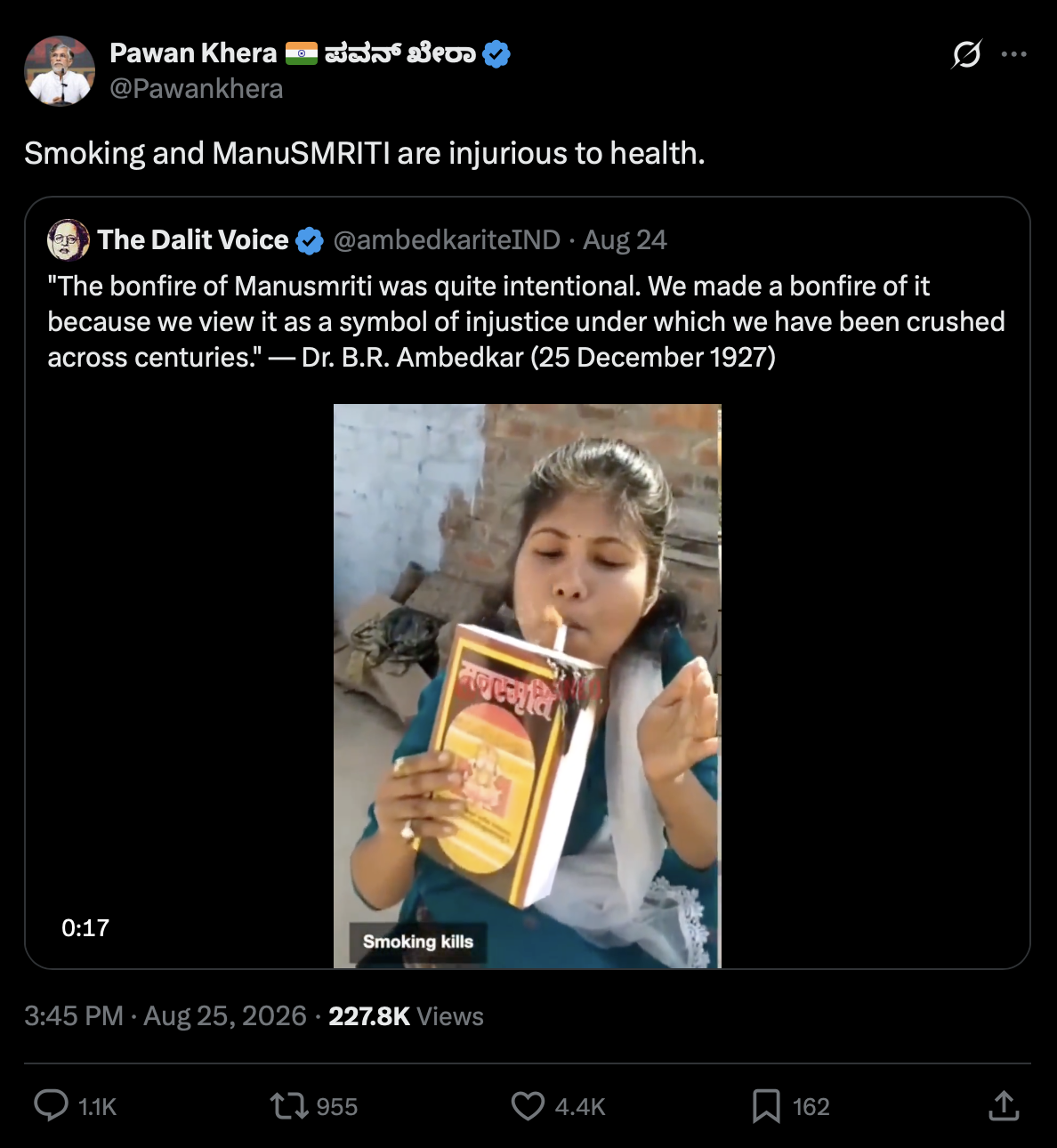
This was not political satire. Khera was not merely making an irreverent joke about an ancient text. By endorsing a post in which a copy of the Manusmriti was being burnt and declaring that “ManuSMRITI” is “injurious to health”, he was reinforcing a much more pointed message: that the text itself is dangerous and ought to be treated as something harmful. It is an attempt to demonise the Manusmriti rather than engage with it. The distinction matters. A serious critique would examine what the text says, its historical context, its competing interpretations and its place in Hindu intellectual history. Khera instead chose the easier route—associate a Hindu scripture with harm, amplify its desecration and package that message as a punchline.
Imagine the same political calculation being applied consistently to the scriptures of every faith. Would Khera casually make a similar joke about the Quran? Would he find equal amusement in a video desecrating the Bible? Would Congress leaders rush to amplify it? Or would suddenly emerge the familiar vocabulary of “sensitivity”, “communal harmony”, “responsible discourse” and “respect for religious sentiments”?
That is the uncomfortable question Congress needs to answer.
The issue here is not whether every Hindu considers the Manusmriti a sacred text. They do not. Nor is anyone suggesting that ancient texts should be placed beyond criticism. Manusmriti can be debated, criticised, contextualised and subjected to historical and philosophical scrutiny. In fact, serious engagement with any ancient text requires precisely that.
But criticism and contempt are not the same thing.
A political leader deliberately joining a social-media spectacle in which a Hindu text is being burnt, and then adding a mocking one-liner, is not some profound constitutional intervention. It is cheap political signalling. And when the person doing it is a senior office-bearer of the Congress party, the question becomes even more pertinent: why does this particular brand of irreverence appear to have such a strong appetite for Hindu targets?
This is where Congress’ claim to be the “flag bearer” of secularism begins to look increasingly selective.
Congress’ secularism has always had a Hindu blind spot
Congress has spent decades presenting itself as the institutional custodian of Indian secularism. Yet its political history contains enough examples to make one wonder whether its version of secularism sometimes means something very different: extraordinary sensitivity towards minority religious sentiment, combined with extraordinary confidence that Hindu sentiment can absorb virtually unlimited provocation.
The contrast is not merely rhetorical.
Consider triple talaq. Congress leaders did oppose the Modi government’s Muslim Women (Protection of Rights on Marriage) Bill, 2019. To be fair, the party’s objections were substantially focused on the criminalisation provision, due-process concerns and the architecture of the legislation rather than a defence of triple talaq itself. Congress MP Shashi Tharoor, for instance, explicitly said he was not defending triple talaq while opposing the Bill’s criminalisation provisions.
That distinction matters.
But it also exposes the political asymmetry. When confronted with a practice that had already been struck down by the Supreme Court, Congress chose to oppose the criminalisation mechanism while arguing that the legislation was legally excessive. In the Rajya Sabha, Congress was among the opposition parties seeking further scrutiny and objecting to the criminalisation provision.
There is nothing inherently illegitimate about opposing a criminal law on constitutional or legal grounds. A secular party should be able to do precisely that.
But where was the same urgency to protect Hindu devotees from contemptuous political rhetoric?
Where is the Congress leader who will say that mocking a Hindu scripture is beneath the dignity of public discourse?
Where is the internal reprimand when a senior leader turns a Hindu religious text into the punchline of a social-media post?
There is a conspicuous silence.
Would Pawan Khera make the same joke about every scripture?
This is perhaps the simplest test of secularism.
If the principle is that religious texts can be criticised, then criticise all of them. If the principle is that ancient scriptures must be evaluated through the lens of modern constitutional morality, apply that standard consistently. If the principle is that nobody gets a veto over criticism of religion, defend that principle universally.
But selective irreverence is not secularism.
It is political convenience.
Khera’s tweet becomes particularly revealing because it does not amount to a scholarly critique of Manusmriti. It does not quote a passage, examine its historical context or engage with competing interpretations. It simply piggybacks on an act of burning the text and labels the book itself as “injurious to health”. The message is unmistakable: Manusmriti is being presented not as an ancient text open to debate, but as a dangerous object worthy of symbolic destruction.
That is not intellectual criticism. It is demonisation dressed up as social-media wit.
And the question of consistency becomes unavoidable. Would Congress’ social-media ecosystem treat the desecration of the Quran or Bible with the same breezy humour? Would senior party leaders compete to amplify it?
The answer is almost certainly no, not because criticism of either scripture is inherently impermissible, but because political parties understand that religious communities have different sensitivities and that irresponsible rhetoric can have serious consequences.
Hindu sensitivities deserve the same consideration.
When ‘Shakti’ becomes a political punching bag
This is not the first time Congress leaders have generated controversy by making Hindu religious concepts part of political rhetoric.
In March 2024, Rahul Gandhi said he was “fighting against Shakti” at a rally in Mumbai, before later clarifying that he was referring to a different conception of power and alleging that PM Modi had twisted his words.
The controversy was not simply about one word. It was about the extraordinary political carelessness involved in invoking a term deeply embedded in Hindu religious vocabulary and then expecting people to accept that its religious meaning was irrelevant to the controversy.
Earlier, Gandhi had also described Parliament MPs as being like murtis in temples without power. He has used Hindu mythology, the Mahabharata, Shiva and other religious references repeatedly in political speeches. There is nothing wrong with politicians invoking religious imagery. India’s political vocabulary has always drawn from its civilisational traditions.
The problem arises when Hindu religious concepts are simultaneously appropriated for political rhetoric and treated with contempt when convenient.
The contradiction becomes even sharper when one considers Gandhi’s 2022 interaction with Catholic priest George Ponnaiah. Ponnaiah made derogatory remarks about Hindu Shakti while contrasting it with Jesus Christ. Gandhi’s presence and interaction with him generated widespread criticism.
Again, the issue is not that a politician can never meet someone controversial. Politicians meet controversial people all the time.
The issue is the broader pattern.
Why does Hinduism so often become the religion that can be dissected, mocked, psychoanalysed, pathologised and used as a prop in political argument, with the Congress ecosystem expecting Hindus to simply take it on the chin?
Rahul Gandhi’s Manusmriti attack gave Congress’ campaign a political imprimatur
If Pawan Khera’s post could be dismissed as the indiscretion of one Congress leader, Rahul Gandhi’s remarks in Pune make that defence considerably harder to sustain. At the August 22, 2026 ‘Chhatron Ki Goonj’ event, Gandhi attacked what he called a “Manusmriti mindset”, described the text’s prescription concerning women’s subordination to male relatives as shameful, and linked that mindset to the patriarchal politics he was criticising.
An ancient Hindu text is presented as the ideological source of a contemporary social order, with the RSS and BJP placed in the same rhetorical frame. That transforms a debate and puts historical context into a sweeping political indictment of a Hindu scripture and, by extension, the civilisation from which it emerged.
And this is where the sequence of events matters. When the Leader of the Opposition himself makes Manusmriti a political symbol of oppression, it inevitably creates political space for other Congress leaders and activists to adopt the same framing. Khera’s subsequent post did not emerge in an ideological vacuum. It came after the party’s most prominent leader had publicly made the Manusmriti a target in a campaign centred on women’s rights.
It would be too strong to claim that Gandhi explicitly instructed Congress workers to attack the text; there is no evidence of such an instruction. But politically, his intervention can reasonably be seen as lowering the threshold for Congress functionaries to treat the Manusmriti not as a text to be debated, but as a symbol to be condemned and ridiculed.
The old politics of ‘saffron terror’
Congress’ history also contains another particularly instructive episode.
In August 2010, then Home Minister P Chidambaram spoke of a “new phenomenon of saffron terrorism” while addressing police chiefs.
But attaching a religiously loaded colour associated with Hindu civilisation to terrorism was bound to attract severe backlash. Congress itself subsequently attempted damage control following the controversy.
That episode demonstrated something important: language matters. Will Congress use the same language to describe Islamic terrorism? No. In fact, when asked about the threat of Islamic terrorism, Congress leaders often employ mental gymnastics to either dodge answering it or accuse the interviewer of being ‘Hindutvawadi’.
If Congress understood that saffron could not casually be fused with terrorism because saffron carries deep cultural and religious significance for millions of Hindus, why does that sensitivity disappear when the target is a Hindu scripture?
Why is “be careful with words” a principle worth invoking only after political damage has already been done?
Intellectual dishonesty of Congress in attacking Manusmriti
There is another intellectual dishonesty that frequently accompanies attacks on Manusmriti.
The argument generally proceeds like this: Manusmriti contains prescriptions relating to social hierarchy and caste; therefore, Manusmriti represents Hinduism; therefore, attacking Manusmriti is equivalent to attacking an oppressive religious order.
This is an astonishingly regressive understanding of Hindu civilisation, shaped in no small measure by a post-Independence historiographical tradition heavily influenced by Marxist scholars. The claim that the Manusmriti served as a universally enforced social code also deserves far greater scrutiny: it was a normative Dharmashastra, not a comprehensive record of how Indian society actually functioned. There is, arguably, no primary source of historical evidence that it mandated and enforced divisions within the society.
But more importantly, the Indian Constitution is the supreme legal framework of the Republic. It prohibits discrimination and provides extensive constitutional protections against caste-based discrimination and untouchability. No ancient religious text overrides the Constitution.
Indeed, that is precisely the point.
A modern democratic republic does not need to burn an ancient book to establish the supremacy of constitutional equality. Nor does it need politicians to mock that book to demonstrate their commitment to social justice.
If Congress wants to fight caste discrimination, fight caste discrimination.
If it wants to defend constitutional equality, defend constitutional equality.
If it wants to critique Manusmriti, produce scholarship, evidence and argument.
But turning the burning of a religious text into a social-media punchline is not social reform. It is political theatre.
And the irony is that such theatre can actually deepen the very social divisions Congress claims to oppose. And such activism for ‘social inclusion’ is limited only to Hindu scriptures. Any questions asked about contentious doctrines of other faiths, and the Congress leaders suddenly pass sermons of secularism and inclusivity.
The real politics behind selective outrage
The Congress’ problem is not that it criticises religion. A democracy needs the freedom to criticise religion. The problem is that its political ecosystem often appears to understand religious sensitivity as a one-way street.
Hinduism is treated as robust enough to withstand ridicule. Hindu gods and symbols can become props in political speeches. Hindu scriptures can become jokes. Hindu civilisational symbols can be politically reinterpreted. And when Hindus object, the response is frequently a lecture on secularism, constitutionalism and the need to tolerate criticism.
But when the political temperature rises around other religions, the vocabulary changes.
Suddenly, sensitivity becomes paramount.
That is precisely why Khera’s tweet deserves criticism.
He is not merely a private citizen posting an ill-considered meme. He is a senior leader of one of India’s oldest political parties. His words carry institutional weight, even if his following doesn’t suggest so. When the senior leader of the Congress party shares such videos, he is effectively sending a message to thousands of others that desecration of that religious scripture will not attract any legal penalty.
Moreover, Congress cannot simultaneously claim to represent constitutional secularism while appearing indifferent to the religious sentiments of a large section of Indians.
If Congress genuinely believes in equal respect for religions, it should demonstrate that principle rather than merely repeating the word “secularism”.
And equal respect does not mean that every scripture must be believed, worshipped or shielded from criticism.
It means the same standard of intellectual seriousness and civility must apply to all.
The question Congress cannot escape
So here is the question for Pawan Khera and the Congress leadership:
Would you post the same post if the book were the Quran?
Would you post it if it were the Bible?
The answer is no because, for Congress leaders, Hindu scriptures alone are considered acceptable targets for this kind of political humour. Khera is restricted from the decades-old votebank that the party has assiduously cultivated, forcing him to not post anything controversial when it comes to Islam. The other aspect could be to keep his head intact from torso, for such an ‘insult’ would instantly attract ‘Sar Tan Se Juda’ threats, like the ones still faced by former BJP spokesperson Nupur Sharma for simply defending her faith.
What Congress cannot do is have it both ways: invoke secularism when defending itself, invoke constitutional morality when attacking Hindu traditions, demand sensitivity when another community’s religious sentiments are involved, and then treat Hindu religious symbols as disposable political props.
The Manusmriti can be criticised. Its historical claims can be debated. Its prescriptions can be rejected. Hindus themselves have every right to reject portions of it.
But that cannot be grounds to encourage and normalise its desecration. Will it be acceptable for the Congress party if Hindus began “criticising” scriptural texts from other faiths?
India’s secularism cannot mean that one religion is expected to develop an infinite capacity for insult while everyone else is granted an increasingly expansive right to sensitivity.
That is not secularism.
That is selective secularism.
And Pawan Khera’s tweet, rather than disproving the charge, has once again placed the question squarely before Congress: if your secularism demands equal respect for every faith, why does your irreverence so often stop at the doorstep of other religions and begin so confidently at the doorstep of Hinduism?