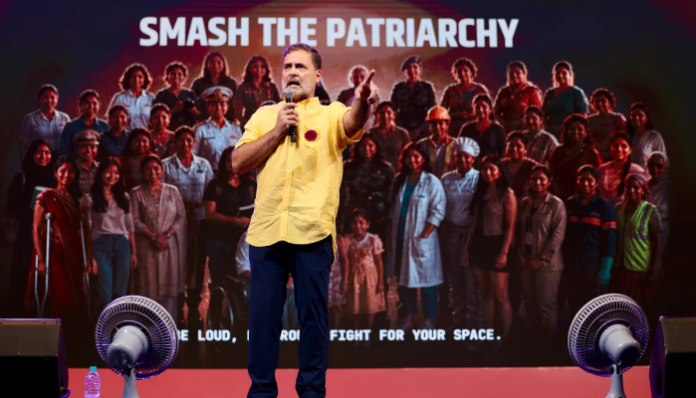
Leader of the Opposition in the Lok Sabha, Rahul Gandhi wants to cultivate the image of a champion of women’s rights and empowerment. The entire Indian National Congress ecosystem, too, has consistently worked to reinforce this makeover, presenting him as a political voice committed to feminism and greater inclusion for women.
However, there is one glaring problem with the carefully manufactured narrative: when the grand old party actually controls the levers of power, women’s representation appears to become an afterthought. It currently holds power in three states, but the party’s commitment has shrunk dramatically in relation to providing a meaningful place to the fairer gender at the table where authority is actually exercised.
Both Himachal Pradesh and Karnataka have no women in their state cabinets, while Telangana has experienced a reduction in its already limited female representation, falling from two ministers to one after the controversial ouster of Konda Surekha. She ultimately paid the price for her political tussle with Chief Minister Revanth Reddy, facing disciplinary action over comments made by her daughter, despite her explanation that she had no involvement in them.
The status of women empowerment under Congress
One woman among nearly 60 ministers across three states. That, in a nutshell, is the truth of the much-hyped women empowerment practised by Congress. For a party so eager to claim the feminist high ground, this is more than an awkward statistic which exposes the disparity between its claims and the reality of its actions.
After all, feminism cannot simply be a branding exercise reserved for election speeches and political attacks. It has to show up in the cabinet room too. However, the record of Congress looks very different from the picture it has been aggressively marketing, especially in the recent weeks. Notably, this is hardly the first time the party has been caught on the wrong side of the very ideals it alleges to endorse.
The contradiction runs deeper than induction in cabinet. Rahul Gandhi and his party, which routinely invoke the rhetoric of “smashing patriarchy” in their political addresses, voted down the Modi government’s delimitation bill linked to the implementation of 33% reservation for women (Nari Shakti Vandan Adhiniyam) in the Lok Sabha and state legislative assemblies.
Interestingly, they have been leading the charge to demand this reservation, but when the time came to act, it was revealed that their convenient stand was driven by optics rather than principle. The opposition headed by the Congress first wanted its immediate rollout, only to later accuse the government of rushing the same for political gains.
These parties had already made up their mind not to support the legislation and were instead looking for reasons to justify their position. More tellingly, Congress that assures to keep women’s issues above politics could not support a landmark measure concerning them without viewing it through the narrow prism of political advantage.
It is neither willing to give women a meaningful share of positions of power nor willing to create greater space for their participation in decision-making. Its grandstanding about supporting them is just political jargon directed at the Bharatiya Janata Party (BJP) and designed to appeal to its own captive audience rather than serving the wider population.
A shameful spectacle of misogyny
The party’s much-vaunted respect for women was on display at an event in New Delhi, where Rahul Gandhi hugged veteran leader Sandeep Dikshit during the Rachnatmak Congress National Convention in what appeared to be a carefully staged moment for the cameras. However, the political spectacle quickly took an ugly turn when the latter mocked, “Did you hug me thinking I am Meloni,” making a distasteful reference to Italian Prime Minister Giorgia Meloni and her cordial relationship with Prime Minister Narendra Modi.
However, Rahul Gandhi, who is the self-styled messiah of women, did not object or call out his party colleague and simply chose to smile gleefully at his disturbing misogyny. The comment was greeted with laughter and applause from the Congress audience. Its national spokesperson Supriya Shrinate was captured laughing at the derogatory jibe directed at a woman.
Her reaction, however, sits uneasily alongside her own controversial record, particularly her statement about actor-turned-politician Kangana Ranaut, who was contesting the Lok Sabha election from the Mandi constituency in 2024. She had written, “Kya bhav chal raha hai Mandi mein koi batayega (Will someone tell me what the rate system in Mandi is),” alongside Ranaut’s photograph. She had to delete the post and asserted that her account had been used by another person after severe backlash.
Congress functionary HS Ahir had also abused Ranaut by referring to her as “Mandi se R*ndi.” These are the prominent leaders of a party that aspires to portray itself as a leading voice of women’s issues in the country. However, they have no qualms about dragging a woman down in the most insulting manner when it suits their political agenda.
Congress version of women empowerment
The aforementioned shortcomings are not confined to the ministerial choices of Congress, but its internal record also raises equally uncomfortable questions. Several women leaders have walked away after complaining about mistreatment within the organisation.
Radhika Khera resigned after accusing party leaders of harassing and abusing her, outlining that her appeals for justice went unanswered. Priyanka Chaturvedi, who was among the most prominent television faces of Congress, was also forced to quit. She stated that the party’s supposed commitment to women’s safety, dignity and advancement was not matched by the conduct of its members.
Meanwhile, Assam Youth Congress president Angkita Dutta was expelled for daring to charge then Indian Youth Congress (IYC) president Srinivas BV and its national secretary Vardhan Yadav with harassment. On the other hand, a woman leader was similarly targeted in the presence of Lok Sabha MP Deepender Singh Hooda during a rally in Haryana.
“She (the victim) told me that she was harassed on stage. There can be nothing worse or more condemnable than such an act against a woman. Action must be taken,” expressed Congress stalwart and Lok Sabha MP Selja Kumari at the time.
Moreover, Ranjit Mukher, who was accused of harassing a party colleague and exhibiting “predatory behaviour” towards another woman, was reinstated by Congress and appointed secretary for three key states, Tripura, Nagaland and Sikkim in 2021. He had been removed from the party a year earlier amid the controversy, but it seemed that he was soon rewarded by the party for his misconduct.
These incidents unfolded as Priyanka Gandhi Vadra was sharpening her attack on the BJP government with her slogan, “Ladki hoon, lad sakti hoon” (I am a girl, I can fight), while women seeking justice within her own party were either struggling to make themselves heard or being effectively silenced. Unsurprisingly, the party’s history is replete with such alarming hypocrisy and double standards.
If this disgraceful showcasing of anti-women sentiment was not enough, senior Congress leader Yashomati Thakur blamed the victims of the Amravati sexual abuse case involving Ayan Ahmed Tanveer. He preyed upon hundreds of girls, including minors. The party’s purported pro-women stance, much like its secularism, collapses under the pressure to cater to the Muslim vote bank.
Conclusion
These occurrences barely touch the surface of the barrel. Of course, this is not to suggest that Congress is the only party guilty of misogyny or discrimination against women. However, it has increasingly become a striking example of double-speak, projecting itself as a well-wisher of women while simultaneously curtailing their political space as well as allowing demeaning and sexist treatment of them both within and outside the party.
Wherever Congress has formed a government, women have been pushed to the margins of political power, with authority remaining overwhelmingly in male hands. However, Rahul Gandhi wants the women of India to believe that he is going to “smash patriarchy.” If he is genuinely serious about this promise, why not start with his own party? Ensuring fair representation for women in the council of ministers within Congress governments should be the bare minimum.
The harsh truth is that virtual signalling and fashionable Gen Z rhetoric are far easier than delivering meaningful change where it matters. However, Rahul Gandhi and Congress have repeatedly failed this test. And if one hopes to find feminist slogans and promises of empowerment that rarely travel beyond the podium, the Raebareli MP and his party offer plenty but very little beyond that.