

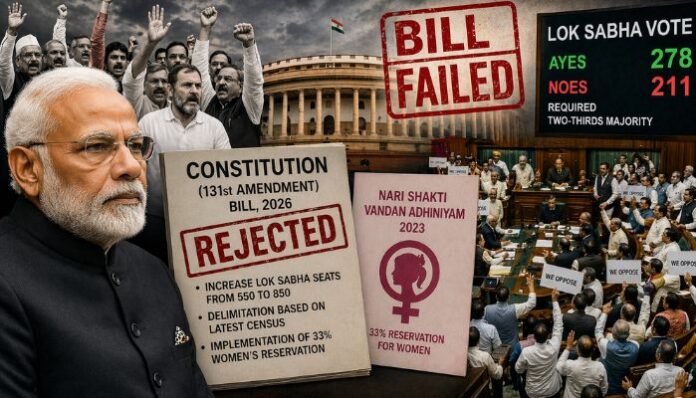
The Indian parliamentary landscape witnessed a major development on Friday, 17th April, as the central government’s plan to transform the nation’s electoral framework came to a halt. In a setback for the ruling National Democratic Alliance (NDA), the Constitution (131st Amendment) Bill, 2026, failed to pass in the Lok Sabha, falling short of the mandatory constitutional threshold.
The bill received 278 votes in favour (ayes) and 211 against (noes), with 489 members present and voting and no abstentions. A constitutional amendment under Article 368 of the Constitution requires the support of at least two-thirds of the members present and voting.
Lok Sabha Speaker Om Birla says, "The Constitution (131st Amendment) Amendment Bill did not pass as it did not achieve a 2/3 majority during voting in the House." https://t.co/ucLnUltYnj pic.twitter.com/xcBUJ3RhAv
— ANI (@ANI) April 17, 2026
The vote comes a day after the Union Government notified the Constitution (106th Amendment) Act, 2023, bringing into force the law providing for 33% reservation for women in the Lok Sabha and State Legislative Assemblies with effect from Thursday, 16th April.
Recognising that the structural foundation of their reform package had been rejected, Union Minister Kiren Rijiju moved to withdraw the accompanying Delimitation Bill, 2026, and the Union Territories Laws (Amendment) Bill, 2026. These bills were inextricably linked to the 131st Amendment; without the constitutional authority to alter the seat limits and the census criteria, the subsidiary bills became legally untenable.
This is a rare and significant blow to the government’s plans, effectively stalling the much-anticipated increase in Lok Sabha seats and, more importantly, putting the implementation of the Women’s Reservation Act into a state of deep uncertainty.
What is the 131st Amendment Bill?
The 131st Amendment Bill was essentially a plan to completely overhaul how India’s elections look. For decades, the number of seats in the Lok Sabha has been frozen based on the 1971 Census. This bill wanted to break that freeze. It proposed to increase the maximum number of seats in the Lok Sabha from 550 to a whopping 850.
Out of these, 815 seats would come from the states and 35 from the Union Territories. The idea was to move back to the principle that every state should have seats in proportion to its actual population, ensuring that every citizen’s vote carries roughly the same weight across the country.
Beyond just adding seats, the bill gave Parliament the power to decide when the next “delimitation” (the process of redrawing constituency boundaries) would happen and which census would be used. The accompanying Delimitation Bill made it clear that they intended to use the 2011 Census for this next round.
Most importantly for the average citizen, this bill was designed to remove the technical hurdles that were blocking the 33% reservation for women. It sought to decouple the start of the reservation from the “first census after 2023” requirement, so that the reservation law can be implemented without waiting for the results of 2026-27 census, aiming to get women into those seats much faster by linking it to the immediate delimitation exercise.
The Nari Shakti Vandan Adhiniyam 2023
Nari Shakti Vandan Adhiniyam, or the Women’s Reservation Bill was passed in September 2023. At that time, Prime Minister Narendra Modi spoke about how this move had been delayed since 1996. The 2023 law was a historic move to reserve one-third of all seats in the Lok Sabha and State Assemblies for women. It even included a sub-quota for women belonging to the Scheduled Castes and Scheduled Tribes, ensuring that the most marginalised voices would be heard in the halls of power.
However, a crucial clause, Article 334A(1), was inserted into that 2023 Act, stating that the reservation would only come into effect after a fresh census was conducted and a delimitation exercise was completed. Since the 2021 census was delayed due to COVID-19 and is expected to be completed by 2027, the actual reservation was looking like a distant reality for the 2029 elections or beyond.
The 131st Amendment was the government’s attempt to fast-track this process. It was the contingent bill that would have cleared the path. By failing to pass the 131st Amendment, the opposition has essentially blocked the only immediate legal route to making the 2023 Women’s Reservation Law functional.
Delimitation Bill
Similarly, the proposed Delimitation Bill of 2026 was a direct consequence of the 131st Amendment. Delimitation is the process of redrawing those boundaries so that each MP represents a similar number of people. Currently, the allocation of seats to states is frozen based on 1971 population figures to prevent penalising states that successfully implemented population control. However, the 131st Amendment sought to break this freeze to reflect the modern demographic reality of India.
The Delimitation Bill would have established a Commission led by a Supreme Court judge to redraw boundaries using the latest published data. This process is essential for women’s representation because the law requires the identification of specific “reserved” constituencies, which can only be done during a delimitation exercise.
By voting down the constitutional amendment, the opposition has not only stopped the increase in seats but has also stalled the redrawing of boundaries that would have identified the 33% of seats specifically for women.
The opposition argued that using the 2011 Census would hurt the southern and north-eastern states because their population growth has been slower. But the government’s counter-argument was simple: you can’t have a democracy where some people’s votes are worth more than others, and you certainly can’t implement women’s reservation without redrawing the map.
After the Constitution (131st Amendment) Bill failed to clear the required 2/3 majority in the Lok Sabha, opposition leaders react
— Nabila Jamal (@nabilajamal_) April 17, 2026
Rahul Gandhi said the opposition “has defeated this attack on the Constitution” adding that the bill was not just about women’s reservation but… https://t.co/tla2leq6e4 pic.twitter.com/XxczFMe3II
Opposition’s anti-women behaviour
The defeat of the bill has sparked a fierce debate over the intentions of the opposition. The move reveals a deeply “anti-women” bias within the INDIA bloc. While the opposition claimed to support women’s reservation in 2023, their actions on Friday tell a different story. By voting down the 131st Amendment, the opposition has effectively told 700 million women that they have to wait even longer for their rights. They claim to support the 2023 law, but they rejected the very bill needed to implement it.
Delhi: On the Constitution (131st Amendment) Bill being rejected in the Lok Sabha, Lok Sabha LoP Rahul Gandhi says, "We have clearly stated that this is not a women’s bill; it is an attempt to change the political and electoral structure of the country, and we have stopped it. I… pic.twitter.com/Ob6xbSfEao
— IANS (@ians_india) April 17, 2026
The opposition’s celebration after the bill fell has been described as a “betrayal.” While leaders like Rahul Gandhi called the bill an “unconstitutional trick,” the opposition’s real fear was the shift in political power that comes with seat expansion. They chose their regional seat counts over the historic empowerment of women.
LoP Rahul Gandhi in Parliament
— Nabila Jamal (@nabilajamal_) April 17, 2026
"This bill has nothing to do with the empowerment of women. This is an attempt to change the electoral map of India"
"You are scared of the erosion of your strength, and you are trying to rejig the Indian political map. You did it in Assam, J&K,… pic.twitter.com/gWiAPiAj3x
Even Samajwadi Party chief Akhilesh Yadav, who talked about supporting women’s rights, ended up opposing the bill over unconstitutional demands regarding religion-based quotas within the reservation. This kind of politics shows that for the opposition, women’s empowerment is a good slogan, but a secondary priority when it comes to their own political survival.
The Prime Minister’s warning
In a cabinet meeting on Saturday, 18th April, following the defeat, he didn’t hold back. According to media reports, PM Modi said that the opposition has committed a massive mistake and will have to face the consequences. “They have let down the women of the country. This message must be taken to every single person, to every single village,” the PM told his cabinet. He had even given a personal guarantee in the House that no state, including those in the South, would face injustice even as the seats increased to 816.
The Prime Minister’s frustration is shared by many in the government. Union Minister Kiren Rijiju called the opposition’s move a “black stain on the Congress and its allies, one that they will never be able to erase.” Home Minister Amit Shah also hit out at the opposition’s “celebration,” saying, “How can anyone celebrate victory after deceiving half the nation’s population… and losing their trust?”
As it stands today, the dream of seeing 33% women in our Parliament is back in the freezer. The failure of the 131st Amendment isn’t just a political loss for the NDA; it’s a setback for the women of India who were told that their time had finally come.


