

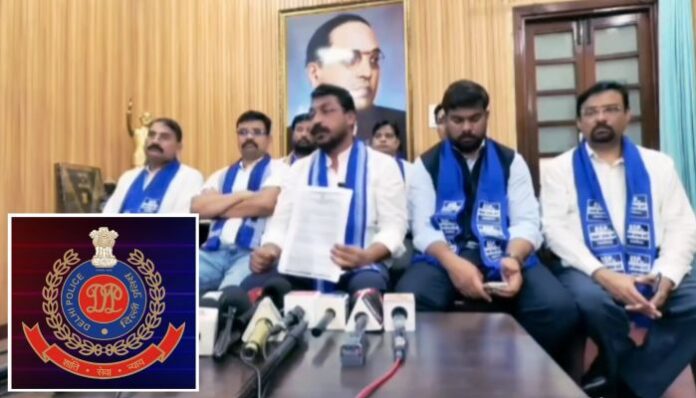
The Azad Samaj Party (Kanshi Ram) and Bhim Army chief Chandrashekhar Azad Ravan have claimed that the Delhi Police cancelled permission for their proposed pro-reservation protest at Jantar Mantar, just two days before the planned demonstration. On Tuesday, 22nd September, Azad claimed that the Delhi Police had denied permission for the protest scheduled for 24th September. The Azad Samaj Party had earlier announced the one-day pro-reservations demonstration at Jantar Mantar. The party had announced the protest on 17th September.
Azad now calls for District-level protests
Following the reported cancellation, a video shared by the Azad Samaj Party on their instagram page showed Chandrashekhar Azad reading a letter and claiming that the Delhi Police had denied permission for the 24th September.
Despite the alleged denial, Azad said the protest movement would continue. He called for district-level demonstrations across the country on the same date and said that an answer would be given to the government. His party has continued to promote the 24th September programme on its social media channels, using slogans such as “24 September Chalo Jantar Mantar” and calling it a “Sampoorna Bhagidari Mahaandolan”.
Why the chosen date is significant
The date chosen for these protests is far from ordinary and holds historical significance. The choice of date is significant because it marks the anniversary of the Poona Pact of 1932. This agreement replaced Dr B.R. Ambedkar’s longstanding demand for separate electorates for the ‘Depressed Classes’ with a system of reserved seats under a joint electorate.
“HOW DID YOU GIVE PERMISSION TO ANTI-RESERVATION PROTESTS?”
— OpIndia.com (@OpIndia_com) September 22, 2026
Chandrashekhar Azad ‘Ravan’ raised this question in his speech today, after Delhi Police allegedly denied permission for the September 24 protest at Jantar Mantar.
The date is significant: September 24 marks the… pic.twitter.com/PSSWKVHybK
The Poona Pact was signed on 24th September, 1932, following intense negotiations involving Mahatma Gandhi and Dr BR Ambedkar. The immediate background was the British government’s Communal Award, announced by Prime Minister Ramsay MacDonald, which had provided separate electorates for the Depressed Classes.
Gandhi opposed the separate electorate for the Depressed Classes and began a fast while imprisoned in Yerwada Jail. Ambedkar, who had supported separate electorates as a means of ensuring independent political representation, eventually negotiated with Gandhi and other leaders. The agreement that emerged became known as the Poona Pact.
What was the Poona Pact?
The most important change introduced by the Poona Pact was that the Depressed Classes would not have separate electorates. Instead, they would have reserved seats within a joint electorate.
The agreement provided 148 reserved seats for the Depressed Classes in provincial legislatures, substantially more than the number offered under the Communal Award. It also provided for reserved representation in the Central Legislature and included provisions relating to representation in public services and educational support.
Under the arrangement, members of the Depressed Classes could participate in a preliminary election to select candidates, after which the final election would take place through a joint electorate. The system therefore attempted to provide reserved representation while keeping voters within a common electoral system.
The question of separate electorates had been an important part of Ambedkar’s political thinking for years. In a 1930 memorandum, Ambedkar and Rao Bahadur R Srinivasan had demanded adequate representation for the Depressed Classes and proposed separate electorates for an initial period, followed by joint electorates with reserved seats.
The Poona Pact ultimately abandoned the separate-electorate model for the Depressed Classes in favour of reserved seats under joint electorates. It remains an important episode in the history of Dalit political representation and Ambedkar’s negotiations over constitutional safeguards.
Azad’s earlier demand for separate electorates
Earlier this year, Aazad himself reignited this debate by raising the demand for separate electorates for Dalits, drawing comparisons that fueled intense political discussions.
On 17th April, Chandra Shekhar Aazad stirred controversy during a speech in the Lok Sabha when he alleged that if the government genuinely wanted to empower backward communities, women, and Dalits, it should implement separate electorates. Claiming that current reservations have failed to genuinely uplift these groups and serve merely as a slogan, he argued that “Muslims could get Pakistan, but Dalits didn’t get anything,” thereby reviving a historical political demand tied to the pre-Poona Pact era.
"We want separate electorates for Dalits"
— Dr. Neha Das (@neha_laldas) April 20, 2026
-Says ASP chief Chandrashekhar Ravan
Now Questions:
1. Who will demand NSA against him?
2. Is this not tukde tukde demand?
3. Why there is no outrage on this, when it is stated publicly, that too in parliament? pic.twitter.com/LZ43yxSDdq
During his speech, the Lok Sabha MP from Nagina also referenced Bahujan leader Kanshi Ram and his book “Chamcha Yug” (Age of Stooges) to claim that representatives elected from reserved seats are forced to operate within system bounds and remain more loyal to political parties than their communities. “Therefore, a separate electorate is the only feasible solution,” he declared.
Therefore, the proposed 24th September mobilisation carries significance beyond the claimed immediate reservation demands. The date recalls the 1932 Poona Pact, while Azad’s recent advocacy of separate electorates has brought back a political debate associated with Ambedkar’s demand.
With the Delhi Police permission issue now becoming part of the controversy, Azad has said that the mobilisation will continue through district-level protests even if the Jantar Mantar programme does not take place as originally planned.


