


Remember this gentleman, who served as the Governor of the Reserve Bank of India and is a ‘world-renowned economist’. His name is Raghuram Rajan. Though, given the context, you probably haven’t seen him in the news over the last five or six years for his economic expertise.
Instead, you’ve likely seen him weeping over GDP figures or dropping curses on India’s manufacturing policy. But guess what? A new “ex-official” has stepped into his shoes to take over the mantle; his name is Subhash Garg, former Finance Secretary.
Recently, Garg presented his own math regarding the country’s 7.8% GDP growth rate. And now, he’s dropped another gem: claiming that the Pradhan Mantri Jan Dhan Yojana (PMJDY), launched 12 years ago, is an utter failure.
He recently authored an opinion piece on a leftist portal, The Quint. The metrics he used in the article to declare the scheme a failure take the entire claim to a ridiculous level.
Let’s first look at the logic Garg uses to write off the scheme. In his article, he points out, with absolute gravity, that around 50 million accounts opened under the scheme currently have zero balance.
His second grand claim is that out of the 590 million accounts opened, 150 million are inactive. Next, he claims that nobody knows how many of them are using UPI. And lastly, Garg claims that people actually open these accounts just to withdraw government welfare money!
Based on this groundbreaking analysis, Garg declares that the scheme should be abolished because it’s a total flop. While such arguments might ordinarily be dismissed, it is important to lay out the context and facts here.
First, when the Jan Dhan Yojana was launched in August 2014, tens of millions of adults in the country lacked a basic bank account. They had no formal mechanism to save money or access institutional credit.
Prior to this, mainstream awareness around zero-balance banking accounts was minimal. A scheme named Basic Savings Bank Deposit Account (BSBDA) existed under the UPA government, but public awareness and adoption remained limited.
PMJDY provided citizens with the facility to open bank accounts without a mandatory minimum balance. Consequently, while only 53% of Indian adults held a bank account in 2014, that figure rose to 89% by 2024.
This effort resulted in the opening of 590 million accounts under the scheme. If some individuals do not maintain funds in these accounts, that is by design; it reflects the core flexibility of a zero-balance facility. The absence of a minimum balance in a Jan Dhan account is an intentional feature, not an operational flaw.
Garg further notes that among the accounts that do hold money, the average balance is only around ₹5,000. It is worth considering that Jan Dhan accounts are not intended for affluent urban residents; they are utilized primarily by low-income individuals in rural areas and small towns, for whom a ₹5,000 savings balance is significant.
Furthermore, these accumulated small savings have collectively provided the banking system with over ₹3 trillion (₹3 lakh crore) in fresh capital.
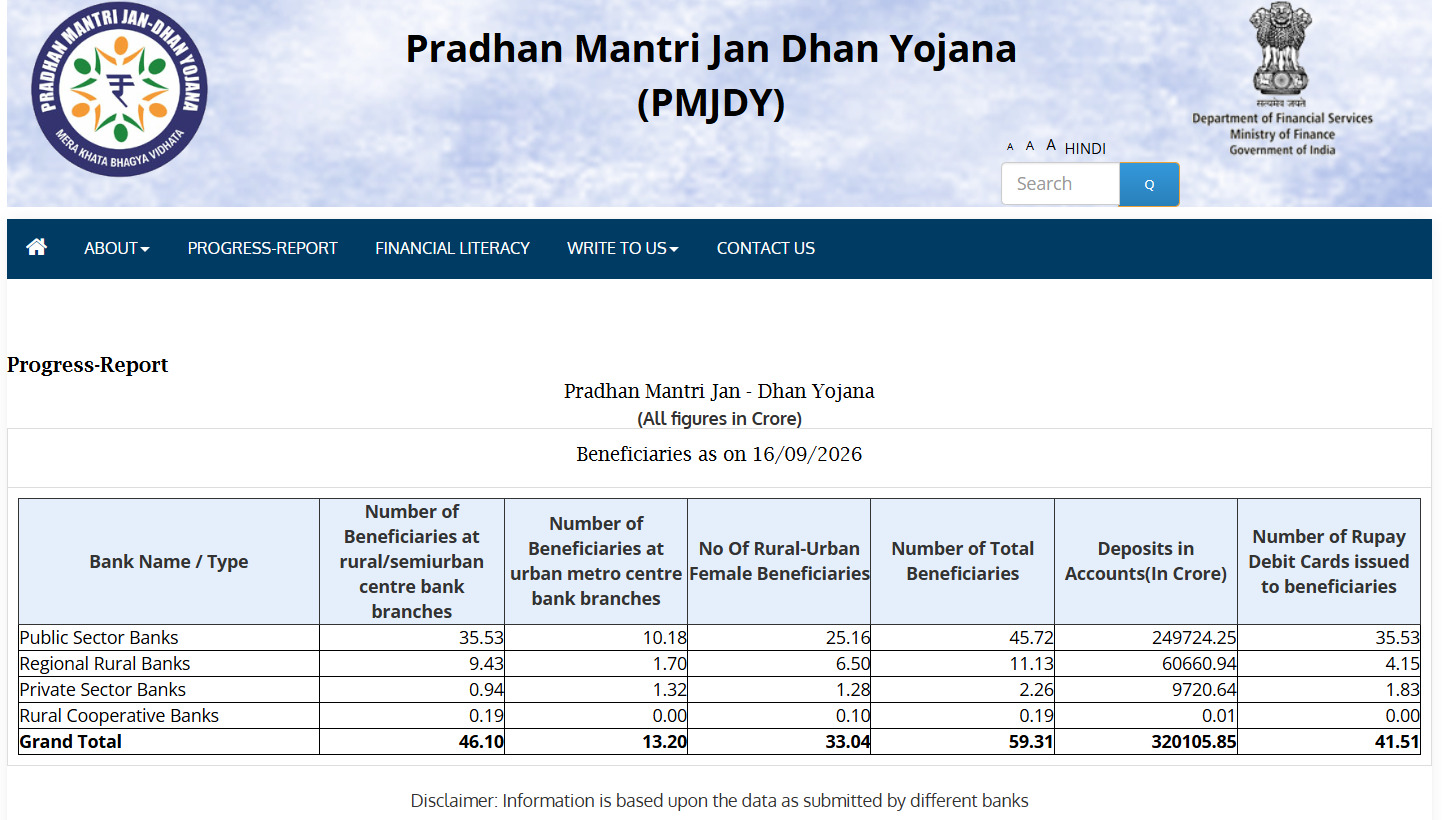
Financial institutions can deploy these funds to extend credit and expand operations. Thus, the scheme has aimed to both empower individuals and strengthen the formal banking architecture.
Regarding his second claim that 150 million Jan Dhan accounts are inactive: the primary objective of the Jan Dhan Yojana was to integrate unbanked citizens into the formal financial framework, not to restrict them to a single account. If a citizen entered the banking system through Jan Dhan and later transitioned to a private bank for additional services, that represents progress rather than institutional failure. The core motive was bringing people into the financial fold.
Coming to Garg’s next claim that beneficiaries primarily use these accounts to receive government welfare transfers. Facilitating Direct Benefit Transfer (DBT) is one of the primary functions of financial inclusion. Without these accounts, the government could not efficiently execute direct welfare transfers to millions of citizens.
Official data indicates that this mechanism has helped prevent leakages exceeding ₹5 trillion (₹5 lakh crore). Therefore, using these accounts to access funds from initiatives like PM-KISAN or the Pradhan Mantri Awas Yojana fulfils the fundamental objective of the framework.
Garg next pointed out the lack of specific data regarding how many Jan Dhan account holders actively use UPI. India currently records over 550 million UPI users, a significant portion of whom likely access it via their Jan Dhan accounts. However, even if UPI adoption varies, it does not mark a structural failure of the scheme.
Depositing money, withdrawing funds, accessing credit, and obtaining debit cards were the core mandates of the initiative, which it delivered. The explicit goal was not merely to drive users from one specific digital product to another.
Finally, Garg argues that the scheme should be abolished and that the government should cease promoting it. It is not unusual for governments to publicise a key public policy milestone. Had previous governments achieved similar milestones earlier, the Modi government probably would not have had to work on this area and highlight its achievement.
The UPA government undertook a similar initiative. It opened roughly 240 million accounts over an eight-year period, whereas the current framework utilised technology to scale beyond 500 million accounts in a comparable timeframe.
If the UPA had achieved something similar, they would have also highlighted their achievement. So why the heartbreak now that the Modi government actually delivered and is talking about it? There is nothing exceptional in the current government highlighting the success of its scheme. Garg’s cribbing makes no sense here.
It is hilarious to see people who keep repeating claims like “Rajiv Gandhi brought computers,” “Nehru built IITs,” or “Indira Gandhi broke Pakistan,” complaining about the current government highlighting its achievements.
It is fine not to like PM Modi or the BJP government. But tere contempt for a political party or government does not make up for the lack of logic in an argument. Substituting facts with opinions renders an argument weak.
The real question Garg should be asking is: why were tens of millions of citizens denied a basic facility like a bank account for decades? Why did it require a special national mission to pull it off in the first place? Instead, he resorts to fault-finding.


