

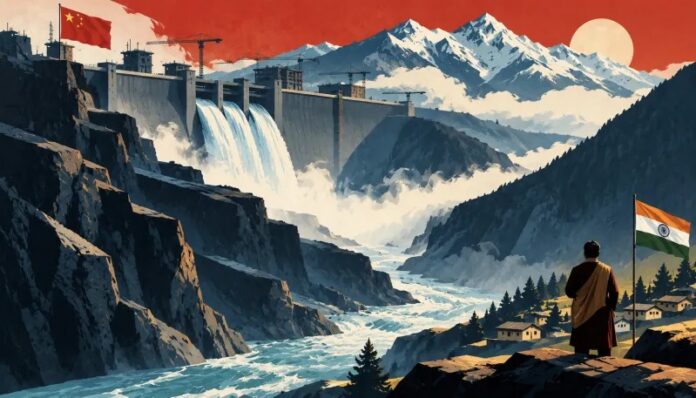
Who really controls a river that crosses borders? On paper, rivers belong to no single country once they become transboundary systems. There are treaties, international principles, arbitration mechanisms and expectations of cooperation between nations that share a river.
But geography creates an uncomfortable reality. The country sitting upstream often possesses something more tangible than legal arguments: the ability to build dams.
China’s enormous hydropower project on the Yarlung Tsangpo illustrates this perfectly. By the time the river enters Arunachal Pradesh as the Siang and eventually becomes the Brahmaputra, decisions capable of affecting its behaviour and control the water flow may already have been made hundreds of kilometres upstream.
India has no binding river-water treaty with China capable of regulating such construction, only limited mechanisms for hydrological cooperation.
Move west across the Himalayas and India’s position reverses. On the Indus, India is the upstream country and Pakistan the downstream one, and here a detailed treaty does exist. After the 2025 Pahalgam attack, India placed the Indus Waters Treaty in abeyance. Contrary to the popular impression that India had “stopped Pakistan’s water,” it had neither the infrastructure nor storage capacity to do so completely; what Delhi actually suspended was cooperation: data sharing, commission meetings and treaty processes. A Hague tribunal subsequently held that India could not unilaterally suspend the treaty, a ruling India rejected while disputing the arbitration process itself. India has that power because geography ordained it so.
Indus Water Treaty evaluated water-sharing scenarios and topography. It was never designed for situations in which Pakistan would send armed terrorists into India to kill civilians, sponsor Islamic terrorist organisations sworn to attack India and launch attack after attack for decades. The treaty has no answer for that.
Put these situations together and an intriguing contradiction appears with plenty of examples globally. Countries naturally emphasise downstream rights when they are downstream and territorial sovereignty when they are upstream.
It is not that laws and treaties are irrelevant, but that laws without the physical capability to build upstream infrastructure can be insufficient. Concrete matters. The Brahmaputra, Indus and even the Nile-where Ethiopia built the GERD despite years of opposition from downstream Egypt, demonstrate how quickly infrastructure can transform negotiating power for a country that shares a river.
For India, the lesson is therefore bigger than building another dam. It means being able to independently monitor Himalayan rivers through satellites and seismic data; creating enough storage and flood-management capacity to absorb unexpected changes; negotiating stronger arrangements with neighbours; and designing future treaties with clear provisions for extraordinary security situations.
The Himalayas are called the Third Pole of the world. The series ‘Geopolitics of Rivers’ in Chapter 1 Mag explains that international law may tell countries how rivers ought to be shared, but geography determines who encounters the water first, and infrastructure increasingly determines what happens to it next.
Read the first article of the series ‘Who owns a river?’ When upstream territory wields power of concrete’ here.
Read the second article ‘The water treaty that wasn’t built for terrorism: India, Pakistan and the Indus River System’ here.
Read the third article ‘Third Pole doctrine: The limits of law and the power of infrastructure’ here.


