

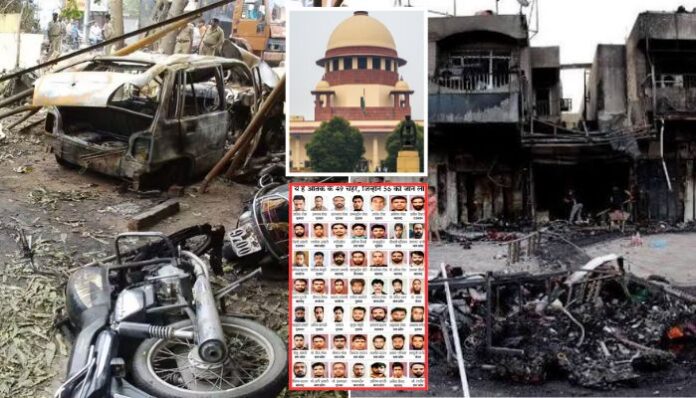
On Thursday, September 1, the Supreme Court stayed the execution of the death sentence awarded to terrorist Ahmed Bawa Abbu Abubakar Barelvi, one of the 38 convicts sentenced to death in the 2008 Ahmedabad serial blasts case. A bench of Justices Vikram Nath, Sandeep Mehta and Augustine George Masih passed the order while hearing Barelvi’s challenge to the Gujarat High Court judgment that had upheld his conviction and death sentence.
Supreme Court hears plea by Ahmed Bawa Abbu Abubakar Barelvi, a death-row convict in the 2008 Ahmedabad serial blasts case, challenging the Gujarat High Court verdict upholding his conviction and death sentence.
— Bar and Bench (@barandbench) October 1, 2026
Bench: Justices Vikram Nath, Sandeep Mehta and Augustine George… pic.twitter.com/im3OWxS71Q
Barelvi had challenged the High Court’s decision before the Supreme Court. During the hearing, his lawyer told the court that his conviction was based entirely on conspiracy. Taking note of the submissions, Justice Vikram Nath ordered that the execution of the sentence be stayed. The Supreme Court also issued notice to the Gujarat government and sought its response to the plea.
Barelvi’s lawyers also requested a translated copy of the Gujarat High Court judgment, pointing out that the trial court records were in Gujarati. The legal team appearing for Barelvi included advocates Ashwin Vaish, MS Mukarram, Ashutosh Thakur, Amit Kumar, Harsh Jha, Yashaswi Dasari and Uttam Panwar.
The Supreme Court’s order is the latest development in a case that has continued for nearly two decades and involves one of the deadliest terror attacks in Ahmedabad.
2008 Ahmedabad serial blasts killed 56 people
The Ahmedabad serial blasts took place on July 26, 2008. A series of coordinated explosions hit different parts of the city within around 70 minutes. The blasts targeted crowded public places and several other locations, including hospitals, buses, parked bicycles and cars.
A total of 21 bombs exploded across Ahmedabad. The attacks killed 56 people and injured more than 200 others. One of the striking features of the attack was that explosions also took place at hospitals where victims of the blasts were being treated.
Two days after the Ahmedabad blasts, several live bombs were recovered from different locations in Surat. Those bombs, however, did not explode.
The police registered 20 FIRs in Ahmedabad and another 15 FIRs in Surat. Investigators later connected the two sets of cases, saying they were part of the same terrorist conspiracy involving Indian Mujahideen, described by the prosecution as a breakaway faction of the banned Students Islamic Movement of India (SIMI).
The investigation led to a long-running trial
The cases were eventually combined for a joint trial. In total, 78 people were tried in connection with the case; one had turned approver. The proceedings continued for several years as the prosecution presented evidence about the blasts, the conspiracy and the roles of the accused.
The Special Court in Gujarat delivered its verdict on February 8, 2022. It convicted 49 people and acquitted 28 others after giving them the benefit of doubt. One accused was granted pardon after becoming an approver, while four approvers who later retracted their statements were convicted during the proceedings.
The convictions covered several serious offences. These included murder under Section 302 of the Indian Penal Code, attempt to murder, criminal conspiracy under Section 120B, and provisions relating to waging war against the State. The accused were also convicted under provisions dealing with promoting enmity between different groups and other offences under laws including the Unlawful Activities (Prevention) Act, Explosive Substances Act and Prevention of Damage to Public Property Act.
Special Court awarded death sentence to 38
After convicting 49 people, the Special Court considered the question of punishment. On February 18, 2022, it awarded the death penalty to 38 convicts and sentenced the remaining 11 to life imprisonment until death.
The court treated the case as a “rarest of the rare” matter. Special Judge Ambalal R Patel, who conducted the trial, announced the operative part of the sentencing order in court.
The 38 convicts were awarded capital punishment under Section 302 of the Indian Penal Code along with relevant provisions of the Unlawful Activities (Prevention) Act. The court also imposed fines on the convicts.
Forty-eight convicts were ordered to pay a fine of Rs 2.85 lakh each. Another convict, Mohammed Usman Agarbattiwala of Vadodara, was ordered to pay Rs 2.88 lakh. He was the only convict found guilty under the Arms Act. The court directed that the money collected through the fines be used for compensation to the victims’ families.
The sentencing order ran into 7,015 pages. The court also ordered compensation for those affected by the blasts. The families of the 56 people killed were to receive Rs 1 lakh each, while people who suffered injuries were also entitled to compensation according to the nature of their injuries.
Gujarat High Court upheld the death sentences
The 2022 Special Court judgment was then taken up by the Gujarat High Court. The High Court had to consider the appeals filed by the convicts as well as the State government’s request for confirmation of the death sentences.
On July 7, 2026, the Gujarat High Court upheld the convictions and sentences of the 38 people awarded the death penalty. It also upheld the life sentences given to 11 others.
A Division Bench of Justices A.Y. Kogje and Samir Dave dismissed the criminal appeals challenging the Special Court’s verdict. The court also allowed the State government’s reference seeking confirmation of the death sentences, which is required in death penalty cases.
Court cited scale of attack and conspiracy
While upholding the death sentences, the High Court referred to the large number of deaths, the scale of the conspiracy and the intention to create widespread terror.
The court also examined the roles and records of the 38 convicts. It noted that the Special Court had considered both circumstances that could support a lesser punishment and those that made the crime more serious before deciding on the death penalty.
The High Court said the large number of deaths, the scale of the conspiracy and the objective of creating fear across society were among the factors supporting the punishment. It also referred to the conduct of some convicts during the trial, their criminal antecedents and disciplinary action taken against some of them in jail.
For the 11 people who received life imprisonment, the High Court said their roles included participation in terror training camps in Gujarat and Kerala and providing logistical support for the conspiracy. The court referred to activities such as procuring scooters, plastic containers and clocks used in the conspiracy and arranging shelter for others.
Who were the convicts?
The 49 people convicted in the case were linked to the terrorist organisation Indian Mujahideen. The convicts included former SIMI leader Safdar Nagori and associates from 11 states. The list of all 49 convicts in the case is given below.
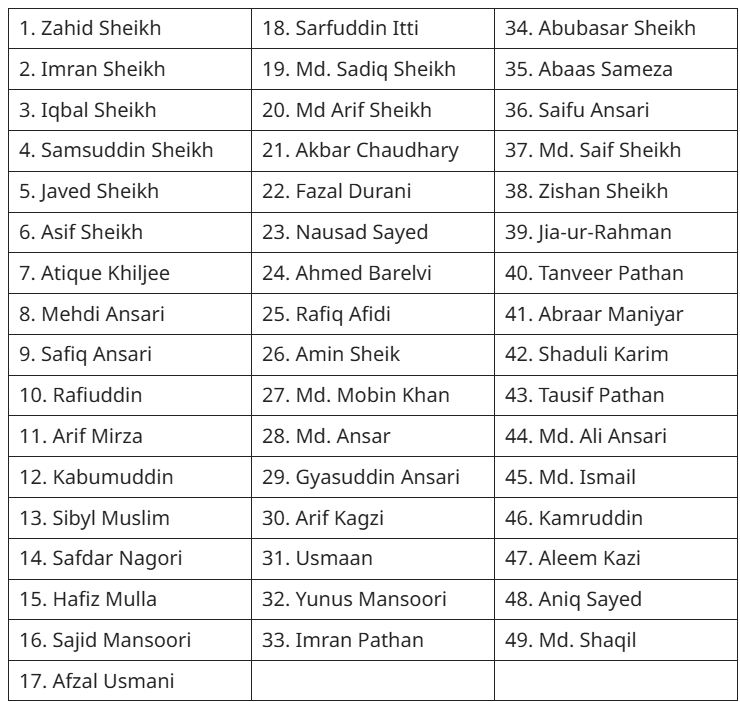
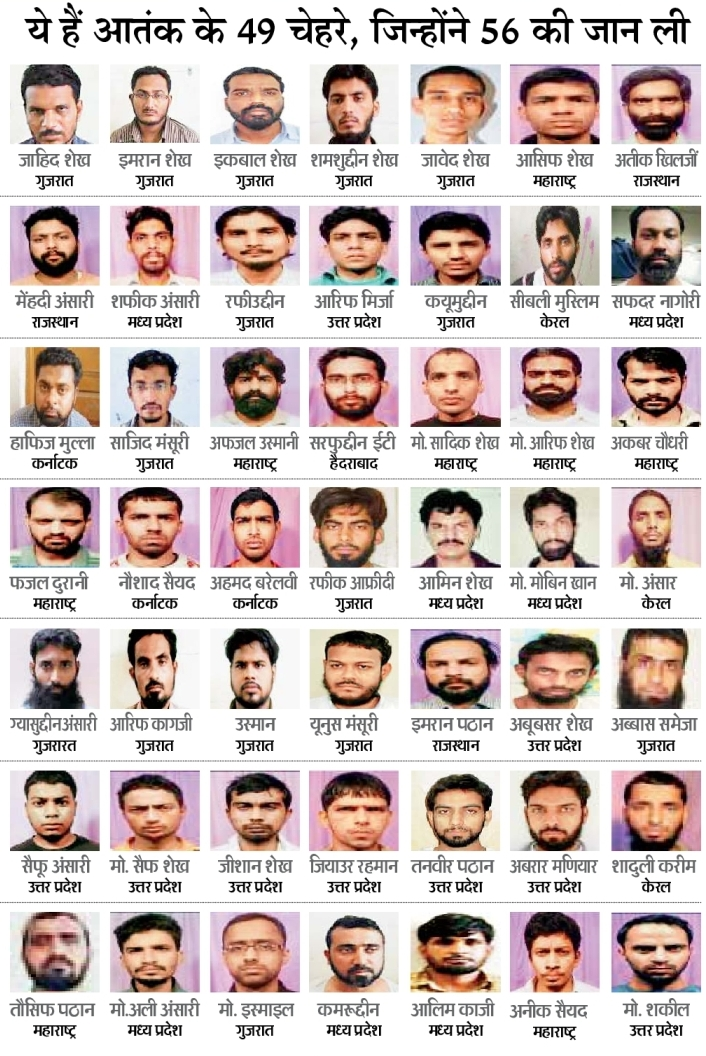
The Special Court’s 2022 decision was significant because it was the first time that 38 people were sentenced to death in a single case. The prosecution’s case involved a large network and a coordinated conspiracy behind the Ahmedabad attacks.
The case also involved multiple locations and a large volume of evidence. The investigation covered the Ahmedabad explosions as well as the recovery of unexploded bombs in Surat.
What happened to the victims?
The 2008 attacks left 56 people dead and more than 200 injured. The blasts caused damage at several public locations and also struck hospitals treating people injured in the attacks.
The courts have ordered compensation at different stages of the case. The Special Court initially directed payments to the families of those killed and people injured in the blasts. The Gujarat High Court later increased the compensation, directing Rs 10 lakh for each deceased victim’s family, Rs 5 lakh for each person with grievous injuries and Rs 1 lakh for those with simple injuries. It was directed to complete the payment by March 30, 2027.
Case now before the Supreme Court
After the Gujarat High Court upheld the convictions and death sentences, Ahmed Bawa Abbu Abubakar Barelvi approached the Supreme Court. His petition challenges the High Court judgment confirming his conviction and capital punishment.
During the Supreme Court hearing, Barelvi’s counsel argued that his conviction was based on conspiracy. The lawyers also sought a translated copy of the Gujarat High Court judgment because the trial court records were in Gujarati.
The Supreme Court has now issued notice to the Gujarat government and sought its response. It has also stayed the execution of Barelvi’s death sentence.
The stay means that the death sentence against Barelvi will not be carried out while his challenge is being considered by the Supreme Court. The larger Ahmedabad serial blasts case, however, remains rooted in the July 26, 2008 attacks that killed 56 people, injured more than 200 and led to one of the country’s longest-running terror trials.


