

Democratic discourse operates at the intersection of dissent and democratic governance. While dissent ensures a check on the government of the day, seamless governance is an inviolable mandate by the people to the ruling dispensation. Hence, a delicate balance between the two is a must. This necessitates the inviolable sanctity of institutions of the state to ensure coherence and harmony in everyday life of the national public sphere.
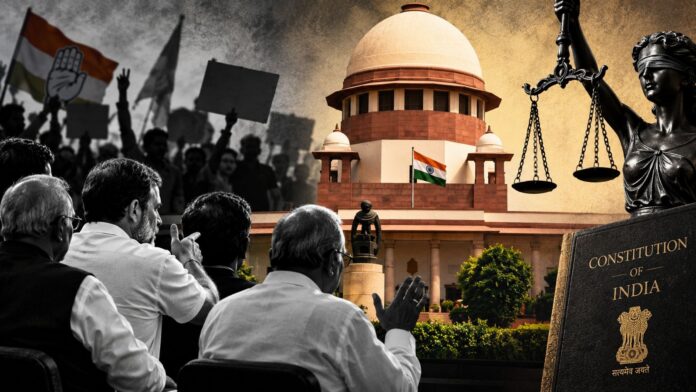
In this backdrop, the incident of opposition led protest turning into an unwarranted attack on the sanctity of the Supreme Court in general and the Chief Justice of India in particular warrants public attention.
In a thriving democracy, the right to peaceful dissent is a citizen’s most potent constitutional asset. In India, the rights to free expression and assembly are not only inherent, but they are also explicitly guaranteed under Articles 19(1)(a) and 19(1)(b) of the Constitution. Furthermore, the right to move the Supreme Court for their enforcement is itself a fundamental right under Article 32, a provision Dr B.R. Ambedkar famously revered as the “heart and soul of the Constitution.” The Supreme Court, therefore, is duty-bound to uphold these liberties whenever approached.
Yet, the manner in which this right is presently being wielded, and the mechanisms sought for its enforcement, triggers a profound institutional alarm.
On October 10, 2026, the Leaders of the Opposition in both the Rajya Sabha and the Lok Sabha wrote to the Chief Justice of India (CJI) seeking a private audience. Their stated objective was to “apprise him of the situation” regarding the alleged “created chaos” stemming from nationwide protests demanding the resignation of the Chief Election Commissioner (CEC). This move was remarkably unfortunate, particularly because a Member of Parliament from the opposition INDI alliance had already brought these exact grievances before the Supreme Court. The Court had treated the matter with such urgency that it convened a special bench on a Sunday to hear it.
The opposition’s letters to the CJI are highly unfortunate on two distinct fronts. First, they strike at the very foundation of the separation of powers. “It has been the desire of this country from long past that there should be separation of the judiciary from the executive,” Dr Ambedkar reminded the Constituent Assembly, a desire codified in Article 50 of the Constitution. While historically framed against executive overreach, this principle applies with equal force to all political branches of the State. When prominent political figures seek a private chamber meeting with the head of the judiciary to discuss a volatile, live political dispute, the boundary line Dr Ambedkar so meticulously drew is dangerously blurred.
Second, these letters constitute a direct interference with the administration of justice. Regardless of their stated intent, they function as an attempt to privately influence the adjudication of proceedings already pending before the Supreme Court.
Nor can these letters be dismissed as an isolated lapse in judgment. On the eve of the Court’s hearing, one of India’s most revered senior advocates, who is representing petitioners in these very protest matters, made the categorical unfortunate public declaration that he does not “have much hope in the Supreme Court of India.” Thereafter, a state unit of the opposition party utilised its official X handle to post a contemptuous demand for the CJI’s resignation. Though the post was subsequently and hastily deleted, it exposed the impact of the insensitive and highly irresponsible conduct of the opposition’s political machinery.
If the leaders of the opposition harbour genuine constitutional grievances regarding the CEC or the State’s response to the protests, the Constitution provides them with two appropriate arenas: the floor of Parliament and the Supreme Court, which is already seized of the matter. Neither of these forums requires, or permits, a private session with the Chief Justice.
India has always fiercely guarded the independence of its judiciary. That collective resolve is etched into our history through the nation’s enduring reverence for Justices J.M. Shelat, K.S. Hegde, and A.N. Grover, who were superseded in 1973, and Justice H.R. Khanna, superseded in 1977. Each of these judicial titans paid the ultimate professional price for delivering judgments that upheld the Constitution against the overwhelming pressure of a powerful executive. In an ironic way, unlike in the 1970s, it is the prime opposition party today that is trying to coerce the judiciary into committing itself to its partisan agenda.
Today, a new environment is being engineered to influence judicial outcomes, this time by bringing the heavy, blunt force of popular opinion and political theatre to bear upon the judiciary. This effort is indisputably not about securing independent adjudication; it is about pressuring the most sacrosanct institution in our republic to conform to a specific political will.
We must not shy away from saying an uncomfortable truth, i.e., coercion of the judiciary is no more acceptable when it emanates from the streets than when it emanates from the government. The judicial independence that this nation so fiercely defended in 1973 and 1977 must now be defended against pressure of a different, more populist kind, and the Supreme Court must be left to decide the matter as Dr Ambedkar intended, on the record, in open court, and free from influence from any quarter, including the streets of our Bharat.


