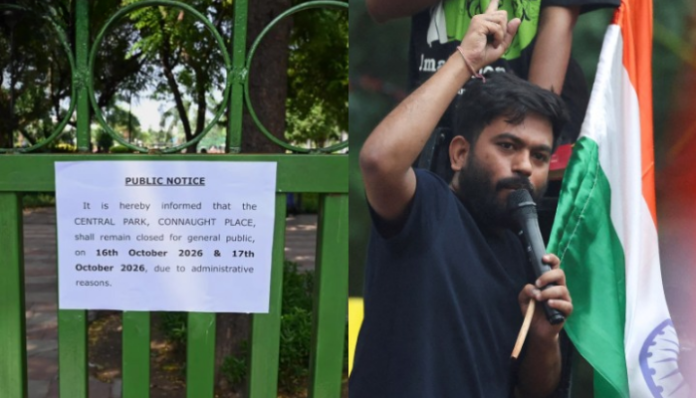
Abhijeet Dipke, founder of the Cockroach Janta Party (CJP), has announced an unauthorised program against the arrests of its co-convenors Saurav Das and Ashutosh Ranka for breaking into the denotified protest site at Jantar Mantar. The “Lehra Do Tiranga” march will be held at Connaught Place’s Central Park on 16th October (Friday).
Another Shaheen Bagh in the making: Intelligence agencies raise alarm
However, intelligence agencies have cautioned that the event could turn into an unending sit-in agitation for the release of the two leaders, reported News18. According to the sources, the participants might refuse to vacate the location after 5:00 pm, as they referred to 20th June, when permission was similarly granted until the same time, but the demonstration persisted for more than a month.
Additionally, agencies anticipate that the attendees will not travel directly to Central Park and instead congregate in small groups at different places, resulting in simultaneous assemblies throughout Central and New Delhi Districts.
It has been highlighted that extensive use of social media for livestreaming and mobilisation, along with last-minute venue or route modifications, could make crowd management and traffic control harder, especially during evening peak hours.
The insiders also mentioned that restrictions on Central Park could lead to attempts to move in the direction of Parliament House, India Gate, Rashtrapati Bhavan, the PMO, the Supreme Court, political party offices, and the homes of high-ranking public officials. Security has been identified as a top priority in the vicinity of these venues.
The evaluation also issued a warning regarding disorder. It stated that anti-social individuals could take advantage of the occasion to engage in unlawful activities, including overcrowding, rumour-mongering, or instigation, which might culminate in pushing, altercations, or damage to public property in and around the area.
The current apprehension stems from past CJP campaigns. Two police officers were hurt in an attack and stone pelting that took place during the 10th October protest close to Akashvani Bhawan. The next day was followed by reports of confrontational incidents.
On 20th July, organisers in the New Delhi district violated prohibitory orders under Section 163 of the Bharatiya Nagarik Suraksha Sanhita (BNSS) when demonstrators tried to depart the designated protest area in defiance of regulations on unapproved processions and assemblies.
The sources stated that the number of people was significantly more than communicated. They also broke through police barricades, which could be repeated this time with another unanticipated surge. An eye is being kept out for mobilisation calls, gathering spots, and last-minute modifications on social media platforms.
Furthermore, preventive measures have been recommended at bus terminals, train stations, and metro stations, where sufficient force and crowd control measures are kept on hand. Police will remain on duty until the throng has entirely dispersed, and security around important installations and VIP zones in the national capital will be strengthened.
A familiar playbook in action
CJP regularly references democracy, the Constitution, the tricolour and other national symbols to portray its “movement” as a struggle for the better future of the country and its people. To the uninitiated, the rhetoric might seem to reflect a genuine commitment to democratic rights. However, a closer look at the party’s past conduct reveals how such revered symbols are routinely used to lend legitimacy to its actions.
It was not long ago that a CJP protest descended into violence and vandalism, leaving hundreds of police personnel attacked and injured over the demanded of the resignation of then Union Education Minister Dharmendra Pradhan.
The group’s supporters were again caught trying to urge others, particularly members of “Gen Z,” to indulge in problematic antics and foment unrest ahead of the 10th October agitation against Chief Election Commissioner Gyanesh Kumar. Their plan, however, was thwarted by stringent measures taken by the authorities.
Hence, the invocation of national symbols, figures and constitutional ideals sits uneasily with its own conduct. The disconnect between its statements and its actions is difficult to ignore, as the appeals evidently serve not as a guiding force but as a convenient cloak to disguise its real objectives.
However, this is not an isolated matter but part of another part of a repetitive script that has often played out on the streets of India, ending up in violence, widespread disruption and chaos. Many agitations, including the anti-CAA (Citizenship Amendment Act) propaganda and the rallies against the three Farm Laws, which were later repealed, driven by unfounded assertions or political and ideological bias, descended into riots and turmoil against Hindus and the state.
The concentrated effort against the CAA, presented as a crusade to defend the Constitution and the rights of Indian citizens, issues entirely unrelated to the legislation, was unveiled to be a profound conspiracy against the nation. The pathway to citizenship for persecuted religious minorities from Pakistan, Afghanistan and Bangladesh was framed as a great discrimination, while the national flag and the Constitution were brandished at the demonstrations, including the infamous Shaheen Bagh.
However, the drama finally exploded into the anti-Hindu riots in Delhi, which claimed at least 53 lives. Intelligence Bureau officer Ankit Sharma was killed during the violence, and former Aam Aadmi Party councillor Tahir Hussain has been convicted in connection with the murder and the rampage. Head Constable Ratan Lal met a similarly tragic fate at the hands of rabid Muslim fanatics.
Shahrukh Pathan, whose pistol-wielding image came to define this dark chapter, was arrested for pointing the weapon and firing at unarmed Head Constable Vivek Dahiya.
Notably, the primary names linked to the protests, including Umar Khalid and Sharjeel Imam, who have been booked under the Unlawful Activities Prevention Act (UAPA), dragged national symbols even as allegations of their involvement in orchestrating violence came to the fore. Khalid has alleged that Kashmir is illegally occupied by India, while Imam wanted to sever the “Siliguri Corridor” (Chicken’s Neck) from the rest of the nation.
Moreover, the incident happened during United States President Donald Trump’s visit, a period when the country’s international standing was under the spotlight. This cabal wanted to trigger disturbances across the country, target the Hindu community and tarnish India’s global reputation in the name of justice and the Constitution.
Similarly, the national flag and the Constitution featured heavily throughout the farmer protests, which were rife with charges of violence. Their most horrifying episode transpired on Republic Day 2021, when shocking scenes erupted at the Red Fort with assaults on police personnel, vandalism and destruction unfolding at a monument of immense national significance. The unruly mob even desecrated the tricolour in a further display of their contempt.
Afterwards, it was found that 299 police officials had been wounded, 236 iron barricades were damaged, and 11 Delhi Transport Corporation (DTC) buses were vandalised. The year-long agitation also caused losses of nearly Rs 50,000 crore in only the Delhi-NCR (National Capital Region). The national symbols were essentially brandished to obscure the trail of carnage that accompanied the demonstration.
The very flag repeatedly invoked to lend the agitation a veneer of patriotism thus became part of a deeply disturbing episode that raised serious questions about the gap between the movement’s public symbolism and the conduct witnessed on the ground.
Furthermore, even the banned Popular Front of India (PFI) sought to project itself as a national and secular entity by exploiting these core values to attract Scheduled Castes, Scheduled Tribes and Other Backward Classes to its jihadi agenda. The Islamist outfit considered them potential instruments of political mobilisation to cultivate support while hiding its extremist goals.
PFI’s “India Vision 2047” clearly mentioned, “The party should utilise concepts such as the National Flag, the Constitution and BR Ambedkar to shield the real intention of establishing an Islamic rule and to reach out to SCs/STs/OBCs.” The symbols were appropriated to stand in direct opposition to the very principles they represent, to do away with the Constitution and to replace the entire system with the rule of Sharia.
Conclusion
It is not surprising to co-opt national symbols for their interests, and the CJP is also following suit. The tricolour and the Constitution are capitalised on as powerful instruments for swaying public opinion, with their symbolism conjuring a veneer of authenticity to narratives that might otherwise fail to win public support.
Neha Bora, national president of the All India Students Association (AISA), who has already aligned herself with the CJP, previously hailed Bangladesh’s regime change and expressed her desire to replicate it in India. Ironically, the national symbols are being harnessed to oust a democratically elected government to save democracy in India.
More troubling, Khalistani and other anti-national groups are also known to join such demonstrations, misusing the national symbols for their propaganda. The tricolour and the Constitution are transformed into tools of deception rather than expressions of genuine patriotism.
This tried-and-tested formula has been adopted by the AAP front CJP as well, with national symbols once again placed at the forefront of a politically motivated exercise. The party has also chosen to resort to age-old yet perilous tactics for short-term political gains, at a far greater cost to the nation and the people it consistently claims to champion.