

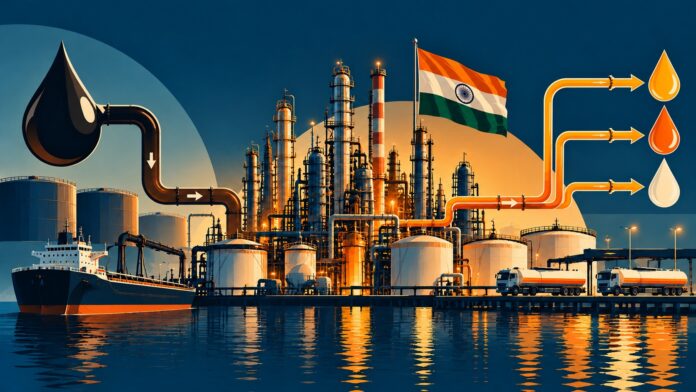
India imports nearly 90% of the crude oil it consumes, yet it is the world’s second-largest exporter of refined petroleum products. India’s strength lies in developing an industrial capacity to transform crude oil from different sources into the petrol, diesel and aviation fuel the world needs. As wars, sanctions and disrupted shipping routes reshape international oil markets, India’s refining capability has become a significant economic and geopolitical advantage.
India’s refining capacity stands at approximately 258.1 million tonnes annually, making it the world’s fourth-largest refining nation in terms of capacity. In FY2025–26, domestic petroleum consumption reached around 243 million tonnes, while exports totalled 61.5 million tonnes. These figures establish an important distinction: India’s refining industry serves domestic energy requirements while simultaneously operating as a major export-oriented manufacturing sector. Petroleum product exports earned approximately $53.8 billion in FY2025–26, making refining a substantial contributor to foreign exchange earnings.
At the centre of this refining power is Reliance Industries’ Jamnagar complex in Gujarat, the world’s largest single-site refinery, processing approximately 1.36 million barrels daily. Reliance accounts for more than 70% of India’s refined fuel exports. However, Jamnagar’s greatest advantage is not merely its size but its technological sophistication.
Crude oil varies considerably in density and sulphur content. Light, low-sulphur crude is relatively easy to process and generally commands higher prices. Heavy, sulphur-rich crude is cheaper but requires advanced refining technology. Indian refineries, particularly Jamnagar, possess sophisticated conversion units capable of processing varied types of crudes from Russia, the Persian Gulf and Venezuela into valuable fuels meeting international standards.
This flexibility allows Indian refiners to purchase crude oil at discounted prices from whoever and wherever, maximise the production of diesel and petrol, and benefit from the difference between crude acquisition costs and refined-product prices. Deep-water ports, storage infrastructure and blending facilities further enable rapid changes in suppliers when geopolitical circumstances shift.
The strategic value of these investments became evident after the Russia-Ukraine war started in 2022. Western restrictions redirected Russian crude away from traditional European customers. India increased its purchases substantially, with Russia’s share of Indian crude imports rising from approximately 2% before the war to 35.8% in FY2024–25. Indian refineries processed these barrels, while alternative crude supplies and finished fuels were redirected through global markets, helping maintain overall availability.
It is not just a robust refining industry that makes this possible. India’s government has consistently stood firm on its priorities to purchase crude oil irrespective of Western pressure, keeping the needs of a 1.4 billion population ahead of geopolitical drama. Washington initially supported continued Russian oil purchases within the G7 price-cap framework to prevent global price spikes. In 2025, the Trump administration imposed punitive tariffs on India, citing Russian oil imports. The European Union subsequently restricted imports of refined products manufactured from Russian crude, requiring Indian exporters to segregate supply chains. Reliance adapted by switching its export-oriented Jamnagar refinery to non-Russian feedstock.
The 2026 Gulf conflict introduced another major disruption. Restrictions on shipping through the Strait of Hormuz threatened a route carrying approximately one-fifth of global oil supplies. India, itself heavily dependent on Gulf energy, responded by diversifying imports towards Russia, Venezuela and other suppliers outside the affected route.
Meanwhile, disruptions to Russian refining, Chinese export restrictions and constrained Gulf shipments increased international demand for Indian diesel. In September 2026, India’s diesel exports reached approximately 620,000 barrels daily, including around 280,000 barrels destined for Europe. These numbers demonstrate how India’s refining infrastructure has become particularly valuable when established suppliers cannot deliver.
Yet this success carries significant costs. Higher international crude prices increase India’s import bill, inflationary pressures and currency vulnerability. Government interventions, including fuel-tax reductions and export levies, must balance profitable overseas sales against affordable domestic supplies. Complex refineries also require substantial energy and generate environmental costs.
India’s future position will depend on the duration of geopolitical disruptions, Western sanctions policies and its ability to maintain diversified crude supplies. Peace could reduce extraordinary refining margins, while prolonged instability could increase demand for Indian exports but impose greater costs on the domestic economy.
India’s defining advantage is flexibility. Oil-producing nations remain tied to their reserves, while India’s sophisticated refineries can switch suppliers, process varied crude grades and serve multiple markets. That capability has transformed India from a major petroleum importer into a critical intermediary in global energy security.
Read the complete article here on Chapter One Magazine.


