

India has recorded “one of the fastest poverty declines” in the world between 2011 and 2023, according to the World Bank’s latest report. In its report [pdf] titled India Poverty and Equity Brief: October 2026, the World Bank highlights that the country has made remarkable progress in reducing poverty across both monetary and non-monetary dimensions.
Over this decade-long span, extreme poverty in the country fell drastically by 24.5%. As the World Bank noted in its note, “Over the past decade, India has made remarkable progress in reducing poverty across both monetary and non-monetary dimensions, recording one of the fastest poverty declines in the world.”
This massive social transformation was largely driven by robust consumption growth, rising employment, particularly among women entering the workforce, and expanded social welfare programs like food subsidies. However, the report also cautions that poverty is becoming increasingly concentrated geographically, with roughly 57% of India’s poor population living in a contiguous belt stretching from Uttar Pradesh to West Bengal.
How the World Bank estimates poverty
The World Bank uses three international poverty thresholds to measure poverty, based on daily income or consumption levels adjusted for purchasing power parity (PPP). The latest estimates use 2021 PPP values and three poverty lines: $3 per day, $4.20 per day and $8.30 per day.
The $3 daily threshold represents extreme poverty, while the $4.20 threshold is used for the lower middle-income poverty line. The $8.30 threshold represents the upper middle-income poverty line. These measures help track poverty across different income levels and allow comparisons between countries.
The estimates in the latest report are based on India’s three most recent Household Consumption Expenditure Surveys, conducted in 2011-12, 2022-23 and 2023-24. The report also uses other data to assess non-monetary poverty and living conditions.
Alongside monetary metrics, the report evaluates non-monetary deprivations, noting that Oxford Poverty and Human Development Initiative’s (OPHI) Multidimensional Poverty Index (MPI) fell sharply by 37.4% between 2005 and 2021, while the World Bank’s own MPI measure stood at 15.5% in 2022–23.
Nevertheless, the report also adds a note of caution that these household surveys may not fully capture the consumption patterns of wealthier households, meaning they are likely to understate top-end inequality.
Expected decline and future projections
The World Bank report projects that poverty will continue to decline across the country, though at a more gradual pace. The poverty rate measured at the $4.20 per day line is expected to fall further from 14.2% in 2026 down to 12.1% by 2028.
Future reductions in national poverty will heavily rely on generating productive employment opportunities, particularly in the states spanning from Uttar Pradesh to West Bengal. The lower middle-income poverty rate also declined significantly, falling by 41.6% over the same period. This represents an estimated 496 million people moving above the $4.20-a-day poverty line.
The World Bank said this progress was mainly driven by strong growth in consumption, an increase in employment, particularly among women, and wider access to social welfare support, including food subsidies. The World Bank also clarified that these are indicative projections based on microsimulation models. They may be revised as fresh labour market and economic data become available.
The graphs show declining poverty and Consumption inequality
The World Bank report also includes two graphs to explain how poverty and consumption inequality have changed over the years.
The first graph shows the downward trend in poverty rates across the three international poverty lines between 2011 and 2023. At the extreme poverty threshold of $3 per day, the rate dropped sharply from 27.1% to 2.6%. At the lower middle-income threshold of $4.20 per day, it declined from 57.7% to 16.1%, lifting an estimated 496 million people out of poverty.
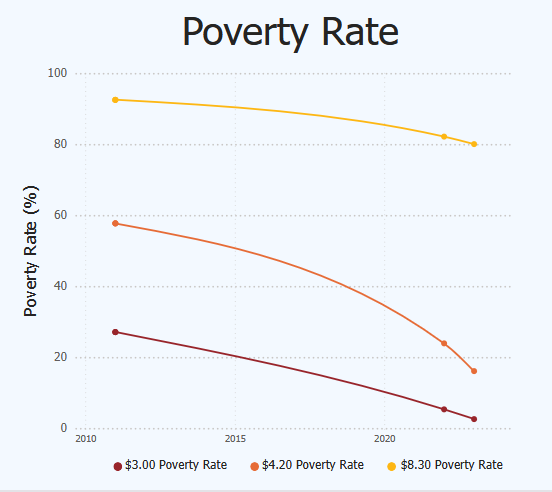
At the upper middle-income threshold of $8.30 per day, the poverty rate also came down, from 92.5% in 2011 to 80% in 2023. However, the figures show that a large share of India’s population still lives below this higher income threshold.
The second graph tracks consumption inequality using the Gini index. The index measures how equally or unequally consumption is distributed across a population. It ranges from 0 to 100, with a higher figure indicating greater inequality.
India’s Gini index fell from 28.8 in 2011-12 to 25.5 in 2022-23 and further to 23.0 in 2023. This indicates a decline in measured consumption inequality over the period.
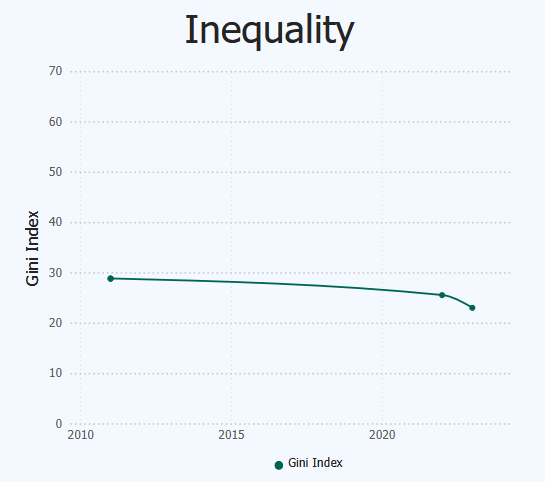
While this consumption-based index reflects a slight compression in measured inequality, the broader report points out that wage disparities remain wide, with the top 10% of workers earning roughly 13 times more than the bottom 10% in 2023.
Poverty remains higher in Rural areas and among children
The report shows that poverty levels differ across regions and population groups. At the $4.20-a-day lower middle-income poverty line, the poverty rate in rural areas stood at 19.3%, compared with 8.6% in urban areas. This shows that rural households continue to face greater economic challenges, even though rural India has recorded significant improvements over the years.
The poverty rate was also slightly higher among women, at 16.6%, compared with 15.7% among men. The World Bank noted that poverty is becoming increasingly concentrated in certain parts of the country. Around 57% of India’s poor population lives in a continuous geographical belt stretching from Uttar Pradesh to West Bengal.
The report also pointed out that households with lower levels of education, fewer assets, limited access to stable jobs and more dependent family members are more likely to remain poor.
Employment growth has played an important role in reducing poverty. Between 2017 and 2023, the number of employed people increased by around 134 million, nearly twice the growth of the working-age population. A large part of this increase came from rural women joining paid work and adding to the number of earning members in households.
However, the report also noted that youth unemployment increased from 14.6% to 15.9% between Q1 FY2026 and Q1 FY2027, particularly among rural young women. Real earnings also remained largely unchanged, with much of the employment growth coming from relatively low-productivity work.
The report also examines India’s multidimensional poverty rate
Apart from income, the World Bank also measures poverty through access to basic facilities such as education, drinking water, sanitation and electricity. This is known as multidimensional poverty because it looks at different difficulties people face in their daily lives.
According to the report, India’s multidimensional poverty rate, measured using the World Bank’s Multidimensional Poverty Measure, stood at 15.5% in 2022-23. The report also cited figures from the Oxford Poverty and Human Development Initiative (OPHI), which show that multidimensional poverty declined from 53.8% in 2005-06 to 16.4% in 2019-21.
Children remain more vulnerable to multidimensional poverty than other age groups. The rate stood at 21.8% among children aged 0 to 14, compared with 14.4% among people aged 15 to 64 and 14% among those aged 65 and above.
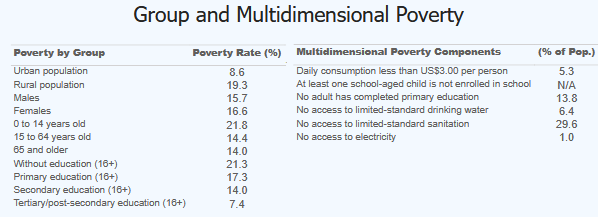
Education also makes a difference. Among people aged 16 and above, the poverty rate was 21.3% for those without education, 17.3% for those with primary education, 14% for those with secondary education and 7.4% for those with post-secondary or tertiary education.
The report also highlighted gaps in access to basic facilities. Around 29.6% of the population lacked access to limited-standard sanitation, while 13.8% lived in households where no adult had completed primary education.


