

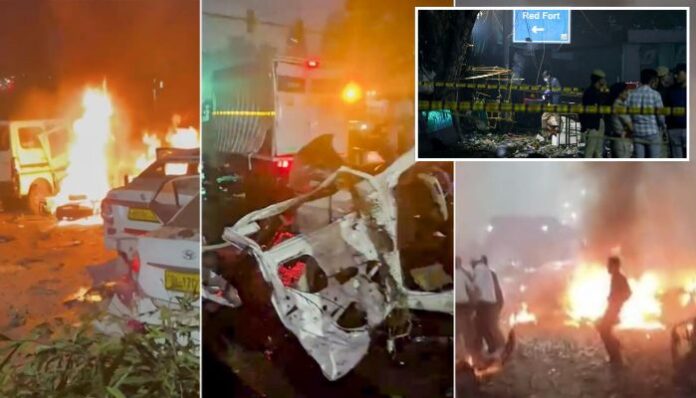
It has been a year since a devastating tragedy shook the National capital. On 10th November, 2025, a powerful car bomb exploded near Delhi’s Red Fort, killing 11 people and injuring over 30 others. The blast took place right inside a Hyundai i20 car that was parked near Gate No. 1 of the Red Fort Metro Station. The blast site was close to the historic Gauri Shankar and Jain temples.
Heavy security arrangements have been made at the blast site outside the Red Fort. Agencies collecting evidence from the debris. #redfort https://t.co/RHnavZ0uhN
— OpIndia.com (@OpIndia_com) November 10, 2025
The explosion was later found to be a planned suicide attack carried out by doctor-turned-terrorist Umar un Nabi. Investigators described it as a vehicle-borne improvised explosive device (VBIED) attack. CCTV footage recovered during the investigation showed that Umar had travelled through several parts of Delhi on the day of the blast before reaching the Red Fort area. He was last seen entering the area shortly before the explosion ripped through the Chandni Chowk area.
Initially, the blast was so violent and devastating that his body was completely torn apart and too badly damaged to be visually identified at the scene. It took rigorous forensic science, specifically a DNA match using biological samples collected from his family in Pulwama, to conclusively confirm that Dr Umar was indeed the suicide bomber.
"After the blast, I saw body parts scattered on the road." A media person present at the scene of the blast near the Red Fort in Delhi told Opindia reporter @Keshavmalan93 the full story of the blast. https://t.co/o5yTPT1Dcz
— OpIndia.com (@OpIndia_com) November 10, 2025
DNA identification exposed the bomber and revealed a white-collar terror module
The investigation later revealed that Umer had been part of a wider terror network involving doctors and other educated professionals. The group, later described as a “white-collar” terror module, was operating across Faridabad, Delhi, Lucknow and parts of South Kashmir. According to investigators, its members used their professional positions and access to medical and laboratory supplies to procure materials that could be used in making explosives. He was part of a much larger, highly sophisticated group linked to the banned terrorist organisation Jaish-e-Mohammed (JeM).
This secret network consisted of nine to ten members, including about five or six other medical professionals.
These highly educated so-called doctors used their professional positions and respect in society to quietly collect chemicals and materials needed to build deadly bombs. Police revealed that they operated covertly between Faridabad, Lucknow, and parts of South Kashmir. Because of their medical backgrounds and professions, they could purchase and handle chemical substances without raising any suspicion from suppliers or local authorities.
The scale of the network came into focus after a raid in Faridabad led to the recovery of nearly 2,900 kg of ammonium nitrate, along with other materials. Investigators also traced links between Umar and other doctors, including Dr Muzammil Shakeel Ganai and Dr Adeel Ahmed Rather. The probe further brought to light links with Jaish-e-Mohammed and other Pakistan-based handlers, as agencies examined the group’s radicalisation, funding and supply networks.
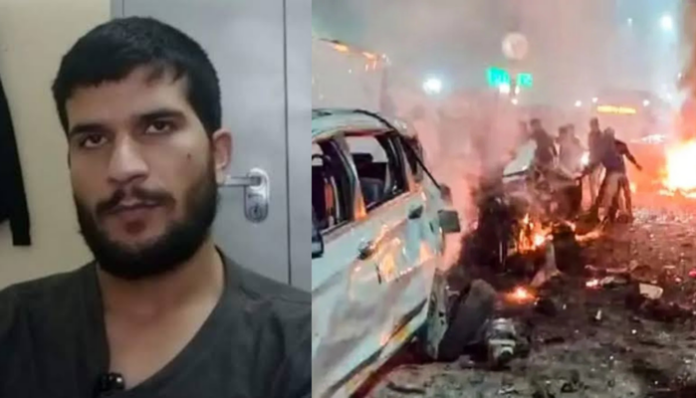
Dr Umar and several members of his group heavily relied on fake identities and fabricated documents to mask their movements. For instance, police seized a red Ford EcoSport registered under Dr Umar’s name in Faridabad, but the Home Ministry later confirmed that the Delhi address listed on the paperwork was completely fake.
Furthermore, police arrested Dr Shaheen Saeed, a former lecturer from Faridabad’s Al-Falah University. According to investigators, she was a key member of a newly formed women’s wing of Jaish-e-Mohammed operating in India for the first time. Known as Jamaat-ul-Mominat, this new faction aimed specifically to recruit young women for the outfit’s radical operations.
The investigation further revealed international connections. Dr Umar and Dr Muzammil Ahmad Ganai had even travelled to Turkey. Investigators stated that this entire network, widely dubbed the “doctors’ module,” was radicalised online by handlers sitting in Pakistan. Their ultimate, sinister objective was to orchestrate large-scale terror attacks reminiscent of the horrific 2008 Mumbai terror attacks, aiming for massive loss of life and widespread destruction in India.
The Red Fort blast investigation exposed a disturbing reality: professional qualifications and social standing do not automatically protect a person from radicalisation or involvement in terrorism. Several accused in the case were doctors or had medical qualifications, and investigators revealed that some used their professional access and knowledge to support the terror network.
The fact that all these arrested doctors turned terrorists used their professional standing to bypass security checks and procure bomb-making chemicals highlights a dangerous new frontier in counter-terrorism, proving that educational degrees do not guarantee moral integrity or immunity from extremist ideologies.
Islamic terror hub Al Falah University was also under scrutiny
The investigation into the Red Fort blast brought Al-Falah University under intense scrutiny as a breeding ground and operational hub for the terror network, especially after multiple faculty members and medical staff were unmasked as terrorists involved in the Red Fort blast.
The university’s controversy deepened when its Chairman, Jawad Ahmed Siddiqui, was arrested by the Enforcement Directorate in November 2025 on money laundering charges, followed by another arrest by the Delhi Police Crime Branch in February 2026 for financial fraud, with investigators revealing that the institution had generated over ₹415 crore in proceeds of crime through deceptive student enrollments.
NIA chargesheets 13 accused; probe reveals ‘Operation Heavenly Hind’
Moving forward from the initial chaos, the legal and investigative response has been robust. In May of this year, the National Investigation Agency (NIA) filed a massive 7,500-page chargesheet before a special NIA court at the Patiala House Courts in New Delhi.
This extensive chargesheet came after months of relentless investigations, raids, and arrests across Jammu and Kashmir, Haryana, Uttar Pradesh, Maharashtra, Gujarat, and Delhi. The charges were formally filed under relevant sections of the Unlawful Activities (Prevention) Act (UAPA) 1967, the Bharatiya Nyaya Sanhita (BNS) 2023, the Explosive Substances Act 1908, the Arms Act 1959, and the Prevention of Damage to Public Property Act 1984.
In an official statement, the probe agency highlighted that the chargesheet is built on solid, comprehensive evidence, comprising 588 oral testimonies, over 395 documents, and more than 200 seized material exhibits. The initial NIA chargesheet named 10 accused Islamic extremists, all linked to the Ansar Ghazwat-ul-Hind (AGuH), an active offshoot of Al-Qaeda in the Indian Subcontinent (AQIS), which was designated a terrorist organisation by the Indian Ministry of Home Affairs in June 2018.
The agency formally proposed the abating of charges against the deceased Pulwama-based suicide bomber, Dr Umar un-Nabi. Investigators also recovered chilling digital evidence, including a video recorded by Umar un-Nabi before the attack in which he attempted to justify suicide bombing, alongside over 70 provocative jihadist videos recovered from various seized phones.
The legal net widened further when the NIA filed a supplementary chargesheet in June this year, naming three additional names in connection with the November car bomb blast. This addition brought the total number of terrorists formally charged in the case to 13. The supplementary chargesheet, filed before the NIA Special Court, named Zameer Ahmad Ahanger, Tufail Ahmad Bhat, and Muzafar Ahmad (also known as Faraz or Zafar).
The National Investigation has chargesheeted three more accused, including an absconder, in connection with the November 2025 car bomb explosion that killed 11 persons near the Red Fort in the national capital of Delhi in November 2025. In its supplementary chargesheet, NIA has named Zameer Ahmad Ahanger, Tufail Ahmad Bhat and Muzafar Ahmad alias Faraz alias Zafar, all from Jammu and Kashmir, as accused. This takes the number of persons chargesheeted in the case to 13, including the prime accused Dr Umer Un Nabi (since deceased).
— ANI (@ANI) June 27, 2026
Zameer Ahmad Ahanger was identified as an Overground Worker (OGW) for the AGuH interim group, accused of maintaining contact with handlers and acting as a courier to ferry arms, ammunition, and cash. Tufail Ahmad Bhat was described as a former OGW of the banned Lashkar-e-Taiba (LeT) who functioned as an arms supplier, procuring high-end weaponry, including an AK-47 rifle, a Krinkov rifle, a pistol, magazines, and live ammunition through dead drops, and delivering them to Dr Umar un-Nabi for ₹3 lakh.
The third accused, Muzafar Ahmad, is a trained paediatrician holding MBBS and MD degrees and is the older brother of co-accused Dr Adeel Ahmed Rather. Identified as a founding member of the AGuH Interim module who attended a secret meeting in Srinagar to form the group, he remains an absconding fugitive with a non-bailable warrant issued against him for his role in manufacturing and testing TATP explosives at the Faridabad facility.
Who are the accused arrested in the Red Fort blast case?
The NIA has so far arrested 11 people in connection with the Red Fort blast conspiracy. Umer un Nabi, the main perpetrator, is not part of the arrest count because he died in the explosion. The agency’s first arrests included accused of arranging the car, providing technical assistance and helping the main conspirators.
Amir Rashid Ali was arrested in connection with the Hyundai i20 used in the attack. The NIA’s 20th November 2025 statement identified him as the person in whose name the car was registered. Jasir Bilal Wani, also known as Danish, was arrested for providing technical assistance to Umar. The NIA said he had worked with Umar and had provided support for terror-related activities, including attempts to modify drones and develop rockets.
The agency subsequently arrested four more accused: Dr Muzammil Shakeel Ganai, Dr Adeel Ahmed Rather, Dr Shaheen Saeed and Mufti Irfan Ahmad Wagay. The NIA described them as key members of the conspiracy. Their arrests were made in Srinagar after the agency obtained production orders from a court in Delhi. Investigators revealed that they had played important roles in planning and supporting the attack.
Soyab was also arrested for providing shelter and logistical support to Umer. Dr Bilal Naseer Malla and Yasir Ahmad Dar were among the other accused named in the first chargesheet. The NIA’s chargesheet placed them among the members of the wider network that supported the conspiracy. The agency’s investigation covered their links and activities as it sought to establish how the module functioned across different locations.
In February 2026, the NIA arrested two more accused, Zameer Ahmad Ahanger and Tufail Ahmad Bhat, taking the total number of arrests to 11. The agency identified Zameer as an overground worker of AGuH Interim who remained in contact with handlers and acted as a courier for arms, ammunition and money. Tufail, described as a former overground worker of the banned Lashkar-e-Taiba, was the module’s arms supplier.
The 13 people named in the two chargesheets therefore include 11 arrested accused, the deceased Umer un Nabi and the absconding Muzafar Ahmad.
Compensation announced for the victims’ families
In the wake of the tragedy, the government stepped in to offer financial relief to those impacted. The Delhi government announced an ex-gratia payment of ₹10 lakh each to the families of those who tragically lost their lives, ₹5 lakh to individuals rendered permanently disabled, ₹2 lakh to those seriously injured, and ₹20,000 to those who sustained minor injuries.
One year after the explosion, the Red Fort blast remains a major terror case involving a network of radicalised professionals, weapons suppliers and other operatives spread across several states. The NIA has filed its main and supplementary chargesheets, naming 13 accused in total, but the investigation is not over. The NIA is still probing the terror attack, and its investigation remains active, with ongoing supplementary filings and efforts to trace the absconding accused.


