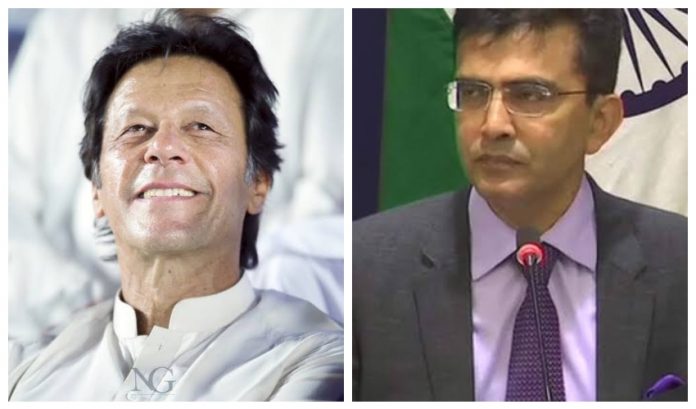
Pakistani Prime Minister Imran Khan has developed a peculiar habit of poking his nose in India’s internal matters. Admonishing Pakistani PM Imran Khan for his fixation to meddle in India’s personal matters, MEA spokesperson Raveesh Kumar in a stern statement told a weekly news briefing on Thursday that Imran Khan had made a habit out of commenting on issues relating to India’s internal affairs.
Delhi, in clear-cut words, asked Imran Khan to take steps to protect the rights of its religious minorities rather than “compulsively issue statements”.
Also pointing to Pakistan’s “draconian blasphemy laws”, MEA spokesperson Raveesh Kumar asked Imran Khan to pay more attention to this issue.
#Breaking | Live: @MEAIndia responds on frustrated Pak PM @ImranKhanPTI’s statement on CAB.
‘Focus on protecting your own minorities’, says MEA Spokesperson.Listen in. pic.twitter.com/r85IVwKG4s
— TIMES NOW (@TimesNow) December 12, 2019
Pakistan’s Prime Minister Imran Khan, in a deranged rant, had gone on to oppose the passage of CAB in Lok Sabha, invoking the ‘bilateral agreements’.
The abrogation of Article 370 has had a detrimental effect on the mental faculties of the Prime Minister of Pakistan, Imran Khan. After losing his mind and dignity over the invalidation of the special status of the Indian state of Jammu and Kashmir, Pakistan PM Imran Khan went on to a bizarre rant to condemn the Citizenship Amendment Bill that was passed in the lower house of the Indian parliament on December 9 and in the Upper House on December 11.
Condemning the citizenship legislation, Pakistan PM Imran Khan had posted a tweet on December 10, asserting that the enactment “violates all norms of international human rights law and bilateral agreements with Pakistan”. He further insinuated that the bill was a part of the “RSS Hindu Rashtra design of expansionism propagated by the fascist Modi government”.
One was left to wonder which bilateral agreements with Pakistan was he speaking of since, in the aftermath of the abrogation of Article 370, a fuming Khan had severed ties with India, suspended bilateral trade and close airspace for Indian flights. He also declared that he will call its high commissioner back and expel India’s envoy to Pakistan.
The Citizenship Amendment Bill seeks to amend the Citizenship Act, 1955, in order to grant Indian nationality to Hindus, Sikhs, Buddhists, Jains, Parsis, and Christians, who come to India because of religious persecution in Bangladesh, Pakistan, and Afghanistan even if they do not possess proper documents.
The historic Bill has managed to clear both the Upper and the Lower house of the Indian Parliament and awaits the President assent before becoming a law.