

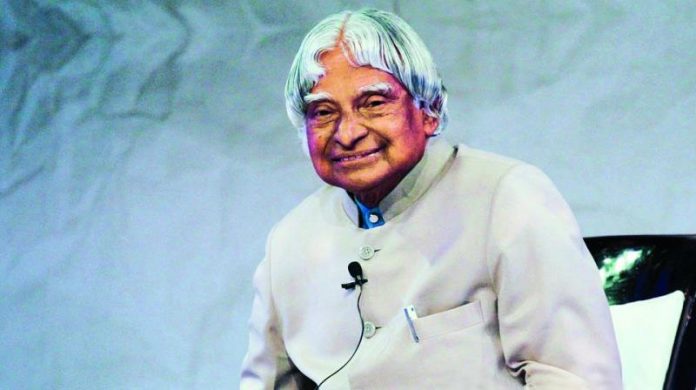
Today, July 27, 2020, marks the 5th death anniversary of unarguably one of the most popular Presidents of India–Dr APJ Abdul Kalam, fondly called as ‘Missile Man of India’. Be it for his stint in politics or for his unparalleled contribution towards India’s scientific progress, the former President of India inspired people from all walks of life, not just in India but from across the world, particularly drawing affection from children and students, among whom he was widely popular.
In one of the videos shared by social media users, Dr Kalam can be seen interacting with children where a girl asks him what made him believe in last benchers of classrooms. Dr Kalam says how he was one of the last-benchers and everyone has got knowledge. “A good teacher doesn’t care whether one is a first bencher or last bencher,” he says.Our Greatest Hero?
— Ritesh (@Sachislife) July 27, 2020
The Greatest of my lifetime for sure.pic.twitter.com/M7TNtfCHNv
Avul Pakir Jainulabdeen Abdul Kalam, popularly known as APJ Abdul Kalam was born on October 15, 1931, at Rameswaram in Tamil Nadu. His initial life was filled with struggles and hardships as he reportedly sold newspapers door-to-door to support his education and family. He studied physics and specialised in Aerospace Engineering from Madras Institute of Technology.
He served as a scientist and science administrator at the Defence Research and Development Organisation (DRDO) and Indian Space Research Organisation (ISRO). Kalam was nicknamed as ‘Missile Man of India’ for his pivotal contribution in the indigenous development of ballistic missile and launch vehicle technology in India.
In a question to ‘how did you become so great’? he explained how dreaming, hard work and perseverance is important for success.Success is when your “Signature” changes to “Autograph.”
— Awanish Sharan (@AwanishSharan) July 27, 2020
-Dr. Kalam pic.twitter.com/7NShtItNU9
Kalam also played an instrumental role in carrying out India’s Pokhran-II nuclear tests in 1998, the first since the original nuclear tests by India in 1974. In 2002, Kalam became the 11th President of India under the BJP-led government at centre headed by Atal Bihari Vajpayee and then under UPA government with Manmohan Singh as the Prime Minister.
Dr APJ Abdul Kalam was also a recipient of a large number off prestigious awards such as Padma Bhushan (1981), Padma Vibhushan (1990), Bharat Ratna (1997), and Veer Savarkar Award (1998).
Kalam was also a prolific writer, authoring a range of books. His notable work includes- India 2020(1998), Wings of Fire(1999), Ignited Minds(2002), Indomitable Spirit(2006) and many others. One of the reasons why he enjoyed a huge popularity among children was his books, which targeted the younger minds and galvanised them into broadening their vision and expanding their dreams.
Top quotes by Kalam included-“Small aim is a crime. Have the courage to think different, invent, travel to unexplored parts, combat the problem and succeed”, “The best brains of the nation may be found on the last benches of the classroom”, “Don’t take rest after your first victory because if you fail in second, more lips are waiting to say that your first victory was just luck”.
Kalam breathed his last at the age of 83 on 27 July 2015 in Shillong. His last rites were performed in his hometown of Rameswaram, where he was buried with full state honours.


