

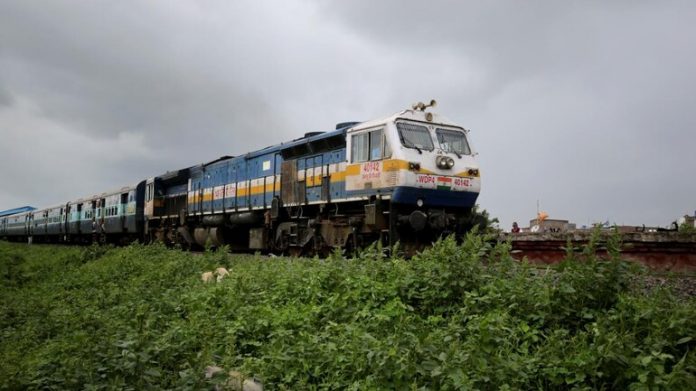
For strengthening the safety of moving trains, the Indian Railway has designed its own indigenous Automatic Train Protection (ATP) System known as “Kavach”. The Railway is promoting ‘Kavach’ as the world’s most affordable automatic train accident protection technology.
Today, Kavach will be tested when two trains will hurtle towards each other at full speed near Secunderabad, one carrying the Railway Minister Ashwini Vaishnaw and the other the Chairman of the Railway Board. However, due to the indigenous ‘KAVACH’ technology, they won’t collide.
Indigenous train collision protection system ‘Kavach’ to be tested with Railway Minister on board.@EconomicTimes @AshwiniVaishnawhttps://t.co/qlKtZzdUQp
— South Western Railway (@SWRRLY) March 3, 2022
The Automatic Train Protection (ATP) system was created in-house to aid the railways in meeting their aim of “zero accidents.” Kavach is a system that automatically brings a train to a stop when it detects another train on the same track within a certain range.
Kavach is designed and developed in conjunction with three Indian vendors and Research Design and Standards Organization, which is a company under Indian Railways.
Kavach operates on the concept of providing Movement Authority with continual updates through radio. In the event that Loco Pilot fails to do so, it limits the speed by applying brakes automatically. Signal elements are duplicated in the cab, which certainly helps at greater speeds and in foggy conditions. Kavach is connected to current signal interlocking systems for this purpose. Also, it meets the highest level of safety certification, SIL-4 (Safety Integrity Level).
The project is now being executed as a trial on several sections of the South-Central Railway zone. In the initial phase, Indian Railways plans to install the technology on high-density routes like as Delhi-Mumbai and Delhi-Howrah. As per sources, it will be deployed on all major routes by 2024. Kavach will also be exported to other nations. In her budget address, Finance Minister Nirmala Sitharaman declared that 2,000 kilometers of the network will be placed under Kavach as part of Atmanirbhar Bharat.


