

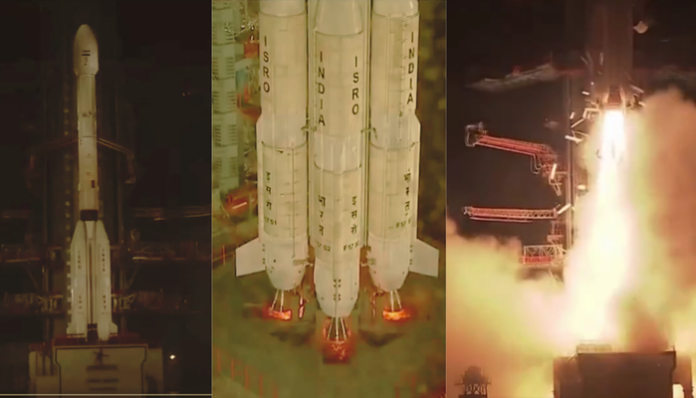
The Indian Space Research Organisation (ISRO) is back in swing with the successful launch of India’s first dedicated Earth imaging satellite. After an eight-month hiatus, the Indian space agency made an illuminated comeback by executing the launch of an EOS-05 satellite in the wee hours of Friday.
Prime Minister Modi described the achievement as a proud moment for the country. “Yet another outstanding achievement by ISRO and a proud moment for our nation. The successful launch of GSLV-F17 carrying EOS-05, India’s first-ever imaging satellite from Geosynchronous orbit, is a reflection of the excellence, innovation and growing capabilities that define India’s space sector. The growing partnership between ISRO and Indian industry is adding new strength and scale to our space programme and expanding India’s capabilities across the entire space ecosystem,” PM Modi said.
Yet another outstanding achievement by ISRO and a proud moment for our nation.
— Narendra Modi (@narendramodi) September 4, 2026
The successful launch of GSLV-F17 carrying EOS-05, India’s first-ever imaging satellite from Geosynchronous orbit is a reflection of the excellence, innovation and growing capabilities that define… https://t.co/fXzwnSmwAF
Union Home Minister Amit Shah congratulated the Indian space agency and its scientists for the feat. “India pushes new frontiers in space! Congratulations to @ISRO scientists as GSLV-F17 successfully carried EOS-05 into orbit. India now has its first-ever imaging satellite operating from geosynchronous orbit. Under the leadership of Modi Ji, India is emerging as a self-reliant and ambitious nation, harnessing the power of its industry for its space programs,” Shah wrote on X.
India pushes new frontiers in space!
— Amit Shah (@AmitShah) September 4, 2026
Congratulations to @ISRO scientists as GSLV-F17 successfully carried EOS-05 into orbit. India now has its first-ever imaging satellite operating from geosynchronous orbit.
Under the leadership of Modi Ji, India is emerging as a self-reliant… pic.twitter.com/QYbOuKpZKB
ISRO chief V Narayanan expressed great pleasure over the successful launch. “I am very happy to announce that the GSLV F-17 vehicle has successfully and precisely injected the advanced EOS-05 geo imaging satellite in the intended and required orbit,” Narayanan rejoiced. The ISRO chief said that this was the second launch of the financial year and the first for ISRO. The EOS-05 satellite was the 107th launch from Sriharikota.
Narayanan divulged that six more launches are lined up for the current financial year, including the ISRO-made second-generation navigation satellite, NVS-03. He added that the teams of scientists are also working on the Gaganyaan mission, with the first uncrewed mission under the programme scheduled for launch during this financial year.
‘Naughty Boy’ made its way into the space
The EOS-05 satellite, nicknamed ‘Naughty Boy’, was carried into space by the Geosynchronous Satellite Launch Vehicle (GSLV-F17) on its 19th flight at 2:55 am on Friday. The launch was made from the Second Launch Pad (SLP) at Satish Dhawan Space Centre, in Sriharikota, Andhra Pradesh.
The satellite, also called Gisat-1A, was placed into the desired Sub-Geosynchronous Transfer Orbit at 3.14 am, roughly 18 minutes after its launch. The launch involved three stages: solid, liquid propulsion and cryogenic. The completion of the cryogenic stage was announced by the directors 15 minutes after the launch, filling the launch room with joy and cheers. The achievement is a result of the tiring efforts of the ISRO scientists to give the country its own dedicated advanced Earth imaging satellite, operating from a geosynchronous orbit.
The launch is significant not only for its success but also because it marked several ‘firsts’ for the Indian space endeavours. This was ISRO’s first launch of the year, involving the country’s first dedicated Earth imaging satellite. EOS-05 is a state-of-the-art Earth observation spacecraft and the heaviest satellite ever launched into a geosynchronous orbit in India so far. A 51.7-metre-tall GSLV with a 420.5 tonnes lift-off mass was launched from Satish Dhawan Space Centre, carrying the satellite with an inclination of 19.28 degrees and a payload mass of 2,367 kg.
A long-awaited success
The idea of having an advanced GISAT has been in the plans for years. The journey to the success of the EOS-05 satellite has been painful, cumbersome, and full of failures. The first attempt to launch an advanced geo-imaging satellite was made by ISRO on August 12, 2021, when the space agency launched GISAT-1 (later designated EOS-03) on GSLV-F10. However, the mission failed as the rocket’s cryogenic upper stage did not ignite, and the satellite never reached orbit.
This was followed by two successive failures of EOS-09 launched on PSLV-C61 (May 18, 2025) and EOS-N1 launched on PSLV-C62 (January 12, 2026). Both launches failed after experiencing a technical glitch at the third stage of firing. After this, the ISRO halted the launches, re-examined the vehicle’s cryogenic systems, and rebuilt the satellite as Gisat-1A.
Why India needed the EOS-05
The EOS-05 will keep a close watch on the Indian subcontinent from the sky. It will provide real-time imagery of large-area regions at frequent intervals, which will be useful in activities such as agriculture, disaster management, and the monitoring of cyclones, cloudbursts, and thunderstorms.
What sets EOS-05 apart is its ability to remain stationary with respect to Earth’s movement. The satellite’s orbital period matches the Earth’s rotation, which allows it to retain its position over the same broad region and observe it constantly, without interruption from nearly 36,000 kilometres above the Earth.
This is a significant advantage that EOS-05 has over lower-orbiting Earth observation satellites, which pass over a certain location at intervals, since their orbital period is not in sync with the Earth’s rotation. The majority of Indian remote sensing satellites, including the Cartosat series and RISAT, operate closer to Earth in low Earth orbits, roughly 500 km to 800 km above Earth.
The proximity of these satellites to Earth gives them enhanced resolution but limited operational capability. They get a very brief and fixed window of time to capture a certain point on Earth, that too, once every few days. If a natural disaster takes place in a region from which the satellite has already passed, it would not be able to observe the region in time. This limitation will be removed with the successful placement of the EOS-05 satellite in its orbit.


