


The Kashmir Files, the latest film from writer and director Vivek Agnihotri has set the cat among the liberal pigeons. The film, which was ignored by everyone before its release, has stunned everyone with the overwhelming response at the box office. With success, come the detractors, and Kashmir Files has had plenty of them – people who tried to dismiss the entire plot as fiction even though it is based on real events.
In their quest to discredit the movie and deny the genocide of Hindus in Kashmir, the liberals have been tying themselves in knots, peddling several theories on social media. Here are the 4 top conspiracy theories peddled by them to shamelessly deny the brutal genocide of Hindus in the 1990s that led to the murder of Hindus by Islamic terrorists and the exodus of lakhs of them.
Jagmohan Conspiracy
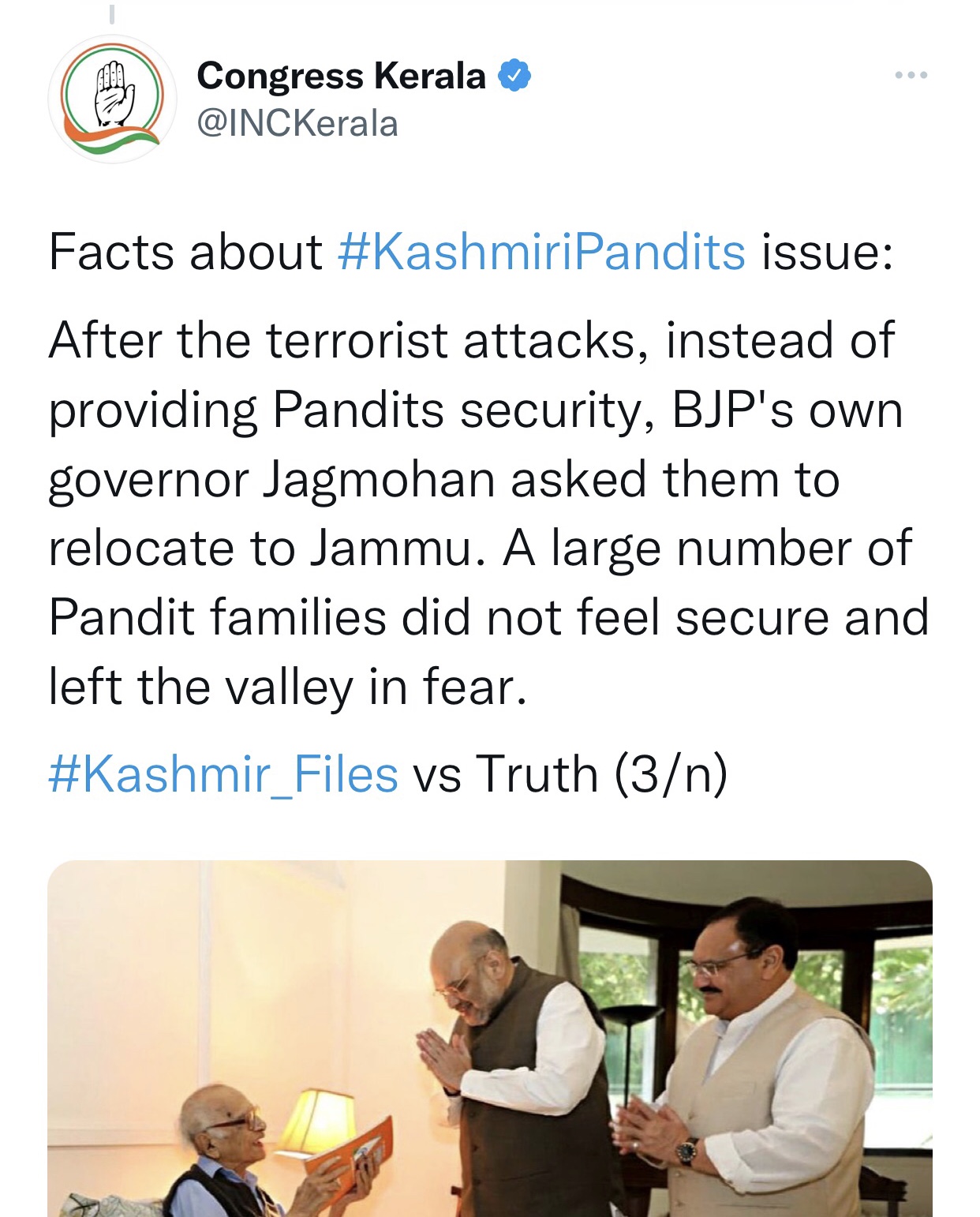
Leading the charge was obviously the Congress party. The party’s official Kerala handle tried to pin the entire blame for the Kashmiri Hindu genocide and exodus on Governor Jagmohan. It didn’t let small details like Jagmohan was just appointed Governor on the 19th of January and didn’t even reach Srinagar before 21st bother it. Very much like they invented 3 days between 28th of February 2002 and 1st of March 2002.
Blaming Advani and his Rath Yatra
If Congress is taking the lead, then how can Congress aligned journalists be far behind. The real godi media went a step further than Congress, and blamed Advani’s Rath Yatra held in September-October 1990 for the Kashmiri Hindu genocide in 1990.
कश्मीर फाइल्स जिसे देखनी हो देखे और जिसे ना देखनी हो ना देखे। लेकिन यह तथ्य ध्यान में रखें कि अगर भाजपा नेता लालकृष्ण आडवाणी ने रथयात्रा न निकाली होती और पूरे भारत में मुसलमानों के खिलाफ माहौल नहीं बनाया होता तो कश्मीर में भी कश्मीरी पंडितों के खिलाफ माहौल नहीं बनता। 1/3
— piyush babele (@BabelePiyush) March 13, 2022
The RTI bogey
Salil Tripathi, who is famous for being famous, thought he made a great point by sharing this old RTI saying “only” 89 Hindus were killed in Kashmir.
So you wanted facts? pic.twitter.com/M2QAvMnonN
— saliltripathi (@saliltripathi) March 14, 2022
Firstly, it is a bit hard to kill someone when you drive their entire population out of that area. And this RTI makes no mention of when did they officially start considering militancy in Kashmir. Dismissing lived experience of an entire generation for a clerk’s report is just inhuman. By the way, this is what Mr Tripathi generally thinks of these clerks.
Using Islamophobia to shut down the film
Rana Ayyub, in the dock for swindling money in the name of Covid victims, added her own twist and claimed that the film is inciting anti-Muslim sentiment. As per the video she shared, people were chanting Desh ke gaddaron ko, goli maaro saa**n ko, however this was termed Islamophobic by her. More than the film, this is offensive to the Indian Muslim community that Rana Ayyub thinks Muslims are the traitors to India.


