

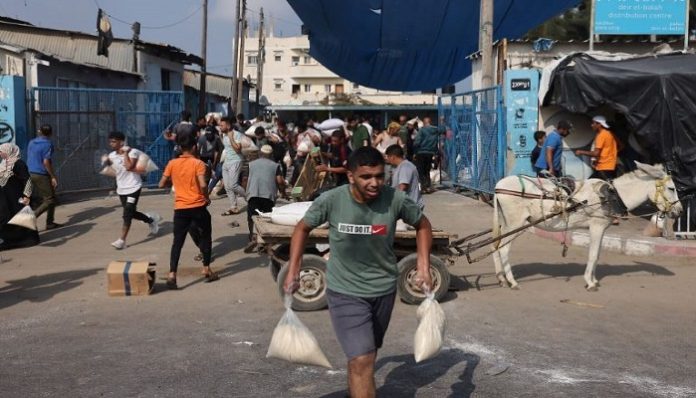
On 29th October (Sunday), the United Nations Relief and Works Agency for Palestine Refugees in the Near East (UNRWA) informed that thousands of people plundered warehouses and distribution centres of the UN aid centres in Gaza to grab flour and other basic survival items. In a statement, the UNRWA warned that these are worrying signs that “civil order” is on the brink of a breakdown in the Palestinian enclave.
UNRWA’s Gaza chief Thomas White said, “This is a worrying sign that civil order is starting to break down after three weeks of war and a tight siege on Gaza.”
The UNRWA said that one of the warehouses in the central town of Deir el-Balah had been used to store supplies from humanitarian convoys that began crossing into Gaza from Egypt on 21st October.
It added, “Thousands of people broke into several UNRWA warehouses and distribution centres in the middle and southern areas of the Gaza Strip, taking wheat flour and other basic survival items like hygiene supplies.”
A spokesperson for the agency Juliette Touma stated that the crowds broke into four facilities on Saturday. She added that the warehouses did not contain any fuel, which has been in critically short supply since Israel cut off all shipments after the start of the war.
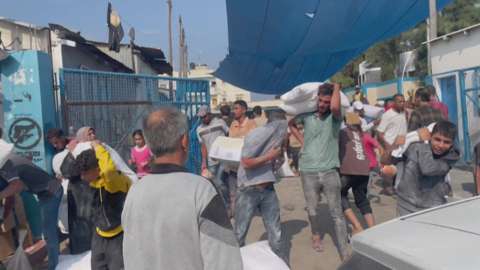
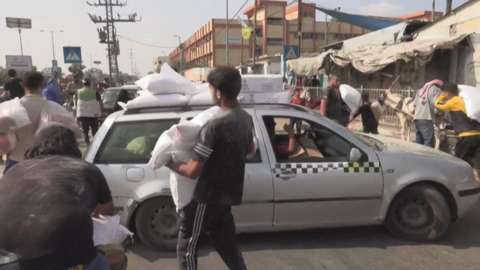
AFP news agency has published images in which people could be seen carrying food bags on Saturday as they stormed the supply centre in Deir el-Balah in the southern Gaza Strip.
During the initial phase of the Israel-Hamas war, the Jewish state originally imposed a total blockade on food, water, medicine, and fuel deliveries into Gaza. However, it later allowed humanitarian aid convoys — excluding fuel — to bring supplies in from Egypt. It also resumed some of its water supply.
According to UNRWA, since then 84 aid trucks have crossed into Gaza but the numbers are far too low. Before the conflict, UN figures showed an average of 500 trucks a day entering Gaza carrying suppllies. It is notable that even during peacetime, Gaza is completely dependent on external aids.
UNRWA’s Gaza chief White added, “Supplies on the market are running out while the humanitarian aid coming into the Gaza Strip on trucks from Egypt is insufficient. The needs of the communities are immense, if only for basic survival, while the aid we receive is meager and inconsistent.”
A senior spokesperson for the World Food Programme (WFP) asserted that the raids at several aid distribution centres in Gaza on 28th October (Saturday) were “expected” as people are facing difficult conditions.
Speaking to the BBC, Abeer Etefa said, “The bottom line is that people are desperate, they are hungry.” Etefa argued that phone and internet blackouts may have contributed to the events at the warehouses and distribution centres. She said that the WFP had to halt its distribution of food because it was unable to communicate with teams on the ground. But we’re resuming today now that the service is coming slowly back.
UNRWA was established in 1949 after the first Arab-Israeli war. It provides public services including schools, primary healthcare, and humanitarian aid in Gaza, the West Bank, Jordan, Syria, and Lebanon.


