Home Blog Page 1371

As former Congress Dy CM busts Rahul Gandhi’s lie that PM Modi was made OBC by BJP govt, Gandhi changes goalpost, read why ‘Kagzi OBC’ allegation makes no sense

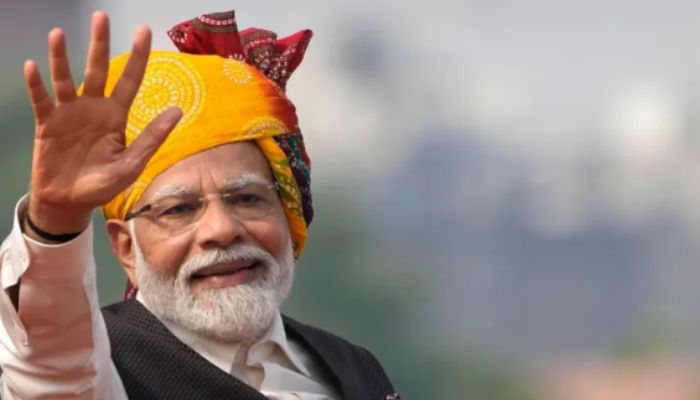
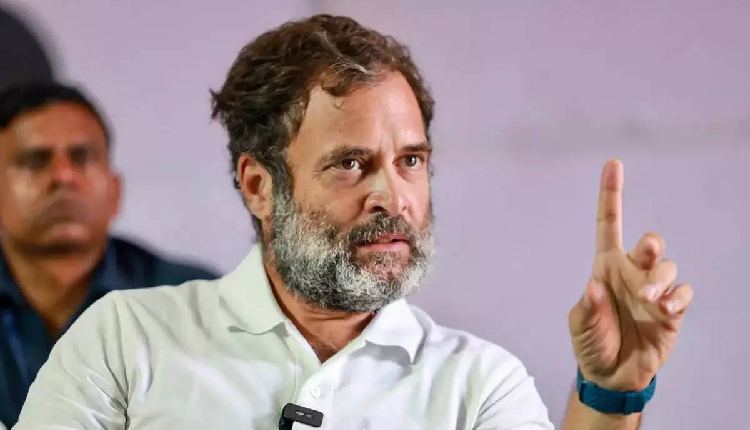
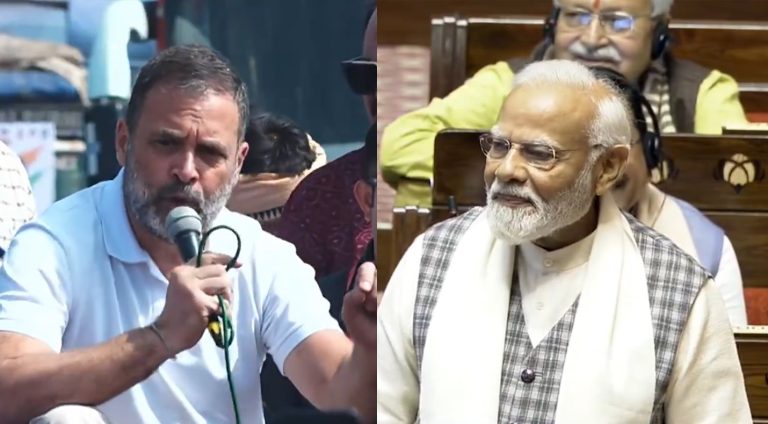
Congress MP Rahul Gandhi has opened a new front against PM Narendra Modi based on another lie, questioning the OBC status of the PM’s caste. Addressing the crowd during his Bharat Jodo Nyay Yatra in Odisha, Rahul Gandhi said that Narendra Modi was a general caste at the time of his birth, as he belongs to the Teli community which was a general caste when he was born. The Congress leader then claimed that the Teli community was added to the OBC list by the Gujarat govt in 2000.

“PM Modi was not born in the OBC category. He was born Teli caste in Gujarat. The community was given the tag of OBC in the year 2000 by the BJP. He was born in the General caste…This man is lying before the whole world that he is OBC Do you know how I know this? I don’t need a birth certificate…He never hugs any OBC person. He never holds the hands of farmers and labourers. He only holds the hand of [Gautam] Adani ji. He will not allow caste census to be conducted in his entire life because he was not born in OBC, he was born in General caste,” Rahul Gandhi said.

Later the Congress party posted a tweet claiming that PM Modi is not OBC  by birth, and he was made OBC by the BJP govt of Gujarat.

It has already been reported how Rahul Gandhi and his party are lying, as Narendra Modi’s caste was included in the OBC list by a Congress govt in Gujarat, not BJP. It was done in 1994, not 2000, and there were Congress governments both in Gujarat and in centre in 1994.

It is notable that no OBC person born before 1991 was OBC at the time of birth, because the OBC category for reservation was created in 1990 after the Mandal Commission report. The VP Singh’s decision to grant reservation for Other Backward Class was upheld by the Supreme Court in 1992. And in just two years later in 1994, PM Modi’s Modh-Ghanchi caste was included in the OBC list by the Gujarat govt under Chhabildas Mehta of the Congress party.

Now a former Congress deputy CM of Gujarat has come forward to bust the lies of Rahul Gandhi. Rajya Sabha MP Narhari Amin, currently a BJP leader, was the Deputy CM of Chhabildas Mehta govt in Gujarat when the notification adding communities to OBC list was issued by the state govt. Narhari Amin asserted that Modi’s community was made OBC by Congress in 1994, not in 2000 by BJP govt, urging Rahul Gandhi withdraw the statement.

Narhari Amin tweeted, “I was serving as the Deputy Chief Minister of Gujarat in the Congress Government when GoG notified Modh-Ghanchi as OBC on 25th July 1994. This is the same caste our respected Prime Minister Shri @narendramodi belongs to Mr. @RahulGandhi is insulting the OBC communities by cooking up mindless lies on this issue. This decision, and the subsequent GoI notification came when Shri @narendramodi was not even MP/MLA forget being CM.”

The current BJP MP then added, “I demand Shri @RahulGandhi immediately withdraw his lies. He should stop defaming OBCs and also apologise to the people of Gujarat for being filled with hate towards our popular Prime Minister Shri @narendramodi”.

Social media users have posted the 25th July 1994 notification by the Gujarat govt, which busts the lies by Rahul Gandhi that PM Modi was made OBC by the BJP govt.

Notably, BJP IT Cell chief Amit Malviya earlier posted that PM Modi’s caste Modh-Ghanchi was notified as OBC in 1999, 2 years before he became the CM of Gujarat. He also posted a gazette notification from the govt of India, which said that the old entry of ‘Ghanchi (Muslim)’, has been replaced with three new entries in the OBC list, Ghanchi (Muslim), Teli, and Modh Ghanchi.

Although at first glance it seems that two years are being mentioned for inclusion of the Modh Ghanchi community in the OBC, actually there is no contradiction here. This is because, the 1994 notification was issued by the Gujarat state govt, while the 1999 notification was from the central govt.

Therefore, the Gujarat Congress in 1994 had notified the Modh-Ghanchi as OBC, and the notification in Gujarati is available in the public domain. Before that in 1993, the central govt had issued a notification including a large number of communities in the OBC list. This included Ghanchi (Muslim) for Gujarat. Then Later in 1999, the central govt amended the list to add Teli and Modh Ghanchi communities along with Ghanchi (Muslim) in Sl Number 23 for Gujarat.

Clarifying the matter, Amit Malviya later tweeted citing Narhari Amin, “Govt of Gujarat, led by the Congress, notified Modi-Ghanchi as OBC in July 1994. Central Govt, following on the recommendations of GoG, notified it as OBC on Oct 27, 1999, a full 2 years BEFORE PM Modi became the Chief Minister of Gujarat.”

After widespread fact-checking of Rahul Gandhi’s claims, he later tried to shit the goalpost by saying that BJP has confirmed that PM Modi was not OBC at the time of his birth. He tweeted, “Modiji is not by birth, but an OBC only on papers. He was not an OBC until five decades after his birth. Thanks to the BJP government for confirming this truth of mine”.

However, this claim makes no sense because it applies not only to PM Modi but to everyone in the OBC category born before 1991. Before the Mandal Commission recommendations were implemented, there was no OBC in the country. Therefore, there is no way PM Modi could be OBC from birth. Just like PM Modi was not OBC for the first 50 years of his life, everyone in the OBC category was not OBC before their communities were notified as OBCs.

Moreover, the reserved categories of SC, ST and OBC are in paper only. Governments keep adding new communities to these categories. Many communities are still making such demands now, which could be accepted by the govt in future. As and when a community is included in SC, ST or OBC list, people from those communities get included in the respective category. PM Modi’s community was also thus included in the OBC category. It is not clear what wrongdoing or scam Rahul Gandhi is finding here.

For example, last year it was reported that 80 more castes had been approved for inclusion in the OBC list. Therefore, if someone from such a caste was born in 1950, such a person will become OBC 74 years after the birth. There are no irregularities or scams here, that is how the caste-based reservation system has been working in India. Nobody can be denied inclusion in reserved categories just because that person’s caste was not on the list at the time of birth and was included later.
Uttarakhand: Mob resort to arson and stone pelting as authorities demolish madarsa built on illegally encroached govt land in Haldwani

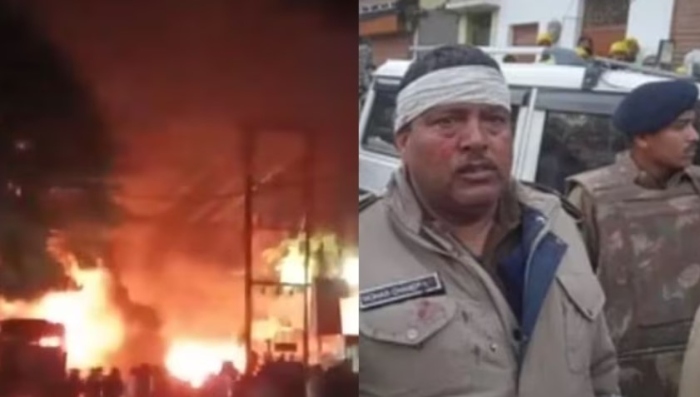
On Thursday, February 8, an incident of stone pelting and arson was reported in Uttarakhand’s Haldwani area. According to reports, the mob attacked authorities who went there to demolish a madarsa built on illegally encroached govt land near the Banbhulpura police station under the ongoing drive against illegal encroachments.

The irate mob reportedly pelted stones at the policemen and Haldwani Municipal Corporation workers present there. Later, they surrounded the police station and went on to set fire to the vehicles stationed outside the Banbhulpura police station.

The mob also set a transformer on fire, resulting in a power outage in the area. Several journalists and administration officials were trapped inside the police station as a mob surrounded the Banbhulpura police station.

A few policemen, Municipal corporation workers including SDM were reportedly injured in the incident.

The police used tear gas to disperse the crowd and prevent the situation from escalating.

Videos of the violent clash surfaced on X (formerly known as Twitter) showing how the frenzied mob indulged in arson and stone pelting leaving several police officers injured and police vehicles gutted in fire.

Presently, an additional police force has been deployed in the area and senior officials of police and administration have reached the spot.

According to news agency ANI, DM Nainital has imposed a curfew in Banbhulpura and ordered a shoot-on-sight order for rioters.

The incident occurred when the Municipal Corporation team, led by Municipal Commissioner Pankaj Upadhyay, City Magistrate Richa Singh, and SDM Paritosh Verma, utilized heavy machinery, including a JCB machine, to raze the illegal structure located in Malik’s garden under the Banbhulpura area of Haldwani.

Officials said that they had sent a notice to the management of the madarsa-mosque informing them that the structure had been illegally built near the Banbhulpura police station. The madarsa management, in turn, could not furnish any documents substantiating that the structure was not illegally constructed. Moreover, the Corporation had previously seized three acres of land near the site of the illegal madrasa and namaz place, which they now demolished.

Reports suggest that Uttarakhand Chief Minister Pushkar Singh Dhami is conducting a meeting with top authorities to assess the situation. 

Uttarakhand government launches crackdown on illegal madarsas and mazars

It may be recalled how in March last year, the Uttarakhand government rolled bulldozers over illegal mazars which were built by encroachment on the reserved forest land. The authorities conducted a survey and identified around 1400 religious structures built illegally on government land.

Prior to this, Uttarakhand Chief Minister Pushkar Singh Dhami reiterated his government’s unsparing stance on illegally constructed mazars on designated forest land that are mushrooming all over the state, including the Jim Corbett National Park, one of the oldest and one of the most famous forested wildlife sanctuaries set amidst the foothills of the Himalayas in the Nainital district of Uttarakhand.

In September 2021, we reported a case of land jihad in Uttrakhand near Tehri Dam. We reported about an illegal mosque that was built during the early 2000s at a site in Khand-Khala Koti Colony, which was in close proximity to the dam, and since then, Hindu organizations have tried multiple times to get it removed. Recently, in the first week of September 2021, a group of local Hindus started fresh protests against the mosque and paced up the efforts to get over 150 square meters of land freed from illegal possession.

In May 2022, Uttarakhand Chief Minister Pushkar Singh Dhami announced action against the mazars mushrooming everywhere in the state calling them encroachments.

In June 2022, our team visited various parts of the state, including Jim Corbett National Park, to delve into this issue further. To our horror, there were several mazars that mushroomed up inside Jim Corbett National Park, one of the oldest and one of the most famous forested wildlife sanctuaries set amidst the foothills of the Himalayas in the Nainital district of Uttarakhand.

OpIndia also spoke to Swami Darshan Bharti, a veteran saint working against illegal mazars and drug addicts, who raised concerns about this radical problem plaguing the state of Uttarakhand.

Swami Darshan Bharati told OpIndia that the biggest boost to the Muslim population in Uttarakhand came during the Congress government led by ND Tiwari. He stated that it was not the BJP government, but the previous Congress regime that helped illegal Roginyas settle here by preparing their official documents.

Months after OpIndia brought the demographic imbalance in Uttarakhand to the fore, the state government took cognisance of this impending issue and directed the state authorities to clear forest land of encroachment. The authorities, in turn, launched a major crackdown, rolling bulldozers over illegal mazars which were built by encroachment on the reserved forest land.

‘Destroy Ram Mandir, erect Mosque over it’: leftist students discuss at ‘Brahmanical Hindutva Fascism’ talk hosted by OP Jindal University

0

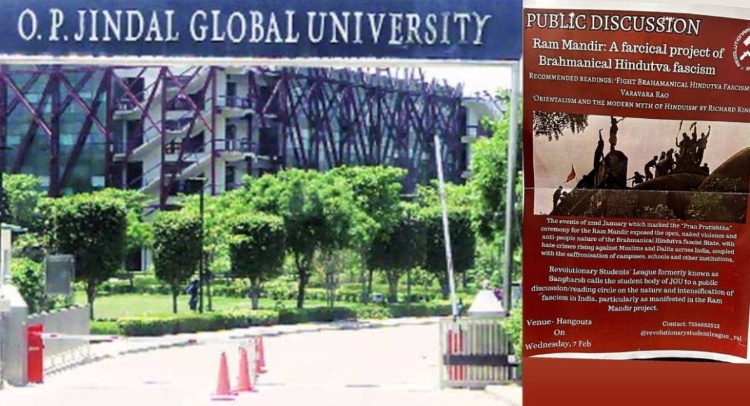
OP Jindal University in Sonipat, Haryana has again found itself in the middle of a controversy after it hosted an event, brimming with anti-Hindu rhetorics and unsettling calls for the destruction of the Ram Mandir in Ayodhya.

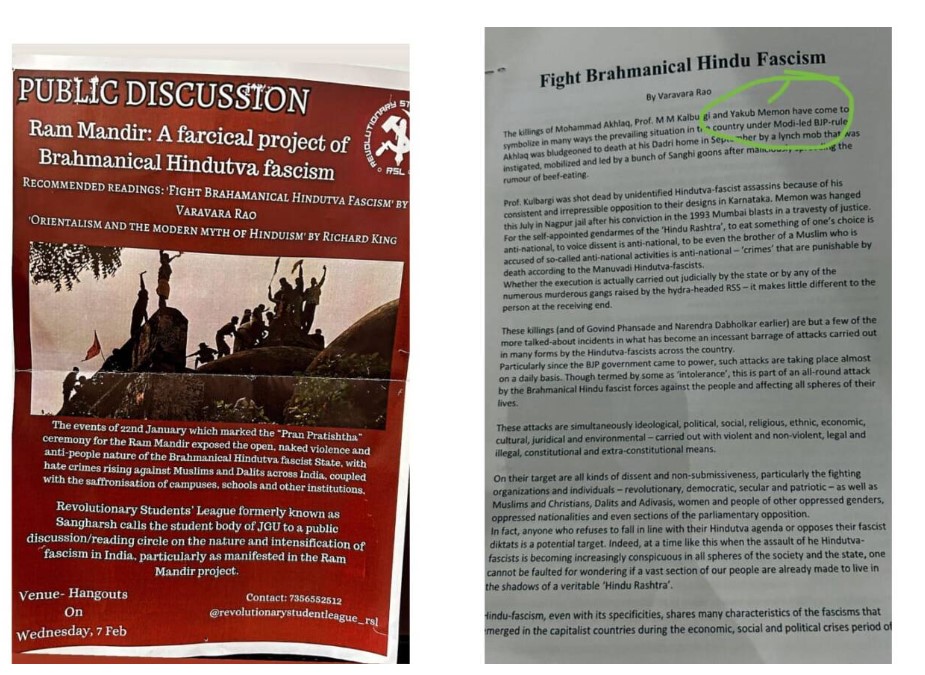
On February 7, the Revolutionary Students’ League (R.S.L), a frontal organisation of the Communist Party of India (Maoist) organised an event at the OP Jindal Global University titled “Ram Mandir: A Farcical Project of Brahmanical Hindutva Fascism.” At the event, the left-wing students affiliated with the organisation reportedly proposed the demolition of the Ram Mandir and the construction of a mosque in its place.

The event organizers contended that the Ram Mandir concept has come to be associated with hate crimes committed against Muslims and Dalits throughout India, in addition to a larger trend of saffronization within educational institutions.

They claimed that the January 22nd ceremony, which marked the Pran Pratishtha of Ram Lalla at the grand mandir in Ayodhya, exposed what they described as the inherent brutality and anti-people nature of the ‘Brahmanical Hindutva fascist regime.’

In its event brochure, the Revolutionary Students’ League urged the attendees to read the contentious book “Fight Brahmanical Hindutva Fascism” by Bhima Koregaon accused Varavara Rao.

Image credit: Organiser

Some anti-Hindu, anti-BJP excerpts from Varavara Rao’s book- ‘Fight Brahmanical Hindutva Fascism’

The text of the content, as quoted in an article by Organiser reads, “The killings of Mohammad Akhlaq, Prof. M M Kalburgi, and Yakub Memon have come to symbolise in many ways the prevailing situation in the country under Modi-led BJP-rule Akhlaq was bludgeoned to death at his Dadri home in September by a lynch mob that was instigated, mobilised and led by a bunch of Sanghi goons after maliciously spreading the rumour of beef-eating.”

“Prof. Kulbargi was shot dead by unidentified Hindutva-fascist assassins because of his consistent and irrepressible opposition to their designs in Karnataka. Memon was hanged this July in Nagpur jail after his conviction in the 1993 Mumbai blasts in a travesty of justice. For the self-appointed gendarmes of the ‘Hindu Rashtra’, to eat something of one’s choice is anti-national, to voice dissent is anti-national, to be even the brother of a Muslim who is accused of so-called anti-national activities is anti-national- ‘crimes’ that are punishable by death according to the Manuvadi Hindutva-fascists,” it continued.

“Whether the execution is carried out judicially by the state or by any of the numerous murderous gangs raised by the hydra-headed RSS, it makes little difference to the person at the receiving end.  These killings (and those of Govind Phansade and Narendra Dabholkar earlier) are but a few of the more talked-about incidents in what has become a continuous barrage of attacks carried out in many forms by the Hindutva-fascists across the country,” the article further stated.

It added, “Particularly since the BJP government came to power, such attacks are taking place almost on a daily basis. Though termed by some as ‘intolerance’, this is part of an all-round attack by the Brahmanical Hindu fascist forces against the people, affecting all spheres of their lives.”

“These attacks are simultaneously ideological, political, social, religious, ethnic, economic, cultural, juridical, and environmental—carried out with violent and non-violent, legal and illegal, constitutional and extra-constitutional means,” reads the article.

The author claimed that Hindutva forces specifically target revolutionary, democratic, secular, and patriotic groups and individuals, as well as any other kind of dissent and non-submissiveness. Furthering his anti-Hindu; anti-BJP rhetorics, the author wrote that the Hindutva forces also target Muslims, Christians, Adivasis, Dalits, women, people of other oppressed genders, people of oppressed nationalities, and even sections of the opposition in parliament.

Past controversies surrounding OP Jindal Global University

This incident is not an isolated one in the history of OP Jindal Global University. Earlier too, the university has come under the scanner for controversies ranging from charges of academic harassment and giving a platform to antisemitic and anti-Hindu views.

One such event involved Professor Sameena Dalwai, who faced allegations of harassment. IN December last year, the Haryana police filed an FIR against the OP Jindal professor for harassing students and breaching their privacy by displaying their profiles in a dating App inside a classroom.

In September, Dalwai allegedly violated the privacy of a student in the classroom by opening their Bumble dating-app account. Dalwai displayed the student’s private account on a Smart TV in a classroom full of students.

A video and screenshots of some chats doing rounds on X, formerly Twitter, showed the professor indulging in a detailed discussion about a dating account, which was allegedly a student’s. Moreover, as per reports, when the students refused to open their profiles, Dalwai allegedly told them to create fake IDs and suggested using Congress leader Rahul Gandhi’s picture.

In another instance, varsity professor Achin Vanaik came under the scanner for his anti-Hindu remarks that he made during a lecture on Palestinian history in November last year.

On 1 November 2023, the university organised a talk titled ‘The History and Politics of the Palestinian Present’ by Professor Achin Vanaik, Retired Professor of International Relations and former Head of Department of Political Science at the University of Delhi, now an activist. Several video clips of the professor’s lecture have appeared, which showed that in the name of solidarity with Palestinian civilians in Gaza, he made several antisemitic and anti-Hindu comments. He also attacked the Modi government over India’s stand on the conflict.

Following outrage over his anti-Hindu remarks, OP Jindal Global University issued a statement wherein it issued a warning to the ‘Professor’ for discriminating against Hindu students.

On February 8, 2023, JGU screened the banned BBC documentary “India: The Modi Question,” drawing ire for its perceived bias against Prime Minister Narendra Modi.

In 2022, a video of an ongoing classroom session at the Jindal Global Law School surfaced in which Arijeet Ghosh, an assistant professor of the varsity was seen ranting about Kashmir being a territory “occupied by India”. 

In an earlier development, the school was caught in controversy in a similar incident regarding the syllabus of the Political Science course. The course manual of the Political Science course taught in the school had topics calling the Indian state ‘oppressive’ while talking about the revolutionary struggle in India. In another segment, Claims of ‘Rise of Hindu Authoritarianism’ were also made

Similarly, in 2021, a controversy erupted after the varsity’s Associate Professor Shruti Pandey during an online lecture, claimed that all Hindus practice untouchability and lauded Islam for allowing widows to remarry.

In February 2020, left-liberal ideologues at JGU staged a protest, putting up offensive banners against the National Register of Citizens (NRC) and the Citizenship Amendment Act (CAA).

India Today-CVoter Mood of the Nation survey projects a third term for PM Modi, gives hope to INDI bloc in some states

0

India Today’s ‘Mood of the Nation’ poll survey has projected a repeat of 2019 for the BJP in the national capital. In a big blow to the Aam Aadmi Party (AAP), according to the survey, the ruling party is likely to make a “clean sweep” of all 7 Lok Sabha seats in Delhi.

The website reads, “The Mood of the Nation’s February 2024 edition is based on a survey of 35,801 respondents in all Lok Sabha seats. The poll was conducted between December 15, 2023, and January 28, 2024.”

The Mood of the Nation predicts a 57% vote share for the BJP, the same as in 2019. As for Kejriwal-led AAP, it is expected to witness a contraction in its vote share, which is now predicted to be just 15%.

Karnataka

The NDA could win 24 out of 28 seats in the state, the survey projects. INDI bloc could win the remaining 4.

BJP’s vote share has been projected at 53%, the same as in 2019 whereas the Opposition INDI Alliance is expected to get 42% of the vote share, again the same as in 2019.

Andhra Pradesh

The India Today survey has projected 17 out of 25 Lok Sabha seats to the Chandrababu Naidu-led Telugu Desam Party (TDP) whereas the YSRCP has been projected to secure 8 seats.

Both, the BJP and Congress may predictably not win any seats in the general elections. YSCRP is projected to secure 41% vote share and TDP 45% vote share.

Telangana

The survey projects that the Congress may win 10 out of 17 Lok Sabha seats in Telangana while the NDA would grab a mere 3 seats.

However, the projection is bad news for the BRS as it projects only 3 seats for K Chandrasekhar Rao’s party.

The BRS had won 9 seats in 2019. AIMIM might get one seat.

Kerala

India Today has projected a clean sweep by the INDI Alliance across 20 seats. This comes as a big setback for the Leftist CPI(M) govt led by Pinarayi Vijayan.

In 2019, the UPA won 19 out of 20 seats in Kerala.

Tamil Nadu

India Today has predicted another “clean sweep” for the INDI bloc in DMK-ruled Tamil Nadu projecting victory on all 39 seats.

The Opposition’s vote share is projected to be 47% and NDA’s at 15%.

Jammu and Kashmir

The survey predicts a “close fight” between the NDA and INDI Alliance in Jammu and Kashmir giving 3 out of 5 seats to the latter and 2 to the NDA.

Haryana

The NDA could secure 8 out of 10 seats in the state albeit with a decline in the vote share, according to the survey. In 2019, the BJP won all 10 seats.

Punjab

In AAP-ruled Punjab, the survey projects five seats each for the ruling party and the Congress while the BJP is projected to secure 2 seats of the 13 Lok Sabha seats in the state.

Uttarakhand

BJP is projected to stage a repeat of 2019 winning all five seats

Uttar Pradesh

In the largest state of India, the survey projects a victory for the BJP by a whopping 70 seats from 80 Lok Sabha seats. The vote share of the BJP has been projected at 50%, the same as 2019.

Jharkhand

The survey suggests 12 out of 14 seats for the NDA which is projected at 56% and vote share of INDI bloc projected at 30%.

Two seats are projected for the INDI Alliance.

Bihar

The survey projects a victory for the BJP albeit with a drop in seats for the NDA in Bihar with 32 out of 40 seats. The INDI Alliance comprising Congress, RJD and Left may see a rise in its tally and win 8 seats.

West Bengal

India Today poll has predicted an “improved” performance of the BJP in TMC-ruled Bengal. BJP is projected to win 19 out of 42 seats whereas TMC could win 22 seats.

BJP might secure 40% vote share, the same as in 2019 and TMC is expected to get 53% vote share, a drop of 4% from 2019.

Himachal Pradesh

The survey projects that the BJP will sweep Himachal Pradesh once again winning all 4 seats this year.

The BJP may secure 60% vote share, a 9% decline from 69% in the 2019 elections. The INDIA bloc is anticipated to secure 29% of the vote share, reflecting a 2% increase from 2019.

Assam

NDA is projected to 12 out of 14 seats, up from 9 in 2019, in the northeastern state while INDI bloc could win 2 seats.

Gujarat

The survey projects a hat trick for the BJP in Gujarat winning all 26 seats, the same as in 2019 and 2014.

Maharashtra

The survey projects “an edge” for INDI bloc with 26 out of 48 seats and has projected 22 seats for the NDA.

It states that the Congress is projected to win 12 seats in Maharashtra, while its allies, Shiv Sena (UBT) and Sharad NCP-Sharadchandra Pawar, are likely to win 14 seats combined.

The poll predicts the INDIA bloc to get 45% vote share while the NDA is projected to get 40% vote share.

According to the India Today-CVoter Mood of the Nation survey, 52% of respondents said that PM Modi is the best suited to be the next Prime Minister. It projects that 16% of respondents batted for Rahul Gandhi.

44% said they would vote for BJP because of PM Modi while 22% said they would vote for BJP because of development and 14% said they would vote for BJP because of “Hindutva”.

While the survey has predicted that if polls were held today, NDA would make a clean sweep but claims that the INDI bloc would see a jump too.

49% of respondents said that the Congress is better off without the Gandhi parivaar. Surprisingly, a survey was held to gauge the mood of the nation on who should lead the INDI bloc. 24% of respondents voted for Rahul Gandhi, and 15% picked Mamata Banerjee and Kejriwal respectively.

Of course, in a more sensible survey question, the majority of the respondents said INDI Alliance will not be able to beat the NDA. Moreover, 59% respondents said they were satisfied with NDA’s performance.

Moreover, 53% of respondents don’t want India to hold talks with Pakistan.

Voting for general elections ends in Pakistan amid allegations of mass rigging, mobile phone and internet services shut down during polling

0

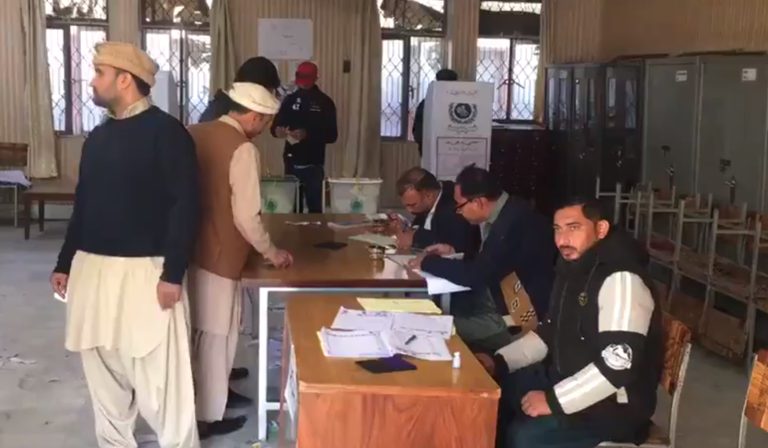
Polling for general elections in Pakistan concluded amid allegations of rigging and the shutdown of cellular and internet services, Dawn reported on Thursday.

The voting process began at 8 am and continued till 5 pm. The Election Commission of Pakistan earlier said that exceptions would only be made for people already inside the polling station.

However, the polling is not being considered free and fair, as many allegations were levelled regarding the rigging and people being barred from voting.

In a major development, the Federal Interior Ministry this morning suspended mobile phone and internet services across Pakistan to maintain the law and order situation during the general elections on Thursday.

Iinternet monitor Netblocks also said that the real-time data shows that internet blackouts are now in effect in “multiple regions of Pakistan in addition to mobile network disruptions,” as reported by Dawn.

This development drew severe criticism from major political parties.

Pakistan People’s Party (PPP) Chairman Bilawal Bhutto Zardari demanded the immediate restoration of mobile phone services across the country

Women voters at a village of NA-20 in Swabi district were completely banned to cast vote, ARY News reported on Thursday.

The locals allegedly prohibited women from exercising their right to vote in Adeena village of Swabi district. According to reports, the election staff has been present at the polling station, while women voters are not being sighted.

In another incident, at least two children were killed in blast near a polling station in Washbood Panjgur, as reported by ARY News.

According to police officials, polling was stopped at the Government High School Malik Abad polling station after the blast.

Pakistan Tehreek-e-Insaf (PTI) alleged irregularities in NA-236 constituency. It accused the authorities for deliberately creating hurdles, Geo News reported.

There were reports of delays in the start of voting which were rejected by the Election Commission of Pakistan (ECP) Sindh.

“The polling process at the polling station in NA-236’s Abul Hasan Isfahani Road going on without any delay or interruption,” a spokesperson for the Sindh ECP said in a statement.

PTI also demanded the Election Commission of Pakistan (ECP to extend the voting time.

However, the former ruling party decided to submit a formal application to the electoral body, seeking an extension in the polling time, Geo News reported.

Among the major leaders contesting, PML-N supremo Nawaz Sharif cast his vote in Lahore. President Shehbaz Sharif and daughter Maryam Nawaz also cast their votes.

Pakistan People’s Party Chairman Bilawal Bhutto-Zardari also casted his vote and urged public to step out and vote perform their constitutional duties.

Former Pakistan Prime Minister Imran Khan and other political leaders who are currently incarcerated also had their votes casted through a postal ballot from Adiala Jail, Pakistan-based Dawn reported, citing sources.

Earlier, polling operations at various stations throughout the country have encountered significant delays owing to a range of technical and logistical impediments, hindering the commencement of the electoral process, pakistan based Samaa reported.

Balochistan Caretaker Information Minister Jan Achakzai said that Balochistan will announce election results later in the evening on Thursday, Dawn reported.

“Like other provinces, Balochistan will deliver results after 5 pm,” he said.

Meanwhile, political violence escalated ahead of election day, with two blasts in separate locations in the southwestern province of Balochistan on Wednesday — a region plagued by decades of insurgency — killing at least 30 people and injuring 40 others.

Also, Pakistan’s caretaker administration, led by Prime Minister Anwaar ul Haq Kakar, has failed to address the country’s economic dysfunction amidst growing debt and inflation. This means that the incoming administration will face significant challenges in handling the crisis-stricken economy since the IMF bailout agreement expires in March.

A recent World Bank report stated that Pakistan’s economic development is limited to the elite which resulted in the country lagging behind its fellow countries in the wake of the economic crisis in Pakistan, Pakistan vernacular media reported.


(This news report is published from a syndicated feed. Except for the headline, the content has not been written or edited by OpIndia staff)

‘Should children of IAS-IPS officers continue to get reservation benefits?’ Justice BR Gavai asks as Supreme Court starts hearing plea on sub-grouping in SC/ST reservation

0

On Tuesday (6th February), the Supreme Court stated that people in the backward castes who were eligible for reservation and have benefited from it should move out from the reserved category to allow others who remained backward to benefit from affirmative action.

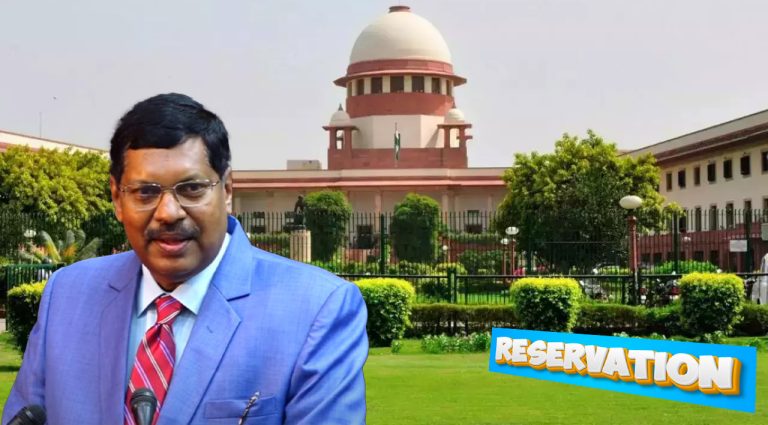
On Tuesday, the Constitution bench, which consisted of Chief Justice of Indian DY Chandrachud and justices BR Gavai, Vikram Nath, Bela M Trivedi, Pankaj Mithal, Manoj Misra, and Satish Chandra Sharma, began the hearing on the permissibility of subclassification within the SC/ST reservation, making some significant remarks about the purpose of reservation for marginalised groups and the need for administrative efficiency. Punjab’s advocate general Gurminder Singh and the state’s additional advocate general Shadan Farasat argued in favour of subclassification within SC/ST reservations.

The Punjab Govt has filed a plea in the Supreme Court challenging a High Court order that cancelled priority reservation for more backward sub-groups within the SC-ST quota introduced by the Punjab govt. The state government passed a law in 2006 to give priority to the “extremely backward” sub-sects within the scheduled castes (SC) and scheduled tribes (ST) in the reservation system. However, the law was turned down by the Punjab and Haryana High Court citing a Supreme Court order ruling out such sub-categorisation.

During the first day of the hearing, Justice BR Gavai, who is reported to be a Dalit himself, remarked that a Dalit from one state might run for office in another state from a reserved seat, raising fundamental questions about reservations within the disadvantaged castes. He then raised the issue of children of high-ranking officials from the backward class getting reservation benefits. “Should the children of people who are already in relatively better circumstances get reservations? Should IAS and IPS officers’ children be granted reservations?” he asked.

“A person from the SC/ST community, after getting into central services like IAS and IPS, gets access to the best of facilities. Yet, his children and their children continue to get the benefits of reservation. Should this continue?” Justice Gavai asked.

On the second day of the hearing, senior attorney and former Attorney General KK Venugopal argued, quoting Justice Krishna Iyer, that there is a need to create a sub-category of disadvantaged Dalits because otherwise, the more powerful will reap the benefits while the weaker will be left helpless.

Punjab Advocate General Gurminder Singh stated that the most backward among backward-class communities must be recognised and provided with the resources to achieve equality in terms of employment opportunities. Senior advocate Nidhesh Gupta stated that SCs make up 33% of the Punjab population, with Balmikis (Churas and Bhangis) and Mazhabis (Sikhs) accounting for 29%. He stated that 43% of Scheduled Caste communities occupied 81% of SC positions in the state government.

During the hearing, Justice Vikram Nath asked Punjab’s advocate general if the state supported removing any SC/ST subcastes from the scope of reservation benefits if they have consistently performed better and are on par with unreserved categories.

“Why should not be there an exclusion? According to you [Advocate General Gurminder Singh], amongst a particular category, some of the sub-castes have done better. They are the forward in that category. They should come out of that and compete with the general. Why stay there? And let the remaining who are still backwards within the backward, let them get the reservation. Once you achieve the concept of reservation, you should pull out of that reservation…,” Justice Nath said.

To this, Singh responded, “That’s the aim, and if that aim is achieved, then the purpose for  which the exercise was undertaken should come to an end.”

Justice Gavai also weighed in, stating that when some castes within a given backward class reach a certain level and are on par with forward castes, they should move out.

“But then, that is only for Parliament to decide… now what happens, a person from SC/ST gets into IAS/IPS, etc. Once you are there, their children do not suffer the disadvantages that persons from the other SC communities suffer. But, by virtue of reservation, they are also entitled to the benefits for the second generation and again the third generation,” Justice Gavai remarked.

Singh responded that, while it is up to the President to declare SC/ST groups under Article 341 and states cannot change that list, he agreed with the view that subgroups that have achieved forwardness should exit to make room for those who truly need quota benefits. Singh also stated that in the Jarnail Singh case (2018), a five-judge court applied the creamy layer test to reservations in SC/ST promotions.

Reacting to this, the CJI stated that there is an exclusion, which also applies to providing reservation to backward castes in comparison to forward castes, and asked if it might be extended to provide specific benefits to the more backward members of the backward class.

“…The only question really is…Can that exclusion not be justified on the same yardstick that we have applied for exclusion in the backward-versus-forward context?… Can the State not say I am not deleting your community from the list of Scheduled Castes which has been designated by the President… but within those communities, I am now making a classification that certain communities are more backward and, therefore, in greater need for protection on the same touchstone of substantial equality?” CJI Chandrachud said.

Advocate Gurminder Singh explained to the court that it is about relative backwardness. “Once we accept the relativity argument in backwardness, and it is the backwardness vis-a-vis forwardness that puts them in at 50 per cent, and it is the more backwardness that provides them the reservation within the reserved, then this argument has no problem,” Singh said adding that no one including the framers of the constitution saw reservations as a perpetual concept.

The Supreme Court of India ruled twenty years ago against the practice of giving priority to “extremely backward” sub-sects within scheduled castes (SC) and scheduled tribes (ST) in the reservation system. Two years later, in 2006, the Punjab Assembly passed legislation allowing reservations for such sub-groups under the SC-ST quota. The Punjab and Haryana High Courts, however, dismissed this law in 2010 based on the Supreme Court’s 2004 verdict in E.V. Chinnaiah v State of Andhra Pradesh case. The Punjab government then appealed this verdict in the Supreme Court, which is now being heard by a seven-judge Constitutional Bench.

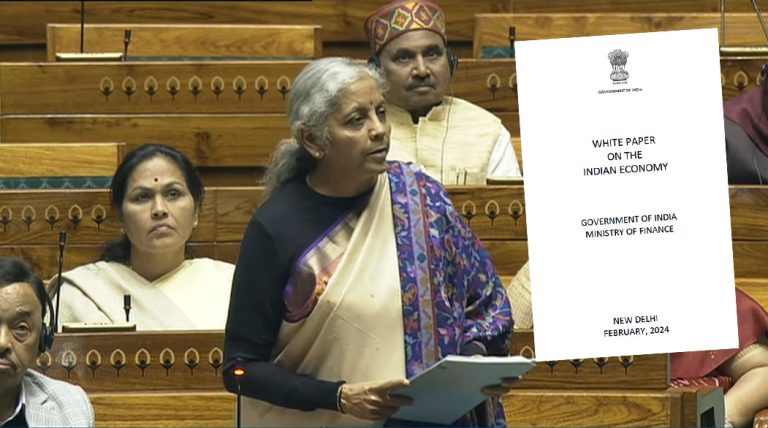
“It was a crisis situation”: Union govt tables White Paper on Indian Economy in Lok Sabha narrating how UPA govt ruined the economy

Finance Minister Nirmala Sitharman on Thursday laid a White Paper on the Indian economy in the Lok Sabha. The White Paper gives a ‘before and after’ account of the economy, comparing the economy during the 10-year UPA rule with the 10-year NDA rule.

The white paper was tabled on the last day of the ongoing budget, which was extended by a day for this purpose. This is the last session of the current Lok Sabha before the general elections expected to be held in April-May this year.

The government had announced in the union budget presented on February 1 that it will come out with a ‘White Paper’ to compare the economic performance of 10 years of the Congress-led UPA government with that of 10 years of the BJP-led NDA government.

The White Paper has been produced in two languages, English and Hindi. The 59-page white paper details how UPA had inherited a healthy economy in 2004, and the Indian economy was in bad shape in 2014, when the Narendra Modi govt replaced the Manmohan Singh govt. The white paper highlights the contrasting trends in the stock market and Foreign Institutional Investors (FII) inflows during both periods.

The white paper says in the overview section: “In 2014 when we formed the government, the economy was in a fragile state; public finances were in bad shape; there was economic mismanagement and financial indiscipline, and there was widespread corruption. It was a crisis situation.”

It says, “The responsibility to mend the economy step by step and to put the governance systems in order was enormous. Our government refrained from bringing out a white paper on the poor state of affairs then. That would have given a negative narrative and shaken the confidence of all, including investors. The need of the hour was to give hope to the people, to attract investments, both domestic and global and to build support for the much-needed reforms.

The white paper further adds, “The government believed in ‘nation-first’ and not in scoring political points. Now that we have stabilised the economy and set it on a recovery and growth path, it is necessary to place in the public domain the seemingly insurmountable challenges – left behind as a legacy by the UPA Government.”

I then says, “Every challenge of the pre-2014 era was overcome through our economic management and our governance. These have placed the country on a resolute path of sustained high growth. This has been possible through our right policies, true intentions, and appropriate decisions.”

The White Paper first gives a glance at the nature and extent of governance, economic and fiscal crises that were bequeathed on the Modi government when it assumed office in 2014.

Second, it informs t about the policies and measures that the NDA government took to restore the health of the economy and make it vigorous and capable of fulfilling the growth aspirations of the people.

Third, the White Paper hopes to generate a wider, more informed debate on the paramountcy of national interest and fiscal responsibility in matters of governance over political expediency.

And at last, it aims to “commit ourselves to national development, with new inspirations, new consciousness, new resolutions, as the country opens up immense possibilities and opportunities.”

The White Paper has been divided in three parts. The first part discusses the macroeconomic situation of India under the UPA government. It notes that this period was marked by double-digit inflation, ailing banking sector with excessive lending and high policy uncertainty which marred India’s business climate and dented its image. India’s economy deteriorated despite the Vajpayee-led NDA government having handed over a healthy and resilient economy with high growth potential in 2004, it states.

The Part 1 also mismanagement of the economy during the Manmohan Singh govt, various scams causing massive revenue losses and out of control fiscal and revenue deficits. “In 2014, our government inherited a deeply damaged economy whose foundations had to be rebuilt to enable self-sustaining long-term economic growth,” says the White Paper.

The Part 2 of the paper gives current status of the various corruption scams of the UPA government.

And the Part 3 narrates how the NDA govt turned the economy around, rebuilt the country’s image and rekindled people’s hopes and aspirations for a better future. “Now, the nation marches ahead with self-confidence and self-belief,” it says.

Infrastructure revolution: From the 2nd largest road network in the world to soaring civil aviation, how 9 years of Modi govt has transformed India

In his book ‘A Vision of American Strength: How Transportation Infrastructure Built the United States’, James Pinkerton writes – “The history of civilization is the history of infrastructure.” That is a pretty telling assertion. If one looks at the progress America has made over the years, a key initiative was the New Deal that President Roosevelt, upon assuming office in 1933, enacted that would take the country out of the clutches of the Great Depression. The role of US Federal Government was fundamentally transformed by expanding its scope and size. Similar parallels can be found in the history of other developed economies too.

For the world’s largest democracy, its ‘New Deal’ moment has probably arrived now. India, with its labyrinth of rural and urban roads, ports, and airports, has had a steady development of its infrastructure since independence. Post-2014, with the new dispensation at the Center, the thrust that infrastructure received was monumental. Let us look at a few key numbers to understand this better. 

  • Over last 9 years, 53,000 Kms of National Highways were added. 
  • The speed of highway construction leapfrogged from 12.1 Km/day in 2014-15 to 37 Km/day in 2022-23.
  • 3.28 lakh Kms of rural roads have been built since 2014, and 27 Greenfield expressways are being developed across the country.
  • Length of metro rails have increased from 248 Kms in 2014 to 860 Kms in 2023. 
  • Till 2014, only 74 airports were operational in the country. By 2023, another 74 airports, heliports and water aerodromes have been added.

The list goes on. 

Let us take a look at two of the major infrastructure components viz Roads and Airports, around how they fare presently in India. 

Roads

India has the 2nd largest road network in the world, spanning 63.73 lakh Km of road network, which includes national highways, state highways, district roads, and rural roads. Road transport carries 87% of total India’s passenger traffic and more than 60% of its freight. National highways account for 2% of the total road network and account for 40% of total traffic. Naturally, there was an impetus needed to expand our NH network. That is where the Bharatmala Pariyojana, approved in October 2017, has played a major role. 

34,800 Km of NH was envisaged as part of Bharatmala Pariyojana. It proposed a corridor-based NH development, to ensure infrastructure symmetry and consistent road user experience. 550 districts are being connected through NH linkages as part of this scheme. Some of the key components of this Pariyojana are as below:

  • Development of economic corridor
  • Inter-corridor and feeder routes development
  • Border and international connectivity roads
  • Coastal and port connectivity roads and expressways
  • 35 locations for multimodal logistics parks
  • 28 cities identified for Ring Roads

A world record was created by constructing 75 Kms of continuous single-lane bituminous concrete roads in record time of 105 hrs and 33 mins. 

Not only this ambitious Pariyojana, road connectivity to rural areas and left extremism-affected areas have also been given a much-needed impetus. Pradhan Mantri Gram Sadak Yojana was approved in 2019. It focuses on consolidating 1,25,000 Km of existing routes that connect habitations to Grameen agricultural markets, as well as schools and hospitals. Since its inception till 13th July 2022, 86,039 Km of road length had been sanctioned and 41,440 Km completed under PMGSY-III.

Construction of roads in left-wing extremism-affected areas was also launched as a separate vertical under PMGSY. Since inception, till 13th July 2022, 12,081 Km of road length had been sanctioned and 6,179 Km completed under RCPLWEA (Road Connectivity Project for Left Wing Extremism (LWE) Affected Areas).    

There has also been an eye for using modern technology in road infrastructure development. States have been urged to use smart technologies to the tune of at least 20 – 25% in infrastructure work.

Civil aviation

A quick set of statistics will set the stage to enumerate the tremendous growth that civil aviation has undergone in India over the past 9 years. The total number of domestic passengers in 2014 was 60 MN, which more than doubled to 143 MN in 2020 before COVID-19. International passengers have increased during the same timeframe from 43 MN to 64 MN. In terms of aircraft, the number has gone up from around 400 in 2014 to 723 in 2023, despite the impact of the COVID-19 pandemic. Over the last 9 years, 11 more greenfield airports have been operationalized. 

Not just airports, the Government is planning to revamp the entire aviation ecosystem as well, including FTOs (Flying Training Organizations), helicopters, ground handling, MRO, and manufacturing. The ‘Make in India, but Make for the World’ impetus as envisioned by PM is seeing fruits here. Boeing, along with Tata and other companies, have set up multiple facilities in India, and exports goods worth over 1 BN USD, that are made in India. Airbus exports goods worth around USD 650 MN from India. One of the largest MRO majors Safran is putting in place a USD 150 MN facility in India for their LEAP engine. 

Infrastructure soaring new height

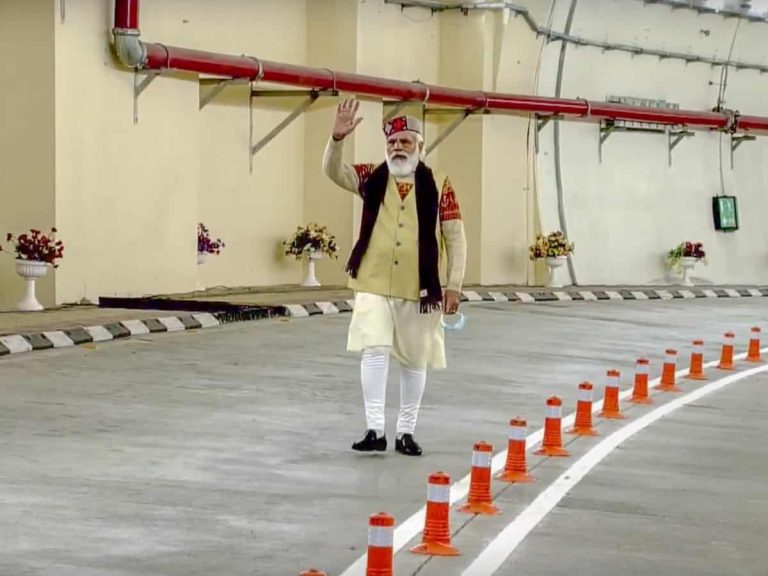
There have been a few notable landmarks accomplished within Infrastructure. The Chenab Bridge is the world’s highest railway bridge that is nearing completion. The bridge, along with the stretch of route from Jammu to Baramulla, is expected to get operational soon enough. Atal Tunnel is the world’s longest highway tunnel above 10,000 ft. Zojila Tunnel is Asia’s longest road tunnel. Himank was the world’s first motorable road through glaciers in Ladakh. Bogibeel Bridge is Asia’s 2nd longest rail-road bridge, and it is India’s first bridge to have fully welded steel-concrete support beams that can withstand earthquakes of up to magnitude 7 on the Richter scale.  

Harbinger to economic prosperity

For every rupee that is spent on Infrastructure, there results in a 2.5 – 3.5 rupees increase in GDP. Nitin Gadkari, India’s minister of road transport and highways is thus spot on when he says that the prosperity of India is coming from the roads. The government is trying to enhance the manufacturing sector’s contribution to 25% of GDP, and in that endeavour, faster and more reliable transit of raw materials and finished goods via improved road and rail assume significance.

About the New Deal for America, Roosevelt famously said, “I pledge myself to a new deal for the American people. This is more than a political campaign. It is a call to arms.” Closer to home, our ‘call to arms’ bugle has seemingly been sounded off. And, an infrastructure revolution that has slowly yet surely swept India over the last 9 years, is leading that charge. 

Congress wants to connect with lakhs of Agniveer aspirants, promising a ‘review’ of the scheme: Why this campaign is dangerous and harmful for India

To enhance national security and development, the Government of India has introduced an extensive scheme of Agniveer for recruitment into the Indian defence forces. Regrettably, the government is currently confronted with a harmful campaign orchestrated by political adversaries, aiming to misguide and mislead young individuals who aspire to join the defence force with the noble intention of safeguarding the nation and its people. This campaign poses a serious threat to the nation’s security and progress, all in the pursuit of political advantage.

In light of the evolving landscape of warfare and geopolitical dynamics in the region, the Indian Defence Force is preparing for a significant modernization initiative. As countries undergo military modernization influenced by broader geopolitical changes, cutting-edge technologies like lethal autonomous systems, artificial intelligence, hypersonic weapons, directed energy weapons, biotechnology, and quantum technology are emerging as crucial elements in the landscape of warfare. To meet this technical advancement power, the Government of India has introduced Agniveer’s scheme for defence recruitment, which aims at addressing critical gaps in the current system to ensure a stronger and more capable defence force.

Despite the noble objectives of Agniveer’s scheme, the Congress party has launched a campaign proposing a reversal of the Agnipath scheme. The Congress is strategizing to connect with 35–40 lakh young men and women who, on average, participate in recruitment rallies annually under the ‘Jai Jawan’ campaign and are driven solely by vote politics. This led to serious concerns about compromising national security and hindering the progress of our defence forces. It is imperative to recognise that national security and development should go beyond partisan politics.

Addressing grey areas and fine-tuning the process of the newly introduced Agniveer scheme is inevitable for better implementation. The government and triservice are committed to that. This commitment ensures that the scheme not only meets the current requirements but also evolves to meet future challenges. As a responsible opposition party, Congress must make efforts to have a ‘meaningful discussion’ in Parliament.

India aspires to become a global superpower and secure its position among the world’s elite armies. To attain this status, the modernization of its armed forces is imperative. In addition to that, ongoing conflicts related to unresolved boundary issues with China and Pakistan, instances of terrorism in Jammu and Kashmir, insurgency in the North Eastern states, the unbridled threat of left-wing extremism, and the escalating challenges posed by urban terrorism have significantly added complexity to India’s security landscape. To effectively combat contemporary warfare, India must equip its forces with state-of-the-art weaponry, technical competence, and a highly motivated, strong young force in the triservice.

Agniveer remains steadfast in its commitment to providing more power to the defence force. The government must act on policy changes that enhance living conditions, healthcare facilities, educational opportunities, service terms, and resettlement jobs to uplift the morale of Agniveers.

The bureaucratic red tape surrounding Indian defence decision-making poses a significant threat to the nation’s security. The cumbersome processes and delays caused by bureaucratic inefficiencies can potentially jeopardise timely and crucial decisions, creating vulnerabilities that may compromise the overall safety and defence capabilities of the nation.

A heartfelt plea to the citizens of our nation: With a background that spans from serving as a foot soldier to an officer engaged in warfare and accumulating 28 years of dedicated service as a veteran, I implore voters to transcend political tactics and acknowledge the pivotal significance of a robust defence, national priorities, and the prosperity of our beloved nation.

Also, I urge the political opposition to prioritise national security over short-term political gains. The party remains committed to its vision for a stronger, safer, and more prosperous India.

Women inmates getting pregnant, 196 babies born in jail: Calcutta HC raises concern over condition of female prisoners in Bengal jails

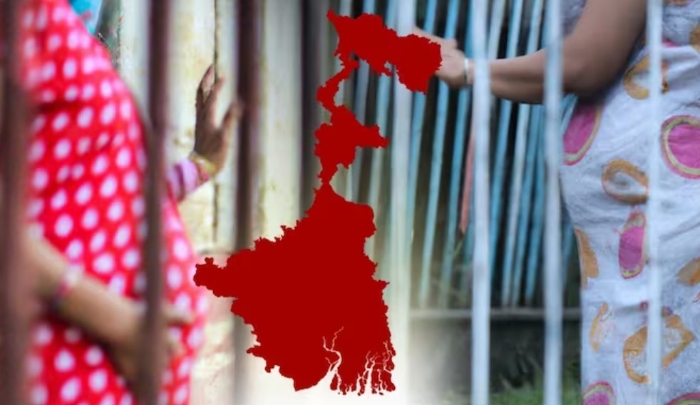
The amicus curiae of all West Bengal correctional homes informed the Calcutta High Court on Thursday, February 8, about the fretting issue of women inmates getting pregnant while in custody. This prompted the court to express grave concerns about the condition of female inmates in West Bengal jails. An estimated 196 babies have reportedly been delivered in different jails throughout the state, according to the amicus curiae.

The submission was made while a case involving West Bengal’s correctional facilities and jail reforms was being discussed. The division bench, presided over by Chief Justice TS Sivagnanam and Justice Supratim Bhattacharya, took a serious view of the case and ordered a hearing before a division bench that specialised in criminal cases.

The amicus curiae proposed a ban on male staff members entering enclosures housing female inmates as a preventive approach to address the problem. This proposal was made in response to the reported pregnancies of female prisoners and the ensuing deliveries of several children inside the jail system.

Additionally, the amicus curiae offered other recommendations that were detailed in a note dated January 25 to enhance the circumstances and guarantee the well-being of prisoners housed in correctional facilities.

The amicus also recommended that all District Judges, who chair the Board of Visitors, be permitted to tour the correctional facilities under their respective purview to ascertain the number of women inmates who have gotten pregnant during their stay in correctional homes.

Additionally, to prevent sexual exploitation of women inmates, the Chief Judicial Magistrates of each district may be instructed to require all women convicts to undergo pregnancy tests before being sent to correctional facilities. To this end, all West Bengali police stations ought to conduct pregnancy testing. The memo from the amicus stated that this Hon’ble Court may issue necessary instructions or directives to this effect.

Recognizing the seriousness of the problem, the bench removed the case from its current list, allowing for additional hearings and discussion of the suggested reforms.

The amicus curiae also described, during the proceedings, how they witnessed firsthand the birth of fifteen children and a pregnant lady at a visiting correctional home, highlighting the critical need to address the structural issues that West Bengal’s jailed women confront.

“Recently, I visited a women’s correctional home along with the inspector general (special) of correctional homes and the secretary of the district legal services authority. I found one pregnant lady and at least 15 other women prisoners staying with their children. They were born in the prison”, he stated.

The revelation has raised a great deal of worry and demands for extensive changes to protect the rights and welfare of female inmates in the state’s jail system.

While assigning the matter to another bench, the division bench of Chief Justice Sivagnanam and Justice Bhattacharya said, “The amicus curiae has mentioned the matter and has placed a note pointing out some serious issues. One such issue is that women prisoners were getting pregnant while in custody. At present 196 babies are staying in various prisons of West Bengal.”