Home Blog Page 2185

Muzzafarnagar: Hindu boy threatened for being friends with Muslim girl, girl’s hijab snatched, accused booked as ‘Jat Association’ calls mob ‘Mughalo ki bheed’

On Monday, the Uttar Pradesh Police filed an FIR against some Muslim persons for harassing a Hindu boy belonging to the Jatt community and a Muslim girl in the city of Muzzafarnagar. The Muslim men had objected to the Muslim girl being friends with a Hindu boy and roaming around with him on his bike.

“The FIR in this case has been filed and the accused persons have been booked under the relevant sections of the law. Teams have been formed to arrest the accused. Advance legal action is being taken by the local police,” the Muzzafarnagar Police tweeted on May 15.

This is after the video of the incident went viral over social media platforms in which the accused could be seen harassing and threatening the Hindu man and the Muslim girl. The accused person asked the man about his identity and threatened him for roaming with a Muslim girl.

Meanwhile, the Muslim girl was also harassed and inquired in the process for being friends with the Hindu man. The accused men snatched the hijab of the girl and asked her to reveal her face on the video. The video was first shared by a Twitter handle named ‘The Jatt Association’ which said that the boy was issued death threats by the accused and that Police had taken no action by then.

The association also condemned the act of forcefully removing the hijab of the Muslim girl. “The men are removing her hijab forcefully? Under which law is this allowed? How can anyone harass a girl like this? If no action is taken by the police, we shall reach the CM for justice,” the tweet in Hindi roughly read.

Further, the video was shared by a journalist of Sudarshan news named Sagar Kumar. He tweeted the video and said, “A Jatt boy was harassed for being with a Muslim girl. The duo misbehaved with and the boy was issued death threats.”

However, the Police took cognizance of the video and confirmed that the accused men have been booked under the relevant sections of the Indian law. The police have launched teams to nab the accused. Investigations in the case are underway.

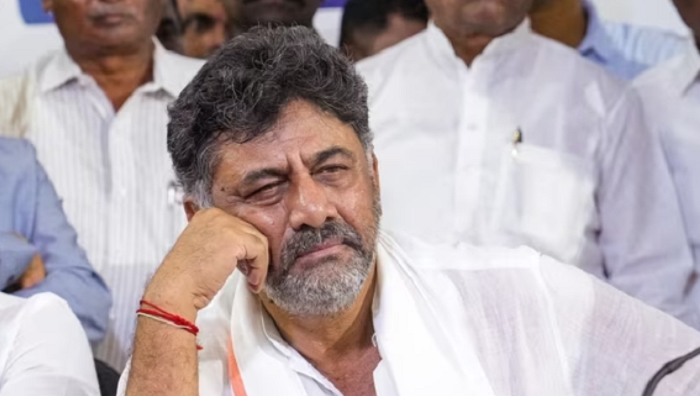
How DK Shivakumar tried to shield himself and other Congress workers from investigation by threatening the very officer who is the new CBI Director: Details

On May 14, the DGP of Karnataka, Praveen Sood was appointed as the new Director of the Central Bureau of Investigation (CBI) as per an order issued by the Department of Personnel and Training (DoPT). Earlier he was working as the DGP of Karnataka and was targeted by Congress leader DK Shivakumar alleging his affiliation with the BJP which was in power in the state at that time.

The Congress leader had also vowed to take action against him if the party would come back to power in the state, however, the high-powered selection committee headed by PM Modi appointed Karnataka DGP Praveen Sood as Director of the Central Bureau of Investigation (CBI) for a period of two years. This is after the Congress recorded a victory in the Karnataka Assembly elections.

In January 2020, Sood, a member of the state cadre and an IPS officer from the 1986 batch, succeeded Ashit Mohan Prasad as the Karnataka DGP.

Congress alleged Police bias towards BJP

Reportedly, the state Congress criticized Sood in March of this year in the lead-up to the Assembly elections, charging the DGP with alleged bias for the BJP. DK Shivakumar, the head of the Karnataka Congress, accused the police of pursuing cases against his party members but remaining silent about the BJP. He tried to divert the investigation into the cases filed against Congress by blaming the Police to have allegedly nurtured a soft corner for the BJP. He declared that the Congress would initiate action against Sood if it formed the next administration.

“This DGP is a ‘Nalayak’. Let our government come. We will take action against him. Congress had also written to ECI to remove him. I thought he (Praveen Sood) was a respected man. Immediately, a case should be registered against him and he should be arrested,” Shivakumar had said.

“He has finished three years in service. How many days do you want to keep and worship him? He has been filing cases only against Congress. He has registered more than 25 cases against us and not a single case against BJP leaders. Let our government come. We will take action against him,” he had added back then.

The Congress leader vowed to take action against the then DGP after the police allegedly failed to take action against the individuals who put up posters of Uri Gowda and Nanje Gowda in Mandya ahead of the Prime Minister’s visit. Uri Gowda and Nanje Gowda fought had fought Tipu Sultan to safeguard the family of Mysuru Maharajas and to protect the state.

DK Shivakumar said in March that more than 25 cases were filed against its workers in connection with several issues, including the ‘Pay CM’ campaign against Basavaraj Bommai but no case was registered against BJP workers.

3 were shortlisted from over 115

The Prime Minister’s selection committee narrowed the pool of applicants down to three candidates on Saturday, but the process was complicated because the opposition representative on the panel, Congressman Adhir Ranjan Chowdhury, voiced his displeasure with the method and demanded that it be restarted.

The Department of Personnel and Training reportedly provided a list of over 115 individuals for the position previously. It is said that Chowdhury brought this up and stated that the service records, personal information, and integrity documents of the officers on the list were not available to him.

The three shortlisted candidates were then forwarded to the Cabinet’s Appointments Committee. The other shortlisted alternatives were Sudhir Kumar Saxena, DGP of Madhya Pradesh, and Taj Hassan, DG of the Fire Service, Civil Defence, and Home Guards.

It is to be kept in mind that Praveen Sood’s nomination was approved by a high-level committee that included Prime Minister Narendra Modi, Chief Justice of India DY Chandrachud, and Leader of the Opposition Adhir Ranjan Chowdhury (Congress leader).

About Praveen Sood

Praveen Sood, a 1986-batch IPS officer from the Karnataka cadre, has served as the State DGP for the past three years. Originally, Sood hails from Himachal Pradesh and is an alumnus of IIT-Delhi. He was appointed the Karnataka DGP in 2020. His other stints include Superintendent of Police, Bellary, and Raichur before getting posted to Bangalore city as Deputy Commissioner of Police, Law and Order.

Sood also worked as principal secretary of the Home Department, ADGP Karnataka State Reserve Police, and ADGP Administration. He was slated to retire in May 2024. However, with his appointment as the new Director of the CBI, he will now work for a tenure of two years, ensuring his presence in office until at least May 2025. It must be mentioned that an existing Director of the CBI and the Enforcement Directorate (ED) can serve for a maximum period of 5 years and a minimum tenure of 2 years.

In 1996, Sood also received the Chief Minister’s Gold Medal for outstanding service. In 2002, he received the Police Medal for Meritorious Service, and in 2011, he received the President’s Police Medal for Distinguished Service.

Karnataka HC recently dismissed Shivakumar’s plea challenging state’s demand for CBI probe in his case

Last year in October, DK Shivakumar had received a summons from the Enforcement Directorate (ED) in connection with a money laundering investigation. He was previously questioned by the ED in Delhi on September 19 for more than 5 hours. Then, DK Shivakumar said that he was also questioned over the National Herald issue and family donations to the Rahul and Sonia Gandhi-run Young Indian Private Limited trust.

In another money-laundering case, the ED had detained Shivakumar on September 3, 2019, and the Delhi High Court had granted him bail in October of that same year. After learning about a charge sheet filed against him by the Income Tax department, the agency lodged a charge sheet against him and others in this matter in May of this year.

Recently, a fresh case was lodged based on an FIR filed against him on corruption charges. On April 20, the Karnataka High Court dismissed the Congress leader’s plea challenging the Bharatiya Janata Party-led state government’s decision seeking a Central Bureau of Investigation (CBI) probe into the disproportionate assets case against him. He had filed an application saying that the Karnataka government’s order for the CBI probe was wrong.

In 2019, the BS Yeddyurappa government sanctioned an investigation against DK Shivakumar. At that time, the CBI registered an FIR with the permission of the state government. Earlier, the CBI had assessed the property after the Karnataka Congress chief had made a statement that he is a farmer and getting income from agriculture.

Notably, the affidavit filed by Shivakumar while submitting his nomination papers for the May 10 Assembly polls revealed that the wealth of Congress’s Karnataka chief had increased by 68 per cent as compared to 2018. In the affidavit submitted by Shivakumar for the Assembly polls, Shivakumar pegged his total assets and those of his family members at a combined value of Rs 1414 crores.

In his affidavit for the 2013 Assembly polls, the assets held by the Congress leader’s family were valued at Rs 251 crores while, in the 2018 affidavit, the combined value of the property held by his kin was pegged at Rs 840 crores. Shivakumar also declared his annual income at Rs 14.24 crores whereas his wife’s annual income is Rs 1.9 crores.

The situation seems to have become unfavourable for DK Shivakumar after Praveen Sood took up the position of new CBI Director as the former had threatened and alleged the then DGP of favouring the BJP. The High Court has dismissed DK Shivakumar’s plea challenging the Bharatiya Janata Party-led state government’s decision seeking a Central Bureau of Investigation (CBI) probe into the disproportionate assets case against him.

China sentences 78-year-old US citizen to life in prison on spying charges

0

A Chinese court has sentenced a 78-year-old American citizen to life in prison on spying charges, CNN reported.

A permanent resident of Hong Kong, John Shing-Wan Leung, was convicted of spying and given a life sentence on Monday by the Intermediate People’s Court in the eastern city of Suzhou, as per a statement on the court’s social media account. 

The court’s statement, which did not provide details on his charges, further said that Leung was detained on April 15, 2021, by state security authorities in Suzhou, Jiangsu province.

The court has also confiscated the man’s personal property worth 50,00,000 yuan, the statement said, according to CNN.

No information on Leung’s detention or the court process that led to his conviction was disclosed by Chinese authorities and state media. Cases that involve state security are usually handled behind closed doors in China.

Leung’s imprisonment took place while Sino-American relations are at their lowest point in fifty years due to escalating competition in trade, technology, geopolitics, and military supremacy.

It also happened at a time when American and Chinese officials are resuming high-level interactions after efforts to improve relations earlier this year were broken by a dispute over a suspected Chinese surveillance balloon.

Leung is among an increasing number of foreigners who have fallen victim to China’s escalating anti-espionage campaign under leader Xi Jinping, according to CNN.

Earlier, a Japanese employee of Astellas Pharma was detained in Beijing on suspected espionage – the 17th Japanese national to have been detained in China since the counter-espionage law was introduced in 2014.

Two Canadians, a former diplomat Michael Kovrig and businessman Michael Spavor, were detained in China for almost three years in another high-profile case.

Their arrest on charges of spying in late 2018 came briefly after Canada arrested Chinese businesswoman and Huawei executive Meng Wanzhou on a US warrant in relation to the company’s business dealings in Iran, as per CNN.

The two men were nevertheless released on the same day that Meng was granted permission by Canada to return to China, despite Beijing’s repeated denials that their cases were motivated by political revenge.

China passed a wide-ranging amendment to its already comprehensive counter-espionage law last month, and it will go into force on July 1.

The new legislation expanded the definition of espionage from covering state secrets and intelligence to any “documents, data, materials or items related to national security and interest,” as well as cyberattacks against government institutions or crucial information infrastructure, CNN reported. 

(This news report is published from a syndicated feed. Except for the headline, the content has not been written or edited by OpIndia staff)

UP ULB polls: AIMIM candidates secure five chairman and 78 councillor seats, hints Muslim voters’ consolidation across state

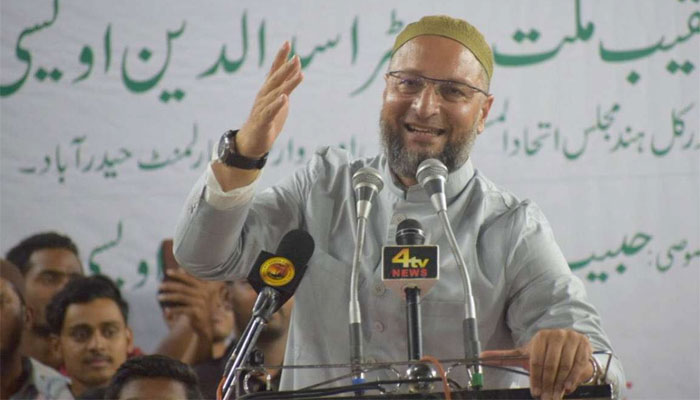
On May 13, the results of the Uttar Pradesh Urban Local Bodies elections were announced. While Bharatiya Janata Party (BJP) won the maximum number of seats, All India Majlis-e-Ittehadul Muslimeen (AIMIM) registered a total of 83 wins. The Party led by Hyderabad MP Asaduddin Owaisi now has five chairmen in UP Nagar Palika Parishad and 75 councillors in municipal corporations.

The Party has won Nagar Palika Parishad seats in Sambhal, Sikardra Rao in Hathras, Ghatampur in Kanpur, Kundarki Nagar Panchayat in Moradabad and Thiria Nizawat Khan Nagar Panchayat in Bareilly.

Though all except Meerut candidates for Mayor elections lost deposits, it is notable that in Meerut AIMIM candidate secured the second position in terms of votes. BJP’s Harikan Ahluwalia won the Meerut seat with over 2.3 lakh votes, while AIMIM’s Mohammed Anas got around 1.2 lakh votes. Analysing the results, it appears that Muslim voters’ consolidation worked in favour of AIMIM and went against Samajwadi Party and Congress in several districts.

Speaking to Indian Express, Anas said, “The Samajwadi Party, which had always been labelling the AIMIM as the BJP’s B team, is, in fact, playing the second fiddle to the lotus party. And it was because of the SP that our candidates could not defeat their BJP counterparts at a majority of seats in the Urban Local Body polls in the state.”

A senior SP leader said it should be a wake-up call for the party leadership. He said, “In the previous ULB polls, the AIMIM could wrest only one seat of the chairman in Nagar Palika parishad, and 32 councillors were elected, but this time, the Party has not only improved its performance but also dealt a major blow to the SP. Our leadership should at least wake up from the slumber, or else we are near political obliteration by the next general elections in Uttar Pradesh.”

Muslim consolidation worked in Congress’s favour in Karnataka

In the recent Karnataka elections, Muslim voters consolidated that resulted in a thumping victory for the Congress party. Notably, the election campaign witnessed dangerous levels of polarisation, with the opposition parties raking up the issue of hijab as well as the Congress party promising to ban the Hindu activist group, Bajrang Dal; it is worth analysing how polarisation helped Congress to consolidate Muslim voters and divide Hindu votes to emerge as victorious in the assembly polls.

The analysis of the electoral results hints that Muslims rallied behind the Congress party, possibly to secure their religious interests, and voted en masse for the candidates fielded by the grand old Party. However, by contrast, the Hindus voted largely based on individual loyalties and local issues, with religion being the least of the concerns, as witnessed by the lack of reverse mobilisation to counter Muslim consolidation and the division of its votes among Congress, JDS, and the BJP.

Furthermore, SDPI had clearly stated their intention of campaigning for Congress in the Karnataka elections, thus rallying more hardliner Muslims behind Congress.

Uttar Pradesh: Computer instructor Mohammad Ali arrested for molesting 12 minor students, his assistant and school headmaster also booked

The Uttar Pradesh police on Sunday, May 14, arrested one Mohammad Ali, a computer teacher working in a junior school in a village in the Tilhar area of UP’s Shahjahanpur area. Ali has been accused of sexually assaulting as many as 12 minor students, including some Dalit students. The headmaster of the school and Ali’s assistant have also been booked in connection with the case.

“Around 12 girl students, including Dalits, studying in a junior government school in Tilhar police station area, were allegedly molested by computer instructor Mohammad Ali”, Circle Officer (Tilhar) Priyank Jain said, adding that a case has been filed and the matter is being investigated.

The issue came to the fore after one of the victims told her father about the harassment she was facing in school. She revealed how her computer teacher, Mohammad Ali, touched her and her classmates inappropriately during and after class hours.

After hearing this, the victim’s father along with other parents raided the school and recovered used condoms in the school’s toilet. The police were informed and a complaint was lodged against Mohammad Ali on Saturday (May 13).

The headmaster of the school Anil Kumar and the assistant teacher Sajia have also been booked in this connection. The duo was accused of not taking any action against the accused computer teacher and “aiding the behaviour of the accused”.

The police said that when some girls complained about this to Headmaster Kumar, he did not take any action.

The police booked the trio under sections of the Scheduled Castes and Scheduled Tribes (Prevention of Atrocities) Act, the IPC, and the POCSO (Protection of Children from Sexual Offences) Act.

Shahjahanpur Senior Superintendent of Police said, “The allegations are grave as all the girls are aged between 12 to 15 years and they had given their statements against the accused teacher. Circle officer of Tilhar, Priyank Jain, is carrying out the investigation. The accused has been sent to jail. We are also investigating the role of two other teachers.”

Basic Shiksha Adhikari (BSA) Kumar Gaurav said, “The head teacher and the assistant teacher have been suspended with immediate effect, and a departmental enquiry has been ordered against them. The teacher was sent to jail on Sunday after the statements of all the girls were recorded by police in the presence of their guardians.”

The BSA said that prima facie, the computer instructor seems to be at fault. He added that the matter is being investigated and strict action will be taken against those found guilty.

The Economist praises the Modi govt for reviving the banking sector, and exposes how the UPA-era policy of hiding losses proved disastrous

On Thursday (May 11), the British weekly newspaper The Economist praised the Modi government for reviving the banking sector in India and turning around its profitability.

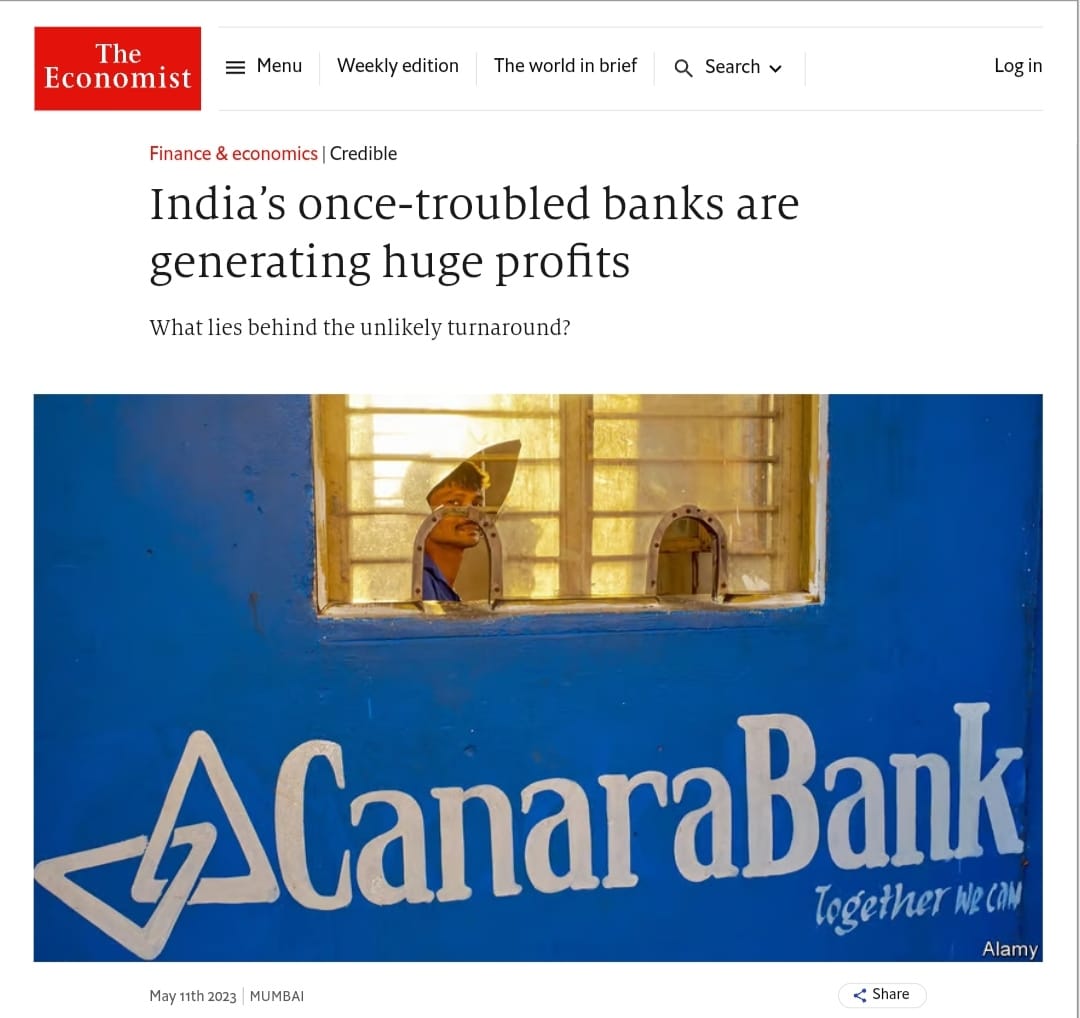
In an article titled ‘India’s once-troubled banks are generating huge profits’, it said, “…Indian banks’ recent annual earnings have been spectacular…India’s state-owned banks generate, on average, over 11% and private banks almost 15%. In a development few, if any, predicted, Indian banks are among the world’s most profitable.”

The Economist noted that the bankruptcy reforms [pdf] introduced by the Narendra Modi government in 2016 helped in the rapid liquidation of failing companies and also forced ‘delinquent businesses to pay up.’

The British newspaper pointed out that the merger of 27 nationalised banks into just 12 and capital infusion in the struggling banking sector paved the way for their revival.

“In 2019, as part of the seemingly endless mop-up of Indira Gandhi’s banking nationalisation half a century ago, the government announced that 27 state-owned banks would become 12, with many branches closing,” it said.

“According to Boston Consulting Group, state banks have also written off $91bn in bad loans in the past five years—just a little less than their combined worth. Many survived thanks to an infusion of 2.6trn rupees ($31bn) from the state, in return for shares, over the past three years. Such infusions have more recently been curtailed, as banks have learned how to stand on their own feet,” the article added.

The Economist emphasised that these measures introduced by the Modi government helped in the overall acceleration of Indian economic growth. “As the system has become healthier, banks have lent more. Annual credit growth slowed to 3% in 2017. It is now up to 18%. Interest rates have risen less sharply than in America, helping limit stress,” it said.

Indian banks showed improvement even during Covid-19 pandemic: Report

The British weekly newspaper also hailed the system of ‘asset-quality review’, which was introduced by former RBI governor Raghuram Rajan in 2015. While it led to failures and write-downs initially, the review proved beneficial 5 years down the line.

The Economist pointed out that Indian banks showed early signs of improvement during the Covid-19 pandemic, despite mass lockdowns. It stated, “Non-performing loans peaked at 16% of corporate lending in 2018. They have since fallen sharply. By early 2024, predicts Crisil, a ratings agency, they should drop below 2%.”

Screengrab of the news report by The Economist

The Economist slams UPA-era system of rolling over bad loans

The British weekly newspaper pointed out how the practice of ‘rolling over bad loans’ was rampant during the first half of the 2010s (aka the Congress-led UPA era).

“During the first half of the 2010s, Indian banks reported numbers that were strong—but unbelievably so. The practice of rolling over bad loans to avoid recognising losses was rampant, particularly with those made by state banks to borrowers with political connections,” it underlined.

The Economist stated, “Reality would have intruded eventually; an accelerant came in the form of scandals over the allocation of government licences in industries including coal, which concluded with the Supreme Court cancelling hundreds of mining permits in 2014, and telecoms, with the surprising exoneration of defendants in 2017. Approvals for projects froze, undermining their financial viability,” it observed.

Bihari Dalit worker’s lynching in Kerala: Mohd Afsal, Fasil, Sharafuddin, Habeeb, Zainul Abid among 9 arrested

Thirty-six-year-old Rajesh Manjhi, a Dalit migrant labourer from Bihar’s East Champaran district, was lynched to death on Saturday, May 13, in the Mallapuram district of Kerala. Following the murder, Kerala police arrested 9 individuals, Mohd Afsal, Fasil, Sharafuddin, Mehboob, Abdussamad, Nasar, Habeeb, Ayoob, and Zainul Abid, all hailing from Kizhissery in Mallapuram district.

The matter pertains to the Kondutty Police Station precinct in Mallapuram. The accused persons captured Manjhi from a house along the Kizhissery-Thavanur road on Saturday at around 1:00 am. The police learned about the incident at 3:25 am.

Out of the 9 arrested, 1 has been arrested for tampering with the evidence and deleting surveillance camera footage, police said on Sunday.

The victim Manjhi had only recently arrived in Kondotty, according to Kondotty ASP B V Vijaya Bharath Reddy, “The people detained claim that the migrant worker fell from the first floor of a house after a failed theft attempt.” The accused apprehended and attacked the boy for over an hour after he fell from the building.

The accused used pipes and wooden sticks to thrash Rajesh Manjhi, injuring him in the chest, ribs, and hips. Rajesh Manjhi’s body was found in Kizhissery on the night of May 12.

“The accused bound and assaulted the victim with sticks and plastic pipes. We have gathered evidence, including pictures, from the accused’s phones. They attempted to destroy evidence, including CCTV footage,” Malappuram district police chief Sujit Das said.

According to ASP Reddy, the police are verifying the house owner’s claim that the migrant worker fell from the building during a break-in attempt. ASP Reddy added that the family of the deceased migrant worker has been informed about his death. 

Further investigations into the case are currently underway.

Saurabh Rajvaidya becomes Mohammad Salim, forces wife to convert to Islam: Professor at Asaddudin Owaisi’s college and the chief of a terror group

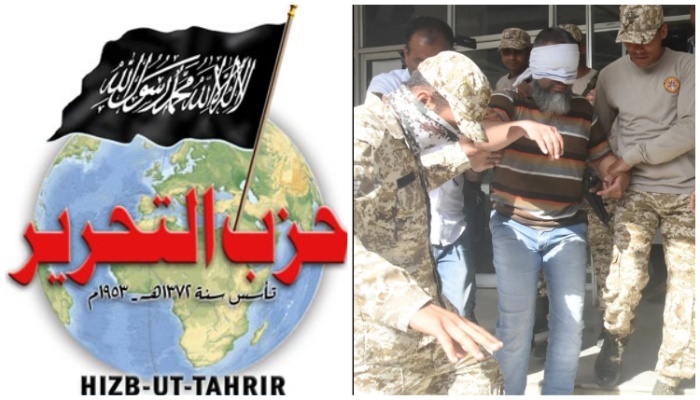
The Madhya Pradesh anti-terrorist squad (ATS) which recently dismantled a Hizb ut-Tahrir (HuT) module and apprehended 16 people from Madhya Pradesh and Telangana revealed that as many as 8 of these terrorists had converted to Islam. There are three arrested from Bhopal who married Hindu girls and later forced them to convert to Islam.

The arrested chief of this module, Mohammad Salim aka Saurabh Rajvaidya was a professor at Asaduddin Owaisi-owned Deccan Medical College in Hyderabad. While some reports identify him as ‘Saurabh Rajvaidya’, a report in the Dainik Bhaskar identifies him as Saurabh Rajvaidya Jain.

ATS asserted that the organization’s strategy was to identify susceptible and vulnerable non-Muslims and influence them to convert to Islam by brainwashing them with provocative speeches and lectures. They intended to foment terrorism and wage war against the country.

According to reports, ATS sources revealed that Yasin Khan, who was apprehended in Bhopal and Mohammad Salim who was arrested from Hyderabad were believed to be heading this group. While Yasin Khan was working as a gym trainer in Bhopal, Salim, living in the Golconda area in Hyderabad was working as a professor in Asaduddin Owaisi-owned Deccan Medical College. Mohammad Salim originally hails from Berasia in Bhopal. His real name is Saurabh Rajvaidya. Saurabh got married in the year 2009.

In the year 2010, Saurabh converted to Islam. His parents and the community were against his conversion. Later, in 2012, Saurabh’s wife also embraced Islam. Saurabh aka Salim first tried to get a conversion certificate made in Bhopal but when his attempts failed he travelled to Maharashtra to procure the certificate. He later relocated to Hyderabad, where he worked as a professor in the Biotechnical Department of the Deccan College of Medical Sciences. Salim used to give provocative speeches and lectures to brainwash others to embrace Islam and join the terrorist organisation.

Likewise, two other arrested accused Abdul Rehman and Mohammad Abbas were also originally Hindus who were brainwashed into converting to Islam. Abdul Rehman, a resident of Odisha was Devi Prasad Panda before he converted to Islam. Similarly, Mohammad Abbas, a resident of Hyderabad was Bux Venu Kumar before he embraced Islam.

Accused Yasir Khan and two others forced their Hindu wives to embrace Islam: ATS

According to ATS sources, Shahjahanabad-based gym instructor Yasir Khan got married to a Hindu woman. After that, he forced her to adopt Islam. Likewise, two other arrested Hizb ut-Tahrir members had also forced their respective wives to convert from Hinduism to Islam.

The ATS team meanwhile have taken some of the arrested accused, namely Mohammad Salim, Abdul Rahman, Mohammad Abbas Ali, Sheikh Junaid and Mohammad Hamid to Hyderabad. The team would be conducting raids and the terrorist’s other hideouts based on the information provided by the arrested youths.

BJP accuses AIMIM chief Asaduddin Owaisi of sheltering terrorists in Hyderabad

Expressing concerns that arrested Mohammad Salim was working as a professor in the Biotechnical Department of the Deccan College of Medical Sciences owned by AIMIM party chief Asaduddin Owaisi, Telangana BJP president Bandi Sanjay Kumar said that Hyderabad has become a shelter for terrorists with the Majlis party providing support as one of the arrested Hizb ut-Tahrir (HuT) activists turning out to be an employee of Owaisi hospital.

“What we have always been stating and feared is turning out to be true with the latest arrest of the most dangerous terrorists. Earlier, Majlis leader Asaduddin Owaisi had offered to help those living illegally, like Rohingyas, when they were arrested. He has gone a step further by providing shelter to terrorists from Pakistan and Bangladesh,” said Sanjay while addressing the media in BJP’s state office on May 10, a day after Madhya Pradesh busted the HuT module are arrested 16 individuals having links with the radical organisation.

Deccan College of Medical Science(DCMS) is a medical school situated in Hyderabad. DCMS is established and administered by Muslim Minority Trust, i.e., Dar-us-salam Educational Trust under the provision of Article 30(1) of the constitution of India. Dar-us-Salam Educational Trust is an autonomous body with Asaduddin Owaisi as its chairman. In fact, in February 2014, Owaisi had taken to Facebook to promote the college.

Meanwhile, National Investigation Agency (NIA) is set to take over the investigation of the recently busted Bhopal-Hyderabad module of the radical Islamic organization Hizb-ut-Tahrir (HuT).

The Madhya Pradesh ATS and IB had initiated the probe, but the case has interstate and international ramifications, necessitating the involvement of NIA, officials have revealed.

On May 9, in a joint operation with the Intelligence Bureau and the Telangana Police, the Madhya Pradesh anti-terrorist squad (ATS) conducted early-morning raids and seized five individuals with links to Hizb ut-Tahrir (HuT) in Hyderabad and 11 from two cities in Madhya Pradesh.

Hindi daily Bhaskar has quoted sources as saying that the son of a Bhopal gas tragedy activist is also included in those taken into custody.

The offenders were employed as teachers, fitness instructors, computer technicians, tailors, vehicle drivers, and labourers, among other occupations.

According to the police, the perpetrators’ possessions included radical literature, laptops, pen drives, hard drives, money, and other items.

The apprehended men were secretly practising shooting and receiving combat training at camps in remote jungle locations, where jihadi material was also passed out and provocative speeches were delivered during private religious gatherings.

The MP Police has registered a case against the accused under sections 13, 17 and 18 of the Unlawful Activities (Prevention) Act, 1967, and other relevant sections. They have been remanded to ATS custody until May 19 by a special court.

Hizb ut-Tahrir

Hizb ut-Tahrir is an international pan-Islamist and fundamentalist political organization whose stated aim is the re-establishment of the Islamic caliphate to unite the Muslim community and implement sharia globally. The group’s aim is to unify all Muslim countries to form an Islamic state or caliphate. After establishing the Islamic State, they plan to expand the caliphate into non-Muslim areas, through “invitation” and through military jihad.

HuT has managed to extend its doctrine and support base to at least 50 nations. The outfit has been training its cadres in chemical and biological warfare while evading international inspection. The group is banned in 16 countries.

The HuT was last active in India in 2010, but recent information on its expansion plans in the country, particularly in Madhya Pradesh, where it has been covertly recruiting and training members, was provided by international security agencies.

Young individuals eager to give their lives for the cause of Islamism were known to be identified and recruited by the accused. They exchanged messages using a variety of encrypted applications, including Threema, Rocket Chat, and other programmes that are akin to those used by ISIS and other terrorist organisations on the dark web.


George Soros-funded Vice Media files for bankruptcy to facilitate sale

Vice and Motherboard, the websites known for their unique content, are facing financial difficulties and have initiated bankruptcy proceedings in the United States. As part of the restructuring process, the company is expected to be acquired by a consortium of its lenders.

Vice Media Group, formerly valued at $5.7 billion, is now facing the possibility of being acquired for $225 million. Despite this financial setback, the youth-focused digital publisher has confirmed that it will continue its operations uninterrupted throughout the bankruptcy proceedings.

The company expressed optimism and stated that it anticipates emerging as a financially robust and more resilient organization within a span of two to three months.

Originally established in 1994 as Voice of Montreal, a niche magazine by Shane Smith, Gavin McInnes, and Suroosh Alvi, Vice has grown significantly and currently operates in over 30 countries.

Vice enthralled its audience with its daring, youth-centric content across a wide range of mediums, including print, events, music, online platforms, television, and feature films.

Among the investors backing Vice Media Group are Fortress Investment Group, Monroe Capital, and Soros Fund Management. The latter is the investment firm established by renowned fund manager and billionaire George Soros.

To ensure the continuity of Vice Media throughout the bankruptcy process, the lenders have granted approval for $20 million in funding. Meanwhile, the company has opened the opportunity for other firms to submit “higher or better” bids, providing the possibility of alternative offers for the media company.

In the event that alternative offers do not succeed, Vice Media’s lenders will proceed with the acquisition of the publisher for $225 million.

Over the past few years, the company has faced stagnant revenues and challenges in achieving profitability.

Additionally, Vice’s attempts to go public through a merger were unsuccessful.Recently, the company faced setbacks, including the discontinuation of its flagship TV program, leading to announced layoffs last month.

In a parallel development, BuzzFeed, another online platform, has recently revealed plans to shut down its news division and initiate layoffs affecting 15% of its workforce. These actions come as a response to significant financial difficulties and a decline in advertising revenue experienced by the company.

From Bihar, Karnataka to Kashmir and role of converted Muslims: ‘The Kerala Story’ and its ISIS tentacles in several other states

Though there is a buzz about the film titled ‘The Kerala Story’, it does not only refer just to the topic of the film – love jihad and subsequently deploying victim women to ISIS – but it also refers to the way Kerala has become a new epicentre of terrorist recruitment in the Indian peninsula. The Kerala Story here essentially implies to the Kerala ISIS module.

The Kerala ISIS module busted by NIA has so far unfolded multiple layers of the story showing connections with other states in India. This shows how Islamic jihad and terrorism it inspires are not a problem of a particular territory but they seed, root, spread, operate, and destruct defying the limitations of borders between different states and nations. Islamists may be divided by borders, but they are united by the ideology behind jihad.

Story of Yasmin Ahmed Jahid of Bihar

Yasmin Ahmed Jahid hails from Muroul village in Sitamarhi in Bihar. According to some reports, she was married to Syed Ahmed and both lived in Saudi Arabia. In 2011, they came to Kerala. Yasmin Ahmed Jahid started living in Malappuram which was already a hotbed of forced Islamic conversions with the intent of jihad. In Malappuram, Yasmin Ahmed Jahid started to work as an English teacher. She joined the ‘Peace International School’.

This Peace International School has 12 branches in India. It also had a branch in Dhaka of Bangladesh. That branch was shut down after people associated with the school were suspected to be involved in the Dhaka bomb blast that took place on 1st July 2016. This Peace International School is inspired by Dr Zakir Naik’s Islamic International School. The fugitive preacher used to run this school in the Mazgaon area of Mumbai. MM Akbar founded this Peace International School in 2006 under Niche Group, an independent religious body aiming to propagate Islam. This school has 10 franchises in Kerala and one each in Karnataka and Tamil Nadu. These schools had classes up to 12th standard and according to a report in 2016, the number of enrolled students was over 7000.

On 3rd May 2016, Yasmin Ahmed Jahid married Abdul Rashid Abdulla. This marriage was solemnized on a phone call. This is the same Abdul Rashid Abdulla who lured an engineering graduate Sonia Sebastian. Sonia converted to Islam for marriage. She became Ayisha. This couple used to conduct the coaching classes of Islamic Jihad in Kerala. Yasmin not only attended these classes but also brought in other students aspiring to become ISIS terrorists.

During interrogation in 2016, Yasmin revealed that till then she had recruited into ISIS 22 people from Kerala, including six women and three children. Many areas of Afghanistan were under the control of ISIS, where these people were sent. She had claimed that Abdul Rashid had brainwashed 40 youths in Kerala by then. Yasmin herself used to attend the religious classes of Abdul Rashid and his wife Ayisha. There she was taught about ‘Hijr’, ‘Jihad’ and ISIS.

Abdul also used to send money to Yasmin, from which she used to arrange air tickets for Afghanistan. Yasmin was accused of recruiting 15 people from the Kasaragod district alone to the terrorist organization ISIS. The Kerala Police had initially taken it as a missing complaint, but the real case was revealed after the NIA investigation.

During interrogation, Yasmin Ahmed Jahid informed that people from Kerala were recruited to ISIS and sent to Kuwait, Dubai, Muscat and Abu Dhabi from Bengaluru, Hyderabad and Mumbai airports. From there they were sent to Afghanistan via Iran. This revelation was about the same ISIS recruitment case of 2016 in Kerala in which 21 Indians were sent to Iran and Afghanistan to join ISIS.

This group included the four women terrorists who urged the Indian government to come back to India after surrendering in Afghanistan but were denied entry into India by the Union government due to their ISIS-related past. The detailed story can be read here. Abdul Rashid Abdulla had also gone in this group with his wife Sonia Sebastian alias Ayisha.

Abdul Rashid would call Yasmin through Telegram. These terrorists were aiming to establish a caliphate in support of ISIS leader Abu Bakr al-Baghdadi. In July 2016, Rashid told her that the men he had sent had reached ISIS territory in Afghanistan. Rashid had made an ATM card in the name of his first wife Ayisha and gave it to Yasmin. In mid-July 2016, Rs 1.5 lakh was also sent to her. Some of the people recruited by him to ISIS were even killed while fighting for the terrorist organization.

Yasmin Ahmed Jahid was arrested from the New Delhi International Airport on July 30, 2016, while trying to escape to Kabul, the capital of Afghanistan, with her minor child. On 24th March 2018, the NIA Court in Kochi awarded seven years of rigorous imprisonment to her. She was 30 years old when the court awarded her the sentence. Yasmin was also handed a Rs 25,000 fine.

NIA Judge S Santhosh Kumar said, “Considering the nature and circumstances of the case, the court doesn’t find any reason to invoke the Probation of Offenders Act. At the time of arrest, the son of the accused was with her and now he is in the custody of his father. However, considering the fact that the accused is a lady aged about 30 years, a lenient view is taken.”

The Kashmir and Karnataka Connection of the Kerala Story

As part of the investigation into the Kerala-ISIS module case, on 4th August 2021, the National Investigation Agency (NIA) conducted raids at five different locations across Jammu and Kashmir, Karnataka, and Kerala. The purpose of these raids was to gather more evidence and information related to the case.

During the operation, the NIA apprehended four individuals: Obaid Hamid from Bemina in Srinagar, Muzammil Hassan Bhat from Bandipora in Kashmir, Ammar Abdul Rahman from Ullal Mangalore, and Shankar Venkatesh Perumal, also known as Ali Muaviya, from Bangalore. This Shankar Venkatesh Perumal alias Ali Muaviya is an important character in the male version of the real-life Kerala Story.

Besides, similar ISIS modules have also been identified and busted in states like Maharashtra and Madhya Pradesh which indicates that the terrorists do not recognize the borders of states and nations. All they recognize is Jihad while walking on the path of their religiously motivated terrorist ideology. Anyone subscribing to it, however unknown in their prior life, is a friend to them. Anyone except those who believe in that ideology is a foe for them.

Conclusion

National integrity, interests of mutual prosperity, and civilizational identity usually motivate persons from different states to come together and initiate an activity. In a large country like India where there are so many different cultures, languages, regions, etc. people come together for these reasons and perform in unison to achieve better. But pan-Islamism is one such concept that defies even international borders and inspires religiously motivated Muslims from one nation to take a stand for a similar lot in other nations.

This is why the Kerala module of ISIS readily attracted Muslims from other parts of the country. This is why Muslims staged violent protests in Azad Maidan in 2012 to stand in solidarity with some so-called religiously persecuted Muslims of Myanmar. This is why an attacker attacked Salman Rushdie in the USA to comply with a Fatwa issued in Iran against the writer even before the attacker was born, proving that this pan-Islamism also transcends time. Thus, for countering this religiously motivated terrorist ideology it is necessary to first understand how Islamic terrorism seeds, roots, spreads, operates and finally destructs beyond the borders.