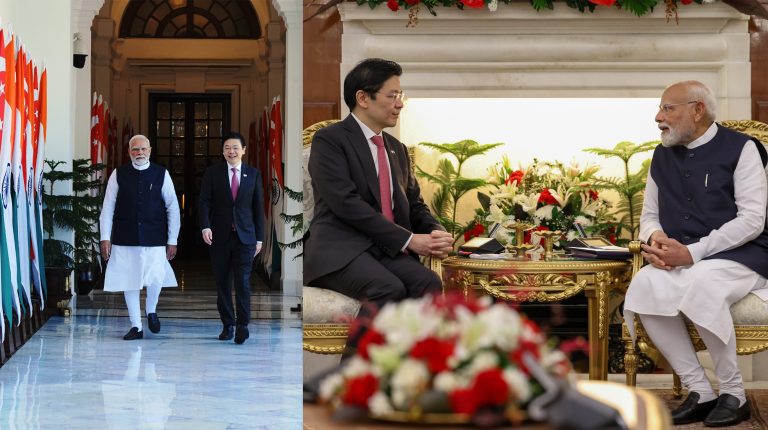
Marking the 60th anniversary of diplomatic relations between India and Singapore, Prime Minister Narendra Modi hosted Singapore PM Lawrence Wong in New Delhi today. The visit, Wong’s first official trip to India as prime minister, resulted in a comprehensive roadmap aimed at deepening cooperation between the two nations across multiple sectors, underscoring the strength of what both leaders called an enduring and forward-looking partnership.
Lawrence Wong arrived in India on 2nd September, and had meetings with several union ministers and NSA Ajit Doval. He also had a meeting with business leaders from the CII Core Group on Wednesday.
At the joint press conference, PM Modi described Singapore as a pillar of India’s Act East policy and a trusted partner whose role extended far beyond diplomacy. He said that after his Singapore visit last year, the ties were elevated to the level of Comprehensive Strategic Partnership. In the course of this year, our dialogue and cooperation have gained both momentum and depth.
PM Modi said, “Today, in the South East Asian region, Singapore stands as our largest trading partner. Singapore has made substantial investments in India. Our defense ties continue to grow stronger, and our people-to-people relations are both deep and vibrant.”
He announced that in order to further accelerate our bilateral trade, a time-bound review will be undertaken of the Comprehensive Economic Cooperation Agreement, as well as India’s Free Trade Agreement with ASEAN. PM Modi added that Indian states will also play an important role in strengthening the bonds between India and Singapore.
India is delighted to welcome Prime Minister Wong. This visit is special because it is his first visit to India after assuming office as Singapore’s PM and it comes at a time when our nations mark 60 years of diplomatic relations. Our talks covered ways to deepen the… pic.twitter.com/uZfVfpwDAH
He said, “Over the past year, the Chief Ministers of Odisha, Telangana, Assam, and Andhra Pradesh have visited Singapore. Gujarat’s GIFT City has now emerged as yet another link, connecting our stock markets.”
“India-Singapore relations go far beyond diplomacy. They are rooted in shared values, guided by mutual interests, and driven by a common vision for peace, progress and prosperity,” he said, noting that Singapore is not only India’s largest trading partner in Southeast Asia but also the biggest source of foreign direct investment.
He underlined the importance of strengthening defence ties, people-to-people contacts, and economic cooperation as the two countries prepare to navigate the challenges of a rapidly changing global landscape.
Prime Minister Wong expressed gratitude for the warm welcome extended to him and called the trip an opportunity to celebrate six decades of “close and enduring friendship.” He stressed Singapore’s commitment to working with India on future-oriented areas of cooperation, highlighting the city-state’s contribution to India’s growth story as a major investor and partner in infrastructure, digital technology and financial integration.
Wong pointed out that roughly a quarter of India’s foreign direct investment inflows in recent years had originated from Singapore, reflecting the scale of economic engagement.
The two leaders announced a series of agreements and initiatives that will define the next phase of the Comprehensive Strategic Partnership. They agreed on a time-bound review of the Comprehensive Economic Cooperation Agreement and regional trade mechanisms, while also unveiling plans to develop sustainable, next-generation industrial parks and expand collaboration in the semiconductor sector through joint research, supply chain integration and skills development.
Met with PM @narendramodi today. Together, we launched an ambitious Roadmap for the SG–India Comprehensive Strategic Partnership, charting cooperation in advanced manufacturing, semiconductors, sustainability, and emerging areas such as digitalisation, AI and space. pic.twitter.com/KUZrJMQyYf
Singapore will also partner with India’s new National Centre of Excellence in Chennai to train workers for advanced manufacturing, aviation maintenance and electronics, ensuring both countries’ workforces are equipped for the industries of the future.
Connectivity emerged as another major theme, with the two sides signing a civil aviation agreement to boost training and research while also inaugurating Phase II of the PSA-operated Bharat Mumbai Container Terminal, India’s largest standalone container port facility. They also committed to greater cooperation between their central banks on digital asset innovation and regulatory frameworks, reflecting the central role of financial technology in bilateral ties.
Maritime and space collaboration added further depth to the agenda. India and Singapore launched a Green and Digital Shipping Corridor to promote environmentally sustainable shipping, digital port processes and cleaner marine fuels. A new agreement between their space agencies was also concluded, covering satellite communication, Earth observation and the exploration of emerging space technologies. The leaders additionally pledged to advance joint efforts in artificial intelligence, quantum computing and other frontier digital fields, while continuing youth exchanges through initiatives like the India-Singapore Hackathon.
During his India visit, Prime Minister Wong paid homage at Raj Ghat, met with President Droupadi Murmu, and joined a banquet hosted by Prime Minister Modi.
Looking ahead, the two countries agreed to institutionalize an annual India-Singapore Ministerial Roundtable to track the progress of new initiatives and ensure implementation of the roadmap. Both leaders concluded that the visit not only celebrated six decades of friendship but also laid a strong foundation for the decades ahead, with a partnership that they hope will remain resilient, innovative and deeply people-centric.
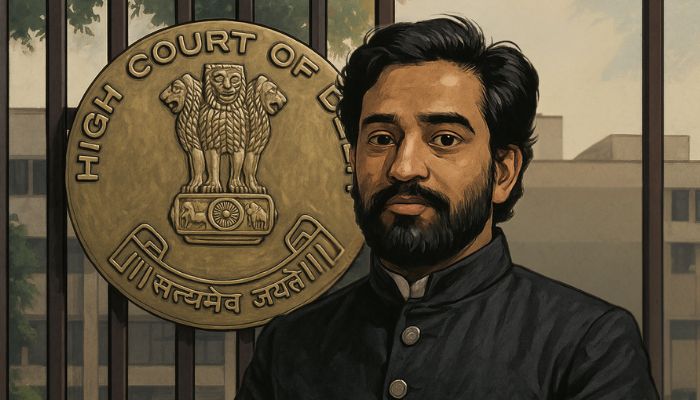
On 2nd September, the Delhi High Court dismissed the bail plea of Tasleem Ahmed, an accused in the 2020 North-East Delhi riots conspiracy case. The Court stressed that the very delays cited by him were the result of adjournments repeatedly sought by co-accused, many of whom are already on bail.
Defence cites five years in custody and right to speedy trial
During the hearing, Ahmed’s counsel argued that he has been in custody since 19th June 2020 and completed over five years as an undertrial without the trial itself commencing. His counsel contended that this amounted to a violation of Article 21 of the Constitution of India that guarantees the right to life and liberty, including the right to a speedy trial.
The defence highlighted that the prosecution had indicated plans to examine hundreds of witnesses, and with the trial still at the stage of arguments on charge, there was no foreseeable end in sight. They relied on the Supreme Court’s ruling in KA Najeeb to say that prolonged incarceration, even under the stringent UAPA, could be a ground for bail. The argument was that liberty cannot be indefinitely curtailed simply because the allegations are serious. The defence therefore pressed that the sheer length of custody should tilt the balance in favour of release on bail.
Prosecution blamed co-accused for dragging the proceedings
The Solicitor General, supported by the Special Public Prosecutor, firmly rejected this reasoning. They argued that while long custody may in rare cases justify bail, the facts of this case did not allow such relief. The prosecution placed on record the trial court’s proceedings to show how arguments on charge were repeatedly stalled at the request of the accused themselves.
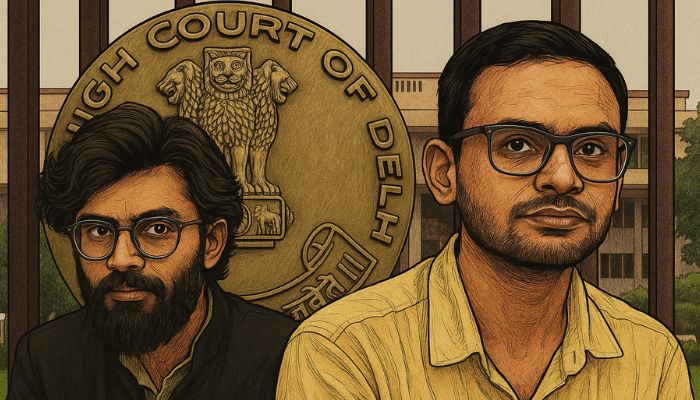
According to the prosecution, adjournments were sought on multiple occasions by co-accused such as Devangana Kalita, Natasha Narwal and Asif Iqbal Tanha, all of whom are already out on bail. Furthermore, even those who are in custody, like Umar Khalid and Sharjeel Imam, sought adjournments. The trial court had noted that the requests directly delayed progress and those still in custody now sought to use the delay as a ground for bail.
It was contended that this was an attempt to game the system. The prosecution pointed out that KA Najeeb does not apply where delay is self-inflicted. The prosecution urged the court not to permit a situation where the accused deliberately prolonged trial proceedings on one hand and on the other hand, argued for bail on the ground of those very delays.
Court noted ‘systematic delay’ caused by accused
The Bench of Justices Subramonium Prasad and Harish Vaidyanathan Shankar agreed with the prosecution. After examining the trial court record, it noted that adjournments had been sought again and again by the accused, despite earlier consensus to proceed with arguments. The trial court itself had recorded its “distress” over this behaviour on 4th October 2024.
The High Court observed, “the inordinate delay in trial, as alleged by the Appellant herein, is not due to the inaction of the Respondent Agency or the Trial Court… the accused themselves have been responsible for delaying the trial.”
The judges went further, warning against misuse of constitutional guarantees, “Speedy trial is a fundamental right. But to ask for bail after there has been systematic delay in trial on the part of the accused is not acceptable, and if it is done, then the statute which restricts the grant of bail on the ground of delay in trial can easily be circumvented by delaying the trial on the one hand and by pressing bail applications on the other.”
The Bench concluded that the delay argument in Ahmed’s case could not hold, since he himself began pressing his arguments on charge only in April 2025, well after filing the present appeal.
UAPA’s tough bail bar emphasised
The court also underlined the legal standard under Section 43D(5) of the UAPA, which bars bail if accusations appear “prima facie true”. Citing the Supreme Court’s Watali precedent, the Bench reiterated that bail under UAPA is an exception, not the rule. The court stressed that while liberty is important, it cannot override the gravity of offences linked to terrorism and conspiracy against the State. Long custody by itself, absent other factors, was insufficient to justify release.
Case background
Tasleem Ahmed was named as Accused No 12 in FIR 59/2020, the principal case alleging a larger conspiracy behind the February 2020 riots in Delhi. He is charged under multiple sections of the IPC, the Arms Act, the Prevention of Damage to Public Property Act, and UAPA provisions relating to terrorism and conspiracy.
The prosecution alleges that the riots were not spontaneous but a “deep-rooted conspiracy” to coincide with the visit of the then US President, resulting in the deaths of 53 people, injuries to scores of police officers and civilians, and widespread destruction of property. Ahmed is among several accused, including student activists, local politicians, and organisers of protest sites, whom the police say played different roles in the conspiracy.
By rejecting Ahmed’s plea, the High Court drew a sharp line: while the right to a speedy trial is sacrosanct, it cannot be turned into a loophole by those accused of delaying proceedings themselves.
On 2nd September, the Delhi High Court denied bail to Umar Khalid, Sharjeel Imam and others in the 2020 northeast anti-Hindu Delhi riots larger conspiracy case. The decision was based on three decisive reasons that are the gravity of the offence, inability to prove parity and delay engineered by the co-accused, both those in jail and those who are out on bail, in front of the Trial Court.
While parity was discussed in our previous report, it is essential to discuss the gravity of the offence, forum shopping by Kapil Sibal in the Supreme Court of India and delay designed by the co-accused as pointed out by the Delhi High Court while rejecting the bail plea of Tasleem Ahmed. The bench stressed gravity under Section 43D(5) and rejected parity; separately, as the High Court explained in Tasleem Ahmed, the trial delays were largely of the accused camp’s making.
Defence claimed Khalid and Imam were engaged only in ‘lawful dissent’
During the arguments, the defence teams of both Umar Khalid and Sharjeel Imam argued in front of the Delhi High Court that they were engaged only in lawful dissent and peaceful protests. They maintained that there was no evidence that could place them at the scene where the riots broke or at the meetings where the violence was directly plotted.
In Umar Khalid’s case, the defence claimed that his Amravati speech of 17th February 2020 called for “peaceful, Gandhian methods”, and no explicit incitement to violence was made. Sharjeel Imam’s counsels emphasised that he was already detained by the police and remained in custody from 28th January 2020, weeks before the main riots. Therefore, he could not be linked to their planning or execution. They also challenged the reliability of protected witnesses and called their statements “concocted, coerced and repetitive”.
The defence further argued that even if some of the material was accepted at face value, it would only fall under Section 13 of UAPA and not the graver Chapter IV terrorist offences that invoked the strict bar under Section 43D(5). They relied on precedents such as KA Najeeb to argue that bail can be granted when incarceration is prolonged and the trial shows no end in sight.
Prosecution counter
The Solicitor General and Special Public Prosecutor opposed these submissions firmly. They argued that the conspiracy was neither accidental nor spontaneous but “well-orchestrated and strategically timed to coincide with the State visit of the President of the USA”.
They pointed to the formation of multiple WhatsApp groups by Imam and Khalid after the Citizen Amendment Bill (CAB) was passed in December 2019. The circulation of pamphlets openly calling for disruption and a sequence of speeches urging chakka-jams and violence escalation were also mentioned.
According to the State, Khalid was a “veteran of sedition” who had instructed Imam to mobilise universities and Muslim-dominated neighbourhoods. Imam’s own pamphlet, distributed on 13th December 2019, explicitly spoke of Muslims being disenfranchised and called for disruptive chakka-jams, stating “Thousands of Muslim youths are ready to disrupt Delhi which will give international media attention to our issues”.
The State further relied on multiple protected witnesses who testified that the two appellants portrayed the government as “anti-Muslim” and urged protestors to “spill blood” to make the government bend.
Court’s observations
In the judgment, the Division Bench of Justice Navin Chawla and Shalinder Kaur reaffirmed earlier findings that the accusations against Khalid and Imam were prima facie true. The judgment emphasised that “Prima facie it appears that the Appellants were the first ones to act after the CAB was passed in early December 2019, by creating WhatsApp groups and distributing pamphlets… including the disruption of essential supplies”.
Furthermore, the judgment categorically pointed out that the alleged “inflammatory and provocative speeches delivered by the Appellants, when considered in totality” prima facie indicate towards their “role in the alleged conspiracy”.
On Imam’s claim of being in custody before the riots and Khalid’s absence from the riot sites, the judgment stated that it is irrelevant whether the appellant was “physically present at the protest sites or in meeting post 28.01.2020”. The Court noted that mere absence “may not be sufficient to mitigate their role, as they have been alleged to be the key conspirators in planning and designing the scheme of events”.
The judgment also invoked Section 43D(5) of UAPA, reminding that once accusations appear prima facie true, the embargo on bail squarely applies.
Forum shopping and Kapil Sibal’s role in delaying bail
During the hearing at the Delhi High Court, Khalid’s team argued that his long incarceration was partly due to delays in the Supreme Court hearing his Special Leave Petition (SLP) after the Delhi High Court’s October 2022 denial of bail. They claimed that the repeated adjournments and the eventual withdrawal of the SLP in February 2023 were forced by the slow pace of the proceedings and changes in circumstances. At that time, senior advocate Kapil Sibal told the Bench at the Supreme Court that Khalid would “try his luck in the trial court” given this change.
The defence presented this narrative to the trial court and later to the High Court as evidence that Khalid was not responsible for the delay, but rather a victim of systematic adjournments. They argued that this justified bail, particularly when the trial itself had yet to conclude.
Prosecution counter
The defence’s argument was dismantled by the prosecution with dates and facts. Special Public Prosecutor Amit Prasad highlighted that seven of the fourteen adjournments in 2023–24 were at the request of Khalid’s side itself. Far from being a victim of delay, Khalid was gaming the system by seeking adjournments strategically, prosecutors argued.
It was also pointed out that after the High Court rejected his bail plea in October 2022, Khalid waited for almost six months before approaching the Supreme Court in April 2023. The question raised was, if he was genuinely aggrieved by the delay, why wait so long?
The withdrawal of the SLP was not about delay but about forum shopping. From October 2022 to February 2024, Khalid’s counsel Kapil Sibal had sought repeated adjournments and then pulled out when it became clear that the judicial climate was not in favour of his client. Furthermore, Khalid’s counsel claimed “change in circumstances” as one of the reasons behind withdrawing the bail plea from the Supreme Court. This so-called change in circumstances coincided with two developments. Firstly, a change in the Bench after Justice Aniruddha Bose stepped down, and cases were listed before Justice Bela Trivedi. Khalid’s lawyers resisted this and sought repeated de-tagging and relisting.
Secondly, a change in law after a Supreme Court ruling in January 2024 in the Gurwinder Singh case under UAPA clarified that in such cases, “jail is the norm and bail the exception”, explicitly endorsing the Watali precedent where the Supreme Court had said that the court would not satisfy the prima facie test unless there is at least a surface analysis of the probative value of the evidence at the stage of examining the question of deciding the bail.
With these clarifications, the defence’s argument that “bail is the norm” was untenable. Thus, the withdrawal before Justice Trivedi and Justice Pankaj Mithal was seen less as necessity and more as a tactic, trying one court, then another, hoping for a favourable bench.
Court’s observations
In its 2nd September 2025 judgment, the Delhi High Court revisited the long bail saga of Umar Khalid. The Bench recalled that his bail application had been rejected by the High Court in October 2022, where the Court, after examining the material, had already found a prima facie case made out against him. The judges emphasised that the arguments advanced before them now had already been raised and considered earlier, and that the earlier conclusion continued to hold good.
The judgment also noted that Khalid had preferred a Special Leave Petition before the Supreme Court, which was later withdrawn upon his counsel’s request on account of what they described as a “change in circumstances”. After this withdrawal, he filed a fresh bail plea before the trial court, again relying on delay and alleged changes in law as grounds.
While the judgment did not explicitly state that the withdrawal of the SLP had no bearing on the earlier finding, its reasoning made that effect clear. By affirming once more that the case against Khalid was prima facie true, the High Court indicated that shifting forums or citing supposed changes in circumstances could not undo the substance of its earlier conclusion.
In practical terms, Khalid could not delay hearings through adjournments and withdrawals and then rely on the resulting passage of time as justification for bail. The strategy of forum shopping, far from helping him, only weakened his claim that his prolonged custody was unfair.
Delays engineered by co-accused outside jail
While seeking bail, the defence repeatedly leaned on Article 21 and the right to a speedy trial. They cited KA Najeeb and other rulings to argue that five years of incarceration without conclusion of trial was excessive. They highlighted that charges were not yet framed and 700 witnesses were to be examined. “There is no likelihood of the trial being concluded in the foreseeable future,” the defence submitted, urging that this delay must tilt the balance in Khalid’s favour.
The prosecution, however, pushed back and cited trial records. In Tasleem Ahmed’s judgment, it was noted that on 5th August 2023, compliance under Section 207 CrPC was completed and the trial court ordered day-to-day hearings on charge from 11th September 2023. But when the day arrived, accused out on bail, Devangana Kalita, Natasha Narwal and others, objected, claiming the investigation was still open.
In the Trial Court’s summary it was stated that, “Despite giving considerable period of time for starting the arguments on charge, no adjournment application was moved on time… the accused persons will later claim bail on the ground of delay in trial.” Within a week, on 18th September 2023, a larger group including Meeran Haider, Athar Khan, Khalid Saifi, Faizan Khan, Ishrat Jahan, Sharjeel Imam, Safoora Zargar, Saleem Malik, Shifa-ur-Rehman, Shadab Ahmad and Gulfisha Fatima also sought deferment. This meant that even though the prosecution was ready to argue charges, the defence deliberately blocked the process.
The prosecution stressed that some accused, including Umar Khalid himself and Tahir Hussain, had actually said they were ready to proceed on 18th September 2023. But the applications filed by Devangana and Natasha derailed the process.
Both the Sessions Court in May 2024 rejecting Khalid’s bail and the Delhi High Court in September 2025 noted that the delay narrative was hollow. The Tasleem Ahmed judgment, which came out the same day, put the issue beyond doubt by reproducing trial court order sheets. On 11th September 2023 and 18th September 2023, objections were raised by Devangana Kalita and Natasha Narwal, among others, stalling arguments on charge. From January to August 2024, “the accused who got bail were not permitting the argument on charge to commence on the ground that the investigation had not been completed”. On 4th October 2024, the trial court recorded its distress, “Despite a consensual schedule, none of the counsel is ready… any delay will be viewed by the court seriously”.
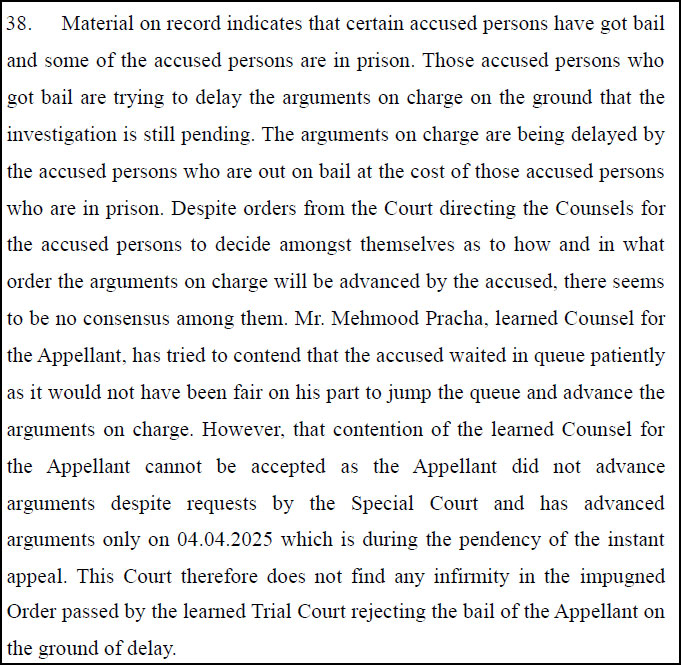
The High Court therefore concluded that it was the accused camp, especially those already on bail, who engineered delay. In Tasleem Ahmed’s case, the Court said, “Material on record indicates that certain accused persons have got bail and some of the accused persons are in prison. Those accused persons who got bail are trying to delay the arguments on charge on the ground that the investigation is still pending. The arguments on charge are being delayed by the accused persons who are out on bail at the cost of those accused persons who are in prison. Despite orders from the Court directing the counsels for the accused persons to decide amongst themselves as to how and in what order the arguments on charge will be advanced by the accused, there seems to be no consensus among them.”
Source: Delhi High Court
The larger strategy
The sequence of events exposes a deliberate pattern. Those on bail delayed proceedings by filing speculative applications questioning the investigation’s completeness. Those still in jail, like Umar Khalid, then sought to leverage that very delay as a ground for bail. The High Court refused to permit this circular logic and held that the bar under Section 43D(5) remained intact as the accusations were prima facie true.
The Central Board of Indirect Taxes and Customs (CBIC) has issued a clarification on the revised Goods and Services Tax (GST) applicable to popcorn, refuting reports that sugar-coated or caramel popcorns would be newly taxed at 18%. Earlier in the day, several reports had claimed that while popcorn mixed with salts and spices will be subject to 5% GST, Caramel popcorn will be taxed at 18%, which is the rate for sugar confectionery.
The reports said that Caramel popcorn will be taxed at 18%, as it contains sugar and falls under confectionery.
CBIC’s clarification came on X as a reply to a post by journalist Rajdeep Sardesai on the social media platform making the same claim. In a now deleted post, Sardesai wrote, “The POPCORN debate has been resolved at last! *Salted or spiced popcorn will now attract a uniform 5% GST, whether it’s sold loose or in pre-packaged form. *Caramel popcorn will be taxed at 18%. Bring on the salted popcorn folks!”
Responding to this post, CBIC stated that the new GST for sugar confectionary is also 5%, not 18%. Therefore, Caramel popcorn will be taxed at 5%.
The central board wrote, “Dear @sardesairajdeep All sugar confectionary items will now be taxed at 5%. Kindly refrain from sharing incorrect information.”
They added the link to the press releasing giving the list of new GST rates. The list shows that the GST for Sugar boiled confectionery has been reduced from 12% to 5%, and tax for Sugar confectionery is reduced from 18% to 5%. The list makes it clear that all items containing sugar will be now taxed at 5%, down from earlier 12% and 18% rates for various items.
Earlier, salted popcorn was taxed at 5% if sold loose and at 12% if it was sold in branded packaging. Caramel popcorn was taxed at 18%, irrespective of the packaging. This varied rate on popcorn had become a point of major debate at the time of its introduction.
Goods and Services Tax (GST) Council announced major reductions in tax rates on several electronic items on Wednesday, 3rd September. Indian consumers received a festive season gift after this announcement. The govt has removed the GST slabs 12% and 28%, while retaining only 5% and 28% slabs. The move, expected to bring down retail prices and boost demand, is part of the government’s broader revised GST reforms aimed at simplifying the tax system.
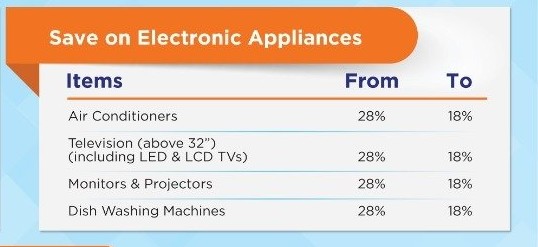
Customers of electronics items will be benefited because of the GST reform. Earlier, most electronic goods were taxed at a flat 28 per cent. With the new reforms, the government has streamlined the system into a simpler two-tier structure of 5 per cent and 18 per cent. Under this, several household electronic appliances will now be taxed at the lower 18 per cent slab instead of 28 per cent.
Union Finance Minister Nirmala Sitharaman, who chaired the 56th GST Council meeting, said the new tax rates will take effect from 22nd September, first day of Navratri. She added that the move is designed to rationalise the tax system while also making everyday goods more affordable for families.
Key appliances get cheaper
The reduced GST rates apply to four major categories of electronics, air conditioners, televisions above 32 inches (including LED and LCD models), monitors and projectors, and dishwashing machines. These items, which earlier attracted 28 per cent GST, will now fall under the 18 per cent slab.
Small-screen TVs below 32 inches were already taxed at 18 per cent, so their prices will remain unchanged. But for large TVs and other large appliances, prices will fall.
Industry experts welcomed the decision, citing that it would not only increase demand but also spur support for the electronics environment. Ravi Agarwal, Co-Founder and Managing Director of Cellecor India, said that the new tariff levels will not only make the products more affordable for consumers but also simplify compliance for firms.
No change for mobiles and laptops
While the tax cuts will benefit larger appliances, there is no change in GST rates for mobile phones and laptops. Both categories will continue to be taxed at 18 per cent. This means there will be no immediate drop in the prices of smartphones and laptops, though experts note that cheaper televisions, ACs, and dishwashers will give consumers relief in festive spending.
Impact on prices
The 10 per cent cut in GST is likely to significantly reduce the prices of big TVs, monitors, projectors, dish washing machines, and air conditioners at the retail level. For example, big LED and LCD TVs larger than 32 inches will be charged only 18 per cent GST whereas earlier they were charged 28 per cent, and similarly ACs and dish washers will also get the same discount.
According to a PTI report, an air-conditioner could now cost Rs 1,500 to Rs 2,500 less, depending on the model. Industry executives believe the cut will not just drive volumes but also push buyers toward premium, energy-efficient models.
Image via X/nsitharamanoffc
Avneet Singh Marwah, CEO of SPPL and Exclusive Brand Licensee of Thomson in India, said the cut on smart TVs will not only make technology more affordable but also drive digital inclusion across households.
Similarly, Aditya Khemka, Managing Director of CP PLUS, noted that the rationalisation of GST on electronics and components would reduce the cost of hardware for modern surveillance systems, making them more accessible for businesses and residential complexes.
Government’s vision
The GST Council described the reforms as part of its ongoing effort to simplify the indirect tax structure. Finance Minister Nirmala Sitharaman stressed that the aim was to make the system easier for industries while easing the burden on ordinary consumers. “These reforms have been introduced to make the structure simpler and boost demand,” she said during the press briefing.
By lowering GST on household electronics ahead of the festive season, the government hopes to give a push to consumer spending while also strengthening India’s electronics industry. For families, it means big-ticket appliances may finally become a little lighter on the pocket.
The middle class has received the perfect gift ahead of the festive season, as the Modi government has announced significant Goods and Services Tax (GST) reductions on automobiles. Following a GST Council meeting held yesterday (3rd September), the government declared significant reductions in indirect taxes on two-wheelers, three-wheelers, and four-wheelers.
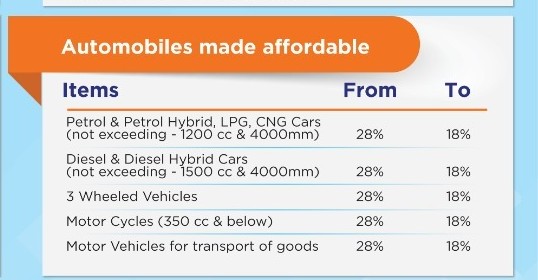
The decision is expected to benefit the middle class, which usually makes automobile purchases during the Diwali season, to avail the special discount offers provided by automakers around this time. Under the reforms, the GST slab has been reduced from 28% to 18% on small passenger cars, three-wheelers, ambulances, motorcycles up to 350cc, and on new pneumatic tyres.
Image via X/nsitharamanoffc
Petrol, LPG or CNG-driven cars with an engine capacity of under 1200 cc and not over 4 m long and diesel cars with an engine capacity not exceeding 1500 cc and length up to 4m, have also been included in the 18% tax category.
Cars like the Maruti Alto, Maruti Fronx, Tata Nexon, Maruti Brezza, Hyundai Venue, Mahindra XUV 3OO, Kia Sonet, Baleno, and Skoda Kushaq fall under the four-meter length category and will be subject to the reduced 18% GST rate.
In what the government described as the ‘Next-Generation Reforms’, it has made an effort to promote eco-friendly commute options by reducing tax on bicycles from 12% to 5%.
Under the GST reforms, luxury cars have been subjected to a condsolidated 40% tax. Earlier, a 28% GST and 17-22% compensation cess used to be levied on luxury cars, bringing the net taxes to 45-50%. After the reforms are applied, luxury cars will become cheaper as there will be a 5-10% reduction in the tax. The modification has been done by the government to do away with compesnation cess.
Besides, motor vehicles categorised as Utility Vehicles, by whatever name called including Sports Utility Vehicles (SUV), Multi Utility Vehicles (MUV), Multi-purpose Vehicles (MPV) or Cross-Over Utility Vehicles (XUV), with an engine capacity exceeding 1500 cc, length over 4 m, and ground clearance of 170 mm and above, will be taxed under the 40% slab. Bikes exceeding 3500 cc will also attract a 40% tax rate.
Revised GST rates for other vehicles
Under the revised GST rates, three-wheelers, buses, and ambulances will attract reduced GST rates of 18% from the earlier 28%. Similarly, the GST rates for Lorries and trucks will also be reduced to 18%.
In addition to that, trailers, semi-trailers of tractors with 1800 cc and non-road tractors will be taxed at 5%. An 18% tax rate will apply to road tractors for semi-trailers with an engine capacity of above 1800 cc. Bikes with up to 3500cc engine capacity will be taxed at the rate of 18%.
All car parts and accessories will be subject to an 18% GST, while the GST for electric vehicles will remain unchanged at 5%.
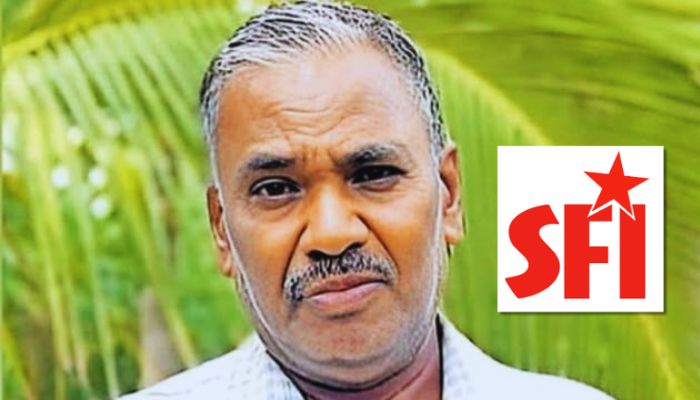
After over a decade of being arrested on accusations of sexual harassment levelled by SFI-linked students, the ordeal of retired professor, Anand Vishwanath, has ended as a Kerala court acquitted him of all charges.
In a recent ruling, a Thodupuzha Additional Sessions Court, noted that the professor was falsely implicated by four girl students from CPI(M)’s student wing Student Federation of India (SFI), after he caught them doing malpractice during a postgraduate examination.
Now retired, Professor Anand Vishwanath, headed the department of Economics at Government College, Munnar in Idukki district in 2014. He was chargesheeted in four cases wherein the SFI-linked students accused him of sexual harassment inside the examination hall. Professor Anand Vishwanath then reported the matter to the invigilator on duty and gave him the manuscripts he seized from SFI-linked students.
One one after the incident, all the four women students filed a joint complaint with the education minister and the State Women’s Commission, accusing Professor Anand Vishwanath of sexually harassing them in the exam hall on different occasions between August and September. An internal committee was formed and FIR was registered against Vishwanath.
The trial started, and in 2021, the Chief Judicial Magistrate court at Devikulam, sentenced Vishawanath to three years’ imprisonment in two cases, and acquitted him in two other cases.
However, Anand Vishwanath challenged the conviction before the Additional Sessions Court in Thodupuzha. Now, the court has set aside his conviction in these cases.
Appearing for the defendant, advocate S Ashokan contended that the prosecution did not producr independent witness. He also said that the invigilator was not made a witness in this case.
“In all the cases, the same girls were the witnesses. If one of the girls is a victim in a case, the other three were arraigned as witnesses in that case. In the other three cases, the same girls were listed in different roles as victims and as witnesses. The court has found that the cases were politically motivated,” the advocate said.
While setting aside the conviction, judge Laijumol Sherif, said that the testimonies of the four students were full of contradictions, omissions and embellishments, making the case an improbable one.
The judge added that these testimonies were not corroborated with evidence from individual witnesses. “Therefore, the evidence brought on record through the complainants is not sufficient to prove the occurrence, but is more than enough to prove that the professor was falsely implicated in the crime,” the court said.
The court further observed that the complainant students did not face any action for their malpractice and that a conspiracy was hatched at CPIM’s office to falsely implicate professor Anand Vishwanath.
“…No action was taken on the malpractice of the four students, and instead there occurred a conspiracy at the party office of the CPIM to rope in the professor…” the court said.
A shocking case has come to light from Aligarh, Uttar Pradesh. Chandrawati Devi, a resident of Hastpur village, and her family have been accused of misusing government schemes meant for Scheduled Castes (SC) and fraudulently pocketing around ₹46 lakh.
What is the case?
According to a Dainik Bhaskar report, police say that in the last 10 years, 15 different cases have been registered against Chandrawati Devi and her family. Many of these cases were filed under the SC/ST (Prevention of Atrocities) Act, 1989.
Under this law, victims are provided financial assistance and legal protection. The allegation is that Chandrawati and her family repeatedly filed false cases to avail the benefits of these schemes and have so far received nearly ₹46 lakh.
NCW calls for strict action against the accused
Dr. Archana Majumdar, a member of the National Commission for Women (NCW), has taken the matter seriously and written to the Chairman of the National Commission for Scheduled Castes (NCSC), Kishore Makwana. She has demanded a thorough investigation and strict action against those found guilty. The NCW has also handed over all documents and police reports to the NCSC.
What does the law say?
There are strict punishments for misuse of the SC/ST Act. If a person files a false case or wrongfully avails government aid, they can face imprisonment ranging from six months to seven years along with a fine. In cases of proven financial fraud, action can also be taken under the Prevention of Corruption Act, 1988, which carries up to seven years’ imprisonment and confiscation of property.
The incident has triggered anger among local residents as well. Ramveer Singh, a resident of Agra, said, “Those who take money through false cases are snatching away the rights of genuinely poor and Dalit families.” Social activist Rajesh Kumar pointed out that this is not the first such incident. In 2018, a similar case was reported in Aligarh where a Dalit family fraudulently obtained ₹3 lakh compensation by filing a false case.
The NCSC will now investigate the matter. The commission has civil court-like powers, such as summoning individuals, calling for documents, and examining witnesses under oath. Chairman Kishore Makwana has previously taken a tough stance against misuse of SC welfare schemes.
This case is not limited to one village but highlights the seriousness of SC/ST scheme misuse across the country. Experts and social activists argue that the government must enforce strict monitoring and verification processes to ensure that aid reaches the truly needy, while fraudsters are curbed effectively.
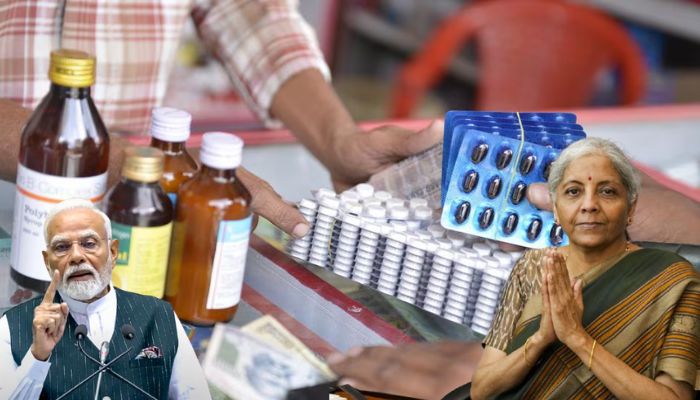
The GST Council, on Wednesday, 3rd September, announced a major GST reform, which provided a big relief to consumers purchasing health insurance and medical products. The government is removing the Goods and Services Tax (GST) on individual health insurance and individual life insurance policies, which were previously taxed at 18%.
In addition to this, the GST on various healthcare products and lifesaving drugs has also been reduced, making them more accessible to the general public.
Healthcare made cheaper as part of GST reforms
With the new reforms, the government has put a strong focus on reducing healthcare costs. Individual life insurance policies, including term life, endowment and ULIPs, will not attract any GST now.
Similarly, all individual health insurance policies, including family floater plans and policies for senior citizens, will also be exempted from GST. Earlier, people had to pay 18% GST on these, which often increased the overall premium amount.
Apart from insurance, several key healthcare items have also seen sharp reductions in taxes. Products like glucometers, test strips, corrective spectacles, medical-grade oxygen, diagnostic kits and reagents, which earlier attracted 12% GST, will now be taxed at just 5%.
Thermometers, which previously carried an 18% GST, have also been moved into the 5% slab. Moreover, GST on 33 life-saving drugs and medicines has been brought down from 12% to zero, offering significant relief to patients who rely on these medicines.
Government says reforms will benefit the common man
Union Finance Minister Nirmala Sitharaman, while announcing the decisions after the 56th GST Council meeting, said the move was aimed at making healthcare and insurance affordable for all.
“After detailed discussions and consultations with stakeholders, we decided to exempt individual insurance policies. Families and individuals will directly benefit from this, and companies will be expected to pass on the benefit to policyholders,” the Finance Minister said.
She also added that the government wants to make it easier for people to buy medical insurance without worrying about high costs. Revenue Secretary Arvind Shrivastava confirmed that insurance companies have assured the government that the benefits of these tax cuts will be passed on to the buyers.
A landmark decision
Industry leaders have welcomed the tax cuts, calling them a landmark decision. Tapan Singhel, Managing Director of Bajaj Allianz General Insurance, said the exemption of GST on health insurance is a progressive step. “At a time when medical inflation is rising steeply, this decision reduces the financial burden on families. It also aligns with the goal of ‘Insurance for All by 2047,’ making healthcare more accessible and increasing insurance penetration in the country,” he said.
The latest data shows that India’s overall insurance penetration has slipped to 3.7% in FY24 from 4% in FY23. Experts believe that this reform will help boost both life and health insurance coverage, while also making healthcare products and medicines more affordable for millions of people.
In a major overhaul of the existing Goods and Services Tax (GST) regime, the Modi government has introduced several middle-class-friendly changes in the indirect taxes on a wide range of items from everyday essential items to luxury cars.
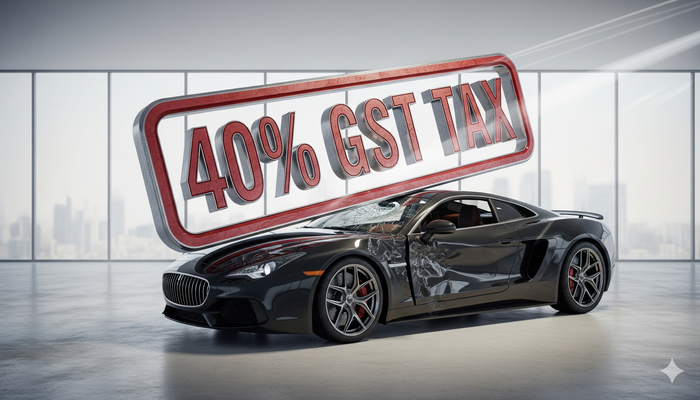
Under the new reforms announced on Wednesday (3rd September), after a meeting of the GST Council, luxury cars have been brought under a newly created tax category of 40%. Under the new rules, cars over 4 metres long and having petrol engines above 1200 or diesel engines above 1500 cc have been categorised as ‘luxury goods’.
As per the existing tax system, luxury cars are taxed at 28% GST with an additional compensation cess of 17%-22%. This makes the net tax on luxury cars 45-50%. But, after the new GST reforms, a consolidated tax of 40% will apply to the luxury cars without any compensation cess. This way, the cost of luxury cars will be reduced by 5-10%.
Luxury cars fall in the category of ‘sin goods’ under the new GST reforms. Sin goods are products, which are considered harmful to health or society, and include tobacco, gutka, pan masala, alcoholic or sugary beverages, Cars larger than 1,200 cc (petrol) or 1,500 cc (diesel), Motorcycles above 350 cc, and Aircraft for personal use. Sin goods have historically been heavily taxed by the government to discourage their consumption.
The reason behind bringing luxury cars under the ‘special tax rate’ of 40% is that the government intended to get rid of a separate compensation cess without dropping the overall tax. Therefore, it merged the compensation cess with the GST and provided a relief of 5-10%.
Government revises GST rates on other vehicles
Three-wheelers and buses will attract reduced GST rates of 18% from the earlier 28% after the reforms. Ambulances, which fall in the category of vehicles fitted with all equipment and furniture required for an ambulance, will also be taxed at 18%. Similarly, the GST rates for Lorries and trucks will also be reduced to 18%.
Besides, 5% tax will be levied on the trailers, semi-trailers of tractors with 1800 cc and non-road tractors will be taxed at 5%. An 18% tax rate will apply to road tractors for semi-trailers with an engine capacity of above 1800 cc engine capacity. Bikes with up to 3500 engine capacity will be taxed at the rate of 18% but the those exceeding 3500 cc will attract a 40% tax rate.