
On 2nd September, the Delhi High Court dismissed the bail pleas of nine accused in the anti-Hindu Delhi Riots 2020 larger conspiracy case including Umar Khalid, Sharjeel Imam, Athar Khan, Khalid Saifi, Mohd Saleem Khan, Shifa-ur-Rehman, Meeran Haider, Gulfisha Fatima, and Shadab Ahmed.
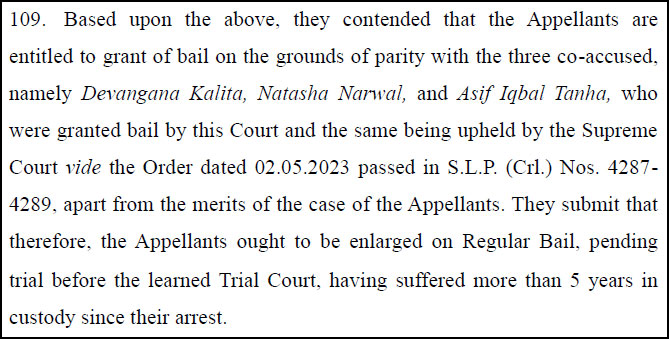
While several grounds were urged, one common thread ran through the submissions of all nine appellants was the plea of parity. The argument was straightforward on the surface that if co-accused such as Devangana Kalita, Natasha Narwal, and Asif Iqbal Tanha were given bail by the Delhi High Court in 2021, and if the Supreme Court had not disturbed those bail orders, then the same principle should extend to the present appellants.
During the argument, the defence stressed that some of the co-accused who had already been released were themselves alleged to have attended conspiratorial meetings. The defence argued that they were present at the protest sites where violence later erupted. If such allegations did not stop the Court from granting them bail, then, by parity of reasoning, the appellants, who in some cases were not even named in FIRs, should also be enlarged on bail.
In the words of the defence, the appellants were “entitled to grant of bail on the grounds of parity with the three co-accused, namely Devangana Kalita, Natasha Narwal, and Asif Iqbal Tanha”.
Understanding the plea of parity
The plea of parity is a claim that an accused person should be granted bail on the same footing as a co-accused who has already been released. The underlying principle is one of consistency and fairness. In case two or more accused are similarly placed in terms of role, allegations and evidence, then they should be treated alike. However, parity is not automatic. Courts have repeatedly held that it requires a careful comparison of the role attributed to the applicant with that of the co-accused already enlarged on bail. If the roles are not alike, or if the applicant is found to have played a more serious or distinct part in the alleged offence, then the plea of parity fails.
Umar Khalid’s parity plea examined
During the arguments, Umar Khalid’s counsel placed three changes in circumstances before the Court. The defence used the Supreme Court’s ruling in Vernon, the parity claim based on bail granted to co-accused, and his prolonged incarceration of more than five years. Each of these was countered by the prosecution, and the Court dealt with them one by one.
The defence argued that the bail of Kalita, Narwal and Tanha formed a strong precedent. They argued that these three had been alleged to have attended conspiratorial meetings and participated in protest sites that later turned violent. However, the High Court considered their role not sufficient to deny bail. By that measure, Khalid, who was not named in the FIR concerning the North-East Delhi Riots, was on a stronger footing. His counsel claimed, “The appellants are entitled to grant of bail on the grounds of parity.”
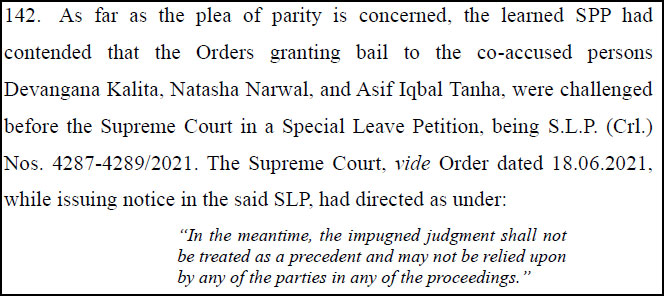
However, the Additional Solicitor General pointed out that the Supreme Court on 18th June 2021 restrained parties from treating those bail orders as precedent. The interim order, which was made final on 2nd May 2023, clarified that “the impugned judgment shall not be treated as a precedent and may not be relied upon by any of the parties in any of the proceedings”. At best, a co-accused could make an independent plea of parity, but that plea had to be established afresh on the facts of each case. Thus, in law, Khalid could not mechanically rely on the earlier bail orders.
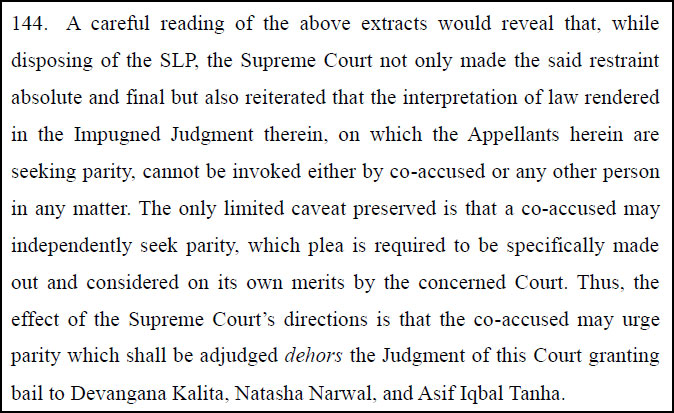
The Court agreed with this reading. It held that, “the interpretation of law rendered in the Impugned Judgment therein, on which the Appellants herein are seeking parity, cannot be invoked either by co-accused or any other person in any matter”. The only caveat was that parity could be considered if, on merits, the roles were alike.
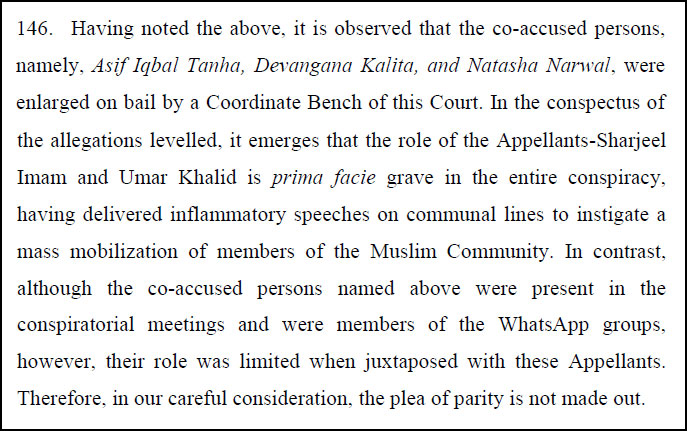
However, the Bench found the case otherwise. The Court said, “In the conspectus of the allegations levelled, it emerges that the role of the Appellants–Sharjeel Imam and Umar Khalid is prima facie grave in the entire conspiracy, having delivered inflammatory speeches on communal lines to instigate a mass mobilisation”. Hence, despite Narwal, Kalita and Tanha getting bail despite attending meetings and protests, Khalid’s role was distinct and more serious.
The defence placed two arguments other than parity. First was the Supreme Court’s Vernon judgment where the Court was not convinced that Vernon changed the balance in Khalid’s favour, noting instead that the allegations of a deep-rooted conspiracy and his speeches continued to stand on record and could not be neutralised by general principles.
Furthermore, the defence used the prolonged incarceration argument. However, the prosecution pointed out that “more than 3,000 pages of chargesheet, an additional 30,000 pages of electronic evidence, four supplementary chargesheets and 58 witnesses”. This meant the pace of trial was naturally slower. The Court accepted the argument and remarked that a “hurried trial would also be detrimental to the rights of both the Appellants and the State”.
Sharjeel Imam’s parity plea examined
In the case of Sharjeel Imam, the defence placed the parity plea at the forefront of his case. The counsel also stressed that three of the co-accused, Kalita, Narwal and Tanha, had been granted bail. He also pointed out that Sharjeel’s name was not in the FIR concerning the riots in North-East Delhi.
The prosecution again argued that those three getting bail could not be treated as a precedent, as stated by the Supreme Court of India in May 2023. At best, the Court could consider a parity plea afresh, but it had to be based on the independent facts of the appellant’s role.
The Court accepted this limitation in law and clarified that while a co-accused may independently urge parity, the High Court’s earlier bail orders could not be invoked to support that claim. Parity had to be tested on the record of each accused’s role. When it came to Sharjeel Imam, the Bench found his position to be markedly different from that of the co-accused who had secured bail. In its words, “the role of the Appellants–Sharjeel Imam and Umar Khalid is prima facie grave in the entire conspiracy, having delivered inflammatory speeches on communal lines to instigate a mass mobilisation.”
On the issue of delay in trial, Imam too claimed prolonged incarceration. Here again the prosecution replied that the size of the conspiracy, the number of accused, and the massive body of evidence, 3,000 pages of chargesheet and 30,000 pages of electronic evidence, explained the slow pace. The Court sided with the State, saying the trial was at the stage of arguments on charge and that “a hurried trial would also be detrimental to the rights of both the Appellants and the State”.
The parity pleas of the remaining accused
For the other appellants too, parity with Kalita, Narwal and Tanha was the primary line of defence. Counsels for each of them pointed out that the High Court had earlier considered allegations against those three, that they attended meetings, participated in protest planning, and were members of the WhatsApp group Delhi Protest Support Group (DPSG), and still found them fit for bail.
The defence therefore contended that their clients were either on par with or in fact better placed than those already released. For instance, it was argued that some of the present appellants were not even part of the DPSG group, or had no direct role attributed to them at protest sites, yet continued to languish in custody when those with more visible roles had secured bail.
Answering in the same tone as for Khalid and Imam, the prosecution pointed towards the restraint order by the Supreme Court which foreclosed the use of the earlier bail orders as precedent, and said parity had to be proved afresh on facts.
It was emphasised that the roles of the present appellants were qualitatively different and, in some cases, graver. The Special Public Prosecutor highlighted, for example, that Gulfisha Fatima had “created the additional two WhatsApp groups to manage protests and ensure participation of women in them” and had “collected money from co-accused Tahir Hussain to manage the protest sites”.
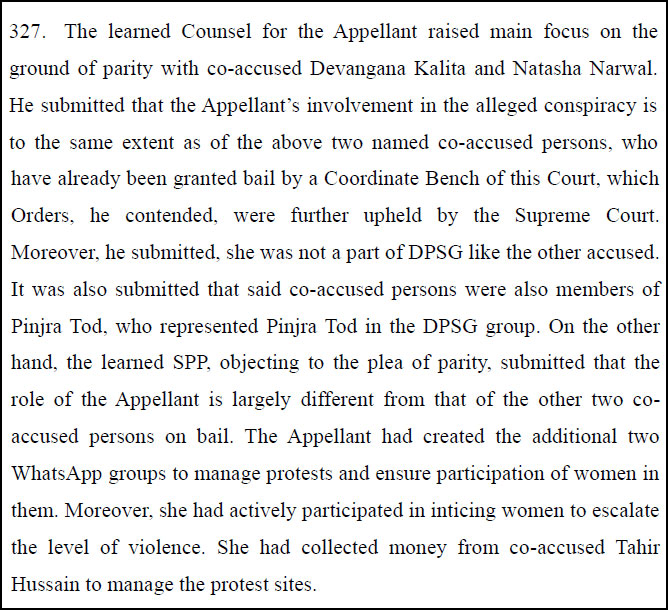
This, according to the State, marked her role as distinct from Kalita and Narwal, despite her membership of Pinjra Tod. Similarly, other appellants were alleged to have engaged in fundraising or mobilisation that went beyond the limited organisational roles of those already bailed.
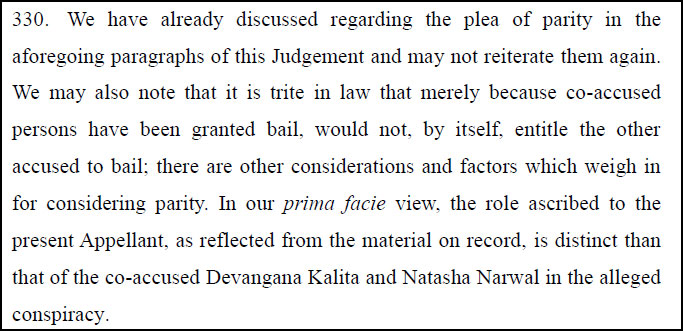
Accepting the prosecution argument, the Court made clear that parity could not be invoked mechanically, “merely because co-accused persons have been granted bail, would not, by itself, entitle the other accused to bail; there are other considerations and factors which weigh in for considering parity”.
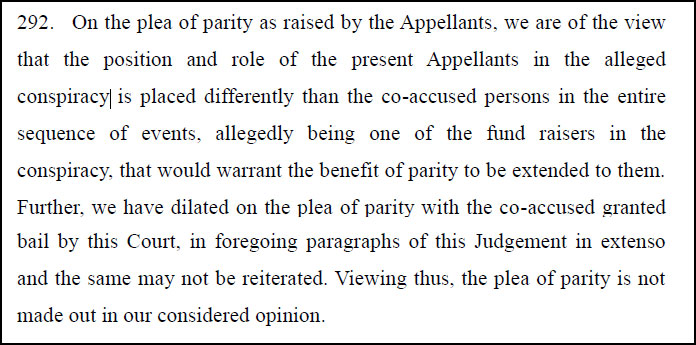
Notably, in its order, the Court was categorical that “the position and role of the present Appellants in the alleged conspiracy is placed differently than the co-accused persons in the entire sequence of events, allegedly being one of the fund raisers in the conspiracy, that would warrant the benefit of parity to be extended to them… the plea of parity is not made out in our considered opinion.” By grouping them in this way, the Court effectively rejected the parity claims of Athar Khan, Khalid Saifi, Mohd. Saleem Khan, Shifa-ur-Rehman, Meeran Haider and Shadab Ahmed, just as it had done with Khalid, Imam and Fatima.
Conclusion
The parity plea was central to all nine bail appeals, but the High Court rejected it on both legal and factual grounds. Legally, the Court pointed to the Supreme Court’s orders of 18th June 2021 and 2nd May 2023, which barred reliance on the bail of Devangana Kalita, Natasha Narwal and Asif Iqbal Tanha as precedent. The top court had made clear that those rulings could not be invoked by any other party, though a co-accused might still plead parity if independently established. Factually, the Bench found that the appellants’ roles were “distinct and graver.”
While Kalita, Narwal and Tanha were said to have played limited roles, Umar Khalid and Sharjeel Imam were accused of delivering inflammatory speeches, and Gulfisha Fatima of organising women’s participation and collecting funds. The Court stressed that bail jurisprudence demands individual assessment, not numerical comparison, and concluded that the parity plea was the main reason for dismissal.