Home Blog Page 260

From SIMI hotbed to Love Jihad hub: 283 cases rock Madhya Pradesh as Malwa-Nimar became ground zero of a chilling Islamist conspiracy

The BJP government in Madhya Pradesh has revealed alarming data on ‘Love Jihad’ cases in the State Assembly. Between January 2020 and July 15, 2024, as many as 283 cases were registered across the state, 73 of the victims were minors.

The highest number of cases emerged from the Malwa-Nimar region, once a hotbed of the now-banned terror outfit SIMI. Indore, part of this very region, has recently seen multiple cases where a so-called “Muslim gang” allegedly targeted Hindu girls.

The data also reveals a disturbing trend: in many cases, victims are unable to withstand societal and legal pressure, often turning hostile during trial or being coerced into “settlements.” Of 86 such cases so far, 50 have ended in acquittals, only 7 in convictions, while one was closed after a compromise.

Even major cities with Police Commissionerates, like Indore and Bhopal, have not been spared. Indore city alone has recorded 55 cases, with the district total hitting 74, the highest in the state. Bhopal follows with 33 cases, while Khandwa and Ujjain have 12 each, and Chhatarpur has 11. Out of the 283 cases statewide, 197 are still pending in court.

State forms SIT to probe Love Jihad cases

In response to a question from BJP MLA Ashish Govind Sharma, CM Mohan Yadav informed the Assembly that the State Police Headquarters has formed a Special Investigation Team (SIT) on May 4, 2025, to investigate incidents of exploitation and forced religious conversion of vulnerable women and girls. These cases are being registered under the Madhya Pradesh Freedom of Religion Act, 2021.

Hindu panchayat rises against Love Jihad

On August 8, 2025, a massive ‘Hindu Panchayat’ was held in Ujjain against the rising tide of Love Jihad. Thousands of Hindu families, along with saints and seers, took out a rally across the city. The gathering resolved to economically boycott those in society who support such acts.

A larger terror conspiracy?

The Malwa-Nimar belt, now infamous for Love Jihad cases, is the same region where SIMI had deep roots. In recent years, reports from districts like Burhanpur, Khandwa, and Khargone suggested that ISIS was attempting to establish a foothold.

This raises a chilling question: could Love Jihad be part of an organized terror-linked conspiracy? The National Commission for Women has also hinted at such a possibility. Evidence suggests that in urban pockets, white-collar operatives may be running a SIMI-style network, orchestrating Love Jihad as part of a larger subversive agenda.

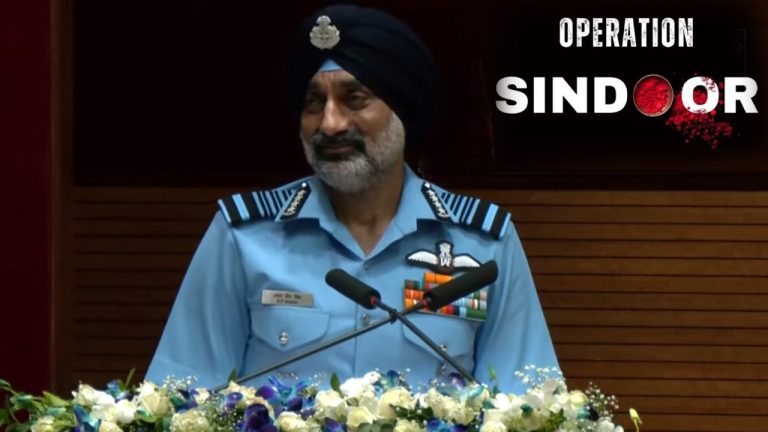
Operation Sindoor: 5 Pakistani fighter jets & an AWACS aircraft shot down by Indian Air Defence System, ‘a few F-16 jets’ and another AWACS destroyed on ground, reveals IAF chief

In an explosive revelation, Indian Air Force Chief Air Marshal AP Singh said on Saturday that five fighter jets and an AWACS aircraft of Pakistan were shot down during the Operation Sindoor. This is the first time the IAF has made an official statement regarding the loss of aircraft by Pakistan in India’s strikes.

Addressing the 16th Air Chief Marshal LM Katre Memorial Lecture in Bengaluru, Air Marshal AP Singh said that five Pakistani fighter jets and one Airborne Early Warning and Control aircraft were confirmed to be shot down by the S-400 missile defence system. Additionally, a few American F-16 fighter jets and a large aircraft, probably another AWACS, were destroyed in the ground in India’s airstrikes on Pakistani airbases.

He said that the aircraft hit on ground were undergoing maintenance, and they were destroyed after India targeted the hangers in Pakistani air bases. The IAF chief added that the Pakistani air bases were hit from a distance of over 300 kms, saying it is one of the farthest air-to-surface hit.

Air Marshal AP Singh’s comments make it clear that multiple American fighter jets of Pakistani Air Force were destroyed in the brief conflict. While he didn’t disclose the identity of the 5 fighter jets hit in the air, he said that ‘a few’ F-16 jets under maintenance were hit on the ground.

The IAF chief showed before and after satellite images of the terror camps and army bases in Pakistan targeted by India during Operation Sindoor. He emphasised how the airstrikes were precise, as the images show that the adjacent buildings and structures were not damaged in the missile attacks.

Air Marshal AP Singh said that India targeted only terror bases in Pakistan, and there were no plans to go after Pakistani defence establishments. But Pakistan attacked India using missiles, drones, loitering munnions etc on 8th and 9th May. He said that many of the Pakistani drones were unarmed, sent only to saturate Indian air defence system. But India was able to successfully intercept most of the airstrikes, and not a single target in India was hit.

AP Singh called the Russian S-400 system a game changer, adding that Indian forces were ready with sufficient defence systems to intercept Pakistani attack. He also mentioned that indigenous Akash defence system was highly successful, and not a single Pakistani missile could come near it.

As announced earlier, the IAF also said several radar stations were hit by India.

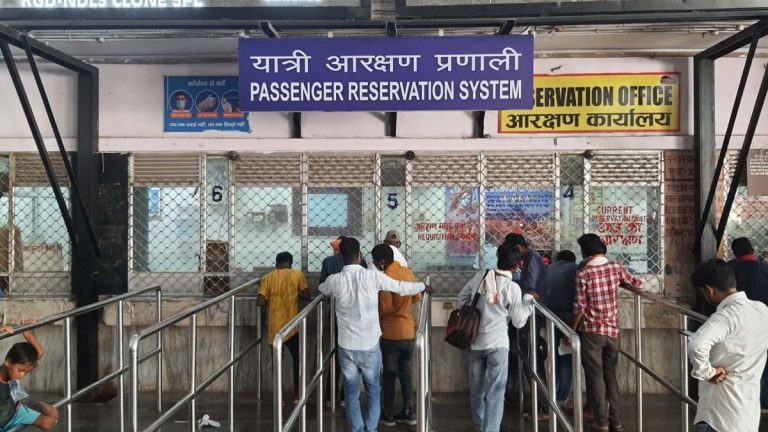
Indian Railways announces 20% rebate on confirmed return journey tickets for the upcoming festival season

The Ministry of Railways has introduced an experimental scheme titled “Round Trip Package for Festival Rush” to ease congestion and provide smoother travel during the upcoming festive season.

Discount aimed at easing festival crowding

As per a Railway Board circular issued on 8 August 2025, passengers booking confirmed tickets for both onward and return journeys on the same route, in the same class, and for the same set of travellers will receive a 20 per cent rebate on the base fare of the return trip. The initiative is designed to redistribute crowding, facilitate smoother bookings, and ensure optimum utilisation of trains, including special services in both directions.

Booking window and conditions

Reservations under the scheme will open on 14 August 2025. The onward journey must fall between 13 and 26 October 2025, while the corresponding return travel can be booked for dates between 17 November and 1 December 2025 using the connecting journey feature. The advance reservation period will not apply to return bookings, but both legs must be purchased through the same channel, either online or at railway counters.

Scope and restrictions

The scheme is valid across all classes and trains, including special services, but excludes those operating on the flexi-fare system. Only confirmed tickets qualify, and the rules clearly state that no modifications, additional concessions, or refunds will be allowed. Rail travel coupons, passes, vouchers, and PTOs cannot be used for discounted journeys under this offer.

Public awareness measures

The Railway Board has directed zonal railways to widely publicise the scheme through media, press coverage, and station announcements. The Ministry emphasised that the initiative is experimental in nature and aimed at providing relief to passengers during one of the busiest travel periods of the year.

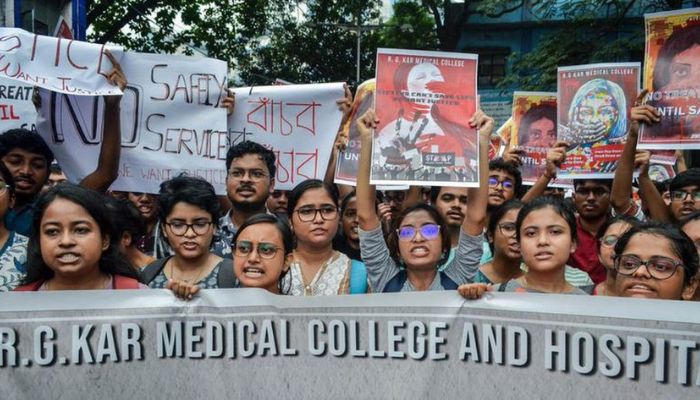
West Bengal: How Mamata Banerjee-led TMC govt is harassing junior doctors, who protested against brutal RG Kar rape-murder case

The Mamata Banerjee-led Trinamool Congress (TMC) government in West Bengal is leaving no stone unturned to persecute junior doctors, who led protests against the gruesome rape and murder case at RG Kar Medical College and Hospital, reported The Indian Express.

For the unversed, a 31-year-old junior doctor (name withheld) was raped and murdered at the institution by a ‘civic volunteer’ of Kolkata police on 9th August 2024. The perpetrator was identified as Sanjay Roy.

The initial attempt at coverup by the college principal, Sandip Ghosh, coupled with the fact that a woman was assaulted and killed at her workplace, triggered mass protests against the Mamata government for over 6 weeks.

It has now been a year since the heinous crime. According to The Indian Express, the junior doctors who carried out demonstrations to ensure justice to the victim are now faced with legal, financial and professional troubles.

Doctors, who became the face of the protests, including Aniket Mahato, Ashfaqulla Naiya, Kinjal Nanda, and Debashis Halder, are now left to deal with undue transfer, court cases and police FIRs.

Some of them were recently summoned by the police. The Mamata government transferred Aniket Mahato, Ashfaqulla Naiya and and Debashis Halder in a ‘punitive and retaliatory’ manner to new hospital facilities.

This was despite the fact that they were previously transferred just 3 months earlier. The cases challenging the transfer are now pending before the Calcutta High Court.

The Mamata government has attempted to rationalise the punitive action as ‘routine move’, unrelated to the RG Kar protests.

Besides transfers, several junior doctors have been booked for ‘causing grievous hurt to police personnel’ and ‘unlawful assembly.’

The police had previously raided the residence of Dr Ashfaqulla Naiya after a complaint was filed over his degree.

The West Bengal Medical Council sought details from RG Kar Medical College Hospital about another protesting doctor, identified as Kinjal Nanda, regarding his allowance and service hours.

It also inquired whether Nanda took permission from the institution before acting in films.

Meanwhile, Dr Aniket Mahato has not received his salary for several months as his case challenging transfer to North Dinajpur is pending before the court.

He told The Indian Express, “Legally, we are fighting the notices. Over the last year, we have faced many difficulties. I haven’t been able to practise medicine. I am sitting idle, not drawing a salary. Since April, I have been off duty… This has also affected me mentally.”

“We had no intention to jump into politics. But I am firm that I will continue my fight against injustice. My family has never pressured me, but they have been concerned,” he emphasised.

Junior doctors, who carried out protests demanding justice for the RG Kar victim, are miffed that their demands to ensure the safety and security of health professionals have not been met.

These include creation of a central referral system and filling of vacancies. The protesting doctors have raised concerns about plausible evidence tampering and the involvement of more than one perpetrator in the rape and murder case.

While a Sealdah court had convicted Sanjay Roy of the heinous crime in January this year, questions remain about the police investigation in the sensational case and the vindictive attitude of the Mamata government.

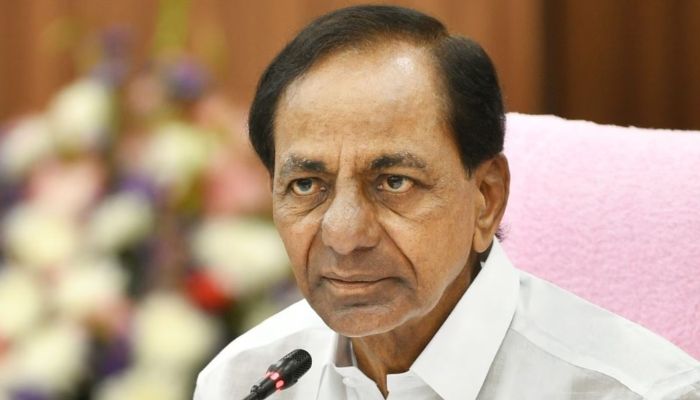
BRS govt, which snooped on more than 600 people, destroyed hard disks after losing Telangana election, switched off CCTV: Here is what we know so far

The BRS government, which tapped the phones of over 600 influential people, including politicians, journalists and activists, had destroyed 62 hard disks after losing elections by switching off CCTV footage for 1 hour.

On the night of 4th December, 2023, something unusual happened inside Telangana’s Special Intelligence Branch (SIB) office in Hyderabad. For exactly one hour, from 8:34 pm to 9:34 pm, the CCTV cameras at the state’s top intelligence agency were switched off.

According to a report by The Indian Express, the Hyderabad police investigation has determined the exact window when 62 hard disks were destroyed. Investigators say the disks were cut, ground into bits, and dumped into a river. All this happened in a small anteroom of the SIB office.

From fighting Naxals to spying on political rivals

The case is part of a larger investigation into allegations that five senior police and intelligence officers, along with a TV channel operator, carried out illegal surveillance on at least 600 people, all for the benefit of the then ruling Bharat Rashtra Samithi (BRS).

Those targeted included politicians, bureaucrats, businessmen, a sitting High Court judge, and even their families, drivers, and old friends. The surveillance was carried out using systems originally meant to track Maoist activity.

Politicians among those under the scanner

Union Minister of State for Home Affairs and BJP leader Bandi Sanjay Kumar, who is said to be one of the targets, appeared before the Hyderabad police on Friday, 8th August. After his statement, he claimed that as many as 6,500 phones were tapped, including those of Telangana Chief Minister Revanth Reddy and BRS MLAs.
Reports have also suggested that a separate team was dedicated just to monitor Revanth Reddy and his associates.

Who gave the destruction order

Investigators believe the order to destroy the disks came from then SIB chief T Prabhakar Rao. He resigned from his post on 4th December, 2023, just one day after the Congress came to power in the state.

In his Supreme Court plea, however, Rao has claimed that the decision to destroy the data was approved earlier, on 2nd December, by a committee that included the Chief Secretary, the Secretary of the General Administration Department, and the Law Secretary.

What was inside those disks

Police say most of the destroyed disks contained “political intelligence”, personal profiles, phone conversations, and online chats of political leaders. But some disks also had legitimate surveillance data on the CPI (Maoist), which the SIB is supposed to collect.

By wiping these drives, investigators say, decades of valuable intelligence were lost — something that could even put the country’s internal security at risk.

The secret Special Operations Team

Out of the 62 disks, 36 were under the control of a Special Operations Team (SOT) created in 2020 within the SIB. This team focused not on Naxal activities, but on political spying.

The SOT’s lead officer was DSP D. Praneeth Kumar, also known as Praneeth Rao, who was later arrested in connection with the case but is now out on bail. He reportedly had three exclusive rooms in the SIB office, 11 staff members, 17 desktops, two laptops, dedicated phone lines, and a private internet connection.

How they tapped calls and tracked online activity

According to investigators, the SOT’s lead officer was D. Praneeth Kumar alias Praneeth Rao, a DSP of SIB, who was arrested in connection with the case and is now out on bail.

Kumar had three rooms in the SIB office to himself and 11 personnel under him. They had access to 17 desktop computers, two laptops, two phone numbers and a dedicated leased line with internet connection.

According to investigators, the SOT would write to various telecom service providers to allow them to intercept calls. This activity, called legal interception, was signed off by Prabhakar Rao, investigators familiar with the chargesheet said.

As per law, such data must be destroyed every six months. But here, the witness told police, the destruction order came a month early, and there was no reason to turn off the CCTV cameras during the process.

Even technicians were not allowed inside the SOT rooms for repairs; they had to collect machines from outside the door.

Help from a private surveillance company

The SOT also worked with a Hyderabad-based private surveillance operator. This firm provides technical help to law enforcement and defence agencies, including intercepting online chats on platforms like WhatsApp.
Investigators say the company provided three special tools to gather information from platforms like X, Facebook, Instagram, YouTube, and Snapchat, to decrypt captured network data, and to read WhatsApp messages from targeted phones.

Background: How the case began

The illegal surveillance began in 2018–19 but peaked just before the 2023 Telangana Assembly elections. Between 16th November and 30th November, election day, at least 600 people were under watch, according to the SIT.

Those targeted included top Congress and BJP leaders, such as Telangana Pradesh Congress Committee president Mahesh Kumar Goud and Union Minister Bandi Sanjay Kumar.

In March 2024, the case surfaced when an Additional Superintendent of Police from SIB filed an FIR against DSP Praneeth Rao, accusing him of using illegal methods to collect intelligence. The Punjagutta police later named six accused, including former SIB chief T Prabhakar Rao, Praneeth Rao, ASP M Thirupathanna, N Bhujanga Rao, former DCP T Radha Kishan Rao, and TV channel owner N Shravan Kumar.

The Supreme Court has given Prabhakar Rao protection from arrest until August. Others, including Praneeth Rao, Bhujanga Rao, Thirupathanna, and Radha Kishan Rao, were arrested and later released on bail. Shravan Kumar is still in Chanchalguda jail in another case, but also has interim relief in the phone-tapping case.

Officials say the surveillance was done by misusing Section 419(A) of the Indian Telegraph Rules, which allows interception orders only from senior government officials or in emergencies by specially authorised officers. In this case, the rules were bent to justify spying on people with no links to Naxalism, purely for political gain.


Israel’s security cabinet approves proposal to take control of Gaza City despite Hamas threat to execute the remaining hostages, gives Palestinians 7 October deadline to evacuate

Israel’s political-security cabinet on Friday (8th August) approved a plan proposed by Prime Minister Benjamin Netanyahu for the Israeli military to take over Gaza City. “The IDF will prepare to take control of Gaza City while providing humanitarian aid to the civilian population outside the combat zones,” Netanyahu’s office said in a statement, referring to the Israeli Defence Forces. The decision comes after the attempts to mediate a ceasefire failed in July this year.

Yesterday, Netanyahu had reportedly expressed the intention to take military control of the entire Gaza Strip, but the plan approved by the security cabinet is limited to Gaza City, the largest urban centre of the territory, located in its north.

The Israeli military operaration will involve displacement of all Palestinian civilians from Gaza city to camps in central Gaza. The broader plan envisions the disarming of Hamas, which has run the enclave since 2007, the return of all the hostages kept by Hamas, and the demilitarization of the entire Gaza Strip and Israeli control of it.

The PM’s proposal has been approved despite threat by Hamas to kill the remaining Israeli hostages if Israeli forces proceeds towards Gaza City. The IDF has also warned that he operation risks the lives of the remaining hostages, apart from the possibilty of sparking a humanitarian disaster.

Evacuation of Palestinians from the territory will take 2 months

As per the approved plan, the Palestinians have two months’ time until October 7, 2025 (which coincides with the second anniversary of Hamas terror attack on Israel), to evacuate Gaza City. Subsequently, the IDF will lay a siege on the territory, and any remaining Hamas operatives will be eliminated. After that, the IDF will proceed to acquire the remaining areas of Gaza.

According to reports, a statement by the Prime Minister’s office said that Israel would provide humanitarian aid to the civilian population outside combat zones. A Day before yesterday, US Ambassador to Israel Mike Huckabee said that the US- and Israeli-backed Gaza Humanitarian Foundation will expand its operations from 3 to 16 distribution sites that will be operational around the clock.

The statement from the PM’s office also stated that the cabinet, by majority, also approved a list of five principles that Israel would demand to be fulfilled before agreeing to a ceasefire with Hamas. The principles are- (1) The terror group’s disarmament;

(2) the return of all 50 remaining hostages — 20 of whom are believed to be alive;

(3) the demilitarization of the Gaza Strip;

(4) Israeli security control over the Gaza Strip; and

(5) the existence of an alternative civilian government that is not Hamas or the Palestinian Authority.

IDF warns of risk to the lives of hostages, ministers go ahead with the plan

The development is said to have come amid the warnings of the Israeli Defence Forces that the operation might risk the lives of the remaining hostages in Gaza. The IDF Chief of Staff, Lt. Gen. Eyal Zamir, reportedly expressed his opposition to Netanyahu’s proposal.

“The lives of the hostages will be in danger if we go ahead with this plan to occupy Gaza. There is no way to guarantee that we will not harm them. Our forces are worn out, the military tools need maintenance, and there are humanitarian and sanitary (concerns regarding the Palestinian population),” the IDF chief was quoted as saying. He added that a complete occupation of the Gaza Strip would take a year or two, involving an initial phase of about five months of intensive fighting.

The IDF Chief reportedly presented an alternative plan to Netanyahu’s plan, but the majority of ministers agreed with the Prime Minister’s plan. The ministers believes that the alternative plan will not be able to defeat Hamas and secure the release of the hostages. The Prime Minister’s office said that the operation is intended to defeat Hamas, and that it can be stopped at any point if Hamas agrees to Israel’s demands. Around 50 hostages are still said to be held in Gaza, out of whom around 20 are believed to be alive by the Israeli officials. The hostages were captured during October 7 terrorist attack by Hamas.

A complete occupation of the Gaza territory by Israel would amount to reversing a 2005 decision of the country, wherein it withdrew thousands of Jewish settlers and military forces following Palestinian militant attacks, but retained control of its borders, airspace and utilities.

Election Commission debunks lies and ‘vote chori’ conspiracy theory of Congress leader Rahul Gandhi point-by-point: Details

On Friday (8th August), the Election Commission of India (ECI) debunked the lies peddled by Congress leader Rahul Gandhi as part of his campaign to undermine the integrity of the nodal election body.

In a video shared by him, Rahul Gandhi posed 5 rhetorical questions before the ECI. These included –

  1. Why are you not giving voter lists in digital machine-readable format to the people of India? 
  2. Why are you destroying video evidence? 
  3. Why is ECI committing massive fraud in the voter lists? 
  4. Why is ECI threatening opposition instead of answering our questions? 
  5. Why is ECI behaving like an agent of the BJP? 

However, the Congress leader did not expect a point-by-point rebuttal of his falsehoods and vicious propaganda.

At the very onset, the Election Commission of India made it clear that the Supreme Court had turned down Congress’ petition for providing machine machine-readable voter list in 2019. As such, the nodal election body is under no compulsion to entertain this demand of the grand-old party.

It pointed out why CCTV footage is destroyed after 45 days and the rationale behind its preservation in specific case.

The Election Commission of India stated, “Any aggrieved Candidate can file an election petition (EP) to challenge his election in the concerned High Court within 45 days. If an EP is filed, CCTV footage is retained; otherwise, it serves no purpose unless someone intends to breach voter privacy. For example, reviewing CCTV footage from 1 lakh polling stations would take 1 lakh days-that’s approximately 273 years-with no legal outcome.”

While responding to the claim of ‘committing mass fraud’, ECI pointed out how almost no appeals were made by the Congress party across 36 States and Union Territories, following the 2024 Lok Sabha election. This was despite the fact that the grand-old party had the legal sanction to challenge the nodal election body.

The Election Commission further stated, “Many such allegations are being made by Shri Rahul Gandhi and are being reported by the media, despite no written complaint ever being submitted by him. In the past as well, he has never personally sent a self-signed letter. For example, he raised the Maharashtra issue in December 2024. Subsequently, an advocate from AICC wrote to ECI. Our reply, dated 24 December 2024, is publicly available on ECI website. Yet, Shri Rahul Gandhi claims that ECI never responded.”

The nodal election body has therefore requested the Congress leader to submit his specific claims and objections against voters and sign the Declaration/Oath as per Rule 20(3)(b) of the Registration of Electors Rules, 1960.

“If Shri Rahul Gandhi does not sign the Declaration, it would mean that he does not believe in his analysis, resultant conclusions and is making absurd allegations. In which case, he should apologise to the nation,” it concluded.

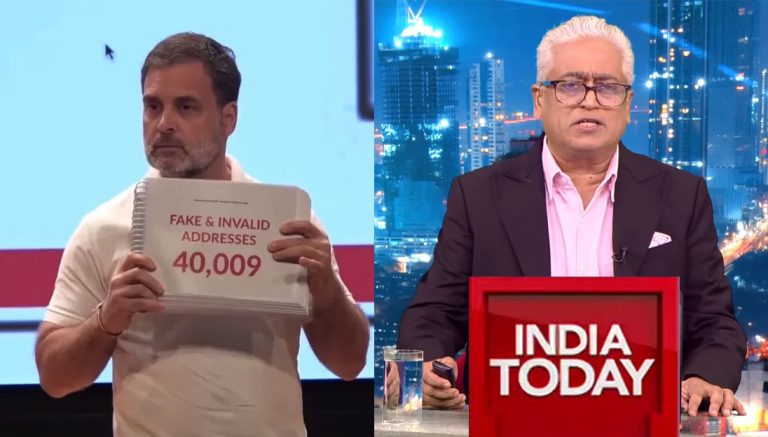
80 voters in 10 sq feet house? Rajdeep Sardesai cites India Today report to amplify Rahul Gandhi’s ‘vote chori’ claims, the report itself debunks Congress’ claims

Congress leader Rahul Gandhi has once again attacked the integrity of the Election Commission of India. In his latest attack, Rahul Gandhi claimed that 1,00,250 “fake votes” in the Mahadevapura Assembly segment in the Bangalore Central Lok Sabha constituency in Karnataka to ensure a win for the BJP. As an example of such ‘faker voters’, the Congress leader claimed that at House No. 35 in Muni Reddy Garden, around 80 voters fraudulently registered.

On 8th August, IndiaToday ‘journalist’ Rajdeep Sardesai amplified Gandhi’s claims. Taking to X, Sardesai said, “Fact check by @IndiaToday @sagayrajp reveals that yes, 80 voters are registered at one tiny Bengaluru home as claimed by @RahulGandhi. Will there be a free and fair investigation by @ECISVEEP?”

In his desperation perhaps to prove loyalty to the Congress party, Rajdeep Sardesai did not read the very India Today report he quoted to question the ECI and amplify Rahul Gandhi’s claim of fraudulent registration of 80 voters. Notably, Sardesai is currently the consulting editor and anchor of India Today Television.

As per the India Today factcheck report, a large number of voters are indeed registered with the address in question— House No. 35 in Muni Reddy Garden. However, the report shows that there is no scam in it, because it is a rental house, and various tenants who lived there at various times used the address to register themselves to the voter list.

The house is at present occupied by a food delivery worker named Dipankar. The present occupant of the house is originally from West Bengal and moved here one month ago.

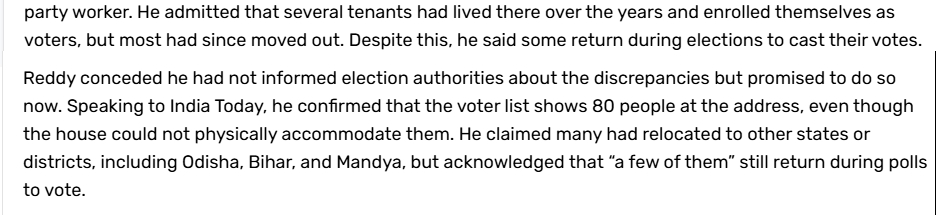
The house in question is owned by one Jayaram Reddy, who claims to be a BJP voter-supporter. As per IndiaToday report, “He (Reddy) admitted that several tenants had lived there over the years and enrolled themselves as voters, but most had since moved out. Despite this, he said some return during elections to cast their votes.”

“He confirmed that the voter list shows 80 people at the address, even though the house could not physically accommodate them. He claimed many had relocated to other states or districts, including Odisha, Bihar, and Mandya, but acknowledged that “a few of them” still return during polls to vote,” the report adds.

However, the claims of ‘fraudulent’ voter registration or “vote chori” as alleged by Rahul Gnadhi, seem unfounded since BLO Munirathna has clarified that several migrant workers living in small houses along the IT corridor use rental agreements to obtain voter IDs. “These occupants are typically job seekers working as security guards, housekeepers, or domestic helpers. After acquiring voter IDs, many vacate the premises, but their names remain on the electoral rolls,” the India Today reported.

Many these voters who have moved from here, refuse to have their names removed saying that they need the voter ID and return to cast votes during elections. Contrary to Rahul Gandhi’s insinuation that these 80 ‘fraudulent’ voters live together in 10 sq. ft. house, although these people have their voter IDs registered at the same address, these voters, mostly security guards, house helps etc, are not living together at the same time. They came, stayed for some time and moved to other places for some or the other reason.

This does not imply any ‘fraud’ and also does not prove that they may or may not be essentially voting for the BJP. Clearly, Rahul Gandhi and his media cheerleader Rajdeep Sardesai have labelled migrant voters as ‘fraudulent voters’. Moreover, the SIR exercise conducted by EIC in Bihar, is specifically aimed at addressing issue of migrant voters. But Rahul Gandhi and Congress party have been opposing the move.

As reported earlier, Rahul Gandhi while alleging ‘vote chori’ had zeroed in on Mahadevapura, one of eight Assembly segments under Bangalore Central Lok Sabha constituency, claiming that over 1 lakh votes out of 6.5 lakh were either duplicated or linked to fake addresses.

As an example, Rahul Gandhi cited the case of one Gurkirat Singh Dang, whose name allegedly appeared on voter rolls at four different booths. From this single instance, he extrapolated a sweeping claim of “thousands” of such cases, without presenting any independently verified evidence. What Gandhi fails to acknowledge, however, is the very real and common phenomenon of intra-city and inter-state migration, particularly in urban hubs like Bengaluru, where people frequently shift residences for work, education, or housing constraints.

In such cases, it’s not unusual for individuals to be enrolled at their new address without having formally applied for the removal of their names from earlier rolls. This administrative overlap can result in multiple entries, but it does not automatically mean that the person voted more than once, let alone that they were part of any coordinated fraud. To conflate registration anomalies with actual voting malpractice is not just misleading; it grossly misrepresents how electoral rolls evolve in dynamic urban settings.

Moreover, Gandhi also conveniently overlooked the fact that parties receive voter rolls well in advance and are free to raise objections during the verification phase. If such large-scale discrepancies truly existed, why weren’t they flagged before polling day? Clearly, Congress is manufacturing outrage by alleging ‘vote chori’, while the party’s media allies are amplifying its conspiracy theories.

Madras HC orders re-investigation in a case relating to offensive Facebook post on Lord Krishna, says depicting Hindu Gods in disrespectful manner not justified

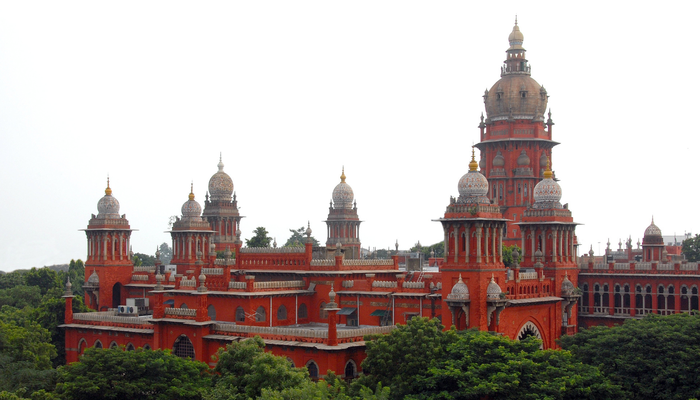
The Madurai Bench of the Madras High Court pulled up the Tamil Nadu police on Monday (4th August) for not diligently pursuing a case registered on a complaint filed against a derogatory Facebook post about the Hindu God Krishna. The High Court also criticised the concerned Judicial Magistrate, Thoothukudi, who ordered the closure of the case based on the final report and concealing certain facts.

A single bench of Justice K Murali Shankar allowed a criminal revision petition filed by one P Paramasivan and directed the police to conduct an investigation into the case and submit a final report within three months from the date of the receipt of a copy of the order.

While ordering a re-investigation in the case, the High Court remarked, “Depicting Hindu Gods in a disrespectful manner, intentionally hurting the sentiments of millions, cannot be justified. Such actions have the potential to spark enmity, religious outrage, social disorder, and undermine communal harmony. Given the deep-rooted respect for religious symbols and deities, disrespect can lead to social unrest and hurt a large section of society. Therefore, it is crucial to approach such depictions with sensitivity. The Government must ensure that freedom of expression does not translate into hurting religious feelings.”

Brief facts of the case

An offensive Facebook post was published by a Facebook profile named Sathish Kumar on August 19, 2022, about the Hindu God Krishna. The Facebook post contained an obscene image and two Tamil comments. The image showed some nude girls taking a bath in a pool and Lord Krishna stealing their clothes, and the Tamil comments said that Krishna Jayanti was a celebration of a man who stole the clothes of bathing women. The misleading post deeply hurt the sentiments of the petitioner, who filed a complaint with the police. The complainant said that the post was uploaded with the intent to defame Hindu gods and tarnish the image of Hindu women, and could potentially trigger law and order problems.

Based on the complaint, an FIR was registered on August 26, 2022, under Sections 298, 504, 505(2) I.P.C., and Section 67 of the Information Technology Act, 2000. After completing the investigation, a final report was submitted by the Tamil Nadu police on March 12, 2025. Aggrieved by the order of the concerned Judicial Magistrate, the petitioner approached the High Court seeking a direction to the police for re-investigating the case.

Police did not try to verify the details of the Facebook profile: HC

After examining the facts of the case, the High Court noted that the police did not pursue the case diligently. In the final report, the police said that they requested Meta (which owns Facebook) to provide information about the Facebook user who made the offensive post. Meta, in an email, refused to provide the details about the Facebook user and said that a Mutual Legal Assistance Treaty (MLAT) request or letter rogatory was required for it to give the information sought.

The Court observed that after receiving a negative response from Meta, the Investigating Officer did not take any further steps and instead went on to file a negative final report and closed the case as ‘undetected’. The court said that the Investigating Officer limited the entire investigation to requesting Meta for information, while, as pointed out by the petitioner, the Facebook profile named Sathish Kumar had personal details, including educational background, work history, residence, and a photograph, which could have provided a lead to the police.

“The prosecution has not verified the accuracy of these details or provided any explanation for not doing so. While the Investigating Officer identified the post’s potential to create law and order issues and disturb communal harmony, the investigation was not pursued diligently, and the final report appears to have been filed mechanically,” the court said in its judgment accessed by OpIndia.

The concerned Judicial Magistrate concealed the facts and closed the case

The High Court also criticised the concerned Judicial Magistrate, who ordered the closing of the case based on the police report. The Court said that the Judicial Magistrate concealed the facts about the appearance of the petitioner before the court. The Magistrate in the impugned order noted that the petitioner (complainant) did not appear despite notice and thus failed to file any objection against the final report of the police.

It was brought to the knowledge of the High Court that the complainant did appear before the magistrate through his Counsel and raised objections. “But the learned Magistrate, without disclosing the above aspects, has proceeded to close the case as the complainant has not turned up. Moreover, the learned Magistrate has neither referred nor considered the objections raised by the de facto complainant’s side at the enquiry,” Justice Shankar said.

Ordering a reinvestigation, the High Court ruled that the final report and the order passed by the concerned Judicial Magistrate “cannot legally be sustained.”

India halts purchase of Stryker vehicles and Javelin missiles due to Trump’s tariff assault after pausing Boeing P-8I purchase, claims report

As anticipated, Donald Trump’s tariff assault on India has resulted in Indian government having a rethink on multi-billion-dollar defence equipment import from the USA. Days after Trump announced 50% tariff on imports from India for buying Russian oil, the Modi government has reportedly put on hold the plans to procure new weapons and aircraft from the USA.

As per a report by Reuters, the two most important procurements put on hold are Stryker combat vehicles and Javelin anti-tank missiles. The report stated, “Reuters is reporting for the first time that discussions on India’s purchases of Stryker combat vehicles made by General Dynamics Land Systems and Javelin anti-tank missiles developed by Raytheon and Lockheed Martin have been paused due to the tariffs.”

The report also confirmed earlier reports that India has paused a $3.6 billion deal to purchase six Boeing P-8I Poseidon maritime patrol aircraft. Indian Navy currently operates 12 P-8I aircraft, and India was buying 6 more to augment the navy’s capacity. Talks over the deal were at an advanced stage, but now that has been put on hold.

Reuters stated that Defence Minister Rajnath Singh was to visit Washington DC in the coming weeks to finalise some of these deals, but now that visit has been cancelled. However, the report added that these are all oral instructions, and no written official order has been issued.

This means, if Trump reverses his Tariff stand, India may also revive the procurement processes for American defence systems. Reuters cited a source saying that the defence purchases could go ahead once India had clarity on tariffs and the direction of bilateral ties.

Trump’s tariffs have effectively halted plans for India’s procurement and joint production of American defence equipment. Trump had also proposed to sale the F-35 aircraft to India, but multiple sources in the govt and the IAF have stated that they are not keen on acquiring the American fifth generation fighter jet. While India’s own fight generation jet AMCA will be ready after a decade, India may procure Russian Su-57 jets to meet its current needs.