Home Blog Page 4931

Punjab’s new Agriculture Laws are hogwash meant to fool gullible farmers, violates the constitution: Read how

The Punjab Government has recently passed 4 laws related to agriculture, namely the Essential Commodities Bill, Farmer Produce Trade and Commerce Bill, Farmers Agreement on Price Assurance and Farm Services Bill, and the Code of Civil Procedure Bill. This article explains provisions of the Essential Commodities (EC) Bill passed by Punjab that has a blatant disregard for Parliamentary norms and how it is meant to fool gullible farmers. 

Problems with statement of Objects and Reasons (SOR) of the EC Bill of Punjab:

The SOR of the EC Bill of Punjab itself has several shortcomings. Some of them are listed below:

Powers of state govt

On a plain reading of the Bill it seems that the CM Amrinder Singh has not read the provisions of the Union Government’s EC Act. The Central EC Act does not affect or hinder action taken by any State Government against hoarding & black marketing of agricultural produce which is mentioned in SOR of EC Bill of Punjab. It may be mentioned that the states derive powers delegated to them vide order dated 9.6.1978 which have not been withdrawn at present. Thus, they continue to be in force. In fact, to the contrary the Central EC Act will have a positive impact on the livelihood of farmers, as it seeks to facilitate investment in the agricultural sector.

Contravention of the Constitution of India

The SOR of EC Bill of Punjab mentions that ‘‘production, supply and distribution of goods’ is also a state subject under entry 27 of List II read with, Entry 33 of List III of Seventh Schedule of The Constitution of India.” But this is an incorrect claim made by the Punjab govt, because the Constitution of India clearly states in entry 27 of list II-  ‘Production, supply and distribution of goods subject to the provisions of entry 33 of List III.’ Thus a plain reading of the Constitution makes it clear that it lies in the domain of Concurrent List and the central law will have an overriding effect on items under the State List. It may be noted that list II pertains to the state list, while the list III includes subjects in the concurrent list. Subjects in the union list are mentioned under list I.

The entry 33 of the list III, which has been used by the union govt to pass the recent farm laws, says:

33. Trade and commerce in, and the production, supply and distribution of—
(a) the products of any industry where the control of such industry by the Union is declared by Parliament by law to be expedient in the public interest, and imported goods of the same kind as such products;
(b) foodstuffs, including edible oilseeds and oils;
(c) cattle fodder, including oilcakes and other concentrates; (d) raw cotton, whether ginned or unginned, and cotton seed; and
(e) raw jute.
This makes it clear that trade, production, supply and distribution of agricultural products come under concurrent list, and therefore, central laws take precedence over state laws in this matter.

This makes it clear that trade, production, supply and distribution of agricultural products come under concurrent list, and therefore, central laws take precedence over state laws in this matter.

Impinges upon the role of the Centre

It is mentioned in the SOR of the Punjab act that the onus lies upon the State Government to protect consumers from hoarding and black-marketing of agricultural produce including vegetables and fruits etc. It may be pointed out that the Central Essential Commodities Act takes care of all sections of the society by ensuring adequate availability of Essential Commodities at fair prices. Likewise, states can continue to submit their proposals under the Essential Commodities Act for the concurrence of the Central Government.

Problems with Specific Provisions of the Act

Tries to add a proviso to Section 3(1A) EC Act which brings back opacity and discretion in decision making

By adding a provision to Section 3(1A) EC Act Punjab Vidhan Sabha has passed a Bill not only in contravention of Central law but seeks to bring back ambiguity and opacity. The law enacted by the Parliament provides that the stock limits may be imposed if the prices breach a predefined trigger (50% for non-perishable commodities and 100% for perishable commodities).  In the amendment proposed by the Punjab Assembly, price rise has not been defined and it would add to the uncertainties which the Parliament sought to remove while amending the EC Act. Under the EC Act of Punjab there are no stock limits and will continue with discretionary decision making rather than bring in transparency and accountability.

Section 3 tries to amend the EC Act unilaterally

Despite knowing fully well that the Act falls in the Concurrent list, the State Government led by Capt. Amrinder Singh has tried to unilaterally amend a Central Act. This goes against all parliamentary norms and procedures and shows the Congress Party’s Knowledge and respect for our Constitution.

Most provisions redundant or less than the value of paper they are written on

Many provisions of the EC Bill of Punjab are redundant. Like under Section 5, as per the constitutional mechanism, a Central Act or a State Government cannot restrict an Act of Parliament but this is exactly what the EC Bill of Punjab tries to do. If one goes for legal opinion it may be seen that the value of the whole Bill is less than the value of paper it is written on and is merely a political stunt.

Breakdown of federal structure & larger conspiracy in sight

With two more states namely Chhattisgarh & Rajasthan in the fray for conducting special assembly sessions possibly around the same theme, it seems that there is a deeper conspiracy by congress ruled state Governments to undermine the federal structure of India. This is not only in contravention of the Constitution but also inimical to the interests of all Indians including all farmers. On the top of such moves, the CM of Punjab has met the Governor and handed him a letter stating that ‘the central Acts have been rejected for being against the interests of farmers, landless workers’. Nothing can be further from the truth.


Paris: Two Muslim women stabbed under Eiffel Tower by white women shouting “dirty Arabs”

In a suspected racist attack amidst the outrage over the beheading of the Paris teacher, two Muslim women were stabbed repeatedly under the Eiffel Tower on Sunday night by two white women who called them “dirty Arabs”.

The French police have arrested the suspects, who are described as being white women of “European descent” and now face attempted murder charges, according to city prosecutors. The police claim that an argument about dogs allegedly devolved into violence and racist insults.

Two women of European appearance attacked Muslim women after they asked them to leash their dogs

According to one of the victims, the attackers had taken out a knife after refusing to leash her dogs and attacked her on the skull, arms and ribs. The victims have been identified as French women from Algerian background named as Kenza and Amel.

“We were out for a walk. At the ground level of Eiffel Tower, there is a small dark park. We were strolling in the park when two dogs came towards us,” Kenza told Liberation newspaper while adding, ” the children got scared of the dogs, prompting my cousin, Amel, to ask the two women to leash their dogs.”

After they refused, one of them slashed her knife at Kenza, injuring her and then attacked her cousin.

As per reports, one of the victims was stabbed six times and endured a punctured lung. The other victim had her hand severely injured and required surgery.

Witnesses of the macabre incident claimed that they heard shouts of “dirty Arabs” and “go back to your own country” by the assailants. Two local shop owners reportedly intervened and held one of the attackers down until the police arrived at the spot. The second suspect was arrested later.

The gruesome beheading of Paris teacher by an Islamist terrorist

The Sunday’s attack came days after the murder of Samuel Paty, who was beheaded by an Islamist terrorist in the Paris suburb of Conflans-Sainte-Honorine for showcasing cartoons of Prophet Mohammed to his students at College du Bois d’Aulne. Samuel Paty, a history teacher, showed the cartoons to his students on October 9 during a civics class on freedom of speech.

The gruesome attack was executed by a Muslim teenager of Russian origin, Abdoullakh Abouyezidovitch A. He stabbed the 47-year-old teacher in his throat, right outside the school, while shouting “Allahu Akbar”. He was later shot dead during an encounter with the police. French President Emanuel Macron had condemned the barbaric attack and had dubbed it as ‘Islamist terrorist attack.’

How do Customs officials remove gold concealed in the rectum of smugglers? Things you never thought you’d want to know

Over the past few months, there have been a great many numbers of gold smuggling cases reported by the customs officials from various parts of the country. The cases have brought to fore the rampancy of gold smuggling and novel methods that the smugglers are employing to hide gold on them, in a bid to avoid detection at the airport.

In a large number of the smuggling cases that are caught by the customs officials, the illicit gold is hidden in the rectum of the passengers travelling from abroad.

Increased number of cases where gold is hidden in the rectum

Recently, Customs officials in Chennai recovered 864 grams of gold paste, valued at Rs 45.4 lakhs, from four passengers travelling from Dubai. The passengers had hidden the gold paste in the form of bundles in their rectum.

Similarly, the Customs team of Calicut had seized 481 gms of compound gold from a passenger arrived from Dubai. In this case, too, the compound gold was hidden in the rectum of the passenger in four capsule-shaped objects.

A few days back, the Air Intelligence Unit of Kannur airport recovered 972 gms of compound gold concealed in his rectum.

Earlier this month, the CPD Calicut team seized 660 gms of compound gold from a passenger who had arrived from Sharjah. The passenger had hidden the compound gold inside the rectum.

The increased number of incidents where the customs officials have found passengers hiding the smuggled gold inside the rectum has piqued the curiosity of some social media users, who have wondered about the methods employed by the officers to retrieve the gold.

How is gold concealed inside the rectum removed by Customs Officials?

Responding to the curiosity surrounding the ways used by customs officials to remove gold hidden inside the rectum, one of the Twitter users, Dr Kiran Kumar Karlapu, who goes by Twitter handle @scarysouthpaw and claims to be a “Customs Guy” asserted that either the passengers voluntarily eject the packets carrying concealed gold in the toilets after much convincing by the officers or the customs officials obtain permission from the court and get the suspected passengers x-rayed before government-appointed doctor extract the hidden gold.

The Twitter user also added that sometimes the passenger is made to eat a lot of bananas and drink lots of coffee to build the “pressure” for him to eject the hidden gold.

Funny explanations that passengers provide after being caught with gold in their rectum

Dr Karlapu also shared some funny explanations that the passengers provided after getting caught with illicit gold in their rectum. He asserted that one of the passengers caught told him that he was sleeping in the night when someone unknown put the gold in his backside.

In another incident shared by Dr Karlapu, a passenger reportedly told him that his friend insisted to carry the gold and he could not turn him down.

Fake news peddler Prashant Kanojia granted bail by Allahabad High Court

0

Self-proclaimed ‘journalist’ Prashant Kanojia has been granted bail by the Allahabad High Court on Wednesday. Kanojia was arrested by the Uttar Pradesh for posting fake and morphed images on social media platforms.

Jagisha Arora, who is the wife of Kanojia, took to Twitter to say that he has been granted bail by the High Court. “My faith in the judiciary and Babasaheb’s constitution is restored. I want to thank all the people who joined in this fight,” she tweeted.

The Hazratganj police had arrested habitual fake news peddler Prashant Kanojia from his residence after he had morphed an image and had shared it on his social media post in an attempt to spread fake news and incite hatred among people.

The Hazratganj police arrested far-left troll Kanojia based on the complaint by a person Dinesh Kumar Shukla on August 17, 2020, for the morphed post that was posted by Prashant Kanojia on Twitter on August 16.

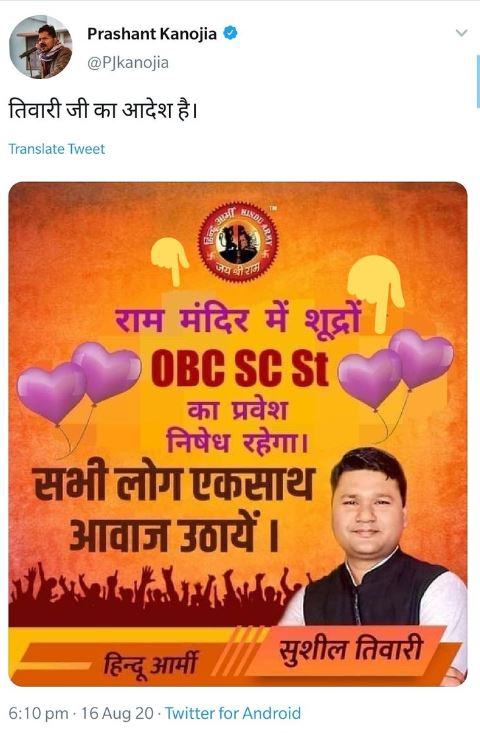
The controversial troll, who masquerades as a ‘journalist’, had posted a morphed image on Twitter to insinuate that the ST/SC and backward class people will not be allowed inside the Ram Mandir.

Morphed image shared by Kanojia, courtesy: @Lala_The_Don via Twitter

Kanojia was booked under Section-154 of the CrPC, 1973 and IPC sections 153-A (Promoting enmity between different groups on grounds of religion, race, place of birth, residence, language, etc., and doing acts prejudicial to maintenance of harmony), 153-B (wantonly giving provocation with intent to cause riot), 420 (cheating), 465 (Punishment for forgery), 468 (Forgery for purpose of cheating), 500 (Punishment for defamation), 505(1)(b) (likely to cause, fear or alarm to the public), 505(2) (offence committed in any place of worship or in any assembly engaged in the performance of religious worship) and 66 (imposed for non-payment of fine).

However, this is not the first time that the far-left ‘journalist’ has been arrested. Last year, Kanojia was arrested by the Uttar Pradesh government for posting derogatory tweets about Hindu Gods and fake allegations on UP CM Yogi Adityanath.

The accused Prashant Kanoja known in social media for habitually spreading fake news, rabid anti-Hindu hate especially against Dalits by making atrocious statements. Prashant Kanoja has a history of making vile comments against Dalits and Hindu saints. He had even referred to Dalits as ‘animals with no brains’ in the past.

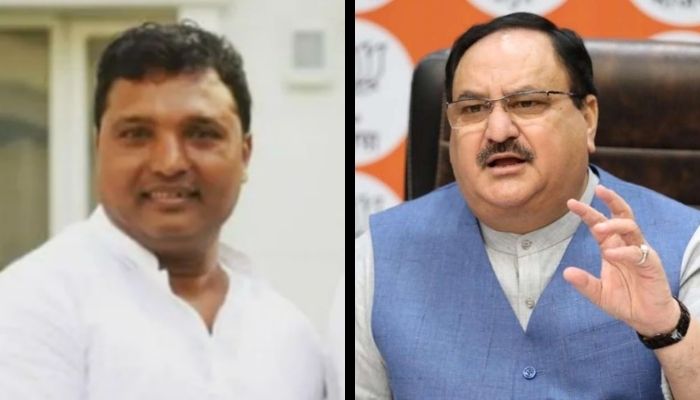
Youth Congress chief spreads misinformation about Modi govt’s Bihar package, distorts statement of BJP chief JP Nadda

Ahead of the Bihar elections, the Congress party has weaponised fake news and misinformation to target the NDA government. With no counter political narrative in sight for the Mahagathbandhan against the mighty BJP, the Congress has resorted to distorting facts, hoping that it could attract the voters from the BJP camp.

On Wednesday, BJP National President JP Nadda addressed a public gathering in Motihari in Bihar. During his 30-minute long speech, JP Nadda highlighted the package sanctioned by the Modi government during the span of the last 5 years. However, in a bid to target the BJP on its promises made to the people of Bihar, Congress Youth President Srinivas BV prematurely jumped the gun.

Congress Youth President targets BJP with fake news

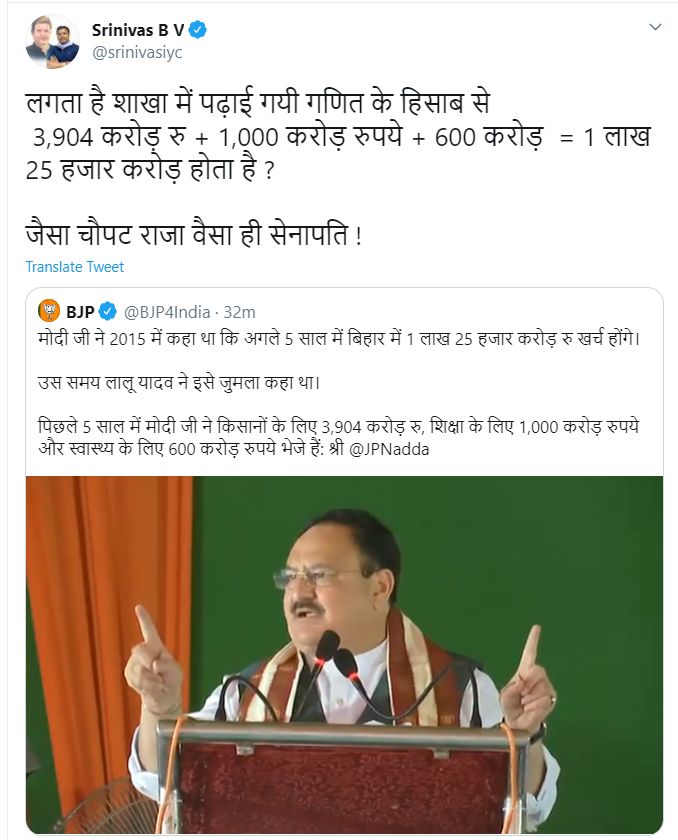
He retweeted a tweet by the official handle of the BJP, which highlighted just a small part of JP Nadda’s speech. The BJP had tweeted, “5 years ago, PM Narendra Modi had promised that a total of 1,25,000 crores would be spent in the State of Bihar. At that time, (RJD supremo) Lalu Yadav had dubbed it as an election gimmick. In the past 5 years, PM Modi had sent ₹3,904 crores for farmers, ₹1000 crores for education and ₹600 crores for health.”

Under the impression that this was the only expenditure done by the Modi government in Bihar, Srinivas B V tried to implicate that the BJP did not spend even a quarter of the funds that it had originally promised to people. He claimed, “Looks like as per the mathematics taught at (Rashtriya Swayamsevak Sangh) sakhas, 3904 cr + 1000 cr+ 600 cr = 1, 25,000 crores.” The Congress Youth President added, “The minister is as foolish as the king (PM Modi).”

Screengrab of the tweet by Srinivas BV

What is the truth?

While JP Nadda had listed the complete breakdown of the Bihar package, as sanctioned by the Union government, the Congress Youth President chose to target him and the BJP using only a small part of the speech. In the subsequent tweet posted by the BJP, it pointed out the other expenses incurred by the Modi government for the welfare of Bihar.

The tweet read, “₹16,130 crores for electricity, ₹13,820 crores for road construction, ₹54,173 crores for highways, ₹2,700 crores for airports, ₹21,476 crores for petroleum and gas and ₹1400 for 22 places (please check this).” The BJP’s Twitter handle listed every detail of the Bihar package that was provided by the Modi government in multiple tweets due to character limination on Twitter. On adding the amount spent on health, education, agriculture, petroleum, electricity, road and highway construction etc, the total expenditure stands close to ₹1,25,000 crores.

However, Congress Youth President tried to take a dig at RSS shakhas by falsely assuming the expenditure on health, education and farmers as the total package sanctioned by the Modi government. Although he claimed that the BJP lacks understanding of Mathematics, it is clear that Srinivas B V definitely has lack of basic comprehension skills.

21 October 1943: Netaji Subhash had formed the Azad Hind Government, India’s ‘declaration of independence’

Today, Oct the 77th anniversary of the formation of the first Indian government. In 1943, on October 21, one of India’s greatest sons – Netaji Subhash Chandra Bose announced the formation of the ‘Arzi Hukumat-e-Azad Hind’ or the provincial government of free India in Singapore and declared war on the British Empire.

Subash Chandra Bose had launched a struggle to free India from British rule by forming the provisional government-in-exile during the latter part of the Second World War. Bose was convinced that it was armed struggle that would help the countrymen to achieve independence. 

The leadership of Bose pulled Indians, who united with thousands of soldiers, along with former-prisoners and other expatriates who were living in Malayasia and Burma.

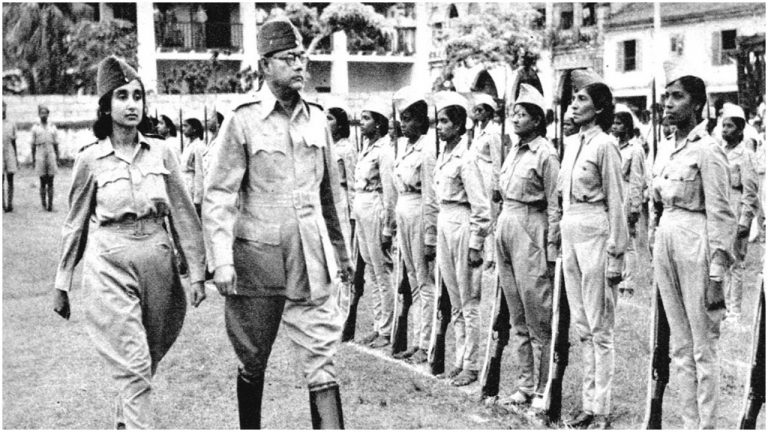
Under the provisional Government, Bose was the Head of State, Prime Minister and Minister of War. Captain Lakshmi headed the women’s organisation while SA Ayer headed the publicity wing in the newly-formed government. Revolutionary leader Ras Behari Bose was designated as the supreme adviser by Netaji Subhash Chandra Bose. The government was supported by the Axis powers of Imperial Japan, Nazi Germany, the Italian Social Republic, and their allies.

How was it set up?

The struggle for independence was carried on by Subhash Chandra Bose from abroad. The outbreak of the Second World War provided a good opportunity to Bose to strike a blow against the British imperialists. Bose, who was put on house arrest in 1940 managed to escape to Berlin on March 28, 1941.

The Indian community in German helped Bose to set up the Indian Independence League in 1942. The league took a decision to form the Indian National Army (INA) for the liberation of India.

On June 13, 1943, Bose arrived in Singapore on the invitation of Ras Bihari Bose. Netaji Bose was appointed as the head of the Indian Independence League and was also designated as the leader of the INA or ‘Azad Hind Fauj’. Bose gave his famous battle cry ‘Chalo Dilli’ and promised independence to Indians saying, “Tum mujhe khoon do, main tumhe Azadi dunga’ (You give me blood, I will give you freedom).

Significance of the Azad Hind government

Soon after the formation of the government, the Azad Hind government proclaimed authority over Indian civilian and military personnel in Southeast Asian British colonial territory and prospective authority over Indian territory to fall to the Japanese forces and the Indian National Army during the Second World War.

The provisional government not only enabled Bose to negotiate with the Japanese on an equal footing but also allowed him to the mobilise Indians living in East Asia to join and support the Indian National Army (INA). The Azad Hind Fauj or the Indian National Army (INA) played an extremely important role during the national movement by providing a much-needed impetus to India’s struggle for Independence.

The Azad Hind government under Bose had in fact started its own bank, currency, civil code and stamps. Bose had even formed the first women regiment of the INA – Rani Jhansi Regiment, thus laying down the foundation for equal opportunity for women in armed forces.

Immediately after the formation of the government-in-exile, Azad Hind declared war against the Britishers and allied forces on the Indo-Burma Front. The Azad Hind Fauj also fought against the British Indian Army and the allied forces as part of the Imperial Japanese Army in the Imphal-Kohima sector.

The existence of the Azad Hind Government had given India’s independence struggle against the British a greater legitimacy. The brave actions of Subash Chandra Bose and his decision to set up the country’s first government had directly or indirectly triggered a chain of events that eventually forced the British government to leave India in August 1947.

The actions of INA, Azad Hind Govt had triggered events that resulted in India’s independence

The historical accounts especially noted down by the governors of the various provinces, the Intelligence Bureau, as mentioned in teb book Netaji: India’s Independence and British Archives, written by Kalyan Kumar De, points out that by the mid-1940s, the British had already gone into panic and were threatened because of the tremendous popularity of Subhas Chandra Bose and the nationwide appreciation.

As mentioned in the article by The New India Express, the sympathy for the INA that Subhash Chandra Bose had established to militarily oust the colonial power had created a havoc in the minds of the British, who understood that it was impossible for them to rule India anymore. The heroic actions of Bose and had triggered a naval mutiny in Bombay and several other stations, along with rebellions in some army camps, including Madras and Poona.

The subsequent actions of the British to court-martial officers and men of the INA led to nationwide anger over these trials. An IB report of November 1945 had warned the British government that there was enormous sympathy for the soldiers of the INA and mentioned that if the government did not take cognisance of this sentiment, the consequence would be a mass agitation and bloodshed.

The sentiments of Indians towards INA was such that several governors, out of the fear and anxiety had written letters to Viceroy Lord Wavell, warning him that the government would be playing with fire if it targeted the INA because they were seen as brave freedom fighters. They warned that this could result in a mutiny in the Indian Army.

The mutiny by Indian officers employed in the Royal Indian Navy in 1946 and the rebellion against the British in various cities convinced the British that they could no longer rely on the Indian armed forces to keep fighting their wars. The Indian soldiers working in the RIN were witness to the developments around the world and had supported the INA.

As they realised they could not continue to rule the sub-continent, the British government took a swift action to end their rule in India.

China fines dairy company for ‘incorrect’ map of its territory in an advertisement, the company issues apology

0

On Sunday, the market supervision bureau in Shanghai fined a dairy company named Bright Dairy and Food Co. Ltd for putting up an incorrect map of China. The company was established in 1996 and one of the top producers in the refrigerated fresh milk industry, with 12.146 billion yuan of revenues and 308 million yuan in profit.

As per reports, the dairy brand has been fined to the tune of 3,00,000 yuan (₹33,00,000) for a video advertisement titled, ‘Bright Dairy’s strategic plan from 2016 to 2020’, posted on the company’s website on September 27. The authorities penalised Bright Dairy and Food for not showing the ‘complete and correct territory’ of China, which is a violation of Chinese laws. The Shanghai market supervision, however, did not highlight any specific issue with the video ad.

Dairy firm withdraws the ‘contentious’ video ad

The company has now taken down the advertisement. In its response, the dairy brand had blamed a third-party company for negligence and oversight. At the same time, it has assured the authorities to ‘strengthen’ the screening of promotional material in future and reiterated that the ad did not reflect the company’s intent. Bright Dairy has initiated an internal investigation into the matter and claimed that the controversy has revealed ‘management-level problems in the company.’

Chinese government regulates the publishing of maps

The Communist regime in China has taken strict action against companies, in the past, for what it deems as ‘incorrect’ representation of Chinese territory. Reportedly, the Chinese government regulates publishing of maps within its territory and imposes fine for ‘incorrect’ maps.

In January 2018, China fined 8 companies for using maps that did not include disputed territories as China’s land. They were heavily reprimanded by the National Administration of Surveying, Mapping and Geoinformation. Similarly, last year, a television drama titled, ‘Go Go Squid’ was fined 1,00,000 yuan (₹11,00,000) for excluding Taiwan and Hainan from the Chinese map

No, going to Dubai to buy the new iPhone 12 Pro is not cheaper than buying in India. Here is how

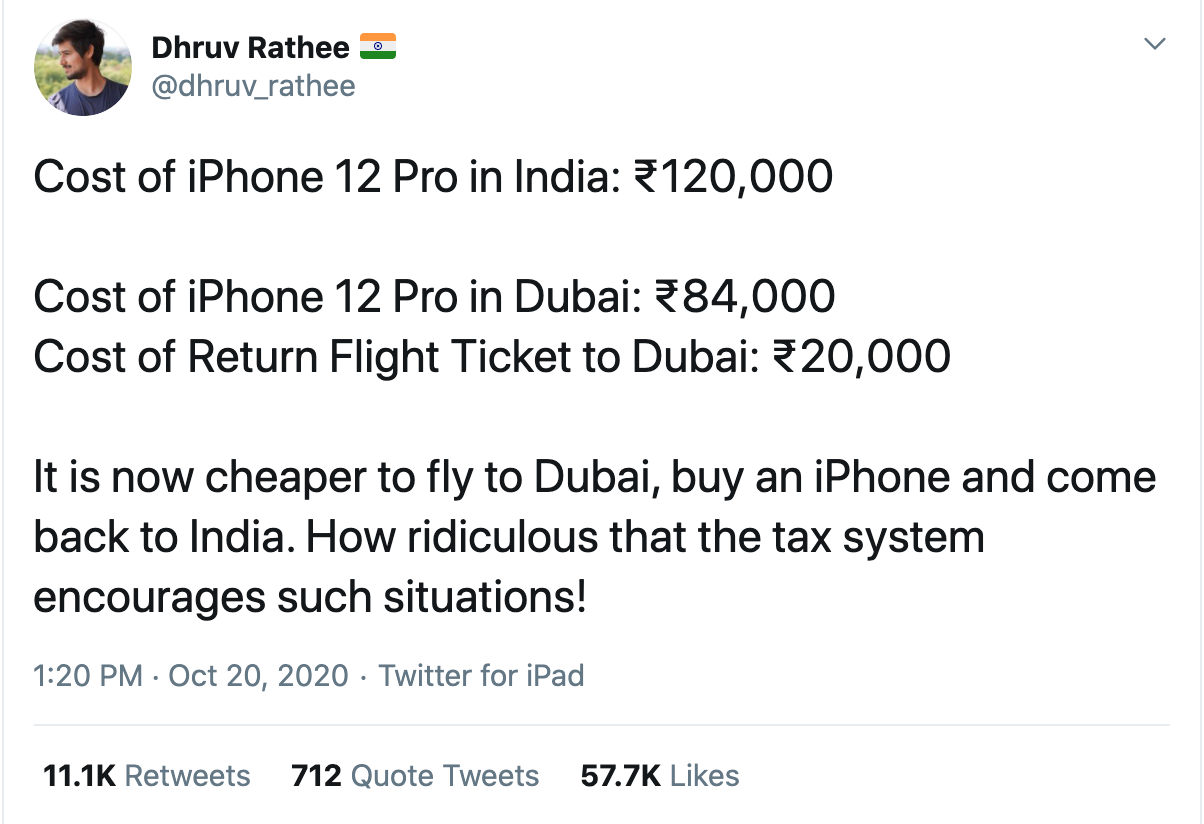
Pro-AAP vlogger Dhruv Rathee yesterday posted a tweet criticising the ‘Indian Tax system’ by alleging that it would be cheaper to fly to Dubai to get Apple’s new premium flagship mobile phone, iPhone 12 Pro, than buying it from India.

Rathee listed down the cost of iPhone 12 Pro in India and Dubai, along with the alleged return flight ticket fare to Dubai, to allege that it is economical to travel to Dubai for buying the recently launched iPhone instead of purchasing it from India.

Dhruv Rathee claims travelling to Dubai to buy iPhone 12 would be cheaper than the Indian pricing of the phone

Rathee claimed that the iPhone 12 Pro priced at Rs 1,20,000 in India comes at Rs 84,000 in Dubai and the return ticket to Dubai costs around Rs 20,000. “It is now cheaper to fly to Dubai, buy an iPhone and come back to India. How ridiculous that the tax system encourages such situations,” Rathee proclaimed following his ‘cost analysis’.

While gullible AAP and Congress supporters would be the only ones to blindly buy into the superficial ‘analysis’ of price variation of iPhone 12 Pro peddled by Rathee, the rules and regulations governing Customs highlight the gaping holes in Rathee’s assertion that travelling to Dubai and getting an iPhone 12 Pro from there is significantly cheaper than buying it from India.

Customs rules on imports of ‘non-essential’ products worth more than Rs 50,000

As per Customs’ rules and regulations, imports of ‘non-essential’ products worth more than Rs 50,000 are not permitted to air travellers as baggage allowance. Instead, these luxury entertainment commodities attract a total levy of 36.05 per cent. Travellers have to make an oral declaration to the Customs authorities in the Disembarkation Card whether they are carrying dutiable goods or not.

The Green Channel or Walkthrough channel is meant for customers who have nothing to declare and are carrying dutiable goods within the prescribed free allowance. The passengers can simply walk through the Green Channel with their baggage on the basis of their Oral declaration/Declaration on their Disembarkation Card. On the other hand, the Red Channel is meant for passengers who have something to declare or are carrying goods in excess of the duty-free allowance.

Passengers who fail to declare products that are worth more than Rs 50,000 carried by them have to pay a duty of 36.05 percent, along with penalty of 20 per cent and fine of approximately 10 per cent over the cost of the product.

Several Twitter users highlighted how Dhruv Rathee was either unaware of the Customs rules and regulations or was encouraging tax theft by hiding information.

One of the Twitter users even pointed out how the cost of iPhone 12 Pro would significantly rise if a passenger who did not declare bringing in an iPhone 12 Pro from overseas and is caught with the mobile phone at the green channel.

The person found smuggling in an iPhone without declaring it to the customs officials will not only have to pay the Duty of 36.05 per cent over the cost of phone but he would also be liable to pay the penalty of approximately 20 per cent of the cost of the goods and fine of 10 per cent for not declaring it in the Disembarkation Card. This would take the price of iPhone 12 Pro to approximately Rs 1,40,000, a whopping Rs 20,000 higher than the price at which it is available in India.

Also, in his hurry to offer a solution to buy iPhones for cheap, Rathee seems to have operated on the premise that people can just hop on an aeroplane and fly to Dubai and come back, just for purchasing an iPhone. His ‘money-saving analysis’ does not add hotel, food, conveyance, and other expenses.

The serial fake-news peddler

There have been several incidents when the Pro-AAP blogger Dhruv Rathee has revealed himself to be a serial fake news peddler who, for some unknown reason, makes videos about everything under the sun. He had earlier shared videos hiding crucial details and facts about the Delhi riots. He had also done dubious ‘fact-checks’ which usually end up exposing himself further. Not just Rathee, but some dubious individuals hosted in his video blogs have been also found to be fake news peddlers.

In 2019, Rathee had claimed that PM Modi has ‘sold’ 1,70,000 acres of dense forest in Chhattisgarh to the Adani Group. After the Adani Group debunked his claim and stated that they would initiate legal proceedings if Rathee does not take down his “malicious and incorrect” claim, Rathee promptly deleted the Tweet.

Is somebody paying the “experts” to spread spurious narratives on Atmanirbhar Bharat?

On May 12 this year, PM Modi addressed the nation and unveiled his vision for “Atmanirbhar Bharat.” The pandemic had shut down global supply chains and there was China snarling at our borders. Naturally, this required India to re-examine our dependence on other countries, especially China. A more self-reliant India, with a bigger industrial base, with lesser trade deficits was the need of the hour. Who could object?

Then, the spurious narratives began. “Experts” came out of the woodwork, many of them household names, with warnings. India should not go back to the era of license-quota-permit Raj, they argued. “Atmanirbhar” should not mean a return to protectionism. That would wipe out all the gains since 1991, they told us.

On the ground, in actual Indian government policy, there was little evidence of any protectionist instincts. In fact, the Modi government just pulled off an ambitious free market reform in agriculture, a sector that had not been touched since independence. India’s FDI regime continues to be one of the most open in the world. With the exception of curbs on Chinese imports, part of a strategic necessity, there has been no effort to close the Indian economy to outsiders. Just an emphasis on identifying sectors where India can become more competitive.

Who would misunderstand something so simple? Not common people with common sense. But only “experts.”

Here is the question to ask. Are those experts really so foolish that they don’t get it? Or are they pushing a spurious narrative on orders from someone else? A superpower, perhaps? A superpower that has something to lose from an Atmanirbhar India and wants to hurt India’s image in general.

What makes a spurious narrative? Here is the perfect example. On June 16 this year, a bloody clash took place between Indian and Chinese soldiers at Galwan Valley in Ladakh. As many as 20 Indian soldiers were killed in action. The Chinese side admitted to casualties, but refused to disclose the numbers. Coupled with China’s habitual aggression towards neighbors, known expansionist tendencies and secretive Communist state, this would look very bad for China. That too in a year when the world is reeling under the Wuhan Coronavirus. This latest act would confirm the world’s worst fears about China.

What would Americans think? How would the world think? Fortunately for China, the New York Times was around to help. In an article published the day after the clash, the New York Times reported that “analysts” had arrived at a stunning conclusion. The clash was not due to China’s expansionism nor aggression. They were merely reacting to a provocation from Indian Home Minister Amit Shah in August of the previous year.

Who are these “analysts” that connected the Galwan clash to Amit Shah’s speech? The New York Times did not name them. If Amit Shah’s speech was a provocation to China, can I see in public the work of any “analyst” who noticed this between August 5, 2019 and June 16, 2020?

Of course not. When Amit Shah spoke on Article 370, everyone knew he was talking on domestic matters of India. The reference to Aksai Chin as Indian territory is something on which India has been consistent for decades. How could it suddenly be a provocation to China?

That is a spurious narrative right there. The idea that India provoked China was created overnight on June 16. Over the next several weeks, this was repeated by experts, both Indian and foreign.

Again, observe that these experts didn’t even notice the alleged “provocation” for 10 months between Aug 2019 and June 2020. The day after the clash, they suddenly said it was the most obvious thing of all. You cannot help but ask: who paid for this sudden realization?

The attack on Atmanirbhar Bharat rouses similar suspicion. How could apparently intelligent experts misunderstand something so badly? Can you point to a single example of a newly protectionist policy created by India since the Prime Minister announced his intention in May? Then, who are you trying to warn?

Is it a spurious narrative.

Let’s explain spurious narratives like this, with apples and oranges. Suppose you decide to add more apples to your diet for health reasons. The next day, there are all these people warning you about the risks of not eating enough oranges. But you never said anything about oranges. Then, why are these experts suddenly giving all these warnings?

The answer is simple. Those experts don’t care about your health. Their warnings are not real warnings, but ads. Those experts work for the guy who sells oranges.

Terror-state Pakistan likely to remain in FATF ‘grey list’ as it fails to act against Islamic terrorist groups

0

Pakistan is likely to continue in the Financial Action Task Forces (FATF) ‘grey list’ as it has yet again failed to comply with the global watchdog’s action plan.

Reportedly, the terror-state has failed to comply 6 out of 27 points in FATF’s action plan. Pakistan is unlikely to come out of the list till June next year, according to experts. Pakistan’s failure to act against all UN-designated terrorists like Jaish-e-Mohammed (JeM) chief Azhar, Lashkar-e-Taiba (LeT) founder Seed and the outfit’s operational commander Zakiur Rehman Lakhvi will be the reason for its retention in the FATF’s ‘grey list’.

According to the reports, the global watchdog against money-laundering and terror financing – Financial Action Task Force (FATF) will begin a three-day virtual plenary meeting on Wednesday which will decide on the fate of Pakistan with regards to the country’s continuation on the ‘grey list’.

The FATF’s Asia Pacific Group (APG) plenary session which is scheduled to take place from October 21 will evaluate on steps taken by the terror-state of Pakistan to crack down on fund-raising by the Islamic terror groups. FATF will also review it’s ‘blacklist’ and ‘grey list’, the lists that classify countries based on the higher risk of enabling money laundering and terrorism financing.

The four nominating countries the United States, Britain, France and Germany are not satisfied with Pakistan’s commitment to taking strong action against the terror groups operating from its soil.

The multilateral watchdog had put Pakistan on its list of “jurisdictions under increased monitoring” or the ‘grey list’ in 2018 for not doing enough to curb financial activities of terror groups. 

Currently, Pakistan, along with 17 other countries are in the ‘grey list’, the countries that represent a much higher risk of money laundering and terrorism financing. North Korea and the Islamic Republic of Iran are on the ‘blacklist’.

Pakistan not complying to FATF’s anti-terror financing rules

Earlier in February, the global watchdog FATF had retained Pakistan in the ‘grey list’. The FATF subgroup International Cooperation Review Group had recommended retaining Pakistan in the list citing that Pakistan failed to take appropriate action against terror financers. In the earlier plenary session, the ICRG noted that the Islamic country had addressed only 14 points out of 27 conditions to get out of the ‘grey list’, which is considered unsatisfactory.

Last month,the Asia Pacific Group (APG) had concluded that Pakistan had only fully complied with only two out of 40 recommendations to curb money laundering and terror financing. The APG had said that the abuse of non-profit organisations (NPOs) and registered charities by groups such as Lashkar-e-Taiba as a “significant threat”.

In October 2019, the Asia Pacific Group (APG) of the Financial Action Task Force (FATF) had published its annual report (Mutual Evaluation report of Pakistan) which stated, “With the exception of some recent actions discussed in detail below, Pakistan has not taken sufficient measures to fully implement UNSCR 1267 obligations against all listed individuals and entities – especially those associated with Lashkar-e-Tayyiba (LeT)/Jamaat-ud-Dawa (JuD), and Falah-i-Insaniat Foundation (FIF) as well as the groups’ leader Hafiz Saeed.”

Pakistan removes names of terrorists from watchlist to evade the scrutiny

Earlier in April, a New York-based Artificial Intelligence startup had revealed that Pakistan has silently removed the names of almost 4,000 terrorists from its terror watchlist. The removed named include LeT leader and Mumbai attack mastermind Zakir ur Rehman Lakhvi and many others.

The Artificial Intelligence startup Castellum has revealed quoting Financial Action task Force that in October 2018 the country’s terror watchlist had 7,600 names. As the work of AI is to add new data sources, it noted that between March 9 and 27 data showed that Pakistan removed 1,069 names from the Proscribed person List and all those names appeared on the country’s denotified list.

After 27 March, 800 names were also removed and eventually 3800 names have been placed in the denotified list till so far without any explanation or notification to the public. Several of the names removed are the aliases of designated terrorists listed by the US or the United Nations. 

Interestingly, ahead of this year’s plenary session, FATF has strongly noted that the sudden disappearance of the names of more than 4,000 terrorists from its original list of 7,600 under Schedule IV of its Anti-Terrorism Act.