After the Khalistani extremists led by Sikh for Justice (SFJ) held a ‘referendum’ in Auckland’s Aotea Square on the Indian state of Punjab on 17th November, the New Zealand government said that it “respects and recognises” the “sovereignty and territorial integrity” of India.
? New Zealand Votes For Khalistan
Aotea Square, Auckland NZ Nov 17 Khalistan Referendum Voting
The Foreign Ministry of New Zealand told WION that it is “aware of the so-called ‘referendum’,” and while the country is a “strong supporter of human rights at home and around the world” provided such “initiatives are lawful and peaceful”.
Notably, the authorities in New Zealand had granted permission to the Khalistani extremists to stage the anti-India protests on Sunday (17th November) citing the “right to protest” and “freedom of expression”, sparking criticism from the Indian community. “Police recognises the right to protest and is working with the organisers, alongside other relevant authorities, as well as the community,” a police spokesperson said.
During the Khalistani protests on Sunday, a white man confronted a group of Khalistanis in Auckland city of New Zealand and asked them to go back to their country. In a video shared by journalist Mocha Bezirgan, the white man could be heard saying, “Why would you think you could come over to this country, where soldiers left this country and are buried on foreign soil? New Zealand and Australia, the ANZACs, are buried on foreign soil.
“They went and bled and died for this country. And you think you can come over here and fly that disgusting yellow flag in another country? How dare you? Who do you think you are?” the brave man yelled.
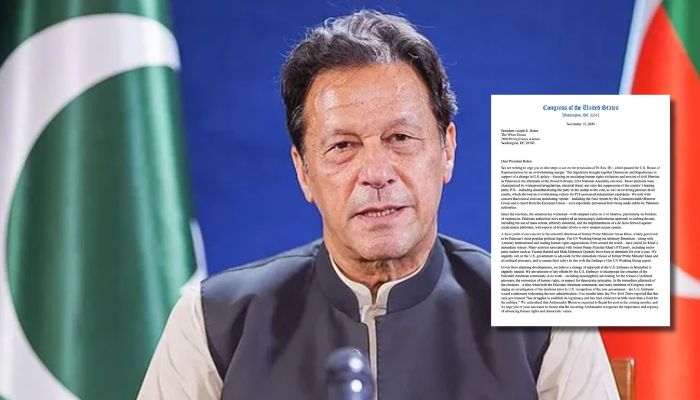
On the 15th of November, over 40 US lawmakers called upon US President Joe Biden to advocate for the immediate release of former Pakistan Prime Minister Imran Khan, along with all other political prisoners in the country and ensure their safety in line with the findings of the UN Working Group report. In a letter to outgoing President Biden, as many as 46 members of Congress urged Biden to take steps and act for the release of the incarcerated PM.
The letter mentions that irregularities, state-led suppression, and election fraud marred national assembly elections held in Pakistan earlier this year. It pointed out that the Pakistani government prevented several election monitoring reports from being publicly released.
“We are writing to urge you to take steps to act on the provisions of H. Res. 901, which passed the U.S. House of Representatives by an overwhelming margin. This legislation brought together Democrats and Republicans in support of a change in U.S. policy focusing on escalating human rights violations and erosion of civil liberties in Pakistan in the aftermath of the flawed February 2024 National Assembly elections. These elections were characterized by widespread irregularities, electoral fraud, and state-led suppression of the country’s leading party, PTI—including disenfranchising the party in the leadup to the vote, as well as reversing precinct-level results, which showed an overwhelming victory for PTI-associated independent candidates. We note with concern that crucial election monitoring reports including the final reports by the Commonwealth Observer Group and a report from the European Union-were reportedly prevented from being made public by Pakistani authorities,” the letter states.
Around 50 US Lawmakers have written to US President Biden expressing concerns over human rights violations & erosion of civil liberties in Pakistan; Call for release of Imran Khan pic.twitter.com/fhuBUGji4a
Lamenting Imran Khan’s alleged “lawful detention”, the US lawmakers called on the US government to advocate for the immediate release of Imran Khan and other “political prisoners”.
“A focal point of our concern is the unlawful detention of former Prime Minister Imran Khan, widely perceived to be Pakistan’s most popular political figure. The UN Working Group on Arbitrary Detention-along with Amnesty International and leading human rights organizations from around the world-have called for Khan’s immediate release. Many activists associated with former Prime Minister Khan’s PTI party, including senior party leaders such as Yasmin Rashid and Shah Mehmood Qureshi, have been in detention for over a year. We urgently call on the U.S. government to advocate for the immediate release of former Prime Minister Khan and all political prisoners and to ensure their safety in line with the findings of the UN Working Group report. Given these alarming developments, we believe a change of approach at the U.S. Embassy in Islamabad is urgently needed,” the letter adds.
Sharing the letter of the US lawmakers to the outgoing President Joe Biden on X, the US unit of Imran Khan’s party Pakistan Tehreek-e-Insaf (PTI) said, “46 members of the US House of Representatives, including members from both the Republican and Democratic parties, have written a letter to President Joe Biden calling for urgent action for the release of Imran Khan. The letter, jointly led by Rep. Susan Wild (D-PA) @RepSusanWild and Rep. John James (R-MI) @RepJames, criticizes the role of the US Ambassador Donald Blome and his failure to “incorporate the concerns of the Pakistani American community in its work including meaningfully advocating for the release of political prisoners, the restoration of human rights, or respect for democratic principles.” This letter, supported by @PAKPAC, brings the total number of members of Congress who have responded to the concerns raised by the Pakistani-American diaspora in recent weeks to close to one hundred.”
BREAKING: 46 members of the US House of Representatives, including members from both the Republican and Democratic parties, have written a letter to President Joe Biden calling for urgent action for the release of Imran Khan.
Meanwhile, the US lawmakers’ letter demanding their government to advocate for Khan’s release from jail did not go down well with the Pakistani government and its Foreign Ministry is stopping Pakistani media from reporting about the said letter. In a press statement, they ‘advised’ its media not to propagate this news further.
Pakistani Foreign ministry is not happy over the story of US lawmakers writing to President Biden over human rights situation in Pakistan, Imran Khan release; Statement says,'we advise the media not to propagate this story further' https://t.co/DjIk1BnTh2pic.twitter.com/tQKkyJtPKg
“We reject the story attributed to the Foreign Office carried in today’s “The New International” and “The Jang”. We are taking the matter with the editors of the newspapers about their editorial standards and journalistic ethics. We advise the media to seek confirmation from the Ministry of Foreign Affairs before publishing stories attributed to them. We also advise the media not to propagate this story further,” a spokesperson of the Pakistani Foreign Ministry said.
Notably, Imran Khan was ousted from premiership in 2022 when he lost a vote of confidence, following which he launched a strong comeback campaign attacking Pakistan’s military, whose leading generals had once backed him, and drew massive crowds. Khan was imprisoned in August last year on various charges from corruption to inciting violence.
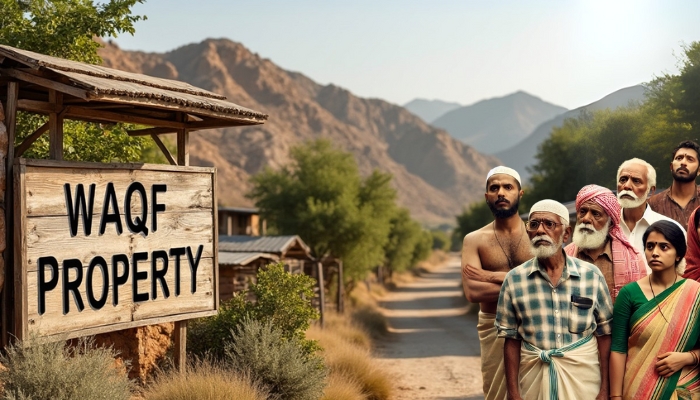
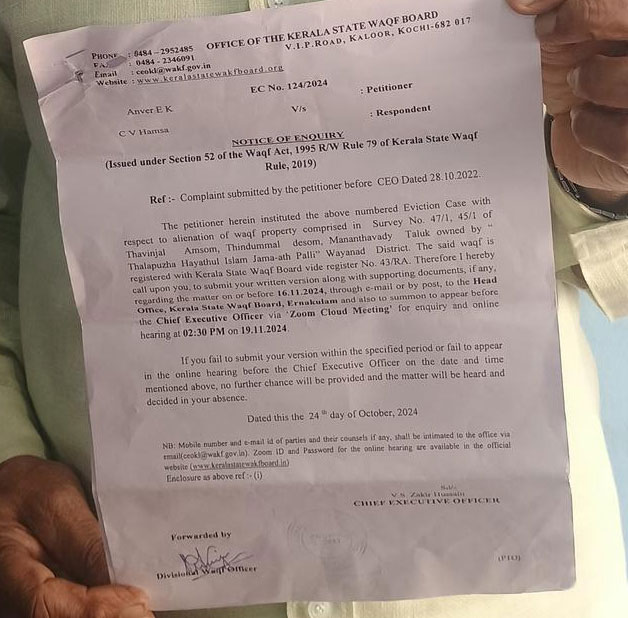
On 28th October 2024, families in Talapuzha village of Wayanad district in Kerala received notices from the Kerala State Waqf Board claiming that the land parcels they owned belonged to the board. The notices, as shared by The Hindu in its report, cite complaints of alienation of Waqf property. The notices have sparked significant controversy in the region. Though five families have received notices so far, the locals fear that the remaining families in the area will receive similar notices sooner or later.
What the notice says
As per the notice issued under Section 52 of the Waqf Act, 1995, there was a complaint filed about the alienation of 4.7 acres of land registered as Waqf property under Survey Numbers 47/1 and 45/1. The Kerala State Waqf Board directed the landowners to present their written submissions with supporting documentation by 16th November 2024. An online hearing in the matter was scheduled for 19th November 2024, as per the notice. Furthermore, the notice issued a warning that failure to respond or appear would lead to decisions being made in absentia. In other words, the board said it would proceed with the case ex-parte.
Source: The Hindu
Affected landowners speak out
The notices have stirred strong emotions among the landowners. They have asserted their legitimate ownership of the land, backed by decades of legal documentation and uninterrupted possession. Among the five families that have received the notices, both Hindu and Muslim families have expressed distress over the matter and see it as an attempt to encroach on their property rights.
One of the recipients of the notice, Tushara Ajith Kumar, expressed disbelief. She stated that her family has held the title deed for their land since 1949. Her father-in-law, Havaldar Kunjuraman, purchased the land from a Christian family in the 1940s and maintained all documentation properly. Kunjuraman ensured meticulous documentation, with records dating from 1949 to the late 1960s.
Later, the land was distributed among his six children, including Tushara’s husband, Ajith Kumar. Recently, she attempted to sell a portion of the land and suspects that the issue arose when three members of the Thalapuzha Hayathul Islam Jamaat mosque committee objected to the sale. They claimed that the land belonged to the Waqf Board. She believes that the members of the mosque committee escalated the matter to the Waqf Board.
Tushara is a homemaker and is among those who vocally oppose the claims laid down by the state Waqf Board. Her family owns a total of 75 cents of land in Talapuzha village.
Tushara expressed her determination to resist the board’s claims, saying the land could only be taken “over her dead body.” Her son, Jithul, has since delved into the legal provisions of the Waqf Acts and amendments, and the family is working with an advocate to contest the notice.
Muslim families also in distress
The notices were not limited to non-Muslim landowners. Seventy-year-old Hamsa Faizi got the shock of his life as he became one of the landowners who received the notice. He owns 12.75 cents of land that he purchased in 1998 from Sukumaran and Krishnankutty, children of Kunhootty Alakkandy, and paid Rs 50,000 per cent at that time. Since then, he has maintained his tax payments and property records as required.
Interestingly, Faizi was an office-bearer of the Jamaat committee for several years. Expressing his dismay, he said, “I have all valid documents for my property, and yet I was sent this notice.” Faizi’s house was built in 1987 by a former resident. He has been living in the house for decades. Despite assurances from local leaders of support in the matter, Faizi fears for the future of his land.
Jamal’s unexpected ordeal
Jamal owns a 15-cent plot. He described the notice as a “bolt from the blue.” He has been living on the property for the past 14 years and runs a shop on the premises. He also has all the valid land records and tax receipts. He noted that some of the families in the area own as little as 9 cents of land, which shows the ownership of the properties is scattered among owners.
Commercial and residential use
There are seven houses and ten shops on the so-called disputed land, which is located along the road near the Thalapuzha police station. Residents worry that the claims laid down by the Waqf Board could disrupt their lives and livelihoods.
Ancestral and documented ownership
The landowners uniformly insist on the legitimacy of their claims. Records from the Thavinhal Panchayat show that at least one building on the disputed land has documentation dating back to 1948. Most of the residents have title deeds that predate the 1963 deed cited by the mosque committee. Many are second- or third-generation landowners who have consistently paid land taxes and maintained property records without any prior disputes over Waqf claims.
Growing fear among other residents
While only five families have been issued notices so far, other residents in the area, numbering around 50 families, fear that they will receive similar notices in the future. These families also own small parcels of land within the so-called disputed 4.7-acre stretch.
Claims by the mosque committee
The managing committee of the Thalapuzha Hayathul Islam Jamaat Mosque lodged a complaint with the Waqf Board, suggesting that the disputed land was originally donated by the faithful in 1963 through a registered title deed. The mosque currently retains only 67 cents of land, which includes the mosque, a madrassa, and a cemetery. Abdul Nassar, the committee president, claimed that the issue first arose between 2006 and 2012 but was formally reported to the Waqf Board in 2022 following an inquiry into another matter.
Political and community reactions
The controversy has drawn widespread attention from local leaders as well. NDA candidate Navya Haridas visited Talapuzha and assured the affected families of her support. She vowed to prevent the Waqf Board from taking over private land. BJP sources alleged that the board was hastily issuing notices to acquire land ahead of proposed amendments to the Waqf Act.
Meanwhile, the local community has formed an action council, submitting memorandums to Chief Minister Pinarayi Vijayan and Minister OR Kelu. Residents are demanding government intervention to protect their property rights.
‘Once a Waqf, always a Waqf’
The literal meaning of Waqf is detention, confinement, and prohibition. As per Islam, it is the property now available only for religious or charitable purposes, and any other use or sale of the property is prohibited. As per Sharia law, once Waqf is established, and the property is dedicated to Waqf, it remains Waqf property forever.
Waqf means that the ownership of the property is now taken away from the person making the Waqf and transferred to Allah. As per Sharia, this property is now permanently dedicated to Allah, making Waqf irrevocable in nature.
‘Waqif’ is a person who creates a Waqf for the beneficiary. As Waqf properties are bestowed upon Allah, in the absence of a physically tangible entity, a ‘mutawalli’ is appointed by the Waqif, or by a competent authority, to manage or administer a Waqf.
Recently, the Gujarat Waqf Board had staked claim to the Surat Municipal Corporation building which is now the property of the Waqf because the documents were not updated. As per Waqf, back during the Mughal era, the Surat Municipal Corporation building was a sarai and used during the Hajj travels. The property then belonged to British Empire during British rule. However, when India got independence in 1947, the properties were then shifted to the government of India. However, since the documents were not updated, the SMC building then became Waqf property, and as Waqf Board says, once a Waqf, always a Waqf.
In another bizarre case of staking a claim, Divya Bhaskar had reported that the Waqf Board had written an application to Gujarat High Court staking claim on the ownership of two islands in Bet Dwarka in Devbhoomi Dwarka. A perplexed High Court Judge refused to hear the application and asked the Board to revise its petition wondering how can Waqf stake a claim on land in Krishnanagri.
Another interesting aspect of Waqf is that an apartment in your housing society can any day turn into a mosque without any input from the other members of the society if the owner of that apartment decides to endow it as Waqf. Something similar happened in Shiv Shakti society in Surat where one of the plot owners registered his plot with the Gujarat Waqf Board, making it a holy place for Muslims, and people started offering Namaz there.
OpIndia’s detailed explanation of Waqf can be checked here.
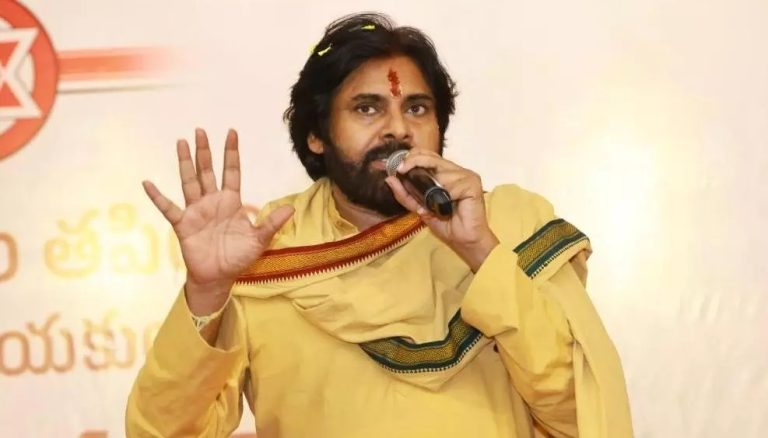
Andhra Pradesh Deputy Chief Minister Pawan Kalyan has condemned the tragic deaths of two Hindu girls, aged 15 and 17, in Pakistan’s Islamkot area. The girls, identified as Hema and Venti, were found hanging from a tree.
The incident has caused outrage and fear among local Hindus. Kalyan also expressed concerns over the atrocities faced by Hindus in Pakistan and Bangladesh.
“It pains a lot to see, our Hindu sisters in Pakistan going through such atrocities and losing their lives. Every time I see such news about the plight of Hindus in Pakistan and Bangladesh, it pains me deeply. I pray for Hema and Venti’s departed souls with tears,” Andhra Pradesh Deputy CM said on X.
It pains a lot to see,our Hindu sisters in Pakistan going through such atrocities and losing their lives.
Every time I see such news about the plight of Hindus in Pakistan and Bangladesh, it pains me deeply. I pray for Hema and Venti’s departed souls with tears. https://t.co/0Py2VYuGJ1
He was responding to information posted by “INSIGHT UK” which reported that two Hindu girls, aged 15 and 17 years old, were found hanging from a tree in Pakistan’s Islamkot. Insight UK also questioned the failure of international bodies like the United Nations Human Rights Council (UNHRC) to address such incidents.
“In Islamkot, Tharparkar, a tragic incident occurred where two young Hindu girls, Hema and Venti, aged 15 and 17, were found hanging from a tree. This event has instilled a state of fear in the local area. Hindus across the world are outraged and concerned over the safety and rights of Hindus and other minorities in Pakistan who face relentless persuasion from Islamists,” Insight UK posted on X.
Insight UK describes itself as a social movement addressing issues concerning British Hindus and Indians in the United Kingdom. Earlier in the month, Ministry of External Affairs (MEA) spokesperson Randhir Jaiswal had condemned the attacks on the Hindu community in Chittagong, Bangladesh and said that such actions would only create more tensions in the community. Jaiswal, during a weekly media briefing, urged the Bangladesh government to ensure the safety of Hindus.
(This news report is published from a syndicated feed. Except for the headline, the content has not been written or edited by OpIndia staff)
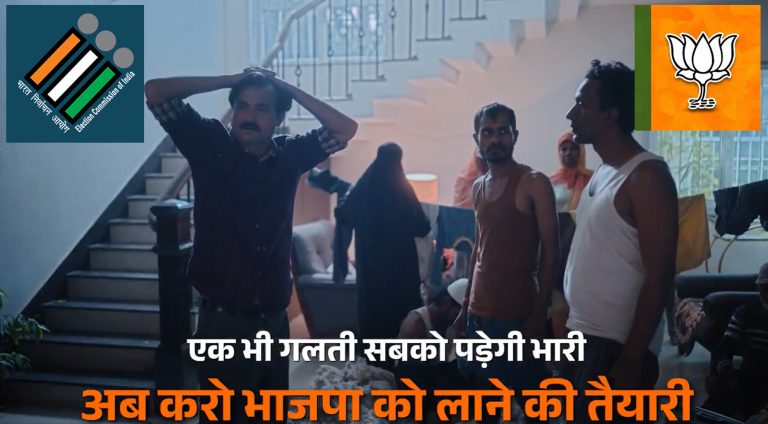
The Election Commission of India has directed the BJP to take down a video posted on social media platforms targeting the JMM-led govt in Jharkhand amid the assembly elections. The EC directed the Chief Election Officer of Jharkhand to immediately direct BJP Jharkhand to take down the said post from the party’s social media platforms.
ECI took the action after a complaint was filed by Congress and JMM, objecting to the video titled “poore Jharkhand ka kaya palat kar denge” posted by BJP Jharkhand. The complaint alleged that the video violates the provisions the model code of conduct. The ECI agreed with the complaint, and the notice said, “it appears that the above referred social media post is prima facie violative of the MCC.”
“It is therefore, directed to take immediate action as per existing laws and procedures and thereafter direct the concerned social media platfoms, through the authority designated in the State of Jharkhand under section 79(3)(b) of the IT Act to take down the referred posts immediately,” states the directive issued by the ECI to the CEO Jharkhand.
The CEO has also been asked to serve a show cause notice to BJP Jharkhand to explain the alleged violation of provisions of the Model Code of Conduct. The ECI directive said, The party may be immediately take down the said post and any related content from social media and any other form of media.
The video posted by Jharkhand BJP on social media purportedly showed the house of a JMM supporter with a banner of JMM outside the house. It also showed a poster with a photo resembling Hemant Soren, with the caption “pure Jharkhand ka kaya palat kar denge”. It shows a large number of alleged illegal immigrants entering the house to forcefully reside there. They take over the house, shocking the family.
It is shown that the immigrants are brought to the JMM supporter’s house by two locals. When the house owner complaints to them saying that the immigrants are destroying his house, the local persons say, “The govt that you elected brought these people here. Therefore, your house should also be destroyed, why only our colony?”
The video ends with the message, “Just one mistake will cost everyone”, an apparent warning against voting for the JMM-Congress alliance. It then says, “Now get ready to bring BJP”.
The complaint alleged that the video published by the BJP Jharkhand is rife with baseless allegations and falsehoods to unduly influence voters by creating feeling of hatred and enmity against JMM and its leaders.
India’s ambitious strides in the semiconductor industry are best exemplified by the development of a semiconductor unit in Morigaon, Assam, spearheaded by Tata Semiconductor Assembly and Test Pvt Ltd (TSAT). This project, set to become one of the country’s premier manufacturing sites, aligns with the nation’s broader goal of establishing a self-sufficient semiconductor ecosystem. With an investment of Rs. 27,000 crore, the Morigaon facility is expected to produce up to 48 million semiconductor chips per day, employing advanced packaging technologies like flip chip and Integrated System in Package (ISIP). Designed to cater to essential sectors such as automotive, electric vehicles, telecommunications, and consumer electronics, this facility is projected for completion by mid-2025.
The Morigaon unit goes beyond technological development, it brings significant socio-economic benefits by generating 15,000 direct and 11,000-13,000 indirect jobs, contributing to regional economic growth in Assam and nearby areas. As a high-capacity production site, the facility’s daily output will serve both domestic and international markets, positioning India as a competitive force in the global semiconductor supply chain.
India Semiconductor Mission: Fostering a Self-Reliant Semiconductor Industry
Industry estimates place the Indian semiconductor market at approximately $38 billion in 2023, with projections indicating growth to $109 billion by 2030. To support this rapid expansion and reduce reliance on imports, the Indian government has implemented several initiatives aimed at promoting domestic semiconductor manufacturing. The India Semiconductor Mission (ISM) aims to build a sustainable semiconductor and display ecosystem that will position India as a leader in electronics manufacturing and design. Guided by international semiconductor experts, ISM coordinates efforts across government ministries, industry, and academic institutions to ensure efficient deployment of resources and support.
Launched in 2021 with a financial outlay of ₹76,000 crore, the Semicon India program is structured to promote the domestic semiconductor industry through incentives and strategic partnerships. This initiative supports various sectors of the semiconductor industry, extending beyond just fabrication facilities (fabs) to include packaging, display wires, Outsourced Semiconductor Assembly and Testing (OSATs), sensors, and other critical components, creating a comprehensive ecosystem. Under the program, four schemes have been introduced namely Modified Scheme for setting up of Semiconductor Fabs in India, Modified Scheme for setting up of Display Fabs in India, Modified Scheme for setting up of Compound Semiconductors/ Silicon Photonics/ Sensors Fab/ Discrete Semiconductors Fab and Semiconductor ATMP/ OSAT facilities in India, and Design Linked Incentive (DLI) Scheme.
The Morigaon semiconductor facility is part of a wider network of government-backed projects aimed at bolstering India’s semiconductor production capabilities. The Union Cabinet has approved the establishment of multiple semiconductor units across the nation, including new facilities by Tata Electronics in Dholera, Gujarat, and CG Power in Sanand, Gujarat. Additionally, Kaynes Semicon Pvt Ltd was approved to set up a unit in Sanand as well. This expansion signifies India’s commitment to reducing reliance on semiconductor imports and fortifying its position in the global semiconductor value chain.
The government has also focused on modernizing the Semi-Conductor Laboratory in Mohali and implementing the Scheme for Promotion of Manufacturing of Electronic Components and Semiconductors (SPECS) and the Production Linked Incentive (PLI) Scheme for Large-Scale Electronics. These efforts ensure support for every segment of semiconductor production, fostering an ecosystem that encompasses chip design, fabrication, testing, and assembly.
The establishment of the semiconductor unit in Morigaon, Assam, marks a pivotal step toward achieving India’s semiconductor ambitions. This project, along with others approved under the Semicon India program, strengthens India’s technological foundation and supports the nation’s vision for economic resilience and self-reliance. As the demand for semiconductors surges worldwide, India’s burgeoning semiconductor infrastructure is set to drive innovation, create jobs, and secure the country’s position as a significant player in the global digital economy.
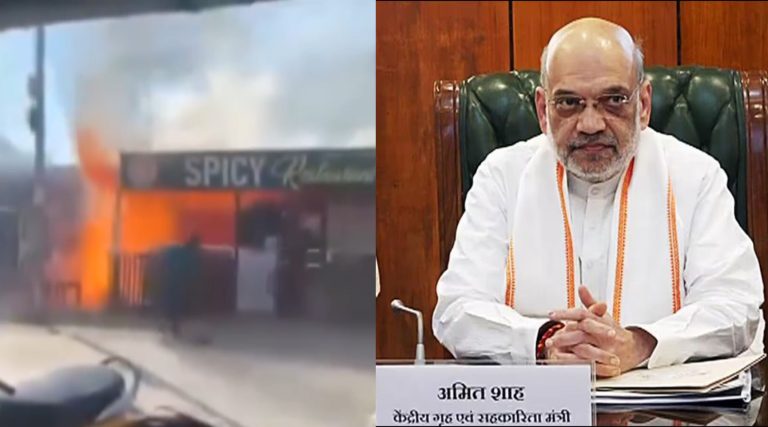
Union Home Minister Amit Shah on Sunday convened a high-level meeting with senior officials in the national capital to assess the security situation in Manipur.
Sources indicated that the Home Minister has planned to hold a detailed review meeting on Monday to address the concerns and strategies surrounding the fragile security scenario that has gripped Manipur in recent days.
The situation in Manipur has seen heightened tensions, prompting the government to take proactive steps in monitoring and managing regional stability.
Shah convened the meeting after he returned to his residence in Delhi, postponing his planned visit to Vidarbha, where he was expected to attend a series of rallies ahead of Maharashtra assembly polls on November 20.
Armed miscreants from both Meiti and Kuki communities in conflict have been indulging in violence leading to unfortunate loss of lives and disruption in public order in Manipur.
A day ago the Ministry of Home Affairs had informed that all the security forces were directed to take necessary steps to restore order and peace in Manipur.
It was also informed that strict action would be initiated against anyone trying to indulge in violent and disruptive activities.
The ministry also mentioned that important cases were handed over to the National Investigation Agency for effective investigation.
Meanwhile, the MHA requested public to maintain peace and not to believe in rumours and cooperate with the security forces to maintain law and order in the state.
In light of continued tensions in the region, the Director General of the Central Reserve Police Force (CRPF) Anish Dayal Singh also reached Manipur earlier on Sunday.
This visit comes as the security situation remains volatile, with the CRPF playing a crucial role in maintaining peace and stability.
The Director General’s visit aims to assess the ground situation firsthand, meet with local security officials, and explore further measures to de-escalate tensions in the area. This high-level visit underscores the government’s commitment to addressing ongoing issues and ensuring the safety and well-being of the communities.
(This news report is published from a syndicated feed. Except for the headline, the content has not been written or edited by OpIndia staff)
Amid the ongoing Jharkhand Assembly Elections 2024, the echoes of ‘roti’, ‘beti’, and ‘maati’ resonate strongly. Amidst these echoes, 8th November and 15th November (Janjatiya Gaurav Diwas) have also passed. The 8th of November is considered significant as it marks the first recorded instance of Christian conversion of tribal/Adivasi (Scheduled Tribes) individuals on this day in what is now Jharkhand.
When and how did STs first convert to Christianity in Jharkhand?
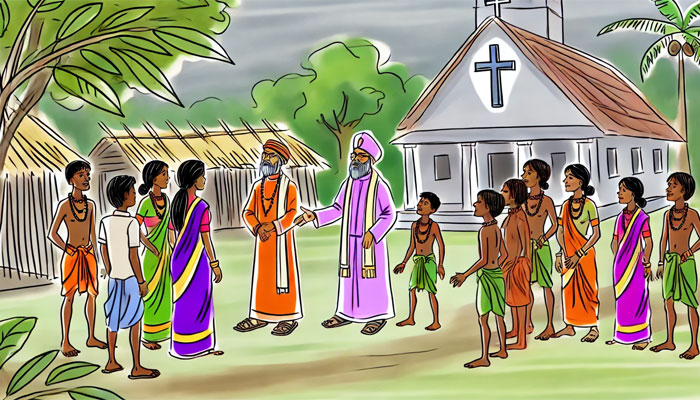
In 1873, Archbishop Stains from Kolkata baptised 28 individuals from six Munda families in Khuntpani (also spelt Khutpani/Khuntpani). Khuntpani is now part of the West Singhbhum district in Jharkhand. A commemorative stone engraved with the names of these first converts still exists. To mark the day, a “pilgrimage fair” is organised annually on 8th November, attracting Christian converts from Jharkhand and neighbouring states in significant numbers. Roman Catholic devotees from foreign countries also visit the fair.
Santhal Pargana – From the first Christian conversions to present-day Muslim infiltration
Khuntpani is part of the Chotanagpur region, which has been significantly affected by the Christian missionary conversion mafia in Santhal Pargana. The influence is so pervasive that electing representatives from the ST community who have converted to Christianity has become common in the region.
The region is also under scrutiny for demographic changes caused by Bangladeshi-Rohingya Muslim infiltration. Sarna (tribal sacred sites) are vanishing, replaced by mosques and mazars. Tribals are losing not only their land and employment but also their daughters. Prime Minister Narendra Modi has expressed concern over these issues in many rallies.
The promise to curb infiltration and introduce the Sarna code
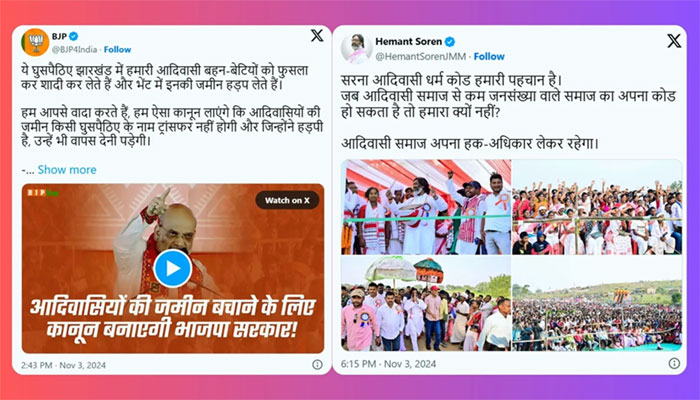
In light of this dire situation, the Bharatiya Janata Party (BJP) has pledged that if the National Democratic Alliance (NDA) gains power in the state, it will not only stop infiltration but also enact laws to reclaim land occupied or fraudulently acquired by infiltrators. Apart from infiltration, the Sarna Dharma Code has become a prominent issue in these elections.
Source: OpIndia Hindi
What is the Sarna Dharma Code?
As of now, Indian law recognises six religious communities: Hindu, Muslim, Christian, Sikh, Buddhist, and Jain. The Congress-HMM alliance, which denies concerns about infiltration, has promised to implement the Sarna Tribal Religious Code.
In November 2020, the INDIA coalition government convened a one-day special session of the Jharkhand Assembly to unanimously pass a proposal to include ‘Sarna’ as a separate religion in the 2021 Census. Despite questioning the government’s intentions, the BJP supported this proposal. Subsequently, Chief Minister Hemant Soren wrote to Prime Minister Narendra Modi, reiterating the demand.
While releasing its manifesto for the Jharkhand elections, Union Home Minister Amit Shah stated that the BJP would consider the Sarna Code and make appropriate decisions. Shivraj Singh Chouhan, the BJP’s election in-charge for Jharkhand, reiterated this stance on several occasions. Assam Chief Minister and election co-incharge Himanta Biswa Sarma went further, promising that the party would implement the Sarna Code if it forms the government.
The Sarna Code recognises tribal society as a distinct religious group. While the BJP has not publicly opposed it, its stance in this election appears softer compared to the RSS’s ideology, which considers tribal society part of Hinduism. The RSS, through organisations like the Vanvasi Kalyan Ashram, operates in tribal areas with this belief. Sandeep Oraon, regional coordinator (Bihar-Jharkhand) of the RSS-affiliated Tribal Security Forum, claims that implementing the Sarna Code would create several problems at various levels.
The Sarna Code will not address the issue of Christian conversion engulfing tribal society. From 1871 to 1951, tribal societies were recognised as a separate religious group in the Census, yet Christian conversions persisted, beginning in 1873 in Khuntpani, as discussed earlier.
Can the Sarna Code counter Christian conversions?
Similar to Khuntpani, Madku Dweep in Chhattisgarh’s Mungeli district also hosts religious fairs promoting Christianity. Surrounded by the waters of the Shivnath River, the island is believed to be the site where Rishi Mandukya composed the ‘Mundaka Upanishad’, which inspired the motto ‘Satyamev Jayate’.
Reaching this island is challenging. In September 2022, I crossed the river by boat to visit it. However, I was shocked to see a platform with a cross on this deserted island. The largest annual gathering here is a week-long Christian fair held every February since 1909.
Kharkona’s story mirrors Khuntpani
Chhattisgarh’s Jashpur district is a major hub of Christian conversion activities. The country’s largest church is located in Kunkuri, within Jashpur district. The conversion of tribal society in this region began even when Sarna was recognised as a separate identity under British rule.
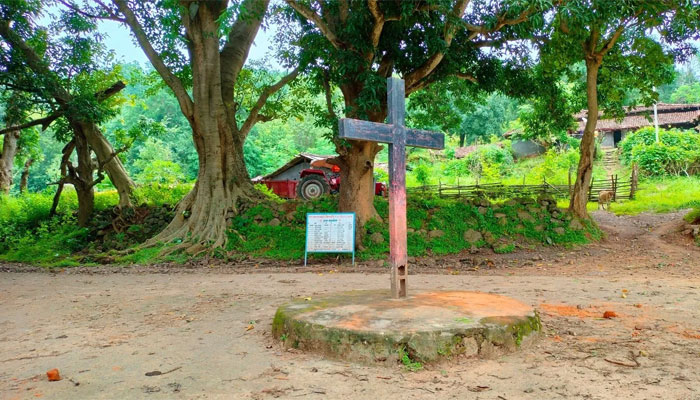
In the Manera block of Jashpur district lies a village called Kharkona. Upon entering the village, visitors are greeted by a Cross Square. A plaque near the church lists the names of 56 individuals baptised on 21st November 1906. In this village, I also visited ‘Sahib Kona’, which hosts annual events for converted Hindus.
The devastating impact of Christian conversion is evident in Jashpur. According to government records, one in every four people in the district identifies as Christian. This demographic shift occurred despite the significant influence of a royal family recognised for its efforts to counter missionary conspiracies and facilitate the return of converted Hindus (especially tribals) to their ancestral faith.
Clement Lakra’s 30-year fight for Sarna recognition
The fight for Sarna recognition predates the 24-year-old state of Jharkhand. It has spanned over 30 years, symbolised by the struggle of 58-year-old Clement Lakra. During my 2022 visit to Clement’s home in Duldula, Chhattisgarh, he shared:
“My father was deceived. He was made a fool. The day I understood this, I lost my faith in Christianity. I vowed to reclaim the Sarna faith that they (the Catholic institution) desecrated and return to my ancestors’ religion. Let’s see how long I can fight them.”
Clement, a father of two daughters, resides in Duldula within Chhattisgarh’s Kunkuri Assembly constituency. His wife, Sushma Lakra, is the sarpanch of Duldula. Photographs on the walls of their home indicate the family had converted to Christianity, while documents scattered on a corner table narrate the hardships they endured post-conversion.
Clement’s approximately 10 acres of land is now occupied by a Catholic institution. This land houses a church, a school, residences for priests and nuns, and farmland cultivated by members of the institution. Clement’s father, Bhade alias Vashil Oraon, lost this land in exchange for converting to Christianity.
Despite winning a legal battle against the Catholic institution, Clement has yet to reclaim the land. Instead, Catholic officials and their allies harass his family, obstructing development work in Duldula Panchayat. They have pressured his wife to convince Clement to withdraw the case. Recalling one incident, Clement said, “In February 2022, a meeting was held in the church. I was told that if I didn’t withdraw the case, I’d be ostracised from society. They even threatened that no one would marry my daughters.”
Christian missionaries seize opportunities even in disasters
An organisation called Unfolding Word works on the mission of translating the Bible into every language. Its CEO, David Reeves, made shocking revelations in 2021. He disclosed that around 100,000 people were converted to Christianity during the Covid-19 pandemic. Each church was tasked with organising prayers in ten villages. During the pandemic, when physical gatherings were restricted, prayers were disseminated via phone calls and WhatsApp.
According to Reeves, the number of churches built in India during the pandemic surpassed the total constructed in the preceding 25 years. One such church was observed in Jashpur’s Girang on forest department land. This church, constructed in an inaccessible area with no pathway, was eventually closed after protests halted its construction. Abhishek Gupta, affiliated with the BJP’s youth wing, told OpIndia, “Christian missionaries engage in land jihad in this manner. Wherever they find vacant land, they plant a cross and build a church. Over time, they conspire with the administration to construct access pathways, and soon prayers begin. Later, no matter how much one protests, the administration refuses to remove the encroachment.”
This church was being constructed during Covid-19 pandemic and the construction was stopped after protests. (Image: OpIndia Hindi)
Can the Sarna Code stop the Joshua Project?
The Joshua Project, a US-based organisation established in 1995, claims to work under the biblical directive to convert and baptise people globally. According to reports, the organisation builds churches on tribal lands in states like Madhya Pradesh, Chhattisgarh, Jharkhand, and Odisha. In 2011–12, these four states had approximately 12,000 churches, which have now grown to over 25,000. This expansion has occurred despite laws prohibiting outsiders from purchasing tribal land.
After converting tribals to Christianity, missionaries often ask them to cut down Sarna trees, which hold sacred value for tribal communities. The impact of Christian conversions is so extensive that entire villages have been converted. In some cases, only a few Hindu families remain. Outside villages where missionaries have succeeded, crosses are erected as a symbol of dominance.
When Christian population surpasses majority mark in any village, a cross like this gets placed in the village.
The Joshua Project’s activities extend beyond tribal communities. It has collected data on India’s 2,272 castes and tribes. The organisation reports that it has yet to reach 2,041 of these groups but has already influenced 103. Among these, some groups have seen significant Christian conversions, with 10%–100% of their populations converted in several cases.
‘Roti-beti-maati’ and the BJP’s election campaign
Centred around ‘roti-beti-maati’, the BJP has brought the dual threat of infiltrators and Christian missionaries to the forefront of its election campaign. Discussions now revolve around the legitimate and illegitimate methods used by churches to expand their presence across villages. To ensure that converted individuals from tribal communities retain their reservation benefits, many are being classified as crypto-Christians.
Even the Madras High Court has flagged this issue. In a case involving Catholic priest George Ponnaiah from Kanyakumari, Justice G.R. Swaminathan noted significant demographic shifts in the region. Referring to Kanyakumari’s religious composition, the judge observed:
“There has been a noticeable demographic shift in Kanyakumari’s religious composition. Since 1980, Hindus have ceased to be the majority in the district. However, the 2011 Census still identifies Hindus as the largest religious group at 48.5%, which might not reflect the ground reality. A significant number of Scheduled Castes have converted to Christianity but continue to identify as Hindus to retain reservation benefits.”
The need for political and societal action
This trap is not a recent phenomenon, nor is it limited to Jharkhand alone. It has deeper roots and a wider impact, threatening tribal and Hindu communities across India. While strict anti-conversion laws may act as a deterrent, they are not enough to counter this menace comprehensively. Hindu society cannot afford to remain complacent, relying solely on political parties, organisations, or a few families to fight against Christian missionaries.
To rescue Hindus from this vicious cycle, political and administrative willpower is crucial. Equally important is for every Hindu to remain aware and vocal about the demographic changes unfolding in their surroundings. Unfortunately, in independent India, neither politics has consistently demonstrated such resolve, nor has Hindu society compelled collective action on these issues.
Political forces often exploit tribal identity issues, such as the Sarna Code, to divide Hindus while inadvertently aiding missionary activities. When the proposal to recognise Sarna as a separate religion was brought to the Jharkhand Assembly, the BJP expressed concerns about the potential divisions it could cause. Now, the BJP must focus on measures to counter missionary activities permanently.
The party needs to adopt the same level of aggression against Christian conversions as it demonstrates against infiltration. If this issue is not addressed promptly, the ongoing demographic battle will further weaken Hindus on the ground—weakening the foundation of the larger vision of ‘Akhand Bharat’.
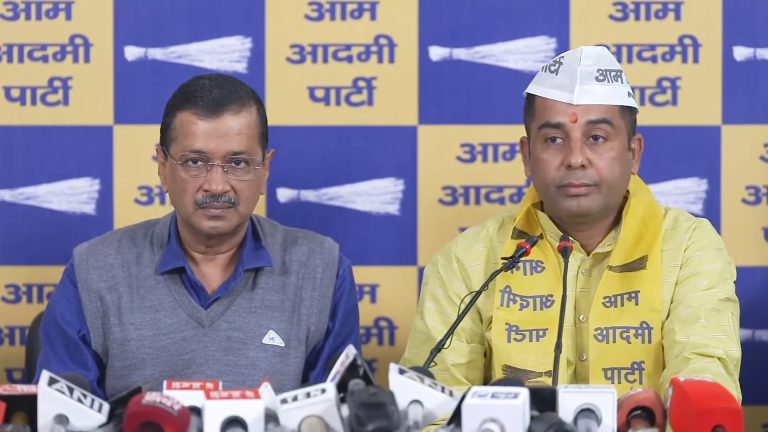
Former BJP MLA Anil Jha on Sunday joined the Aam Aadmi Party (AAP) in the presence of party’s national convenor Arvind Kejriwal.
Jha, a two-time BJP MLA from the Kirari Assembly constituency, joined the AAP at an event in the national capital. This came after Kailash Gahlot, a senior leader of the Aam Aadmi Party (AAP) and minister in the Delhi Government, quit the AAP.
“I thank those who weaved the fabric of social justice for the people of Purvanchal, Dalits, and backward classes. There is no place for Purvanchal in the party I used to work for. I thank Arvind Kejriwal who worked for the people of unauthorized colonies. If anyone is strengthening the slogan of social justice, it is Arvind Kejriwal. The people of Purvanchal, Magadh, and Awadh are standing with you,” Jha said while speaking to the media.
Welcoming Anil Jha, Kejriwal said that he (Jha) is considered one of the biggest leaders of the Purvanchal community.
AAP national convenor also hit out at the opposition (Congress and BJP) parties, saying that both parties have only served injustice to the community. He further praised the AAP government for bringing development in the “illegal colonies” of the Purvanchal community.
“I welcome Anil Jha to AAP. He is one of the leaders who worked for the people of Purvanchal. Anil Jha is considered one of the biggest leaders of Purvanchal. When people of UP and Bihar couldn’t get a better education and services in their state, they came to Delhi for education and employment. When the DDA failed to build houses for the poor, then illegal colonies were built and a large number of people from Purvanchal lived in them. Both parties (Congress and BJP) have done injustice to the people of Purvanchal. When I became the CM, for the first time I started laying roads, sewers, and water pipelines in illegal colonies. We have laid water pipelines in 1650 out of 1750 illegal colonies…,” Kejriwal said while addressing a press conference.
Kejriwal further accused the Centre of overlooking the Purvanchal community and questioned the BJP about the work done by them for the community.
“There are two governments in Delhi, one is the state government and the other is the central government. Both have power and resources. The center has a lot of money. Delhi Govt is a small govt. The Delhi government has done so much work for the Purvanchal people. Amit Shah and BJP should tell what they did for the people of Purvanchal. They did not have the intention. Why should the Purvanchal community vote for them?… BJP has only cheated people. In the last election, to get the votes of the Purvanchal community, Amit Shah and Hardeep Puri had announced that they were starting registration, but in five years not even a single registration has been done in slum colonies. Although a lot of work still needs to be done, but we have worked in the last ten years,” he added.
(This news report is published from a syndicated feed. Except for the headline, the content has not been written or edited by OpIndia staff)
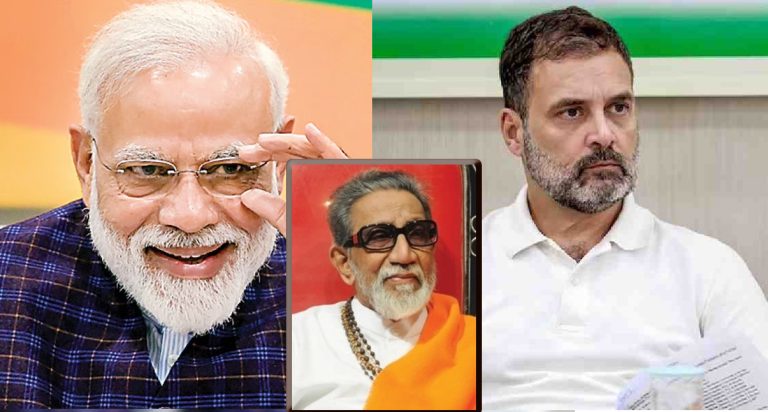
Three days after Prime Minister Narendra Modi challenged the Shiv Sena (Uddhav Thackeray) to get Congress to praise Balasaheb Thackeray, Rahul Gandhi on Sunday posted a tweet remembering the Shiv Sena founder on his death anniversary.
Rahul Gandhi tweeted, “Remembering Balasaheb Thackeray ji on his 12th death anniversary. My thoughts are with Uddhav Thackeray ji, Aditya and the entire Shiv Sena family.” Notably, this is the first time Rahul Gandhi has ever posted on the senior Thackeray on social media. Even though now Uddhav Thackeray is in the Congress camp, Bal Thackeray was a staunch opponent of the Congress party and its appeasement politics.
Remembering Balasaheb Thackeray ji on his 12th death anniversary. My thoughts are with Uddhav Thackeray ji, Aditya and the entire Shiv Sena family.
Rahul Gandhi’s tweet comes after Narendra Modi on Thursday dared Uddhav Thackeray to get the “shehzada of Congress” to praise Balasaheb Thackeray. He said that Uddhav Thackeray has handed over the ‘remote control’ of his party to the Congress party.
PM Modi said in an election rally in Shivaji Park in Mumbai, “Mumbai is a city of self-respect, but a party in Maha Vikas Aghadi has handed over its ‘remote control’ to those who insulted Balasaheb Thackeray.”
He then added, “That is why I challenged them to get the Congress to praise Balasaheb Thackeray. To date, these people have not been able to get the Congress and the ‘shehzada’ of Congress to praise Balasaheb.”
However, while Rahul Gandhi tweeted about Bal Thackeray on his death anniversary, there no praise from him. The Congress MP only ‘remembered’ him, and there was no praise for the Shiv Sena founder as challenged by PM Modi. It is evident that Rahul Gandhi posted about Bal Thackeray only for political compulsions, because had he remained silent, he and Uddhav Thackeray would have been targeted by the ruling Mahayuti alliance.
But his remembrance of Bal Thackeray came across as a half-hearted effort, as there was no positive word for the deceased leader, which is customary for such messages.