Home Blog Page 638

The Wire columnist compares Afghanistan’s currency with INR to insinuate its economy is stronger than India’s, becomes the butt of all jokes

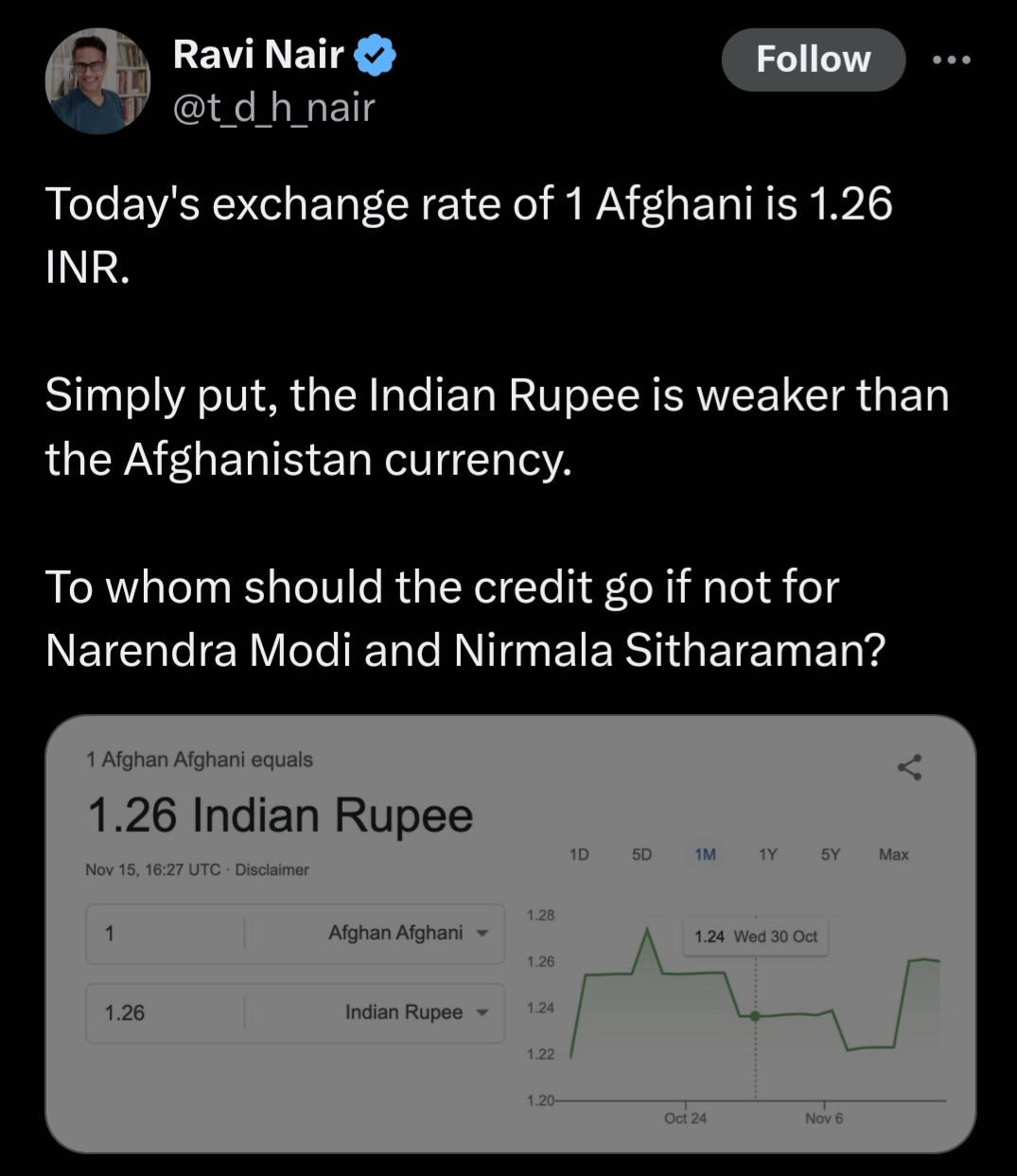
Low IQ leftwing propagandist Ravi Nair recently became a butt of all jokes after he compared the Afghan currency with the Indian rupee to take a swipe at the Modi government.

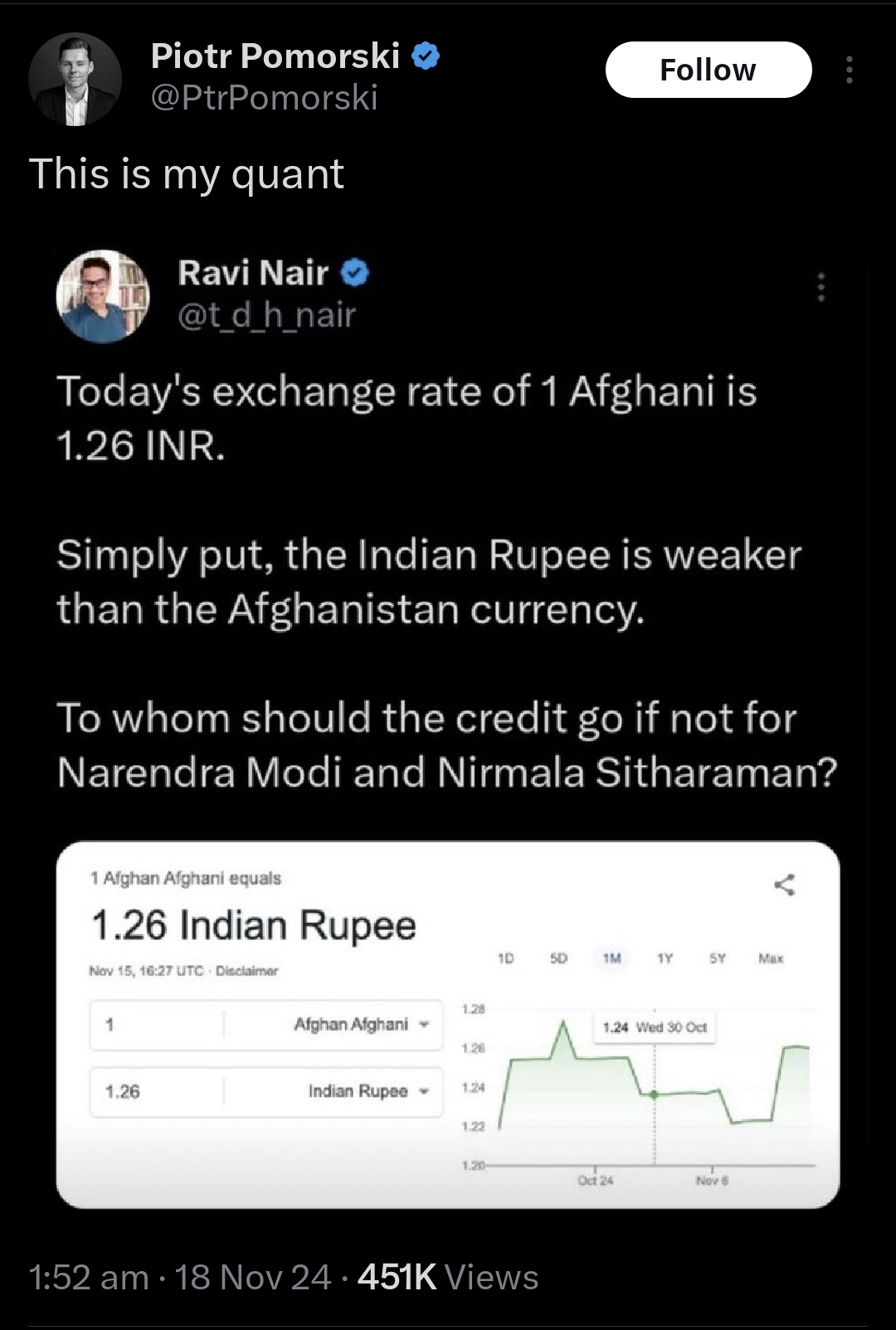
Nair, infamous for being a loyal henchman for the far-leftist propaganda portals like The Wire, Newsclick, etc. to promote wild allegations and ridiculously nonsensical insinuations against the Modi regime, posted a tweet that implied that the Afghanistan’s currency is stronger than the Indian Rupee because 1 Afghani is equivalent to Rs 1.26.

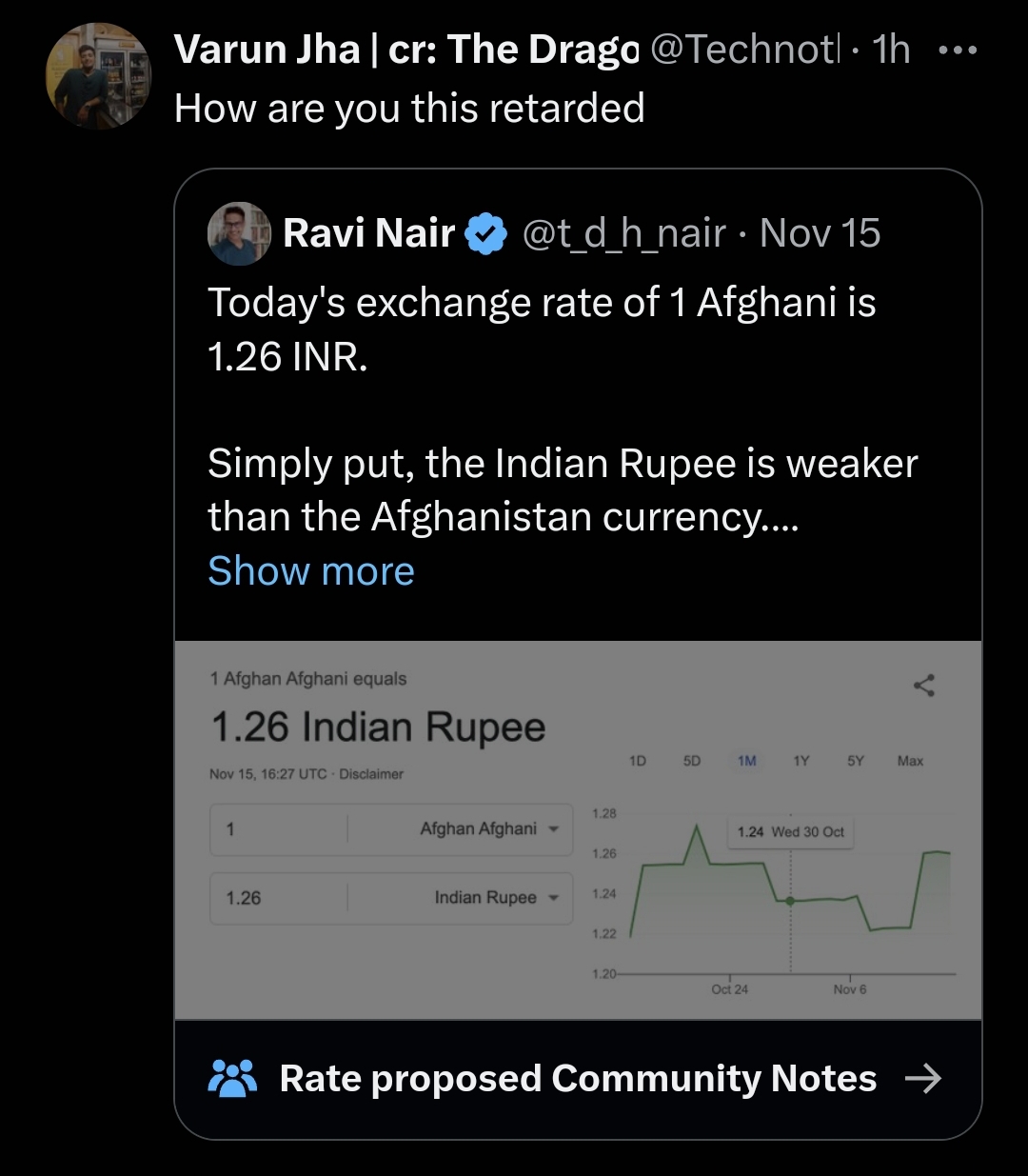
While one cannot be sure whether Nair was being naturally retard or deliberately disingenous to fool his brainless followers into beliving that a perpetually strife-torn country’s currency could be stronger than the world’s fifth largest economy, it, nevertheless, failed to deceive social media users who ridiculed him for his insanine comparison.

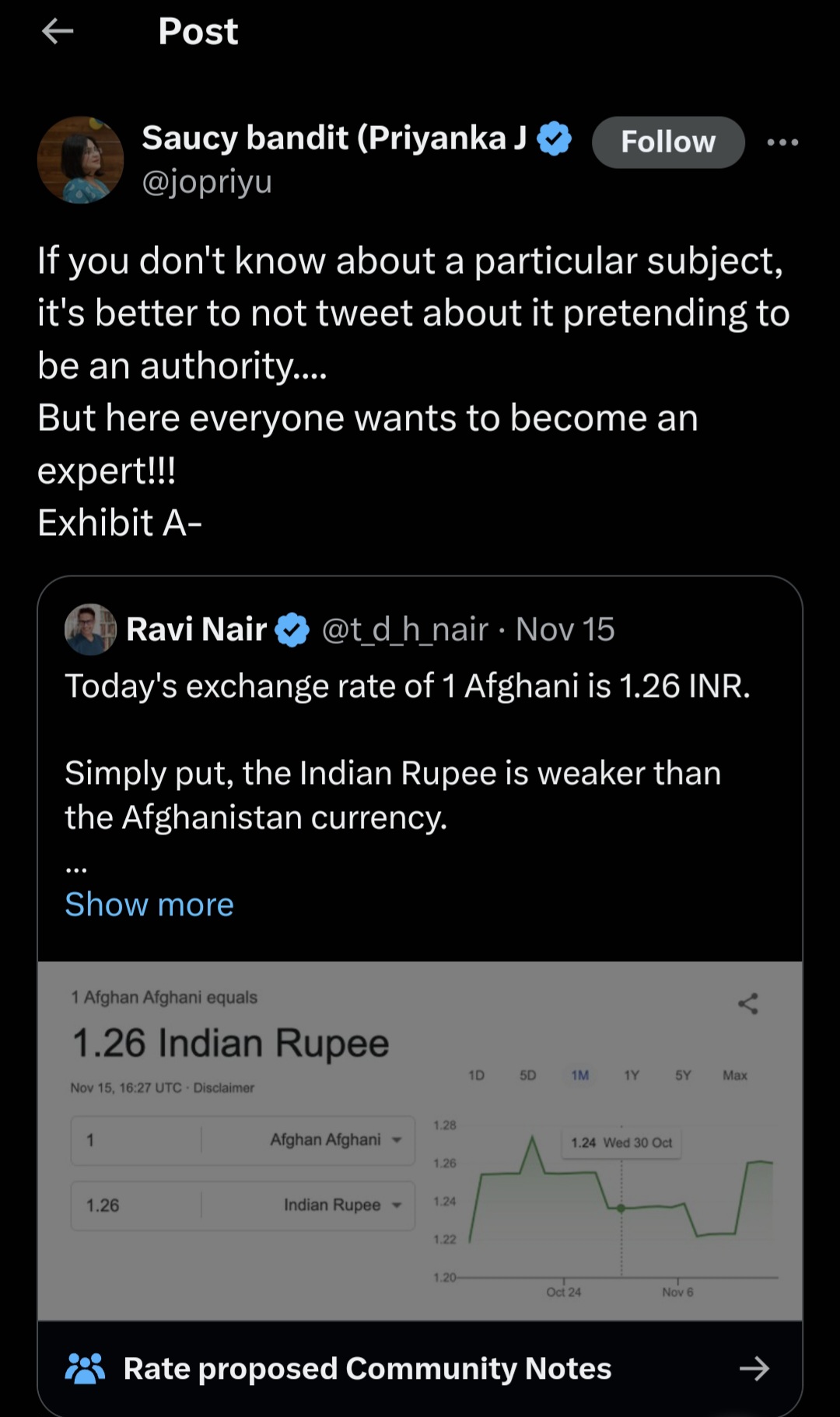
Social media users from India as well as around the world mocked Nair for his tweet insinuating that the Afghan economy is stronger than the Indian economy.

There are several flaws in Nair’s assertions, the primary being a unit of one currency greater than a unit of other currency being an indicator of the former’s economy being in a better shape than the latter’s. Economy of a nation, by its depth and complexity, is an incredibly profound concept that cannot be pinned down to just how a country’s currency fares as compared to another country’s currency.

For instance, an Indian Rupee is equivalent to 1.84 Japenese Yen doesn’t mean that the Indian economy is bigger than Japan’s. India’s economy size is slated to be $3.89 trillion in nominal GDP while Japan’s $4.1 trillion. Despite being in greater in size, the Japanese currency is almost 50 percent weaker than the Indian Rupee.

Secondly, the Afghan currency (Afghani) has indeed improved dramatically following the ouster of the United States and Talibani takeover in May 2021, but it is chiefly because for a long time before the Taliban’s return, the government in Afghanistan was controlled by the US and the Afghans had started using US dollars and Pakistani rupee locally.

The Taliban had banned using them after coming to power and enforced the use of Afghan Afghani as the national currency. The Taliban had also outlawed online trading and threatened those who violate the rules with imprisonment. This had naturally spiked demand for Afghan rupee and its value had improved significantly, while the economy remains poor and dismally undiversified, rendering it risk-prone to the vagaries of global economies and supply-chain woes.

But Modi detractors like Nair are not bothered by such nuances since genuine criticism of the governmemt has never been their priority. They are preoccupied with weaving a web of negative campaign against the Modi government and discredit them, even if that means fooling their followers and employing sophistries to further their agenda.

It is notable to mention that Nair was schooled by the Election Commission of India earlier this year for casting aspersions on EVMs. Ravi Nair had alleged that because the VVPAT machine sends some data to the Control Unit, like battery charge and the paper availability, it means that VVPAT communicates with the CU, with the implication that this can be used to manipulate vote data stored in the control unit.

Responding to a post by left-wing propagandist Ravi Nair aimed at casting aspersions on EVMs, the Election Commission of India (ECI) schooled him on Sunday (14th April) about the basic functioning of EVM machines. The poll body also highlighted the ‘difference’ between the basic English words ‘command’ and ‘communication’ to point out the mischievous blunder in Nair’s post.  

Nair had also been at the forefront of the disinformation campaign mounted by Congress and Rahul Gandhi over the purchase of Rafale jets with the French aviation company Dassault. Though Congress and opposition shills tried really hard to entangle the Modi government in what they called ‘Rafale scam’, the allegations fell flat as the Supreme Court pronounced that there was no wrongdoing in the deal. After EVMs and Rafale deal, this time, Nair seems to have zeroed in on the economy to embarrass himself.

Chhattisgarh: Mukhtar Ansari killed 3 members of a Hindu family, including 2 minors, with an axe, skeletons found two months later

0

On Friday (15th November), 3 skeletons were found in the Dahejwar village in Balrampur, Chhattisgarh. The investigations into the case revealed that the recovered skeletons were of a woman and her two children. Following this, the police arrested a man named Mukhtar Ansari for allegedly committing the horrific triple murder. The victims of the brutal murders included a 17-year-old girl.

Reports say that accused Mukhtar’s elder brother Arif Ansari was in a relationship with the minor girl and was thus not sending money to his family. Infuriated over this, Mukhtar allegedly killed the minor girl, her mother and brother (also minor).

Speaking about the matter, Balrampur SP Vaibhav Banker said that the accused Mukhtar Ansari, originally from Jharkhand, was arrested by the police and presented before the court. The police have taken the 38-year-old accused on a five-day remand from the court. The remaining details of the case will be revealed after interrogating the accused.

Earlier, on Friday, three human skeletons were discovered in a field near a closed fly ash bricks plant, with three skulls and other body parts recovered. Sarees, salwars, trousers, and other garments were also found at the location. The deceased trio were identified as Surajdev Thakur’s wife Kaushalya Thakur (36), daughter Muktavati alias Muskan Thakur (17), and son Mintu Thakur (6), who had been missing from Kusumi since the 27th of September.

The investigation revealed that Muskan Thakur had a love affair with the accused’s brother. Arif Ansari, the younger brother of the main accused Mukhtar, who worked as a contractor. Reports say that the relationship between Arif and Muskan has been confirmed by their call details and messages.

It has been reported that accused Mukhtar Ansari’s father was bitten by a snake, due to which his body parts are rotting. Despite this, his younger brother Arif did not send money for his father’s treatment. Mukhtar Ansari was angry with this and hatched a conspiracy to kill Muskan and her family.

On the 27th of September, Mukhtar Ansari arrived at Kusumi and convinced his brother’s girlfriend, her mother and her little brother to travel with him. When all three were sleeping at night, he attacked them with an axe several times on their heads and foreheads. After brutally murdering the trio, Mukhtar threw their bodies in a drain in a paddy field filled with water. Since the bodies were in water, the stench did not spread. It was only after the paddy field’s owner, a Maharajganj resident came and found the shattered skeletons, that he informed the police.

Meanwhile, Balrampur Police has also been accused of negligence, as although a missing persons case was registered, they allegedly refused to register a criminal case back in September even as Surajdev Thakur suspected that Arif may have kidnapped Thakur’s family.

The police said that an investigation is underway to find out if the victims came to Balrampur only at the behest of the main accused Mukhtar Ansari or if his brother Arif Ansari was also involved in the crime.

Kerala: JCB owner N Thangaraj fined Rs 45 lakh for wetland violation for removing soil from a Kabristan, Mosque authorities who hired him excluded from punishment

0

N Thangaraj, a JCB owner in Kasaragod, Kerala, is facing severe financial troubles as Revenue officials have imposed a fine of Rs 45 lakh on him for removing soil from a Kabristan area near the Nazrat-ul-Islam Jamaath Mosque in Ganesh Mukku. The action against him was initiated on allegations of illegally filling wetlands listed in the data bank.

As a result, Thangaraj’s JCB was confiscated by the district collector. Despite providing clarification that he was hired by the mosque committee to remove the soil, he has been left solely accountable for the penalties as the committee has distanced itself from Thangaraj.

The sequence of events

On 24th June 2023, Thangaraj was called by the mosque committee to remove soil from the Kabristan site. Soon after, Chandera Sub-Inspector MV Sreedas and agriculture department officials intervened, suggesting that the land from which the sand was removed was protected under the Kerala Conservation of Paddy Land and Wetland Act, 2008. They brought the JCB to the police station. Initially, the revenue department imposed a fine of Rs 12 lakh on Thangaraj for removing the sand.

The mosque committee lodged a complaint with MLA NA Nellikkunnu at the collectorate. However, on 14th June 2024, the penalty was raised to Rs 45 lakh. The district collector valued the JCB at Rs 29.9 lakh and imposed a fine equivalent to 1.5 times its value as per the Act.

On 27th July 2024, the JCB was confiscated by the collector from the police station under the provisions of the said Act, as Thangaraj was unable to pay the fine. The vehicle has since been rusting at the Chandera police station, leaving Thangaraj and his family in financial ruin.

Thangaraj said that the mosque committee abandoned him despite being the ones who had called him to remove the sand. He said, “The committee now claims I was not called and has refused to assist with the fine. I cannot enter the site with a JCB without being asked. There’s no way to survive.”

His family includes his wife and twin daughters. He has filed multiple petitions seeking relief but has not received any response. As per reports, Thangaraj purchased the JCB using all his life savings and a loan of Rs 37 lakh. For 18 months, his JCB has been collecting rust, and he has been unable to recover it despite all efforts. Thangaraj, in a statement, said that he and his family are on the verge of suicide as all sources of income have stopped.

What the law says about sand removal and penalties

The Kerala Conservation of Paddy Land and Wetland Act, 2008, prohibits the removal of sand or soil from wetlands to protect agricultural sustainability and the ecological balance. Under Section 11 of the Act, any unauthorised removal or reclamation of wetlands is banned. Section 20 grants district collectors the authority to confiscate machinery involved in such violations and impose fines up to 1.5 times the value of the seized property. These provisions aim to curb the rampant conversion and degradation of ecologically sensitive lands.

In Thangaraj’s case, the officials claim that he violated these provisions by aiding in the filling of approximately 60 loads of soil spanning an area of 20 metres by 12 metres. The Act categorically holds individuals accountable for activities contributing to wetland destruction, whether carried out knowingly or under directives from third parties. However, Thangaraj insists that he was misled by the mosque committee and has sought mercy from the authorities. While the Act imposes severe implications for violating wetland conservation laws, it requires clarity on the division of responsibilities between landowners and contractors.

How Wikimedia Foundation makes editorial decisions for Wikipedia, censors dissenting admins and engages in favouritism

Wikipedia and its content is controlled in their entirety by the Wikimedia Foundation, even though the latter claims to not interfere in the editorial decision-making process, reported Pirate Wires.

The year was 2019. A prominent Wikipedia admin ‘Fram’ was handed a year-long ban by the free-encyclopedia, reported Ashley Rindsberg of Pirate Wires in August thus year.

It was unique in the sense that the ban was not enforced by the English Wikipedia Arbitration Committee (Arbcom) but by the NGO Wikimedia Foundation that owns Wikipedia.

Favouritism and conflict of interest

The drastic and abrupt decision saw the resignation of 2 Wikipedia bureaucrats (high-ranking editors who can assign admin rights) and 18 admins (editors with enhanced rights) in protest.

The top-down ban on Wikipedia admin ‘Fram’ marked a departure from the free encyclopedia’s supposed principles of consensus, openness and self-governance. The issue had become so big that even co-founder Jimmy Wales was forced to intervene.

It later transpired that the banned Wikipedia admin ‘Fram’, who had over 2 lakh edits to his name, had an altercation with another editor named Laura Hale.

Hale, a PhD student in Australia at that time, was in a long-term relationship with another Wikipedia editor named Maria Sefidaris. Coincidentally, the latter was the Chair of the Wikimedia Foundation Board of Trustees.

Additionally, she was part of top-level decision-making committees at the Wikimedia Foundation. Maria Sefidaris had come to her partner Hale’s defence amid her feud with Wikipedia admin ‘Fram’.

Attempts to portray herself as a victim in the aftermath of the #MeToo Movement also drew support for Hale from the Wikipedia faction ‘Women in Red’

But soon accusations surfaced about how Maria Sefidaris might have influenced her position in the Wikimedia Foundation to enforce the ban on ‘Fram’ over his confrontation with Sefidaris’ love interest Hale.

It also came to light that Hale was able to secure a paid project at ‘Wikipedian in Residence’ for the Spanish Paralympic Committee despite starting to learn the language only a few years prior.

“Salacious as it all was, if this had been the end of the story, it would have been an unpleasant, but quirky, footnote in Wikipedia history. In reality, it was only the beginning of a fundamental change that would replace the decentralized ethos of the site’s founders, and impose the WMF agenda on Wikipedia to use it as a tool for progressive social change,” Pirate Wires stated.

Wikipedia admins serving personal interests

In 2021, Maria Sefidaris stepped down from the Board of Trustees of the Wikimedia Foundation to become a ‘paid consultant’ at ‘The Movement Strategy.’ This created a hullabaloo among the Wikipedia community about ‘self-dealing.’

The General Counsel of the Wikimedia Foundation, Amanda Keton, came to her rescue and attempted to rationalise the decision.

According to Pirate Wires, ‘The Movement Strategy’ was launched in 2017 to veer Wikipedia from an alleged ‘decentralised knowledge platform’ to one with a ‘hyper-centralised space of top-down justice activism and advocacy’ by 2030.

Maria Sefidaris was directly named at the launch event of ‘The Movement Strategy’.

The Movement Strategy and the agenda till 2030

The ‘free-encyclopedia’ thereafter began its pivot towards championing DEI (Diversity, Equity and Inclusivity) goals.

Wikipedia eventually violated its ‘No Original Research’ policy to promote pages such as ‘Black Lives Matter,’ ‘Police Brutality in the United States,’ ‘Racism in Oregon’ and ‘US National Anthem Protests.’

Pirate Wires noted, “Instead of aggregating information from other sources, Wikipedia editors began both going to protests and proactively reaching out to photographers who would be willing to allow Creative Commons use of protest photography.”

The Movement Strategy also served another purpose. It focused on filling the coffers of the Wikimedia Foundation deep into the future.

A partnership with Google

Wikipedia’s vast dissemination of ‘free information’, carefully curated and verified by its coterie of motivated editors, earned the top spot on Google’s search engine including its knowledge graph.

Google in turn benefitted Wikipedia through regular donations, including a sum of $2 million in 2010.

“Google could donate funds that would eventually get funneled into grants for radical social justice programs with a hefty degree of plausible deniability and no small amount of opacity,” Pirate Wires noted.

OpIndia dossier on Wikipedia and govt intervention

On 5th November, the Modi government sent a notice to Wikipedia pointing out the biased and inaccurate information published by the ‘free  encyclopedia.’

The notice was issued by the Union Information and Broadcasting (I&B) Ministry. It highlighted the hegemony of a small group of editors and their control over its content.

The Modi government has asked Wikipedia why it shouldn’t be treated as a publisher instead of an intermediary.

It is important to mention that OpIndia highlighted the same issue in its 187-page dossier published on 9th September 2024.

By definition, an intermediary is not supposed to follow a specific editorial line. It is meant to merely be a platform for the public to air their own views. However, that is not the case with Wikipedia.

Firstly, not everybody can air their views on Wikipedia. Secondly, only a small group of editors and administrators have the final say on the nature of content that is added in any articles, making the articles one-sided, biased, and toeing a specific ideological line.

Thirdly, several of these so-called ‘volunteers’ are paid by the Wikimedia Foundation to further their ideological and business interests.

The sources that are allowed to be quoted in Wikipedia articles also suffer the same bias, often injected by editors and administrators who are directly paid by Wikimedia Foundation.

With all of these realities, Wikipedia does not fall under the intermediary category, but the publisher category – additionally – a publisher that is actively undermine the interest of India without following the law of India – financially or editorially.

Joe Biden throwing oil on fire: Russia reacts to US allowing Ukraine to use American missiles to target Russian territory

On Monday, November 18, Russia reacted to reports that US President Joe Biden has allowed Ukraine to launch US supplied long-range-missiles into Russia. Kremlin spokesperson Dmitry Peskov, reacting to the development, said that the United States is “throwing oil on the fire” with the decision.

Accusing outgoing President Joe Biden of increasing tensions with this decision, Peskov said, “If such a decision has been taken, it means a whole new spiral of tension and a whole new situation with regard to US involvement in this conflict”.

Peskov also said that such a decision by the Biden administration signals NATO’s direct involvement in the ongoing Russia-Ukraine war.

The statement from the Kremlin added that if missiles provided by the US are fired deep into Russia, Moscow will view the attack as not from Ukraine, but from the US itself.

Notably, Biden Administration’s decision to allow use of long range US missiles to target Russia comes less than 2 weeks after the Democrats lost the Presidential Elections to Republican candidate Donald Trump, who has long advocated bringing the war to an end.

Earlier, on November 17 (local time), the administration of United States President Joe Biden allowed Ukraine to use the US-supplied long-range missile to strike inside Russia, which marked a significant change in the policy of the United States in the Russia-Ukraine conflict.

Meanwhile, after Joe Biden’s decision, its NATO-ally Germany said that Germany stands by its decision to not provide long-range missiles to Ukraine.

A German government spokesperson was asked whether there may be a shift in its policy after the US decision to allow Ukraine to fire long-range missiles into Russia.

Why the Haka inside New Zealand Parliament? As Maori MP’s unique protest goes viral, here why a treaty from 1840 is the reason behind it

New Zealand is witnessing a major protest by the indigenous Maori people with thousands marching towards the national capital Wellington over a controversial bill redefining the Treaty of Waitangi. The country’s political theatre caught global attention when on the 14th of November, New Zealand’s youngest Member of Parliament Hana -Rawhiti Maipi-Clarke tore up a copy of the bill and performed a traditional Maori (Māori) haka dance joined by some others in the parliament as a mark of protest against the bill titled Principles of the Treaty of Waitangi Bill.

While the political drama led to a temporary suspension of the proceedings of the House, a video of the same went viral on social media.

The 1840 Treaty of  Waitangi and incessant clashes over the quest for ‘equality’ for all New Zealanders versus the preservation of Maori ‘rights’

The Treaty Principles Bill has been brought forth by the ACT New Zealand, a junior partner in the governing centre-right coalition government, to revise the provisions of the Treaty of Waitangi (Te Tiriti o Waitangi). The Treaty of Waitangi is an 1840 agreement between nearly 500 Māori chiefs and the British crown. This treaty is of immense significance to Maori rights and governance in New Zealand, stressing mutual cooperation and the principles of protection.  

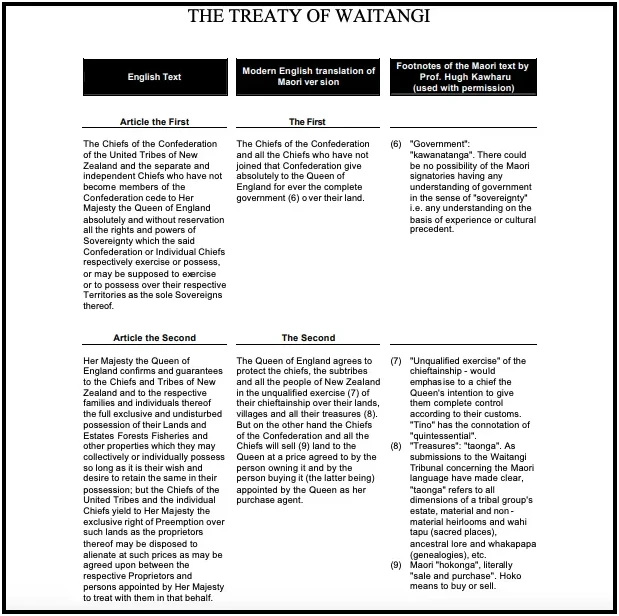
Articles 1 and 2 of the Treaty of Waitangi 1840 with English and Maori interpretations (Source: nzhistory.govt.nz)

The Treaty was a political agreement between the British and Māori to establish a nation and government in New Zealand. It outlines fundamental principles and contains three articles. In the English version, Maori relinquish sovereignty over New Zealand to Britain and provide the Crown the exclusive right to buy their lands, forests, fisheries, and other possessions in exchange for full ownership rights. They are also granted the rights and privileges of British subjects. Although the Maori version of the Treaty is believed to reflect the same meaning as the English version, there are significant variances such as the term ‘sovereignty’ being rendered as ‘kawanatanga’ or governance.

Some Maori believed they were relinquishing control over their lands while preserving the authority to run their own affairs. The English version guaranteed ‘undisturbed possession’ of all their ‘properties’, whilst the Maori version guaranteed ‘tino rangatiratanga’ or complete authority over ‘taonga’ (treasures, which could be intangible). A New Zealand History article suggests that Maori and Crown negotiators had different understandings of the Treaty and thus making it a perennial issue of debate and contention. On various occasions, the Maori people have protested demanding the government to “honour” the treaty.

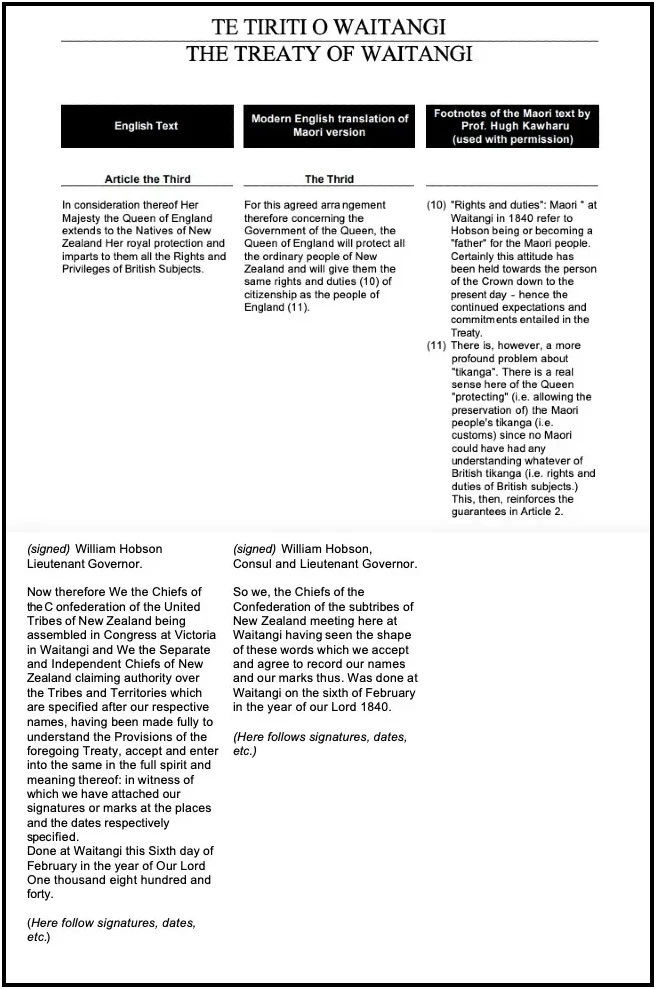
Article 3 of the Treaty of Waitangi

While the ACT party advocates extending Indigenous Maori citizens’ treaty rights to all New Zealanders, regardless of ethnicity, the protesting Maori leaders and people who are taking out a nine-day march or Hikoi, argue that the alleged lack of consultation with Maori groups before tabling this bill violates the treaty’s key commitments. Meanwhile, the Waitangi Tribunal has also slammed the Treaty Principles Bill for allegedly undermining the partnership principle adding that it compromises their rights to self-governance and protection under the Treaty of  Waitangi. Notably, the Bill was introduced 7th of November and on the 14th of November 2024, the bill passed its first reading in the parliament with 68 votes in favour, 54 against and one uncounted since Maori MP Hana was suspended.

“Regarding the Crown’s policy development for the Bill, the Tribunal found the Crown’s process to develop the Bill has purposefully excluded any consultation with Māori, breaching the principle of partnership, the Crown’s good-faith obligations, and the Crown’s duty to actively protect Māori rights and interests. The Tribunal also found this policy process to be in breach of the principle of good government, as Cabinet has decided to progress the Bill despite it being a policy that is not evidence-based, has not been adequately tested, has not been consulted upon, and fails regulatory standards,” the Waitangi Tribunal said earlier.

Maori groups take out “Hikoi” against Treaty Principles Bill

Notably, approximately 10,000 protesters marched through Rotorua, New Zealand, voicing their opposition to the Treaty Principles Bill. As they made their way south towards the capital, Wellington, they were greeted by hundreds of supporters waving the Maori flag. The Hikoi (march in Maori language) is likely to reach Wellington on Tuesday, with participants staging rallies on their passage through towns and cities across the country. The Maori community, who make up 20% of New Zealand’s 5.3 million population, are opposed to the bill introduced by the ACT New Zealand Party, which they feel will lead to racial tensions and diminish Indigenous rights.

Maori protestors carrying their traditional flag (Source: The Post)

What the Treaty Principles Bill 2024 and its supporters say

The Treaty Principles Bill 2024 proposes extending the treaty to all New Zealanders through a referendum, but Maori leaders and activists argue that this will not only undermine Māori rights, but also promote anti-Māori discourse. The Bill is also unlikely to pass since ACT’s coalition partners, Prime Minister Christopher Luxon’s New Zealand National Party and the New Zealand First Party, have stated that they will oppose it in further readings despite their support in the first reading.

The Treaty of Waitangi remained in effect for 135 years until 1975, when the Labour government passed the Treaty of Waitangi Act. This Act indicated that the Treaty has principles, and it was the Waitangi Tribunal’s job to interpret them. The ACT argues that since the passage of the Waitangi Act 1975, the Tribunal, courts, and public service have over time expanded on the principles, however, the non-Maori New Zealanders have not been consulted on these principles.

“The Treaty Principles Bill will not change the Treaty itself. That was set in 1840 and will remain forever. What we are seeking to do is continue the process of defining the Treaty principles, for the first time incorporating the voices of all people through a democratic Parliamentary process, instead of through the Tribunal or the courts,” ACT said.

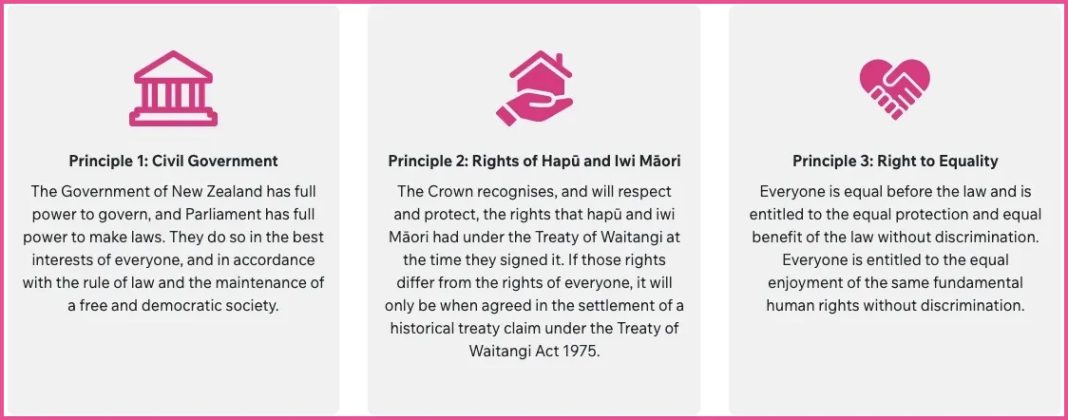
Just as the 1840 Treaty of Waitangi has three articles, the 2024 Treaty Principles Bill has three principles—Civil Government, Rights of Hapū and Iwi Māori and Right to Equality. Civil government—the Government of New Zealand has full power to govern, and Parliament has full power to make laws. They do so in the best interests of everyone, and in accordance with the rule of law and the maintenance of a free and democratic society. Rights of hapū and iwi Māori—the Crown recognises the rights that hapū and iwi had when they signed the Treaty/te Tiriti. The Crown will respect and protect those rights. Those rights differ from the rights everyone has a reasonable expectation to enjoy only when they are specified in Treaty settlements. Right to equality—everyone is equal before the law and is entitled to the equal protection and equal benefit of the law without discrimination. Everyone is entitled to the equal enjoyment of the same fundamental human rights without discrimination,”  the Bill reads.

The three principles of the 2024 Treat Principles Bill (Source: Treaty.nz)

Taking to X, ACT Party leader David Seymour who introduced the bill said that the Treaty of Waitangi promised “equality” and not “partnership”. He added that in the last elections, the people of New Zealand voted for stopping “divisive” policies like Three Waters, the Māori Health Authority, race-based waitlists, among others, with many of such policies being rolled back. However, Seymour raised concern that such policies favouring the Maori community could be brought back in the future if the 1840 Treaty’s principles were not clarified.

“At the last election, Kiwis voted to stop divisive policies like co-governance, Three Waters, the Māori Health authority, race-based waitlists, and two different chief executives at every government department. We’re now winding these policies back, but all of this could be back with the stroke of a pen unless we clarify in law that the Treaty promised equality, not a partnership. Without clarified Treaty principles that write equal rights into law, Labour can – and will – use the idea that the Treaty is a partnership to advance divisive policies that make it harder for us to solve our shared problems in housing, education, health, and the cost of living,” Seymour said.

Several New Zealanders on X pointed out that the police were partaking in the Maori protest march and painting posters and banners.

In another shocking incident, one of the Maori protestors snatched away the flag of New Zealand from a counter-protestor’s hand and tore it up.

The Maori people and their popular Haka

The Māori tribes had settled in Polynesia and New Zealand after arriving in enormous canoes on the seas. Their culture exemplifies a strong connection to the earth and ancestral spirits. Te Reo Maori, the Māori language, remains central to the Maori identity and is widely spoken by the community. The Māori people have a deep spiritual connection to nature and the land and they refer to themselves as ‘kaitiaki’ or the guardians of the natural resources. Moreover, they believe in the notion of ‘whakapapa’, which states that everything in the world is interconnected and has a genealogical connection.

The haka is integral to Māori identity and is typically performed by warriors on the battlefield or to welcome new tribes. The “Haka” demonstrated athletic prowess while also representing cultural pride, strength, and unity. Apart from warfare, the haka was also used for storytelling, expressing communal grievances, celebrating victories, and honouring ancestors. The waiata (chants), transmit profound lessons about Maori culture, values, and connection to the land. Notably, the Haka is not one dance, but rather a type of performance. The Maori people perform various forms of Haka, including the popular Ka Mate, Haka pōwhiri, Haka taparahi, and Peruperu for varied purposes.

While whether the Treaty Principles Bill 2024 gets passed and implemented or not remains to be seen, it has sparked a serious debate in the country with Maori people contending that their fight is to defend their culture from extinction on the other, the non-Maori New Zealanders feel that the Maori get several privileges and demand equality.

Uttar Pradesh: Intelligence Bureau and ATS launch investigation into funding of Maktabs and unrecognized Madarsas operating in Gonda

0

On Sunday, 18th November, the Intelligence Bureau (IB) initiated an investigation into the funding of 286 Maktabs and 19 unrecognized madrasas in Gonda. As per the reports, the IB is looking into various aspects of the case with the aid of the Uttar Pradesh Anti-Terrorist Squad (ATS).

IB officials visited the office of Gonda’s Minority Welfare Officer to obtain a list of the 286 Maktabs and 19 madrasas operating illegally without proper recognition. The objective of the said investigation is to uncover the sources of funding, understand the demographics of students attending these institutions, and determine why proper recognition has not been obtained. The investigation also aims to uncover how long these madrasas have been functioning.

While the UP ATS had already been probing the funding aspect, the IB’s involvement has intensified the scrutiny, causing a stir among madrasa operators and across the district. The madrasas in Gonda, primarily run by the Minority Welfare Department, operate to provide education to Muslim children. However, alongside government-subsidized, and aided madrasas, a significant number of unrecognized institutions are also operational.

The IB is investigating multiple aspects, including funding sources. Under government directives, the IB has identified these unrecognized madrasas and Maktabs and commenced a thorough inquiry into their funding. The findings from this investigation, which will also address other key concerns, will be compiled into a detailed report and submitted to the government and related agencies.

As per the reports, Gonda’s District Social Welfare Officer, Ramesh Chandra, has been instructed to support the IB officials during their investigation. This includes assisting in resolving any challenges faced by the investigation team and facilitating access to necessary locations and records. IB officials will examine a variety of factors and may summon documents from madrassa operators as part of the investigation.

A state-wide inspection of madrasas revealed that 4,000 were operating without recognition. In Gonda, 286 Maktabs and 19 unrecognized madrasas have been identified. The responsibility for investigating the funding of these institutions was assigned to the Anti-Terrorist Squad (ATS). To streamline the process, the madrasas were categorized department-wise, and separate ATS units were tasked with the investigation. Officers and personnel from UP ATS have been deployed to carry out the probe.

Both Maktabs and madrasas provide education to Muslim children, but there are significant differences between them. Maktabs focus solely on imparting religious education, and children usually return home after classes. Modern education is not part of their curriculum. Further, these Maktabs can operate without official recognition, allowing individuals or groups to provide religious education informally.

  • On the other hand, madarsas are institutions of higher learning that offer both religious and modern education. Unlike Maktabs, madrasas often provide accommodation for students along with their studies. Madrasas are generally recognized and follow a broader curriculum, combining traditional and contemporary teachings. Despite these distinctions, the operation of unrecognized institutions, whether Maktabs or madrasas, has raised concerns, prompting large-scale investigations into their activities and funding.

Gonda District Minority Welfare Officer, Ramesh Chandra, stated that the Intelligence Bureau (IB) has also been provided with the list of madrasas and Maktabs, as requested by them. The department is fully cooperating with IB officials in their investigation, and madrasa operators have been directed to assist as well.

600 Hindu and Christian families opposing Kerala Waqf Board’s claim over 404 acres of land in Munambam: All you need to know

The Munambam waqf land dispute has led to protests and political debates in Kerala. Around 600 Christian and Hindu families are opposing the Kerala State Waqf Board’s claim over 404 acres of land in the Munambam suburb of the Ernakulam district in Kerala. The Waqf Board has asserted that the said land was granted as waqf property in 1950. On the other hand, the residents have argued that they legally purchased the land decades ago. The controversy has gained a lot of traction owing to the bypolls in the state, with political parties using the matter for their own agendas.

Dispute origins and historical background

The Munambam waqf land dispute revolves around 404 acres of land in the coastal region of Munambam in the Ernakulam district of Kerala. There are 600 families living on the land, constituted primarily of Christians from the Latin Catholic community and Hindus from backward sections. These families have lived on this land for decades. The Kerala State Waqf Board has claimed ownership of the land, citing a waqf deed registered in 1950. The residents, however, have insisted that they own the legal rights to the land as they purchased it decades ago from Farook College, which was once entrusted with its management.

Historical origins of the dispute

The origin of the controversy dates back over 110 years to 1902, when the Travancore royal family leased the land to Abdul Sathar Moosa Sait, who was a prominent trader in the region. In 1950, Sait’s son-in-law, Mohammed Siddeeq Sait, registered a waqf deed dedicating the land to the President of the management committee of Farook College of Kozhikode. The deed specifically mentioned that the land would be used for charitable and educational purposes as per Islamic law.

Legal battles and property sales

In the 1960s, Farook College started the process to evict residents who were occupying the land, leading to a legal battle. These residents, who lived on the land pockets for generations, did not have the official documentation to prove their ownership. Eventually, the college management decided to have an out-of-court settlement with the residents and sold land pockets to them at the market price.

The sale, however, became another headache, as, according to the documents, the management of the college did not disclose that the land they were selling was waqf property. Instead, they cited a “gift deed” that was registered in 1950 as the basis of the ownership. As the information of the land being waqf property was omitted from the sale information, it became the ground for future disputes. Later, the Kerala Waqf Board argued that the sale of waqf land without the consent of the Waqf Board was illegal under the Waqf Act.

Renewed controversy in the 2000s

For years, the issue did not become a matter of discussion until 2009, when the Nissar Commission, appointed by the CPI(M)-led government, announced that Munambam land was indeed waqf property. The commission found that the sale of the land initiated by Farook College was unauthorised and recommended that the land sold by the college should be recovered.

In 2019, a decade after the findings were reported by the Nissar Commission, the Kerala Waqf Board decided to act on it and suo motu declared the land as waqf property under Sections 40 and 41 of the Waqf Act, 1995. The Board then instructed the Revenue Department to cease accepting land taxes from the occupants of the land, effectively undermining the residents’ claims of ownership of the land.

In 2022, the Kerala state government overruled the Waqf Board’s directive. However, the Board challenged the decision in the Kerala High Court. The court issued a stay on the state government’s action, leaving the residents in a legal limbo. As of now, several appeals are pending in front of the court challenging claims made by the residents as well as the Waqf Board.

The question of land erosion

The dispute is not the only headache for the residents in the area. Adding to the complexity of the situation, the land is facing rapid erosion. While the waqf deed originally talked about 404 acres of land, the actual land available today is much less due to natural erosion caused by the Arabian Sea and the Periyar River. According to the Revenue Department’s survey in 2022, only 225 acres of land are left out of the said 404 acres. It raised further questions about whether the original claim of 404 acres of land is still legally tenable.

Current impact on residents

From the residents’ point of view, it is not just a land dispute but a direct threat to their livelihoods and financial stability. As they no longer get valid land tax receipts, it is not possible for them to mortgage these properties for loans, which adds to their economic woes. Several of these families work as fishermen and daily wage workers. It is not financially practical for them to sustain long legal battles. Protests led by Christian groups and Hindu residents have called for a swift resolution and demanded their property rights be recognised.

Statements from landowners and residents

Residents argue they purchased the land legally from Farook College decades ago and have been paying taxes ever since. They claim the Waqf Board’s actions threaten their livelihoods, as the lack of valid tax receipts prevents them from using their properties as collateral for loans. Protests have been led by Christian groups, including the Kerala Catholic Bishops Council, which has demanded an end to the “harassment.”

Muslim organisations, including the Indian Union Muslim League, have assured they do not seek to evict the residents and favour an out-of-court settlement.

Political responses and polarisation

The Munambam dispute has become a major political flashpoint. BJP leaders, including Union Minister Suresh Gopi, have accused the Waqf Board of overreach. At a campaign rally, Gopi called waqf claims a “brutality” and promised to suppress it through legislative measures. He said, “This brutality will be suppressed in India… To uphold the true Constitution, this Bill (Waqf Bill) will be passed in Parliament.”

BJP leader B Gopalakrishnan took it further, alleging that religious shrines like Sabarimala and Velankanni could face similar claims in the future, urging voters to back the BJP to prevent such outcomes.

Chief Minister Pinarayi Vijayan has defended his government’s approach, saying it stands with the long-time residents of Munambam. He dismissed the BJP’s campaign, calling it an attempt to mislead the people.

Muslim leaders from factions like Samastha have emphasised the importance of reclaiming waqf land. O M Tharuvana, writing in Siraj Daily, called for justice for the residents and accountability for those who facilitated the sale of waqf land.

‘Once a Waqf, always a Waqf’

The literal meaning of Waqf is detention, confinement, and prohibition. As per Islam, it is the property now available only for religious or charitable purposes, and any other use or sale of the property is prohibited. As per Sharia law, once Waqf is established, and the property is dedicated to Waqf, it remains Waqf property forever.

Waqf means that the ownership of the property is now taken away from the person making the Waqf and transferred to Allah. As per Sharia, this property is now permanently dedicated to Allah, making Waqf irrevocable in nature.

‘Waqif’ is a person who creates a Waqf for the beneficiary. As Waqf properties are bestowed upon Allah, in the absence of a physically tangible entity, a ‘mutawalli’ is appointed by the Waqif, or by a competent authority, to manage or administer a Waqf.

Since the ownership of the property is transferred to Allah from the Waqif in the case of Waqf, and the property cannot be taken back from Allah, once a property becomes Waqf, it will always stay Waqf.

Recently, the Gujarat Waqf Board had staked claim to the Surat Municipal Corporation building saying it is now the ‘property of the Waqf’ because the documents were not updated. As per Waqf, back during the Mughal era, the Surat Municipal Corporation building was a sarai and used during the Hajj travels. The property then belonged to British Empire during British rule. However, when India got independence in 1947, the properties were then shifted to the government of India. However, since the documents were not updated, the SMC building then became Waqf property, and as Waqf Board says, once a Waqf, always a Waqf.

In another bizarre case of staking a claim, Divya Bhaskar had reported that the Waqf Board had written an application to Gujarat High Court staking claim on the ownership of two islands in Bet Dwarka in Devbhoomi Dwarka. A perplexed High Court Judge refused to hear the application and asked the Board to revise its petition wondering how can Waqf stake a claim on land in Krishnanagri.

Another interesting aspect of Waqf is that an apartment in your housing society can any day turn into a mosque without any input from the other members of the society if the owner of that apartment decides to endow it as Waqf. Something similar happened in Shiv Shakti society in Surat where one of the plot owners registered his plot with the Gujarat Waqf Board, making it a holy place for Muslims, and people started offering Namaz there.

OpIndia’s detailed explanation of Waqf can be checked here.

Karnataka: Lokayukta gives a clean chit to the previous BJP govt, busts Congress’ ‘40% commission sarkar’ smear campaign

On Sunday, 18th November, the Lokayukta reportedly cleared the previous Basavaraj Bommai government in the alleged 40% commission case lodged by D Kempanna and R Ambikapathy, the late president and vice-president of the Karnataka State Contractors Association. The duo died in the last year as a result of age-related illnesses and heart attack. 

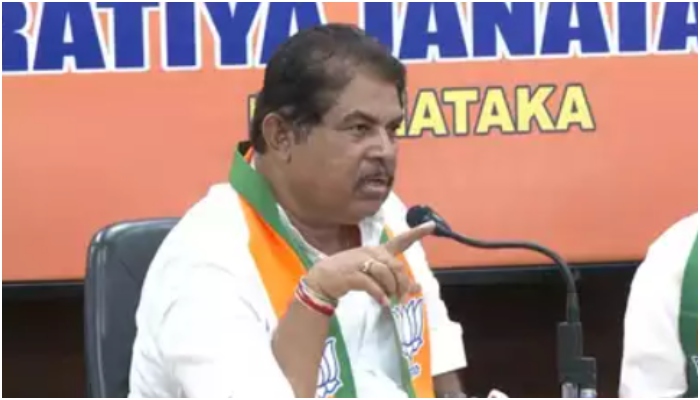
Addressing the media, BJP leader R Ashoka stated that the complainants never provided any evidence of the purported 40% commission, which was used to target the BJP government between 2021 and 2023.

“The Lokayukta never received any evidence of the alleged 40 percent commission given by the contractors. Both Kempanna and Ambikapathy acted as a toolkit of the Congress party and filed the case. But the Lokayukta dismissed the case, saying there was never any evidence produced to substantiate the claims,” he said. 

R Ashok went on to say that the ruling Congress came to power in Karnataka by making false claims against the BJP government and providing false guarantees to voters. He predicted that the ruling Congress party would face defeat in the coming future and its leaders would be forced to stay home.

Meanwhile, the Lokayukta has commented on the issue and stated that there was no key evidence in the complaint.

The former minister, accompanied by former deputy chief minister and Chitradurga MP Govind Karjol, alleged Kempanna was jobless and had not taken any contract in the last six years, which provoked him to make allegations of having paid a 40% commission being proved baseless. 

Responding to the reports of clean chit, former Chief Minister B S Yediyurappa stated that the Lokayukta found no evidence to support the 40% commission. “At least now, I urge the Congress govt to stop spreading lies about the 40 percent commission,” he tweeted.

Further BJP Karnataka also stated that the Congress was now exposed and that it would soon get captured in its own web of lies.

However, Chief Minister Siddaramaiah blatantly dismissed the clean chit, stating it does not mean no wrongdoing occurred. “Just because the BJP claims it received a clean chit does not mean no wrong has happened. There are two ways in which a case is dismissed at the courts. One of the ways is that the evidence could not substantiate the wrongdoing. I have not read the order myself, but I will look into it,” he said. 

Siddaramaiah further reiterated that he has seen many cases where there is insufficient evidence to show guilt, and courts cannot hold the accused accountable for their misdeeds. “If a murder has happened but there is a lack of evidence and the accused is let go, that does not mean the murder has not happened. As per jurisprudence, the benefit of the doubt goes to accused persons. Meanwhile, we have already set up a judicial commission to probe the 40 percent commission and am yet to receive its report,” he said.

Last year, Home Minister Amit Shah challenged the Congress to go to the Courts if they had evidence against the BJP in the given case. This is after Congress’ Rahul Gandhi alleged that BJP was the most corrupt party in India and that the corrupt money was used to steal MLAs of the other parties.

“They can talk about it and should go to court if they have concrete evidence. Neither there’s any probe nor there’s any case. How will people believe in such baseless allegations?” Shah then had said.

The 40% commission remark was in response to the Karnataka State Contractors Association’s charges that government officials, Karnataka BJP MLAs, and Panchayat Raj Minister K S Eshwarappa demanded a 40% commission or bribe from contractors on every project. However, now the Lokayukta has given a clean chit to the party exposing the lies of the Congress.

‘I’ll slap you hard’: Jharkhand Mukti Morcha (JMM) leader Nijamuddin Ansari threatens a journalist, video goes viral

The Jharkhand assembly elections have sent political mercury surging, and the amount of accusations and charges continue to escalate every day. In the latest incident, the state unit of Bharatiya Janata Party has posted a video on 17th November while accusing Jharkhand Mukti Morcha Nijamuddin Ansari of trying to intimidate and slap a journalist.

“It seems that the entire Jharkhand Mukti Morcha is drowned in the despair of defeat. Former MLA and currently JMM candidate from Dhanwar seat Nizamuddin Ansari has become so frustrated that he has started threatening and beating the fourth pillar of democracy i.e. journalists. Just think, right now these are just candidates, if by any chance they win, then you can yourself guess how much oppression and havoc they will unleash on the people,” the saffron party shared on social media.

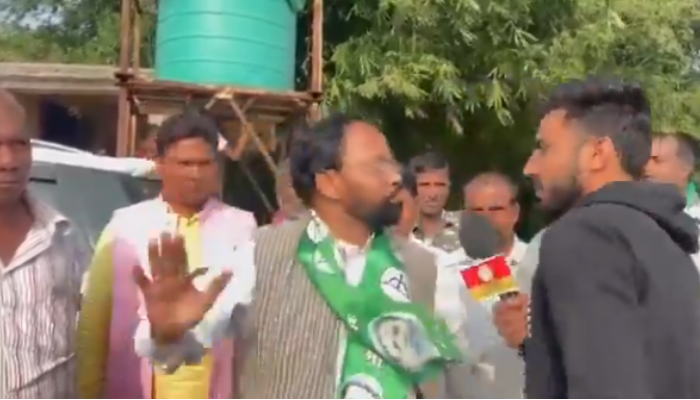
The JMM leader was being interviewed by Khabramatralive reporter Ravi Bhasker when his question seemed to upset the former who angrily raised his hand at him and threatened, “I will slap you hard.” The people around them then intervened and even held the reporter who protested against Ansari’s aggression and asked, “How can he slap me?”

The reporter had asked, “It looks like you are fond of Babulal Marandi (BJP’s Jharkhand unit president),” after which he tried to justify himself and claimed, “I am a revolutionary. You people don’t know about me. I have been with Guruji (Shibu Soren) since 1978. I went to JVM (Jharkhand Vikas Morcha- Prajatantrik) due to some circumstances but I couldn’t stay there even for a month. You should know that they suspended me.” JVM later merged with the BJP on 17th February 2020 in Ranchi.

However, the journalist reiterated, “You could be right but this is Dhanwar and you switched your loyalties. Niranjan Rai who recently joined the BJP did the same. Babulal Marandi formed a new party (JMM) and yet he returned to BJP. So it only leaves Rajkumar Yadav (Communist Party of India’s candidate) with a clean image,” which apparently infuriated the politician and he attempted to assault him. The journalist further accused that Ansari’s supporters even stopped him from asking questions.

The second and final phase of the Jharkhand assembly election is going to take place on 20th November and the votes will be counted on 23rd November along with the results of Maharashtra assembly poll.